
A hybrid car pairs a regular gasoline engine with an electric motor and a battery, letting the two work as a team to cut fuel use. That’s the short answer — but “what is a hybrid car” gets more interesting once you realize the word covers three very different machines: mild hybrids that barely touch the electric side, full hybrids that can drive silently on electricity alone, and plug-in hybrids that can handle a whole commute without burning a drop of gas. Buy the wrong kind for your driving, and you’ve paid for technology you’ll never use.
Toyota has sold well over 20 million hybrids worldwide since the first Prius landed in 1997, so this is settled, mainstream technology — not an experiment. In this guide, you’ll learn how hybrids actually work, how the three types differ, what they really save you, and who should (and shouldn’t) buy one in 2026.
Table of Contents
What Is a Hybrid Car? The Simple Answer
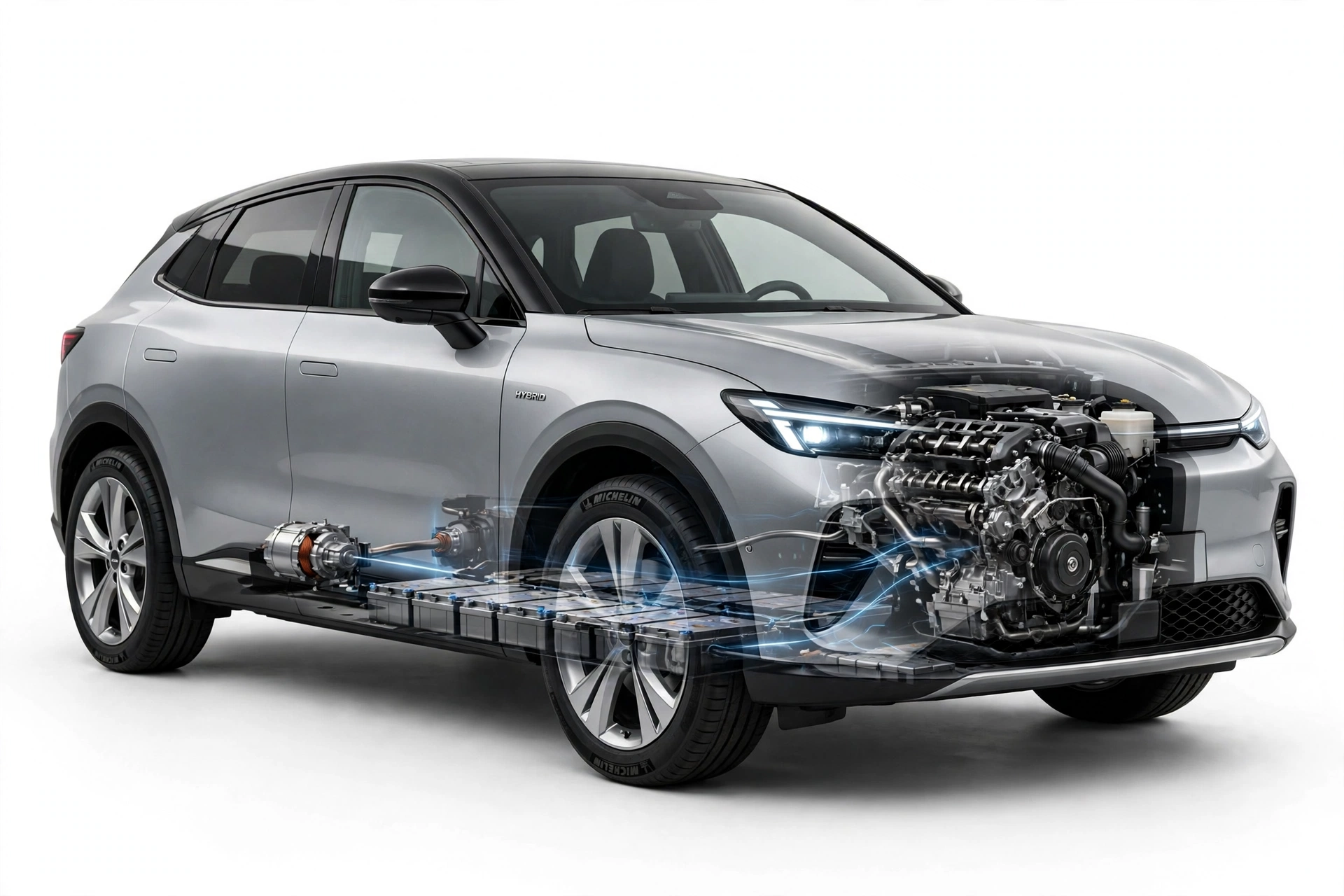
Strip away the marketing and a hybrid car is a vehicle with two power sources: an internal combustion engine (usually gasoline) and an electric motor fed by a battery pack. The car switches between them — or blends them — automatically, choosing whichever is most efficient at any moment.
That automatic switching is the whole trick. Gasoline engines are wasteful at idle and at low speeds — sitting in traffic, crawling through a parking lot, inching along in a school zone. That’s exactly where the electric motor takes over, running silently and burning nothing. Once you’re cruising on the highway, where gasoline engines are at their best, the engine takes over. In stop-and-go city driving, where conventional cars waste fuel most, a hybrid can cut fuel consumption by 30 to 40 percent compared with an equivalent gas-only car.
One thing every hybrid does is regenerative braking. In a normal car, braking throws energy away as heat. A hybrid’s electric motor runs in reverse during braking, turning the car back into a generator and feeding that recovered energy into the battery. It’s free energy you were going to waste anyway, and it’s the reason hybrids shine brightest in city driving with lots of stopping.
How a Hybrid Car Actually Works
You never have to think about any of this from the driver’s seat — there’s no extra pedal, no switch, no charging routine on most hybrids. The car’s computer handles it all in the background. But understanding the basics makes the buying decision much clearer.
Here’s what happens in a typical drive:
Pulling away and low speeds. The electric motor moves the car, drawing power from the battery. No gas burned, no engine noise. This is the most inefficient phase for a gasoline engine, so letting the motor handle it is a huge win.
Cruising. At steady highway speeds, the gasoline engine takes over — this is where it works most efficiently. Depending on the design, the engine may also send spare energy back to recharge the battery.
Accelerating hard. Both the engine and the motor deliver power together for maximum punch. This is why a hybrid can feel surprisingly quick despite a smaller engine.
Braking and coasting. The motor reverses into a generator, capturing kinetic energy and storing it in the battery as electricity.
Two design families do this job. In a parallel hybrid, both the engine and the motor connect to the wheels, and either or both can drive them — the Toyota Prius is the famous example. In a series hybrid, only the electric motor drives the wheels, and the gasoline engine acts purely as a generator producing electricity. Some models switch between both configurations depending on the situation. The details matter to engineers, but to a buyer the practical difference is small: both save fuel the same way.
The 3 Types of Hybrid Cars
This is where buyers get tripped up, because the word “hybrid” hides three genuinely different technologies. They cost different amounts, save different amounts of fuel, and suit different drivers.
1. Mild hybrid (MHEV)
A mild hybrid adds a small electric motor — usually a belt-integrated starter-generator — to an otherwise conventional gasoline car. The motor assists the engine with a modest power boost and makes stop-start systems smoother, but it can never drive the car on electric power alone. Not for a second.
Fuel savings are modest: typically 5 to 10 percent. The benefit is mostly a slightly lower fuel bill and smoother operation for almost no price premium and no behavior change on your part. Just don’t let the “hybrid” badge fool you — a mild hybrid is fundamentally a gasoline car. Models like the Ram 1500 with eTorque or various Audis use this approach.
2. Full hybrid (HEV)
This is what most people picture when they hear the word. A full hybrid has a real electric motor and a battery big enough to move the car on electricity alone — typically for 1 to 2 miles at low speeds. It never needs to be plugged in: the battery charges itself through regenerative braking and the engine.
Real-world example: the Toyota Prius posts roughly 52 to 57 mpg combined in current models, while a comparable non-hybrid hatchback manages around 35 mpg. That’s the 30-to-40-percent city savings in action. The Honda Accord Hybrid and Toyota RAV4 Hybrid are other strong examples. For drivers who do a lot of urban or suburban driving and can’t or won’t install a charger, the full hybrid is the sweet spot — big savings, zero charging hassle.
3. Plug-in hybrid (PHEV)
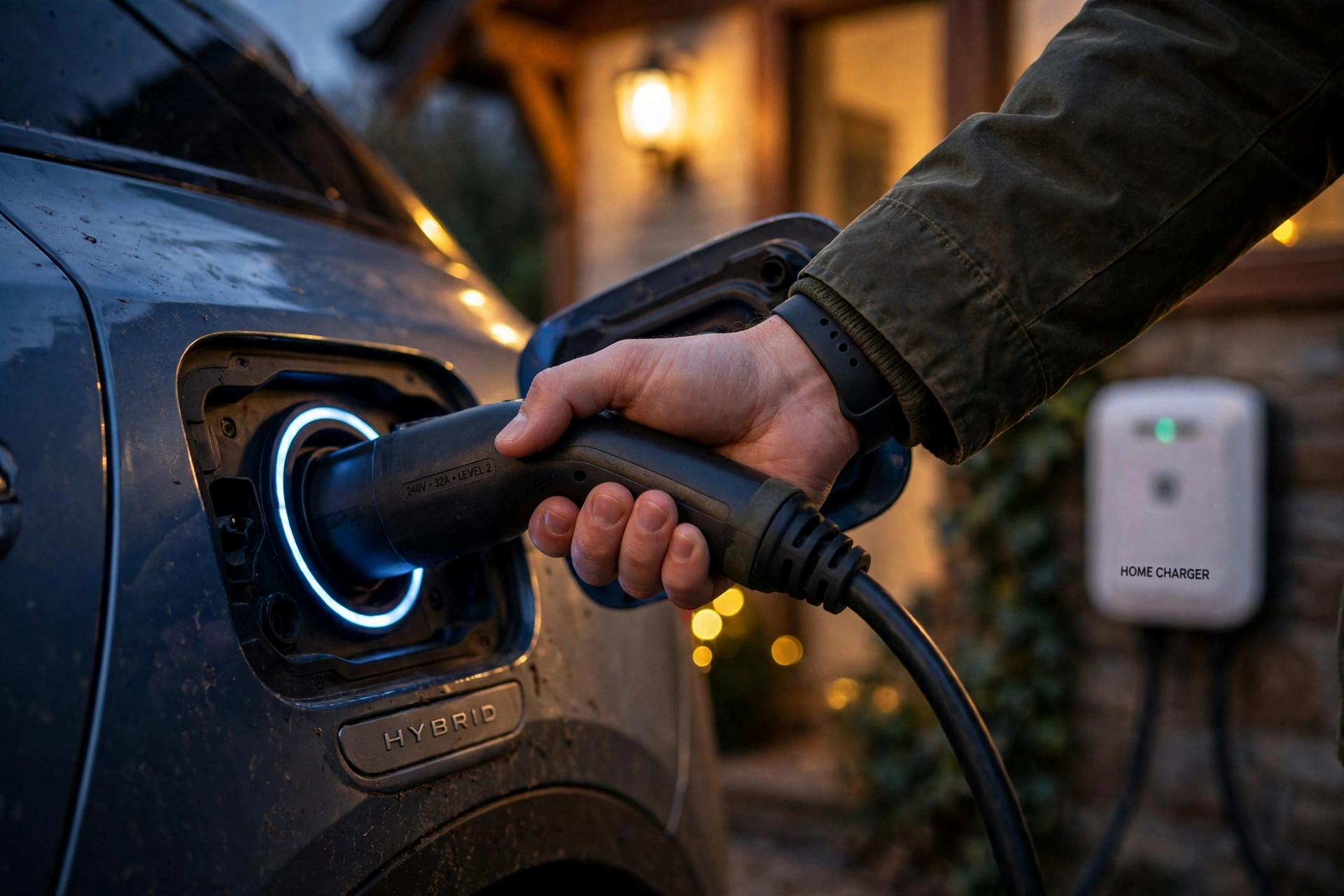
A plug-in hybrid is a bigger leap: a much larger battery that you charge from a wall outlet or home charger, plus a gasoline engine for backup. Most PHEVs deliver 25 to 50 miles of pure electric driving — the Toyota RAV4 Prime manages around 42 miles, the Chrysler Pacifica Hybrid roughly 32 — and then the car behaves like a regular full hybrid when the charge runs out.
Here’s the math that matters: the average American commute is well under 40 miles round trip. If you plug in at home overnight, a PHEV can cover most weekday driving on electricity — costing a fraction of gasoline per mile — while the engine stands ready for road trips. But the deal only works if you actually charge it. Skip charging and you’re hauling around a heavy battery and an engine, getting the efficiency of neither.
| Type | Drives on electricity alone? | Needs plugging in? | Typical savings |
|---|---|---|---|
| Mild hybrid (MHEV) | No | No | 5–10% |
| Full hybrid (HEV) | Yes, 1–2 miles | No | 25–40% (city) |
| Plug-in hybrid (PHEV) | Yes, 25–50 miles | Yes | Up to 80%+ if charged daily |
Hybrid vs Electric vs Gas: The Honest 2026 Comparison
Where does a hybrid sit between a conventional car and a full EV like a Volkswagen ID.Buzz? It depends on what you value.
Fuel and running costs. A full hybrid lands roughly halfway between a gas car and an EV on per-mile energy cost. At current U.S. averages — about $3.40 a gallon for regular gas and roughly 16 cents per kWh for home electricity — a 50-mpg hybrid costs about 6.8 cents a mile in fuel, a 35-mpg gas car about 9.7 cents, and an EV charged at home around 4 to 5 cents. For the full picture on EV running costs, see our breakdown of electric car cost per mile.
Emissions. Hybrids cut tailpipe CO₂ roughly in proportion to their fuel savings — 25 to 40 percent for a full hybrid — but they still burn gasoline and still have tailpipes. A PHEV charged on clean grid electricity can approach EV-level emissions for daily driving. An EV has zero tailpipe emissions, though the full story includes how your local grid generates electricity. We dig into that in how electric cars really affect the environment.
Convenience. This is the hybrid’s strongest card. No charger needed for mild and full hybrids — you fuel up exactly like always. A PHEV asks only for a regular outlet or a home charger. There’s no range anxiety, no trip planning around chargers, and no waiting at public fast chargers. For apartment dwellers without home charging, or anyone who drives long distances regularly, that matters more than any spec sheet.
How Much Money Does a Hybrid Car Save You?
Let’s do the math properly with a worked example. Suppose you drive 12,000 miles a year and compare three midsize sedans:
- Gas-only: 35 mpg → 343 gallons a year → about $1,165 in fuel at $3.40/gal
- Full hybrid: 52 mpg → 231 gallons a year → about $785 in fuel
- Saving: roughly $380 a year, or about $3,800 over ten years
Full hybrids typically cost $2,000 to $4,000 more than their gas-only siblings, so the fuel savings alone can pay back the premium in 5 to 8 years — sooner if gas prices rise or you drive mostly in the city, where hybrids save the most. A PHEV owner who charges religiously and drives mostly electric can save far more: 12,000 miles on electricity at 16 cents/kWh costs roughly $550 a year in electricity, versus $1,165 for gas.
Two caveats. First, the savings assume normal driving — aggressive highway driving at 80 mph shrinks the hybrid advantage because the engine is doing nearly all the work. Second, check insurance quotes before buying: some insurers price hybrids slightly higher because the drivetrain is more complex. The difference is usually small, but don’t skip the quote.
Maintenance and Battery Life: What Owners Actually Pay
The number-one fear about hybrids is the battery. After nearly three decades of Priuses on the road, the data is reassuring: hybrid batteries commonly last 10 to 15 years or 150,000 to 200,000 miles. Federal rules require hybrid battery warranties of at least 8 years or 100,000 miles, and several states extend that to 10 years or 150,000 miles.
If a battery does fail out of warranty, a replacement typically runs $2,000 to $8,000 depending on the model — real money, but a rare event. Our EV battery guide explains battery chemistry and degradation in more depth.
Day-to-day maintenance actually costs less than a gas car in several ways. Regenerative braking means brake pads can last twice as long — some hybrid owners report 100,000 miles on a set of pads. The engine runs fewer hours and at gentler loads, so oil changes and wear items stretch further. For the full maintenance picture, see do electric cars need oil changes.
Who Should Buy a Hybrid Car in 2026?
A full hybrid is a great fit if: you drive a lot of city or suburban miles, you can’t install a home charger, you want maximum fuel savings with zero lifestyle change, or you’re not ready to go fully electric but want to cut emissions now. This describes the majority of American drivers.
A plug-in hybrid is a great fit if: your daily commute is under 40 miles round trip, you have access to a driveway or garage outlet, and you take occasional long trips where EV charging would be a hassle. Charge it daily and it’s nearly an EV for commuting with a gas engine as backup.
Skip the hybrid if: you drive almost entirely on highways at high speeds (savings shrink to almost nothing), you already have home charging and rarely drive more than 250 miles a day (a full EV is cheaper to run), or the price premium over the gas version is so large the payback takes a decade. Also skip mild hybrids if efficiency is your goal — the 5-to-10-percent gain rarely justifies paying extra for the badge.
Frequently Asked Questions
Do hybrid cars need to be plugged in?
Only plug-in hybrids (PHEVs) need charging. Full hybrids and mild hybrids recharge their own batteries through regenerative braking and the engine — you fuel them with gasoline like any normal car.
How long do hybrid car batteries last?
Typically 10 to 15 years or 150,000 to 200,000 miles in normal use, backed by a minimum 8-year/100,000-mile warranty. Heat and extreme use shorten life; most owners never replace the battery.
Are hybrid cars good for long road trips?
Yes — arguably better than EVs for road trips. You get hybrid fuel economy in town and normal gas-car range and 5-minute refueling on the highway. No charging stops required.
Do hybrids cost more to insure?
Slightly, in some cases — the dual drivetrain costs more to repair. The difference is usually small, but get a quote for the specific model before buying.
Is a hybrid better than a fully electric car?
It depends on your charging situation. With home charging and typical daily driving, a full EV costs less to run and emits less. Without charging access, or with frequent long trips, a hybrid is the more practical low-emission choice. The U.S. Department of Energy’s Alternative Fuels Data Center breaks down how plug-in hybrids compare to other drivetrains.
The Bottom Line
A hybrid car is the pragmatic middle ground of motoring: two power sources working together so each does what it does best. A full hybrid delivers genuine, proven fuel savings with no charging, no range anxiety and no change to how you drive. A plug-in hybrid goes further — near-EV commuting costs plus unlimited gas backup — but only if you plug it in. Match the type to your driving, do the payback math honestly, and a hybrid remains one of the smartest car purchases you can make in 2026.