
Let’s get the big news out of the way first: the VW ID Buzz has no 2026 model year in the United States. Volkswagen skipped it. If you walk into a dealership in 2026 looking for a brand-new Buzz, you’ll be choosing from leftover 2025 vans — and if the current plan holds, the van returns as a 2027 model. That single fact shapes everything in this guide: pricing, availability, and the deep discounts that have quietly turned this van into a much better deal than its sticker suggests.
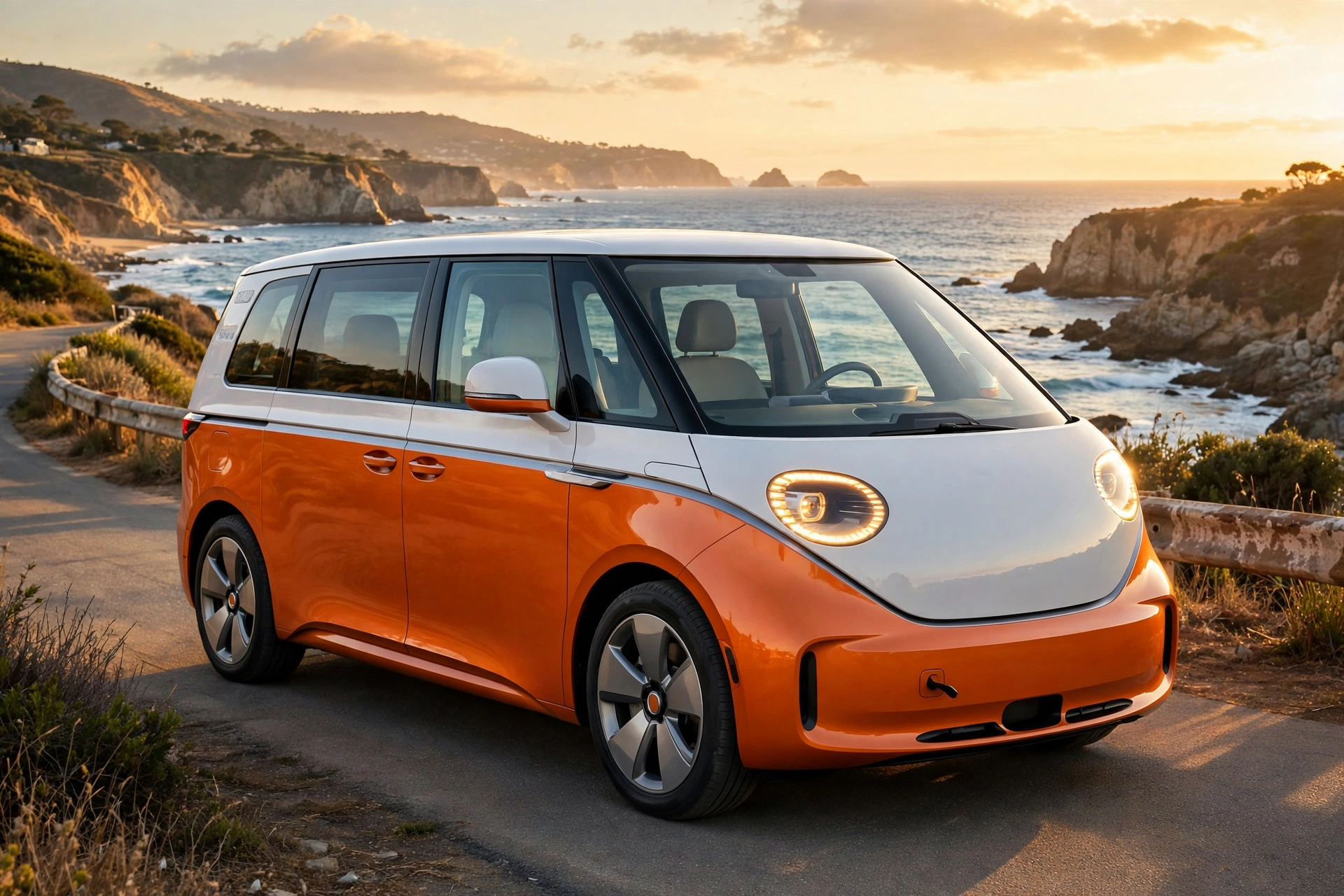
The ID Buzz is Volkswagen’s electric love letter to the old Microbus. Three rows of seats, sliding doors, two-tone paint that makes strangers smile at stoplights. Under the retro skin it’s a thoroughly modern EV: a 91 kWh battery, up to 335 horsepower in all-wheel-drive form, and an EPA-rated range of 234 miles in rear-drive trim. Nobody doubts the charm. The real question is whether it makes sense at its price. Here’s the honest breakdown — range, charging, costs, and who should actually buy one.
Table of Contents
VW ID Buzz Range: The Official Numbers vs Real Life
Every US-spec ID Buzz ships with the same 91 kWh battery pack (about 86 kWh usable). Rear-drive models make 282 horsepower and carry an EPA rating of 234 miles; the dual-motor 4Motion all-wheel-drive version bumps output to 335 horsepower and slips to 231 miles of EPA range. Those numbers are decent, not dazzling — for context, a Kia EV9 with a 99.8 kWh pack is rated at 304 miles, and it costs thousands less.
Real-world range tells a harsher story, and physics explains why. The Buzz is a tall box with a flat nose and an upright windshield — it looks wonderful and cuts through air terribly. Gentle around-town driving can get you close to the EPA figure. Sustained 75 mph highway running with the air conditioning on and a family aboard typically lands between 190 and 210 miles. Push harder in cold weather, and some testers have seen the low 150s. If most of your driving is commuting and school runs with home charging, you’ll rarely care. If you regularly drive 200-plus miles between chargers, the Buzz will ask you to plan your stops.
One more wrinkle worth knowing: US ID Buzz vans are all long-wheelbase, three-row machines seating six or seven, with up to 145.7 cubic feet of cargo space behind the front seats. That size is the whole point — but it’s also why the range can’t match sleeker crossovers.
Charging the ID Buzz: Faster Than You’d Expect
Charging is the Buzz’s quiet strong suit. Peak DC fast-charging speed is 200 kW, and Volkswagen claims a 10-to-80 percent charge in about 26 minutes — competitive with the best in the business and faster than several more expensive rivals. On the road, that means a lunch stop genuinely restores most of the battery instead of a token top-up.
At home, the 11 kW onboard charger fills the big battery overnight on a 240-volt circuit — roughly eight to nine hours from empty, which almost never happens in practice since you’ll plug in at 30 or 40 percent like most owners do. A regular wall outlet technically works, but at 2–3 miles of range per hour it’s emergency-only territory.
Two things to watch. First, 2025 US vans use the CCS1 connector; Volkswagen is using the model-year pause to integrate the NACS (Tesla-style) port, and the coming 2027 vans are expected to arrive with it. Second, public fast charging costs real money — typically 40 to 60 cents per kWh in 2026, which makes a 10–80 percent road-trip stop run about $25 to $35. That’s still cheaper than gasoline per mile, but the “free motoring” romance of home charging doesn’t extend to the highway. If you’re new to public charging, our complete guide to EV charging stations in the USA walks through networks, connectors, and pricing.
For official efficiency and range figures on any trim, the US Department of Energy’s fueleconomy.gov database is the authoritative source — worth a look before you sign anything.

What the VW ID Buzz Actually Costs in 2026
The ID Buzz launched with a $59,995 base price, $61,545 once you add the $1,550 destination charge. The loaded 1st Edition 4Motion listed at $69,995. Those are the MSRPs. Reality in 2026 looks very different: with no 2026 model year coming and dealers sitting on inventory, discounts of $10,000 to $20,000 have been common, and some stores advertised brand-new 2025 Pro S vans under $49,000 in the spring of 2026. At full sticker it’s a tough sell; at $48,000–$52,000 it’s a genuinely interesting proposition.
What you won’t get is the $7,500 federal EV tax credit on a purchase. The Buzz is built in Hanover, Germany, which keeps it outside the credit’s assembly rules. (Leased vans can sometimes capture the credit indirectly through the leasing company — ask the dealer, and get it in writing.)
Running costs are where the Buzz claws back ground. A full home charge of the 91 kWh pack at the 2026 national average of about 17 cents per kWh costs roughly $15.50 and delivers 230-odd miles — about 6.7 cents per mile. A gas minivan doing 22 mpg at $3.40 a gallon costs more than twice that per mile. Maintenance is the usual EV story: no oil changes, no transmission services, brakes that last ages thanks to regenerative braking. Tires and cabin filters are the main recurring bills. Run your own numbers with our EV total cost of ownership calculator before deciding — the fuel savings over five to eight years are substantial, but only if the purchase price you pay is sane.
One honest warning: depreciation has been rough. Launch-era markups of up to $35,000, followed by fire-sale discounts and the skipped 2026 model year, have whipsawed used values. Buy the Buzz because you want to keep it for years, not because you expect it to hold value like a Toyota.
Who Should Buy the VW ID Buzz — and Who Should Skip It
Buy it if: you’re a family of five, six, or seven that wants three usable rows without driving a penalty-box minivan or a $90,000 luxury SUV. The sliding doors, flat floor, huge windows, and genuinely cheerful cabin make daily kid-hauling noticeably more pleasant. Weekend adventurers should note the camping-friendly flat load floor and the 2027 model’s factory camping kit option. And if you charge at home and drive under 150 miles most days, the range limitations will never touch you.
Think twice if: your life involves frequent 250-mile highway days, you can’t charge at home (apartment dwellers, be honest with yourselves about public-charging hassle), or the budget is tight enough that $48,000-plus still stings. Also skip it if you tow — the US Buzz carries no tow rating, full stop.
Cross-shop these before you commit: the Kia EV9 (more range, similar three-row space, lower price), the Hyundai Ioniq 9 (the EV9’s corporate cousin), and the Chrysler Pacifica Hybrid (plug-in, 32 miles of electric range, then a gas engine erases all range anxiety). If the retro styling is the whole draw and the budget is firm, a lightly used 2025 Buzz — some are already trading in the low $40Ks — deserves a look.
The 2027 Comeback: What VW Is Fixing
Volkswagen insists the Buzz isn’t cancelled — it’s paused. The 2027 model carries over the same 91 kWh battery and the same 234/231-mile EPA ratings, so don’t expect an efficiency miracle. The upgrades are in the details: one-pedal driving finally standard across trims, a new Android-based infotainment system, a factory camping kit option, and a two-tone-only color palette leaning into the Microbus nostalgia (candy white over cherry red with white wheels is the headline combo).
Meanwhile the Buzz has a second career brewing: Volkswagen’s MOIA division has been testing self-driving ID Buzz vans in Los Angeles, with plans to offer rides through Uber’s platform. Whether robotaxi Buzz vans become a common sight or a footnote, it says something that VW chose this van as the face of its autonomy ambitions.
Sales context helps explain the discounts: about 6,140 ID Buzz vans sold in the US in 2025, and roughly 2,480 in the first half of 2026. That’s niche — roughly one-tenth of what the EV9 moves. You’re buying the coolest van on the road, not the most popular one.
The Verdict
The VW ID Buzz is the rare EV I’d describe as emotionally correct and financially complicated. At its $61,545 starting MSRP, the range is merely okay, the price is premium, and the federal credit is missing — a hard combination to defend with a spreadsheet. At the discounted prices 2025 leftovers are actually changing hands for, the math gets much kinder, and the van’s real strengths — space, style, family-friendly packaging, fast charging — get room to shine.
If you’re a big family with home charging who smiles every time you see one, find a discounted 2025 and don’t look back. If you’re on the fence, wait for the 2027s and watch the pricing. Either way, you’ve now got the numbers to decide with your eyes open.