💰 EV Charger Installation Cost Estimator
Get an honest itemized estimate for 2026 — hardware, wiring, labor, permits — based on your actual home.
2026 US averages. Prices vary by region and electrician — always get 2–3 quotes. Utility and state rebates (often $500–$1,000) can cut these numbers significantly.
EV Charger Installation Cost in 2026: What You’ll Actually Pay
Ask three electricians for a quote and you’ll get three wildly different numbers — $600, $1,800, $4,000. The reason isn’t dishonesty (usually). It’s that EV charger installation cost depends on five variables most homeowners never think about, and the estimator above prices each one separately so you can see exactly where your money goes.
Here’s the honest national picture first: a typical Level 2 home charger installation runs $900–$2,000 all-in — hardware plus electrician. Simple installs (short wire run, panel space available) land near $800. Complicated ones (long runs, panel upgrades, outdoor trenching) can hit $3,000–$5,000. Now let’s break down why.
The 5 Cost Drivers, Explained
1. The charger itself: $300–$800. Basic 32-amp units start around $400; 48-amp smart chargers with apps and scheduling run $500–$800. Don’t overbuy amperage — a 32A unit covers most drivers and costs less to install (thinner wire, smaller breaker).
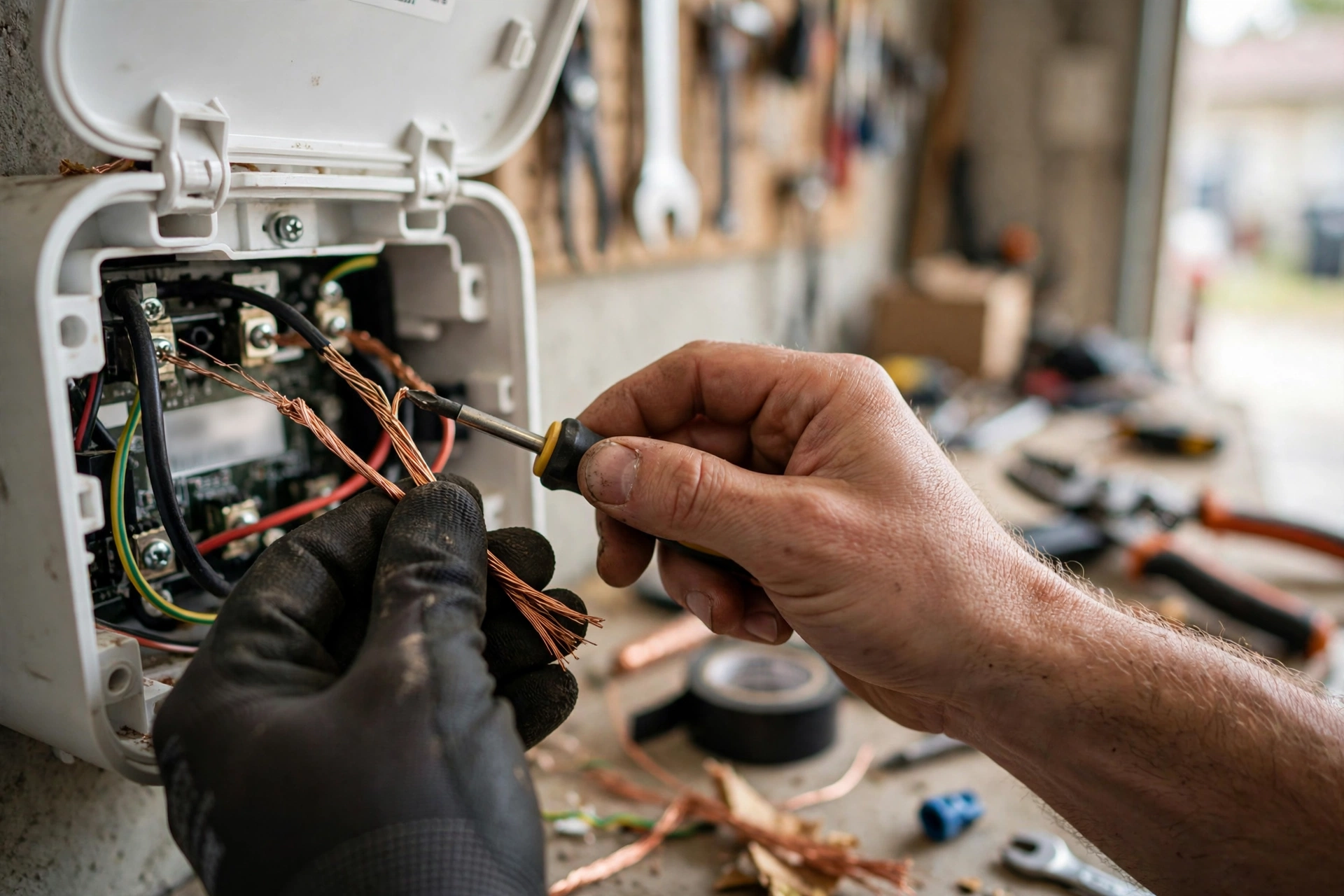
2. Wiring: the silent budget-killer. Wire is priced per foot, and EV circuits need thick, expensive copper. A 25-foot run might add $200–$450; a 100-foot run through an attic can add $1,000+. This is why mounting the charger close to your panel saves real money — every foot counts. It’s the single biggest reason one homeowner’s EV charger installation cost is $900 while their neighbor’s is $2,400.
3. The breaker: $50–$150. Small line item, but remember the 125% rule: a 32A charger needs a 40A breaker, a 48A charger needs 60A. Bigger breakers, thicker wire, higher cost — another reason not to oversize.
4. Labor: $300–$750. A straightforward install takes an electrician 2–4 hours. Long wire runs, fishing wire through finished walls, or outdoor work pushes it higher. Always get 2–3 quotes — labor rates vary enormously by region.
5. Panel work: $0 or $500–$4,000. The wildcard. If your panel has space, this is $0. If it’s full, a smart load-management device ($500–$900) usually solves it. A full panel upgrade ($2,000–$4,000) is the last resort — and you should demand a load calculation before anyone sells you one.
How to Cut the Bill (Legitimately)
Claim every rebate first. This is the biggest lever and the most overlooked. Many utilities offer $500–$1,000 toward charger hardware and installation; some states add more; a few cover the entire cost for income-qualified households. Check your utility’s website before getting quotes — it changes your EV charger installation cost math completely.
Right-size the charger. Dropping from 48A to 32A saves on the unit, the wire gauge, and the breaker — cutting your EV charger installation cost by $200–$400 total. Use our sizing calculator to see what you actually need.
Shorten the wire run. If your panel is in the garage already, you’re golden — your EV charger installation cost stays near the low end. If it’s across the house, ask the electrician about the shortest code-compliant path — surface-mounted conduit in a garage is ugly but cheap.
Time it with other electrical work. Already having an electrician out for something else? Adding the EV circuit to the same visit saves a trip charge and often gets you a better rate on the marginal hour.
What Quotes Should Include (Red Flags to Watch)
A proper quote lists: charger model, wire gauge and length, breaker size, labor hours, permit fees, and whether panel work is included. Vague one-line quotes (“EV charger install: $2,200”) deserve a follow-up question, not a signature.
Red flags: anyone who quotes a panel upgrade without doing a load calculation; prices far below $600 (corners are being cut somewhere — usually permits or wire gauge); demands full payment upfront. Standard practice is a deposit with balance on completion.
EV Charger Installation Cost: Frequently Asked Questions
Can I install an EV charger myself to save money?
The charger unit itself, yes — plug-in models into an existing 240V outlet are DIY-friendly. But new circuits, breakers, and hardwiring should be done by a licensed electrician. Unpermitted electrical work can void your home insurance, which dwarfs any savings.
Does installing an EV charger increase home value?
Modestly — it’s increasingly seen as a desirable feature, like a garage door opener was decades ago. Don’t install one purely as an investment, but it’s a nice bonus when selling to EV-driving buyers.
How long does installation take?
The physical work: 2–5 hours for a standard install. The full process including quotes, permits, and scheduling: 1–3 weeks. Permits are the usual bottleneck, not the wiring.
Are there tax credits for home charger installation?
The federal Alternative Fuel Infrastructure Tax Credit has covered 30% of home charger installation costs (up to $1,000) in the past, subject to location and income rules that change. Check current IRS guidance and your state’s programs — and keep every receipt.
The Bottom Line
Budget $900–$2,000 for a typical install, get multiple quotes, claim every rebate, and don’t let anyone sell you a panel upgrade without a load calculation. Run your numbers above — and remember the charger pays for itself in fuel savings, usually within the first year. Still deciding on hardware? Take our Home Charger Finder Quiz to find your match.