🔌 Home EV Charger Sizing Calculator
Don’t guess — or overpay. Get the exact charger amperage your driving actually needs, plus the breaker and panel check.
Per electrical code, EV chargers are continuous loads: the breaker must be rated 125% of the charger’s draw. Standard charger sizes: 16A, 24A, 32A, 40A, 48A. Always confirm with a licensed electrician before buying.
Why EV Charger Sizing Matters (and Why Bigger Isn’t Better)
Most people shopping for a home EV charger make one of two mistakes: they buy the biggest 48-amp unit “just in case” and pay for capacity they’ll never use, or they assume a regular outlet is fine and discover mid-winter that it isn’t. EV charger sizing is simply matching the charger to your actual driving — no more, no less.
The good news: EV charger sizing is simple math, and this calculator does it for you. But understanding why it recommends what it does will save you from the upsell at the electrical supply store.
EV Charger Sizing: How the Math Works
Three numbers go into EV charger sizing:
1. How much energy you use daily. Divide your daily miles by your EV’s efficiency. Drive 40 miles in a car that does 3.3 miles/kWh? That’s about 12 kWh — roughly a fifth of a typical EV battery.
2. How many hours you can charge. Most people have 8–10 hours overnight. Divide the energy by the hours: 12 kWh ÷ 8 hours = 1.5 kW of charging power needed. That’s tiny — a basic 16-amp charger delivers 3.8 kW, more than double.
3. Round up to a standard size. Home chargers come in standard amperages: 16, 24, 32, 40, and 48 amps (on 240V). The calculator picks the smallest standard size that covers your needs, because there’s no prize for oversizing.
Notice what this means: the average driver (37 miles/day, 8-hour charging window) needs barely 1.4 kW — a 16-amp charger handles it with room to spare. The 48-amp units exist for edge cases: very long commutes, short charging windows, or households charging two EVs on one circuit. Getting EV charger sizing right means ignoring the upsell and trusting this math.
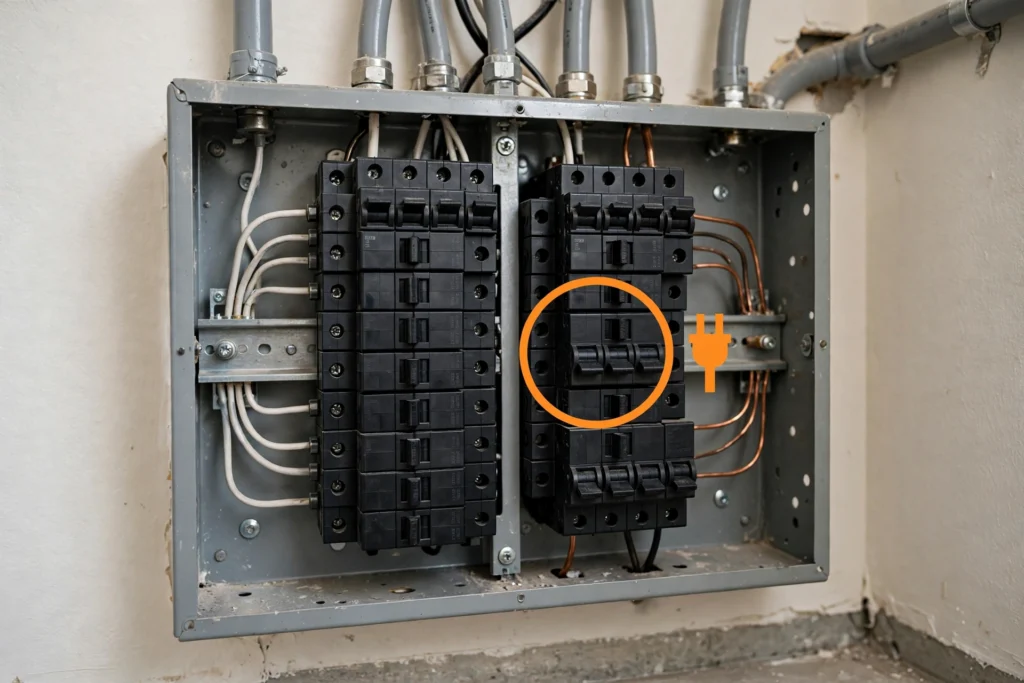
The 80% Rule: Why Breakers Are Bigger Than Chargers
Here’s the part that confuses everyone. A 32-amp charger needs a 40-amp breaker. A 48-amp charger needs a 60-amp breaker. Why?
Electrical code treats EV charging as a continuous load — current flowing for 3+ hours. Continuous loads may only use 80% of a breaker’s rating, so the breaker must be rated at 125% of the charger’s draw. The calculator applies this automatically, but know the rule exists so an electrician’s quote doesn’t surprise you.
Practical consequence: anything above 40 amps usually must be hardwired (no plug), because standard NEMA 14-50 outlets max out at 50-amp breakers. Hardwiring is safer anyway — one fewer connection point to overheat.
Will Your Electrical Panel Handle It?
This is the real constraint in older homes. A 200-amp panel shrugs at any home charger. A 100-amp panel — common in houses built before the 1990s — might not have room for a 60-amp EV breaker alongside the dryer, stove, and AC.
Three outcomes when the panel is tight:
- It fits anyway. A 16–32A charger (20–40A breaker) usually fits a 100A panel. An electrician’s load calculation confirms it in minutes.
- Smart load management. Devices that monitor your panel and pause EV charging when the house needs power cost $500–$900 — far cheaper than a panel upgrade, and code-compliant.
- Panel upgrade. $2,000–$4,000. The last resort, and rarely needed just for EV charging.
Never let anyone sell you a panel upgrade before doing the load calculation. It’s a 15-minute job that prevents a $3,000 mistake.
When a Regular Outlet Is Enough
Worth repeating because it saves the most money: if the calculator recommends 16 amps and your driving is under ~40 miles/day, try a standard 120V outlet first. It adds 3–5 miles of range per hour — about 40 miles overnight. Zero installation cost. Many EV owners never upgrade.
Frequently Asked Questions
Is a 48-amp charger worth it?
Only if you need it: 80+ mile daily commutes, very short charging windows, or two EVs sharing. For average driving it’s like buying a fire hose to water a houseplant — impressive, unused, and expensive to install.
Can I install an EV charger myself?
Legally it depends on your jurisdiction, but practically: a plug-in charger into an existing 240V outlet is DIY-friendly. Anything involving new breakers, wire runs, or hardwiring should be done by a licensed electrician — mistakes here cause fires, and insurance may not cover unpermitted electrical work.
What’s the difference between NACS and J1772?
They’re just plug shapes. NACS (Tesla’s design, now the North American standard) and J1772 (the older universal plug) carry the same power. Most new chargers offer NACS; adapters handle the rest. Match the plug to your car, or buy the adapter once.
Do I need WiFi / a smart charger?
Nice to have, not essential. Smart features (scheduled charging for off-peak rates, energy tracking) are genuinely useful if your utility has time-of-use rates. If it doesn’t, a “dumb” charger charges exactly as well for less money.
The Bottom Line
Good EV charger sizing means matching the charger to your driving, not your anxiety. Most owners need 16–32 amps, not 48. Run the numbers above, check the breaker math, verify your panel — and don’t buy capacity you’ll never use. The money you save buys a lot of electricity.