
Table of Contents
The Short Answer: Charge an Electric Car With a Regular Outlet
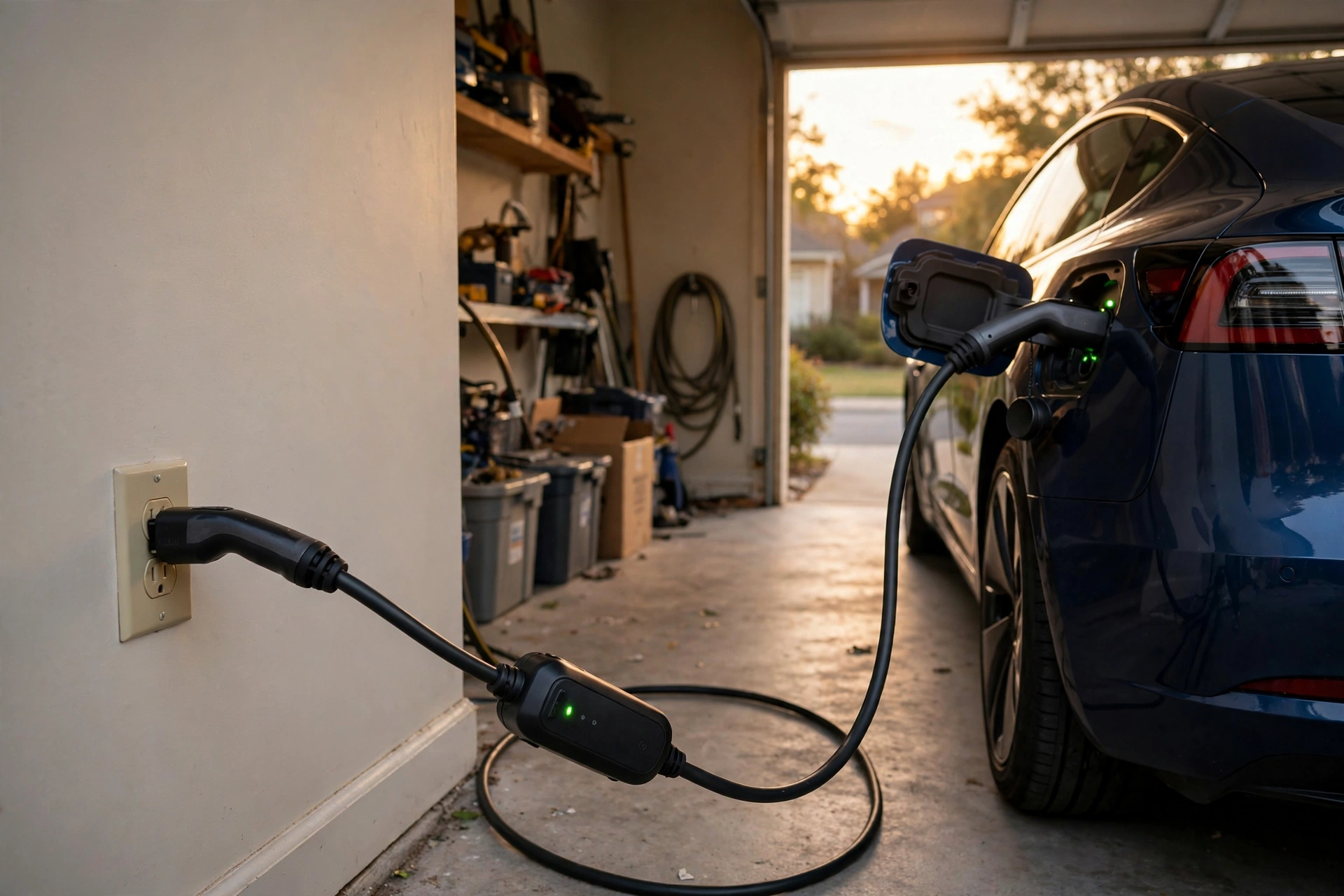
Can you charge an electric car with a regular outlet? Yes — every EV on the market can plug into a standard 120-volt household outlet using the portable charging cable that comes with the car. No electrician, no special equipment, no installation. You literally plug it in like a phone charger. This guide shows you how to charge electric car with regular outlet power — safely, and without spending a dime on installation.
Here’s the catch, and it’s a big one: a regular outlet adds only 3 to 5 miles of range per hour. That means a full charge on a typical 60 kWh battery takes 40+ hours. So the real question isn’t can you — it’s whether it’s enough for your driving. For a lot of people, surprisingly, it is. Let me explain.
How It Works: Level 1 Charging Explained
Being able to charge an electric car with a regular outlet has an official name: Level 1 charging. It’s the slowest of the three charging levels, but also the simplest.
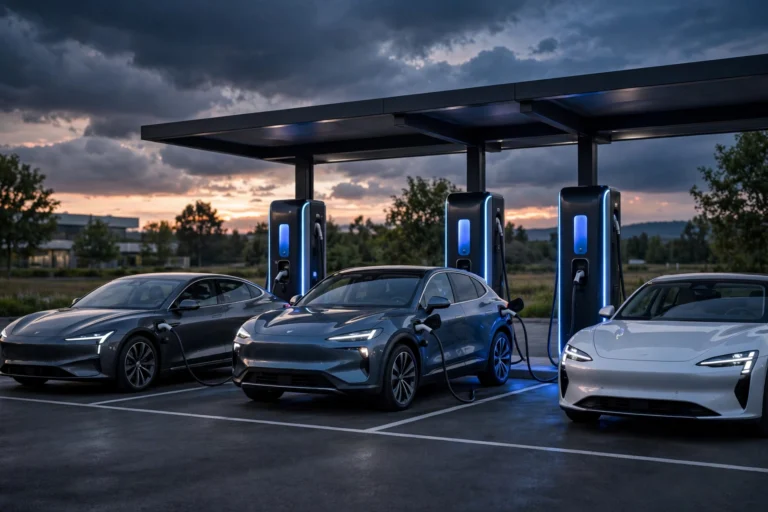
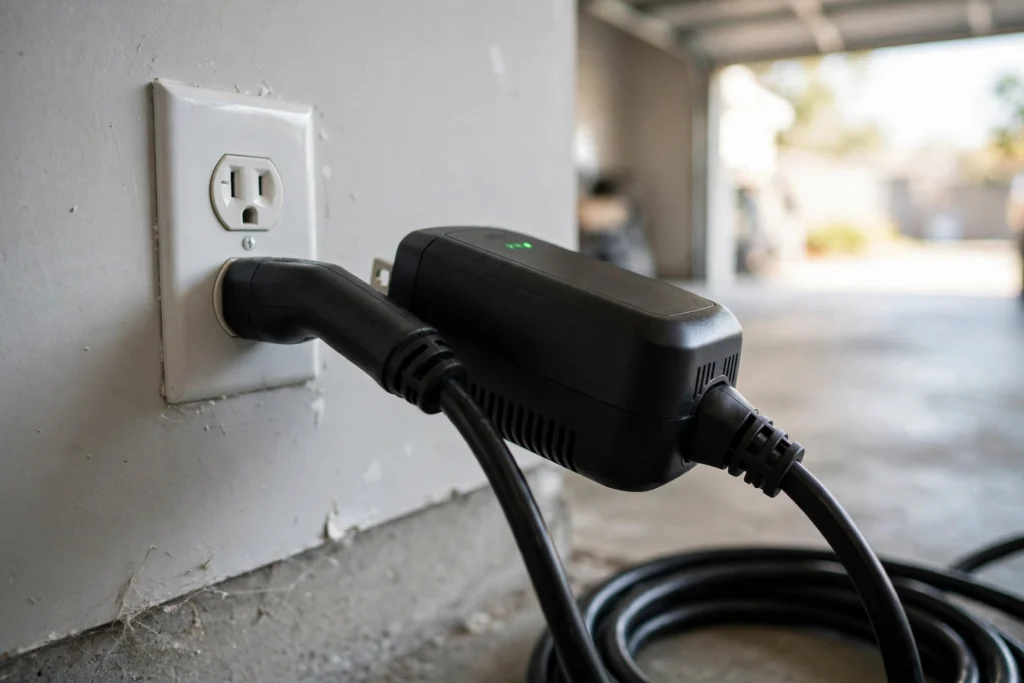
Your standard US wall outlet delivers 120 volts. The portable charging cable (technically called an EVSE — Electric Vehicle Supply Equipment) draws about 1.2 to 1.4 kilowatts through it. Compare that to a Level 2 home charger at 7–11 kW, or a DC fast charger at 150+ kW, and you see why Level 1 is called “trickle charging.” For the official rundown, see the U.S. Department of Energy’s guide to charging at home.
One important note: some manufacturers have stopped including the portable cable for free — Tesla did this a while back, and a few others followed. If your EV didn’t come with one, a basic Level 1 portable charger costs $150–$300. Check what’s in your trunk before you assume yours came with one — without that cable, you can’t charge an electric car with a regular outlet at all.
The Math: Is 3–5 Miles Per Hour Enough?
This is where most articles stop at “it’s slow” and move on. But slow is relative — let’s do the actual math on charging an electric car with a regular outlet night after night.
The average American drives about 37 miles per day. If you plug in at 7 PM and unplug at 7 AM, that’s 12 hours of charging at ~4 miles per hour = ~48 miles of range recovered overnight. That covers the average commute with room to spare.
Wondering what those overnight miles actually cost? Plug your numbers into our EV Charging Cost Calculator to see your real cost per day, month, and year. At typical residential rates, the cost to charge electric car with regular outlet power overnight is often under two dollars.
It gets better: most people don’t drain their battery to zero daily. If you drive 25 miles, you can charge an electric car with a regular outlet back to full in about 6 hours. Plug in when you get home, and you’re full long before morning — even on a regular outlet.
Where Level 1 falls apart:
- Long commutes (60+ miles/day). You can’t recover that overnight on 120V. The deficit grows every day until you’re stranded.
- Road trips. Obviously — you’ll need public fast charging.
- Big battery EVs driven hard. A GMC Hummer EV or similar with a 200+ kWh pack would take a week to fill from empty on Level 1.
- Plug-in hybrids? Perfect fit. A Toyota RAV4 Prime or Jeep Wrangler 4xe has a 14–18 kWh battery that fills in 5–8 hours on a regular outlet. Level 1 was basically made for PHEVs.
Safety Rules: Do This Right
When you charge an electric car with a regular outlet, the car pulls sustained current for hours — far longer than anything else you plug into a wall. That demands respect for the outlet. These aren’t suggestions:
Use a grounded, three-prong outlet in good condition. If the outlet is loose, cracked, or the plug falls out easily, don’t use it. A worn outlet + hours of current = heat = fire risk. If the plug or wall plate ever feels warm, stop and call an electrician.
Never use an extension cord. This is the #1 rule EV makers and electricians agree on. Standard extension cords aren’t rated for 12 amps continuous over hours. They overheat. If you absolutely must extend the reach, only a heavy-duty 12-gauge outdoor-rated cord, as short as possible — but honestly, get the electrician to add an outlet closer instead.
Don’t share the circuit with big appliances. A Level 1 charger draws ~12 amps on a 15-amp circuit. If someone runs a space heater or microwave on the same circuit, the breaker trips — or worse. Ideally the outlet should be on a dedicated or lightly-loaded circuit.
Keep it dry. The car’s charge port and the EVSE are weather-resistant, but don’t let the wall plug sit in a puddle. Common sense, but worth saying.
Level 1 vs Level 2: When Should You Upgrade?
Here’s my honest framework. Stick with the regular outlet if:
- You drive under 40 miles a day
- You can plug in 10+ hours overnight
- You have a plug-in hybrid (small battery)
- You’re renting and can’t install anything
Upgrade to a Level 2 home charger ($500–$2,000 installed) if:
- You drive 50+ miles daily
- You frequently arrive home nearly empty
- You want preconditioning (warming the car on cold mornings without draining the battery)
- Your utility offers cheap overnight rates you want to exploit in a shorter window
A lot of new EV owners install Level 2 immediately out of anxiety, then realize they never needed it. Try the regular outlet for a month first — it costs nothing to test, and the answer might save you $1,500. If you’re still wondering whether you can charge an electric car with a regular outlet long-term, the next section will help you decide.
What About 240V Dryer Outlets?
Quick bonus for the handy: if you have a 240V dryer outlet in or near the garage, devices like smart splitters let you share it with your EV for Level 2 speeds without new wiring. It’s a legitimate middle path between the wall outlet and a full installation — just make sure the splitter is UL-listed and the outlet is in good shape. If you can already charge an electric car with a regular outlet, a dryer-outlet splitter is the natural next step up — same concept, several times faster.
Frequently Asked Questions
Can you charge an electric car with a regular outlet every day?
Yes, it’s designed for exactly that. The portable EVSE monitors temperature and ground faults continuously. Daily Level 1 charging is actually gentler on the battery than fast charging — slow charging generates less heat, which batteries prefer.
How many miles do you get per hour on a regular outlet?
When you charge an electric car with a regular outlet, expect 3–5 miles of range per hour at 120V/12A. Efficient EVs (Tesla Model 3, Hyundai Ioniq 6) land near 5; bigger, heavier EVs (Ford F-150 Lightning) closer to 3.
Does charging from a regular outlet damage the battery?
No — the opposite. Slow charging is the easiest thing you can do to a lithium battery. What degrades batteries is heat and high charge rates, both of which Level 1 minimizes.
Can I use an extension cord if it’s heavy-duty?
Every EV maker says no, and I agree. Even heavy-duty cords add connection points that can overheat over 10-hour sessions. If the outlet doesn’t reach, that’s a sign to have an electrician add one where you need it.
The Bottom Line
Can you charge an electric car with a regular outlet? Absolutely — and for average daily driving, it’s genuinely enough. Twelve hours overnight replaces ~48 miles, which covers most commutes. It’s free to start, gentle on your battery, and requires zero installation.
The regular outlet only fails you if you drive long distances daily or need fast turnarounds. Everyone else should try it for a month before spending money on Level 2 — you might find the humble wall outlet was all you ever needed.