
Table of Contents
The Short Answer: What Happens If an Electric Car Runs Out of Battery
What happens if an electric car runs out of battery? It doesn’t explode, lock its doors, or brick itself. It does exactly what a gas car does when the tank hits empty: it slows down, gives you warnings, and eventually rolls to a stop. The difference is what happens next — and how hard your car tries to prevent it.
Modern EVs give you far more warning than gas cars ever did. Multiple alerts, a “turtle mode” that stretches the last few miles, and navigation that routes you to chargers automatically. Running dry is genuinely hard to do by accident. But if it happens, here’s exactly what to expect — and what to do.
The Warning Sequence: Your Car Won’t Let You Be Surprised
An EV doesn’t just die. It stages a whole intervention:
~20% battery: the first nudge. Most EVs flash a low-battery warning around 15–20%, about the same as a gas car’s low-fuel light. Your navigation will usually offer to route you to the nearest charger at this point — Tesla, Hyundai, Ford and most others do this automatically.
~10%: the serious warning. The alerts get louder. The car may start suggesting you reduce speed, turn off the AC, or switch to Eco mode. Range estimates become conservative — the car would rather under-promise than leave you short.
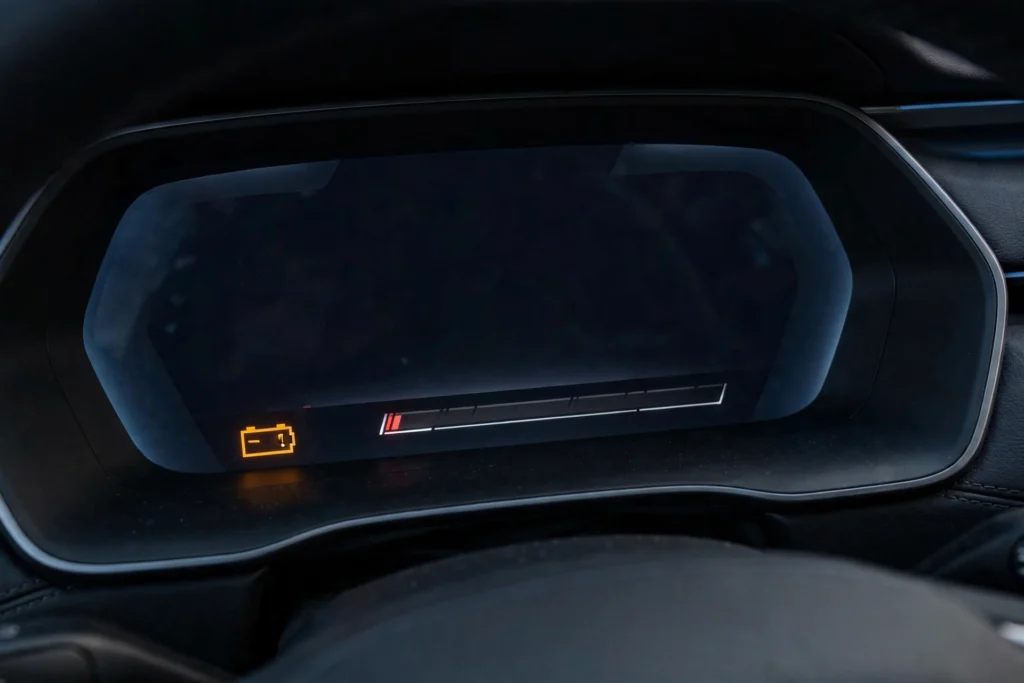
~5% or less: turtle mode. This is the EV’s last-ditch self-preservation. The car limits power output dramatically — you’ll feel it get sluggish, top speed drops, and a little turtle icon appears on the dashboard (yes, really). The point: turtle mode is the car’s final attempt to keep you rolling after your electric car runs out of battery — squeezing every last mile out of the remaining electrons to get you somewhere safe, not somewhere fast.
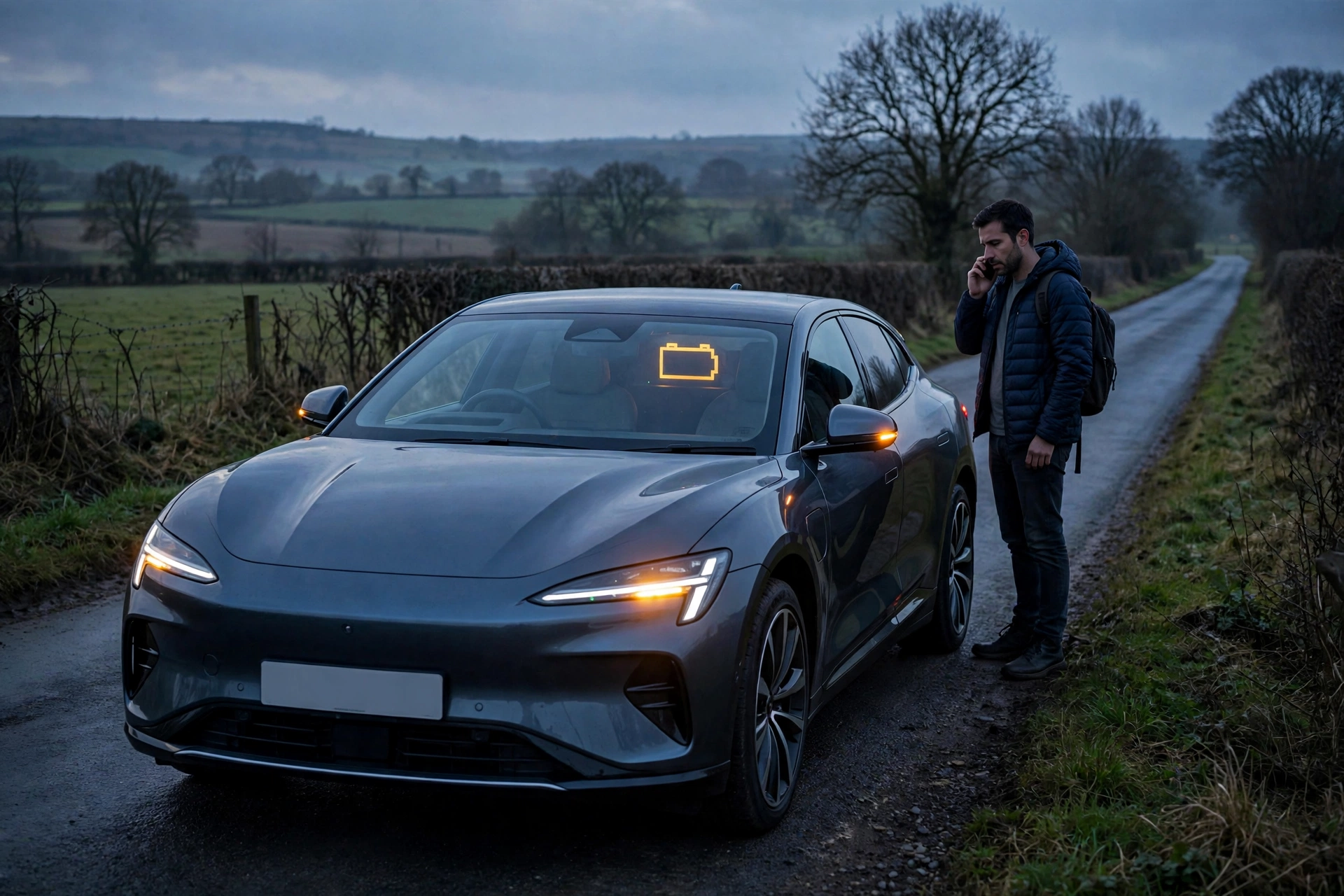
0%: shutdown. The car rolls to a stop. The 12-volt systems (hazards, lights, door locks) keep working off the small auxiliary battery, so you’re not trapped in a dark brick. But the drive motor is done until you add charge.
What Actually Happens When It Stops
Here’s the part people fear most when an electric car runs out of battery, so let’s be precise:
- You don’t lose steering or brakes. Power steering and brake boost run off the 12V system, which stays alive. You can steer to the shoulder safely.
- The doors don’t lock you in. Door locks, windows, and hazard lights all work on 12V power.
- The battery isn’t damaged. “0%” on your dashboard isn’t true zero — manufacturers hold a hidden buffer below displayed zero specifically to protect the battery. Running to displayed 0% once won’t hurt anything. (Making a habit of it isn’t great, but one incident is fine.)
- You can’t just add a gallon. This is the real difference. Nobody can bring you a jerrycan of electricity. Your options are a tow or mobile charging (more on both below).
Your Rescue Options, Ranked
1. Mobile charging services. This is the EV-era answer to the gas can. AAA now offers mobile EV charging in many metro areas — a truck arrives with a generator or battery pack and gives you enough charge (typically 10–15 miles) to reach a real charger. Some automakers (Tesla, Hyundai, others) include roadside assistance with mobile charging for the first few years of ownership. Check what your warranty covers before you need it.
2. A tow to the nearest charger. The old reliable. Any flatbed tow works — and here’s a fun fact: some EVs can actually gain a small charge from being towed with regen engaged, though tow companies won’t do this as a service. Just get the flatbed. Note: most EVs must be towed on a flatbed, not with wheels on the ground — check your manual.
3. A friendly outlet. If you coast into a parking lot near a building, your portable Level 1 cable plus any standard outlet gives you 3–5 miles per hour. An hour of asking nicely at a gas station or shop can buy you enough range to reach a fast charger. People are surprisingly willing to help.
4. Prevention (the best option). Honestly, this list exists for completeness. The car’s warnings make running out genuinely difficult unless you ignore them all.
Why It’s Rarer Than Running Out of Gas
Here’s the thing the fear-mongering skips: an electric car runs out of battery far less often than a gas car runs out of fuel — EVs are harder to run dry, not easier.
You start every day full. Gas car owners start the day with whatever was left yesterday. EV owners who home-charge start with 80–100% every single morning. You’d have to drive your entire range in one day without passing a charger to get in trouble.
The car does the math for you. Modern EV navigation tracks your consumption in real time and reroutes you to chargers proactively. Tesla’s system is famously aggressive about this — it will insist, loudly, long before your electric car runs out of battery.
Range estimates are conservative. Gas gauges lie optimistically; EV range displays tend to lie pessimistically at low charge. When your EV says 10 miles left, there’s usually a bit more.
The people who run out are almost always in one of three situations: a long rural stretch with no chargers (increasingly rare), ignoring repeated warnings, or a charger that turned out to be broken on arrival. All avoidable with 30 seconds of trip planning.
How to Make Sure It Never Happens to You
For daily driving: nothing. If you charge at home, you will effectively never run out. It’s a non-issue.
For road trips: let the car’s navigation plan charging stops and follow it. The #1 reason an electric car runs out of battery on a road trip is a driver who thought they knew better than the route planner. Also: have a backup charger in mind for each stop (apps like PlugShare show real-time status and reviews — check before you arrive).
The 20% rule: treat 20% like gas-car drivers treat the low-fuel light — start looking for energy. Treat 10% as “charge at the next available option, no exceptions.”
Know your real range. EPA estimates are optimistic. Cold weather can cut range 20–40%. Highway speeds above 70 mph eat range fast. Learn your car’s real numbers in your conditions, and plan from those.
Frequently Asked Questions
Can an electric car be jump-started like a gas car?
Not the main battery — there’s no jump-starting a depleted traction battery. But EVs also have a regular 12V battery (for lights, locks, computers), and that can die and be jump-started exactly like a gas car’s. If your EV is completely unresponsive, it’s often the 12V, not the big battery.
Does running out of battery damage the EV?
Once won’t hurt it — the battery management system keeps a hidden reserve below displayed 0%. Repeated deep discharges accelerate degradation slightly, but the occasional incident is a non-event for battery health.
Will roadside assistance charge my EV?
Many do now. AAA offers mobile charging in most major US metro areas, and most automakers’ included roadside assistance covers EV towing (some include mobile charging). Call the number in your owner’s manual or app — don’t just call any tow truck, since EVs need flatbeds. It’s the simplest backup plan if your electric car runs out of battery far from a charger.
How far can you drive after the range hits zero?
There’s usually a small hidden buffer — a few miles — but don’t count on it. Turtle mode below ~5% is your real “extra” range. Once the car stops, it’s stopped.
The Bottom Line
What happens if an electric car runs out of battery? The car warns you repeatedly, slows into turtle mode, rolls to a safe stop with steering and hazards intact — and then you call for a tow or mobile charging. No drama, no damage, no locked doors.
And the honest truth: with home charging and modern navigation, running out is harder to do in an EV than running out of gas. The fear is bigger than the risk. Plan your road trips, respect the 20% rule, and you’ll likely never find out what it’s like when an electric car runs out of battery.