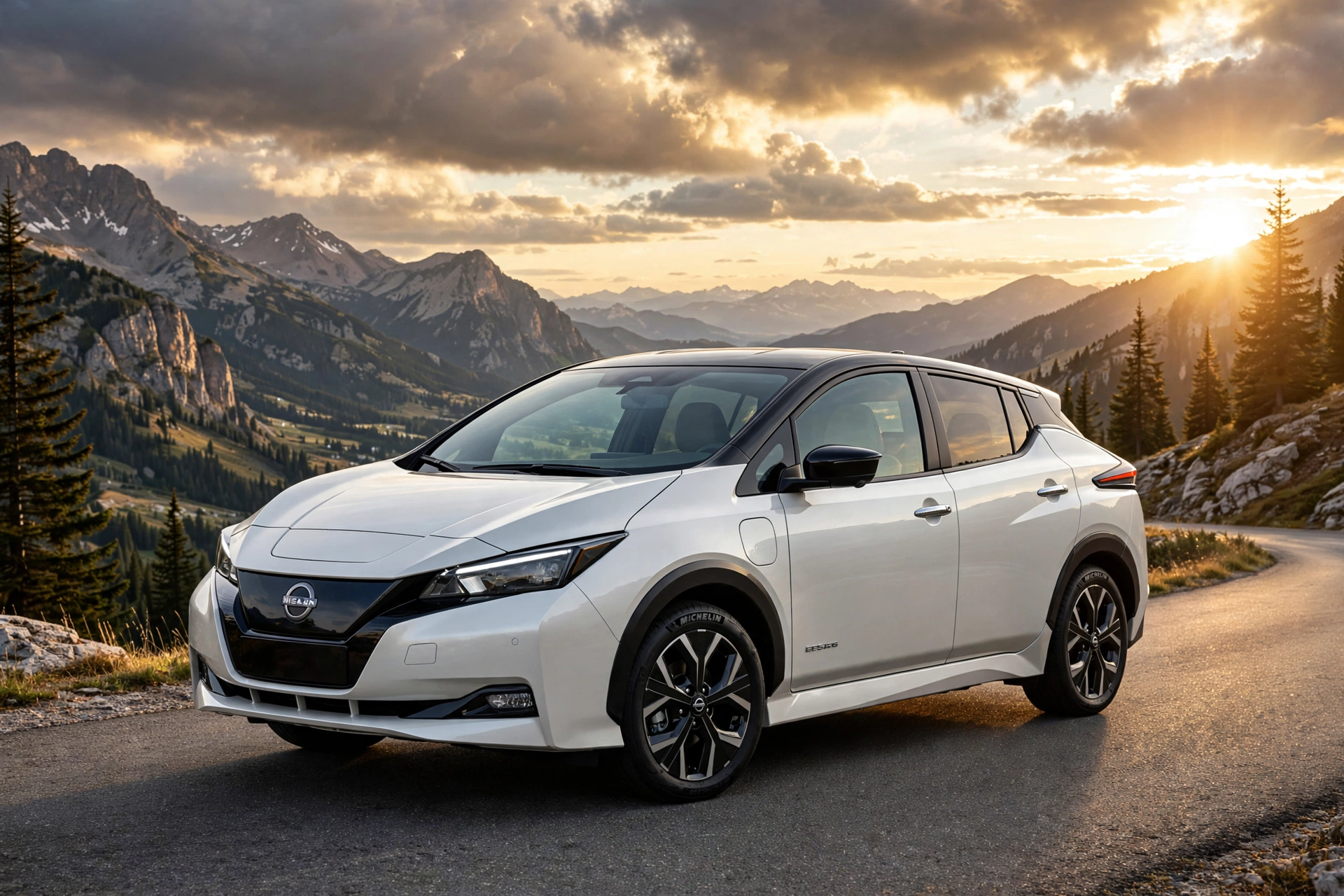

The Nissan Leaf 2026 is not the Leaf you remember. After more than a decade as the modest compact hatchback that put mainstream EVs on the map, the third-generation Leaf has been reinvented as a stylish subcompact electric crossover — with up to 303 miles of EPA-estimated range, a standard Tesla-style NACS charging port, and a starting price under $30,000. If you have been waiting for the Leaf to grow up, this is the year to pay attention.
In this complete 2026 guide, we walk through every Nissan Leaf 2026 trim, the real-world range figures, charging speeds, interior tech, running costs, and who should actually buy one — with the honest downsides included.

Table of Contents
Nissan Leaf 2026: what’s new for the redesign
Everything changed for 2026. The Leaf moves off its old hatchback platform and onto a crossover body with an elevated driving position, more cargo room, and a roofline Nissan describes as inspired by the katana blade of the Z sports car. Flush motorized door handles — a first for Nissan — and a segment-first dimming panoramic roof that switches between transparent and opaque at the touch of a button give the new Leaf a far more premium feel than its predecessor.
The mechanical changes matter even more. The 2026 Leaf adds an active liquid-cooled battery thermal system, fixing one of the biggest complaints about older Leafs, whose passively cooled packs slowed down badly on repeated fast charges. Peak DC fast charging rises to 150 kW, good for a 10–80% top-up in roughly 35 minutes. Nissan also fits two charging ports: a native NACS inlet for the Tesla Supercharger network, plus a CCS-style port — unlocking access to more than 25,000 Tesla Superchargers across North America, with Plug & Charge support so you rarely need an app or a card.
The awards followed quickly: the redesigned Leaf was named the InsideEVs Breakthrough EV of the Year in late 2025, and it is a finalist for the North American Utility Vehicle of the Year award.
Nissan Leaf 2026 trims, prices, and EPA range
Nissan keeps the lineup simple — three trims, all built around the same 75 kWh battery and a 214-horsepower front-wheel-drive motor. Here is how they compare:
| 2026 Leaf trim | EPA range (combined) | Starting MSRP |
|---|---|---|
| S+ | 303 miles | $29,990 |
| SV+ | 288 miles | $34,230 |
| Platinum+ | 259 miles | $38,990 |
Prices exclude a $1,575 destination charge. City ratings are even stronger — the S+ is rated at 325 miles of city driving — while highway ratings land at 276 miles for the S+, 268 for the SV+, and 240 for the Platinum+. For context, the outgoing 2025 Leaf topped out at 212 miles of EPA range, so the 2026 model adds roughly 90 miles overnight.
One caveat: with federal EV tax credits ending for vehicles acquired after September 30, 2025, the Leaf no longer qualifies for a federal incentive. The sub-$30,000 starting price partly makes up for that — very few EVs with 300+ miles of range sell anywhere near this price. We explain how the loss of credits changes the math for buyers in our guide on whether EVs are worth buying without tax credits.
Charging the Nissan Leaf 2026: home and on the road
At home, the Leaf charges on a standard 240-volt outlet or wallbox, taking roughly 12 hours for a full charge on Level 2 — easy to fill overnight. On the road, the story is much improved versus old Leafs. The 150 kW DC peak and NACS port mean a 10–80% stop takes about 35 minutes at a Supercharger or CCS station, and the new liquid cooling keeps that speed consistent even after multiple fast charges in a row — the old passive-cooled packs would throttle badly by the second stop.
Nissan’s Plug & Charge support makes Supercharger stops nearly seamless: plug in and billing happens automatically through your Nissan account. If you mostly charge at home and take occasional road trips, the 303-mile S+ is one of the easiest long-range EVs to live with under $35,000. To understand what makes this generation’s battery so much better, see our deep dive on how EV batteries work and how to care for them.
Interior, screens, and driver-assist tech
Inside, the 2026 Leaf finally looks like a modern EV. All trims get dual digital displays — 12.3-inch screens on the S+, growing to 14.3-inch screens on the SV+ and Platinum+ — with wireless Apple CarPlay and Android Auto standard. SV+ and Platinum+ add Google built-in, including Google Maps with an intelligent route planner that factors charging stops into your navigation automatically.
Safety tech is generous: Nissan’s Safety Shield 360 suite comes standard across the lineup, and higher trims get the class-exclusive Intelligent Around View Monitor plus Invisible Hood View and Front Wide View cameras that make tight parking almost foolproof. ProPilot hands-free highway driving assistance and Nissan’s beloved one-pedal e-Pedal driving round out the tech package.
Real-world range: it goes further than the sticker says
Early independent testing suggests Nissan’s EPA numbers are conservative. In Edmunds’ standardized EV range test, a 2026 Leaf Platinum+ — the trim with the lowest EPA rating at 259 miles — drove 310 miles on a single charge, far exceeding its official figure. Energy consumption came in at 27.8 kWh per 100 miles versus the EPA’s 33 kWh/100 mi estimate, nearly 16% better.
That suggests the S+ could realistically deliver well over 300 miles in mixed driving, and perhaps 340+ around town in mild weather. Cold-weather range will still drop — plan on roughly a 10–20% haircut at freezing temperatures with the heater running — but the Leaf’s new heat pump (available on higher trims) helps cabin heating draw less energy.
Running costs, warranty, and value verdict
Electricity costs remain the Leaf’s quiet superpower. At typical US residential rates of around 17–18 cents per kWh and the Leaf’s ~3.6 miles-per-kWh efficiency, a full 75 kWh “fill-up” costs roughly $13 — good for about 260–300 miles. That’s around 4–5 cents per mile in fuel, versus 12–16 cents for a 30-mpg gas crossover. We break the full calculation down in our guide to EV cost per mile.
Maintenance is minimal — no oil changes, no timing belts, no exhaust — and Nissan backs the battery with an 8-year/100,000-mile warranty. Insurance and tires cost about the same as any small crossover, though budget for tires: the Leaf’s instant torque wears them faster if you drive enthusiastically.
The honest verdict: the S+ at $29,990 is the value sweet spot — the longest range in the lineup and everything most drivers need. The SV+ adds the bigger screens and nicer tech for $4,240 more, a fair trade for tech lovers. The Platinum+ looks expensive at $38,990 given it has the shortest range, and we only recommend it if you specifically want the dimming panoramic roof and full driver-assist suite.
Nissan Leaf 2026 vs. rivals
The Leaf’s main rivals are the Chevrolet Equinox EV (starting around $34,995 with 319 miles of range), the Hyundai Kona Electric, the Kia Niro EV, and the VW ID.4. The Equinox EV beats the Leaf on both range-per-dollar and highway comfort, but the Leaf undercuts it by about $5,000 at the entry level. The Hyundai and Kia twins offer excellent efficiency and long warranties but start several thousand higher than the Leaf S+. Among budget EVs, the Leaf is now the range leader per dollar — though the Equinox EV remains the stronger all-rounder if your budget stretches past $35,000. For a broader comparison of how affordable EVs stack up, see our VW ID.Buzz range and charging breakdown for how Nissan’s rivals handle the same questions.
Who should buy the Nissan Leaf 2026 — and who shouldn’t
Buy it if: you want the most range per dollar in the EV market, you charge at home most nights, you like the crossover form factor, or you’re upgrading from an old Leaf and want the car that fixes every old complaint — range, charging speed, thermal management, and tech.
Think twice if: you regularly drive 200+ miles a day at highway speeds (the Platinum+ highway rating of 240 miles is cutting it close in winter), you need AWD or towing (the Leaf offers neither), or your budget stretches to $35,000+ where the Equinox EV or ID.4 offer more refinement.
FAQ: Nissan Leaf 2026
How much does the 2026 Nissan Leaf cost?
The 2026 Leaf starts at $29,990 for the S+, $34,230 for the SV+, and $38,990 for the Platinum+, plus a $1,575 destination charge. No federal tax credit applies.
What is the range of the 2026 Nissan Leaf?
EPA ratings are 303 miles (S+), 288 miles (SV+), and 259 miles (Platinum+). Independent testing found the Platinum+ actually drove 310 miles — over 50 miles more than rated.
Can the 2026 Leaf use Tesla Superchargers?
Yes. The 2026 Leaf has a standard NACS charging port with Plug & Charge support, giving access to more than 25,000 Tesla Superchargers in North America.
How fast does the 2026 Leaf charge?
Up to 150 kW on DC fast charging, for a 10–80% charge in about 35 minutes. Home Level 2 charging takes roughly 12 hours for a full battery.
Is the 2026 Leaf a good buy compared to the old Leaf?
It’s a completely different vehicle: crossover body instead of hatchback, 90+ more miles of range, triple the charging speed, liquid-cooled battery, and modern tech. For most buyers it’s the first Leaf worth choosing on merit rather than just price.
To compare official EPA range figures across every trim, check FuelEconomy.gov, the EPA’s official fuel-economy and range database.