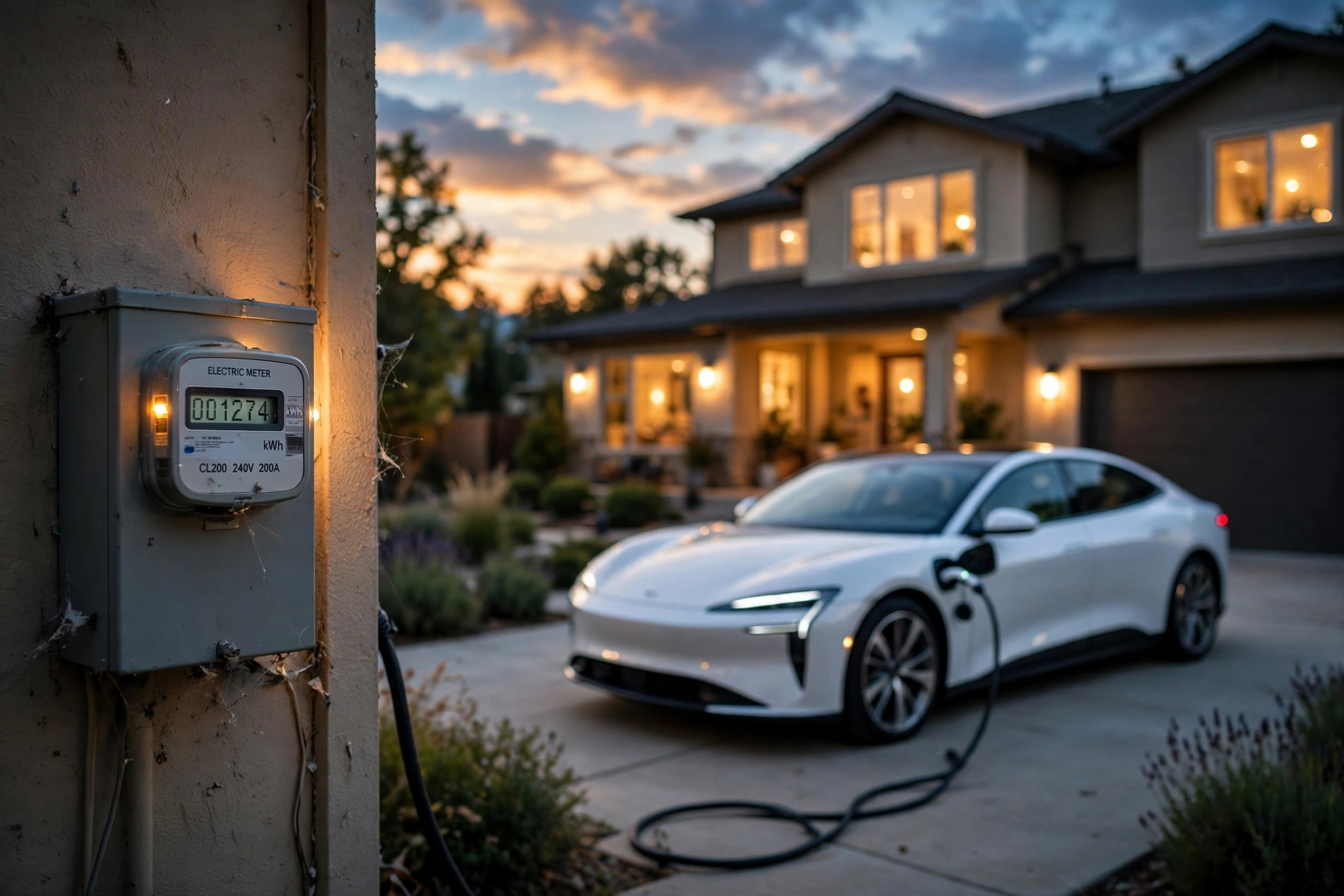

If you are asking whether an electric car is cheaper to run than a gas car, you need one number: the electric car cost per mile. Not the sticker price, not the range — the actual dollars leaving your wallet for every mile you drive. With gas at $4.33 a gallon nationally (AAA, mid-October 2026) and home electricity averaging about 18¢ per kWh, the answer in 2026 is genuinely interesting — and more nuanced than either camp admits.
The headline answer: a typical EV charged at home costs roughly 4 to 5 cents per mile for energy. The same miles in a 30-mpg gas SUV cost about 14 cents. But that gap shrinks — sometimes to nothing — when you rely on public DC fast charging. Let me walk you through the real numbers, the formula, and the traps.
Table of Contents
Electric car cost per mile: the short answer
For an average US driver covering 12,000 miles a year, charging an efficient EV at home costs roughly $560–$590 a year for energy. Run that same mileage through a Toyota Camry Hybrid and you spend about $1,130. A Honda CR-V with a gas engine costs about $1,730. That is the whole story in one paragraph — home charging is where EVs win their biggest running-cost victory.
But “home charging” does a lot of heavy lifting in that sentence. Charge at public fast chargers all the time and an EV can cost more per mile than an efficient gas sedan. We will get to that, because it matters more than most EV fans want to admit.
How to calculate electric car cost per mile yourself
You do not need a spreadsheet for this. The formula is one line of multiplication:
Cost per mile = (your electricity rate in ¢/kWh) × (the car’s consumption in kWh per mile)
A practical example: the 2026 Tesla Model 3 Long Range AWD is EPA-rated at about 26 kWh per 100 miles — that is 0.26 kWh per mile. At the national average of 18¢/kWh:
18 × 0.26 = 4.7 cents per mile.
That EPA kWh/100-mile figure is measured at the wall plug, so it already accounts for charging losses — no extra adjustment needed. You can find it on the window sticker or at fueleconomy.gov’s guide to all-electric vehicles, which explains how EV efficiency ratings work.
For a gas car, the mirror formula is equally simple: gas price per gallon ÷ miles per gallon. A Camry Hybrid at 46 mpg with $4.33 gas: 4.33 ÷ 46 = 9.4 cents per mile.
4 real EVs vs 2 gas cars: the per-mile comparison
I used 2026 EPA efficiency figures, October 2026 fuel prices (18¢/kWh home electricity, 41¢/kWh public DC fast charging per AAA’s EV charging index, and $4.33/gallon for regular gas), and real models you can actually buy:
| Vehicle | EPA efficiency | Home charging (18¢/kWh) | Public DC fast charging (41¢/kWh) | Fuel cost per mile |
|---|---|---|---|---|
| Tesla Model 3 Long Range AWD | 26.3 kWh/100 mi | 4.7¢ | 10.8¢ | — |
| Chevrolet Equinox EV FWD | 26.4 kWh/100 mi | 4.8¢ | 10.8¢ | — |
| Hyundai Ioniq 5 Long Range RWD | 26.7 kWh/100 mi | 4.8¢ | 10.9¢ | — |
| Kia EV6 Long Range RWD | 27 kWh/100 mi | 4.9¢ | 11.1¢ | — |
| Toyota Camry Hybrid (gas) | 46 mpg | — | — | 9.4¢ |
| Honda CR-V (gas, 1.5T) | 30 mpg | — | — | 14.4¢ |
Read the table honestly and you get three conclusions. One: home charging beats gas by half or more for every EV here. Two: the differences between these four EVs are tiny — 0.2 cents per mile separates the best from the worst, which is about $24 a year. Do not pick an EV based on efficiency unless you are choosing between an efficient sedan and a Hummer EV. Three: public DC fast charging costs nearly as much per mile as the Camry Hybrid — and in expensive states it can exceed it.
That third point is the one that bites. AAA puts the national average public charging price at 41¢/kWh, but in places like California it is routinely 48¢–60¢/kWh. At 55¢/kWh, a Kia EV6 costs 14.9¢ per mile — worse than the Camry Hybrid on any road trip. The EV fuel-savings pitch is a home-charging story. If you rent an apartment with no overnight charging, do the math with public-charging rates before you believe anyone’s savings claims.
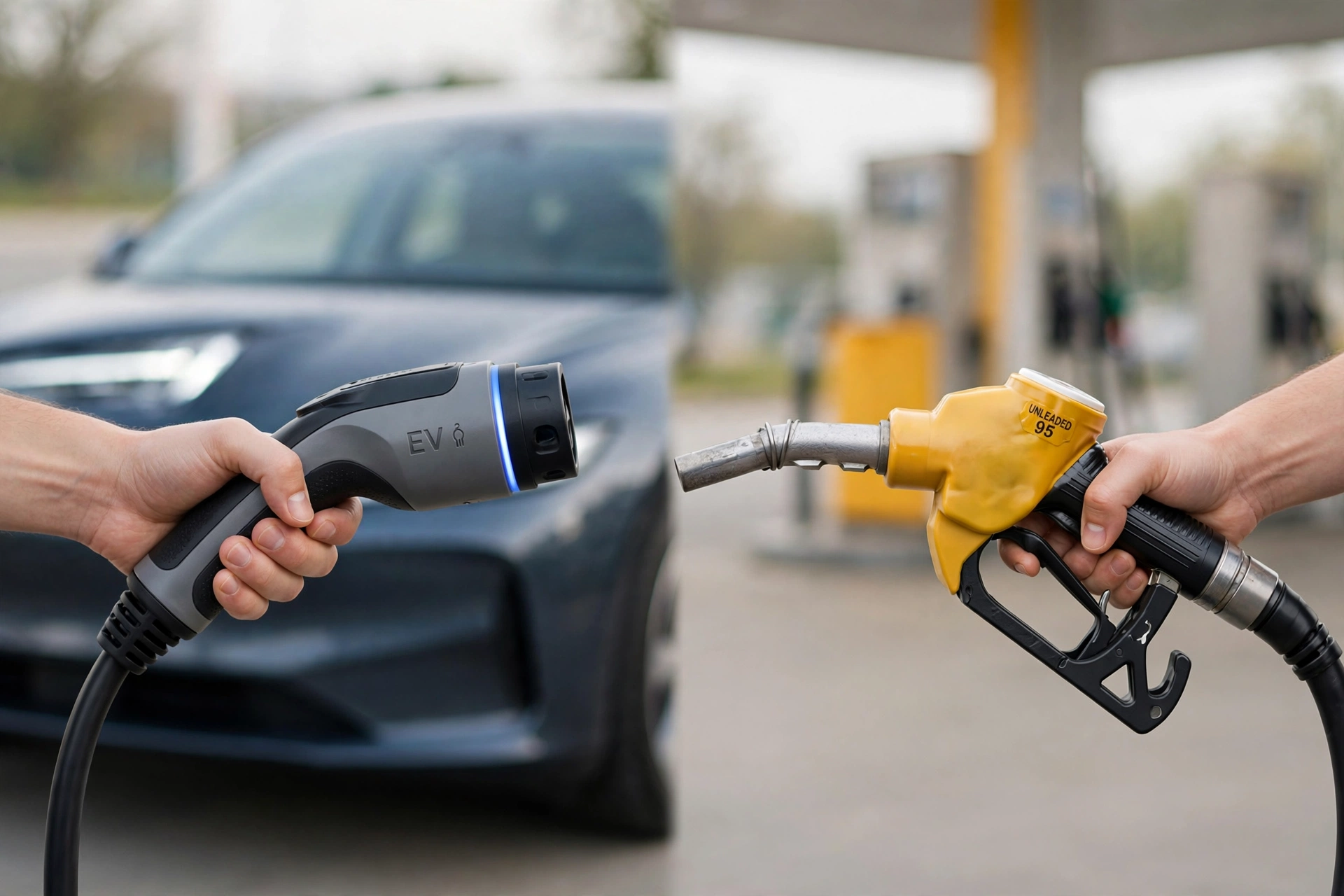
When the electric car cost per mile is NOT cheaper
I want to be straight about this, because EV media tends to gloss over it. There are real situations where a gas car costs less per mile to fuel:
- No home charging. As the table shows, relying entirely on DC fast charging at 41¢/kWh puts you at gas parity or worse versus efficient hybrids.
- Expensive-electricity states. Hawaii residents pay 48¢–52¢/kWh at home. California’s average is above 28¢, and time-of-use peak rates can exceed 50¢. At 30¢/kWh, a Model 3 costs 7.9¢/mile — still cheaper than gas, but the savings cushion gets thin against a Camry.
- Cheap-gas states. Indiana gas was recently $3.75/gallon. A Camry Hybrid there costs 8.2¢/mile while charging an EV at 18¢/kWh costs 4.7¢ — the EV still wins, but the dollar gap shrinks to about $420 a year instead of $570.
- Inefficient EVs driven hard. A Hummer EV uses north of 70 kWh per 100 miles. At 41¢/kWh public charging, that is 28.7¢ per mile — worse than a 20-mpg gas truck at today’s gas prices. Nobody buys a Hummer to save on energy, but the math is the math.
To see how this fits into the full ownership picture — purchase price, depreciation, insurance — run your scenario through our EV total cost of ownership guide and calculator.
Winter and driving style change your number more than you think
The EPA ratings above are year-round averages on a mild test cycle. Real life is less polite.
Winter is the biggest swing. Cabin heating in an EV comes from the battery, not engine waste heat, so cold weather typically cuts efficiency by 20%–35% — sometimes more on short trips where the cabin never warms up. A Model 3 that sips 4.7¢/mile in spring might cost 6¢–6.5¢/mile in a Minnesota January. Gas cars lose efficiency in winter too (roughly 10%–15% from cold starts and winter fuel blends), but the EV penalty is bigger.
Speed is the second swing. EV efficiency falls off a cliff above 70 mph because aerodynamic drag squares with speed and there is no transmission to keep the motor in a sweet spot. Steady 80-mph highway driving can push consumption 20%–25% above the EPA figure. Driving style matters too: smooth, steady driving costs less; aggressive acceleration and hard braking cost more — though regenerative braking softens that penalty considerably.
A practical way to think about it: take the EPA number as your good-weather baseline, then add 25%–30% for winter highway reality. You will be close to your real-world cost per mile in all four seasons.
The tires footnote: maintenance and cost per mile
Fuel is not the whole per-mile story, and the one honest wrinkle for EVs is tires. EVs are heavy and deliver instant torque, which wears tires faster — many owners report replacing tires at 25,000–35,000 miles versus 40,000–50,000 for a comparable gas car. A $900 set of tires every 30,000 miles adds about 3¢ per mile, roughly wiping out a chunk of the fuel savings advantage.
The flip side is everything else: no oil changes, no transmission fluid, far less brake wear (regenerative braking does most of the work), and no exhaust system. EV maintenance is dramatically cheaper overall. But if you are building a true cost-per-mile budget, put a line item in for tires — roughly 2¢–3¢/mile for most EVs — and you will not be surprised at the service counter.
The bottom line on cost per mile
At current 2026 prices, an efficient EV charged at home costs about half as much per mile as a hybrid sedan and a third as much as a typical gas SUV — roughly 5 cents versus 9 versus 14. That advantage survives winter, survives highway speeds, and survives higher tire costs.
What it does not survive is expensive public charging. The whole EV cost-per-mile argument rests on where you plug in. If you have a driveway or garage and can charge overnight, the math is a slam dunk. If you cannot, be honest with yourself about what you would actually pay per kWh — and compare that number, not the national average, against a $4.33 gallon of gas.
For the five-year view including the purchase premium, check our EV vs gas 5-year cost comparison — and if you are wondering whether EVs still make financial sense without federal incentives, our analysis of buying an EV without tax credits breaks it down.