
You’ve probably been there: battery at 22%, unfamiliar part of town, and that low-grade panic as you try to find EV charging stations on a map app that seems to show everything except the one you need. The good news? In 2026, finding a charger is easier than it’s ever been — there are more than 65,000 public DC fast-charging ports in the US alone, and the tools for locating them have gotten genuinely smart. You just need to know which ones to trust and how to filter out the noise.
I’ve spent enough time road-tripping in EVs to know that the difference between a smooth drive and a stressful one usually comes down to preparation, not luck. This guide walks you through nine proven methods to find EV charging stations near you, whether you’re running errands across town or crossing three state lines. Pick the two or three that fit your driving habits and you’ll never stare at a low-battery warning in confusion again.
Table of Contents
Method 1: Find EV Charging Stations With PlugShare
PlugShare is the app most EV drivers swear by, and for good reason. It’s the closest thing the EV world has to a universal map: it aggregates stations from every major network — Tesla, Electrify America, EVgo, ChargePoint, Blink, and dozens of smaller ones — plus independent and free chargers that don’t show up anywhere else.
The killer feature isn’t the map itself. It’s the check-ins. Real drivers leave notes about broken connectors, ICE-ing (gas cars blocking spots), billing quirks, and whether the coffee shop next door is worth the wait. Before you commit to a station, read the last few check-ins. A site with a week of complaints about two dead stalls out of four is a site to skip if you can. Set up your vehicle profile (say, a Tesla Model 3 Long Range or a Hyundai Ioniq 5) and your plug type, and PlugShare will only show stations you can actually use.
One more tip: filter for “DC fast” when you’re in a hurry and “Level 2” when you’ll be parked for hours. A Level 2 plug adds roughly 20–30 miles of range per hour — perfect for a movie or a workday, useless for a quick road-trip stop.
Method 2: Use Google Maps’ Built-In EV Filter
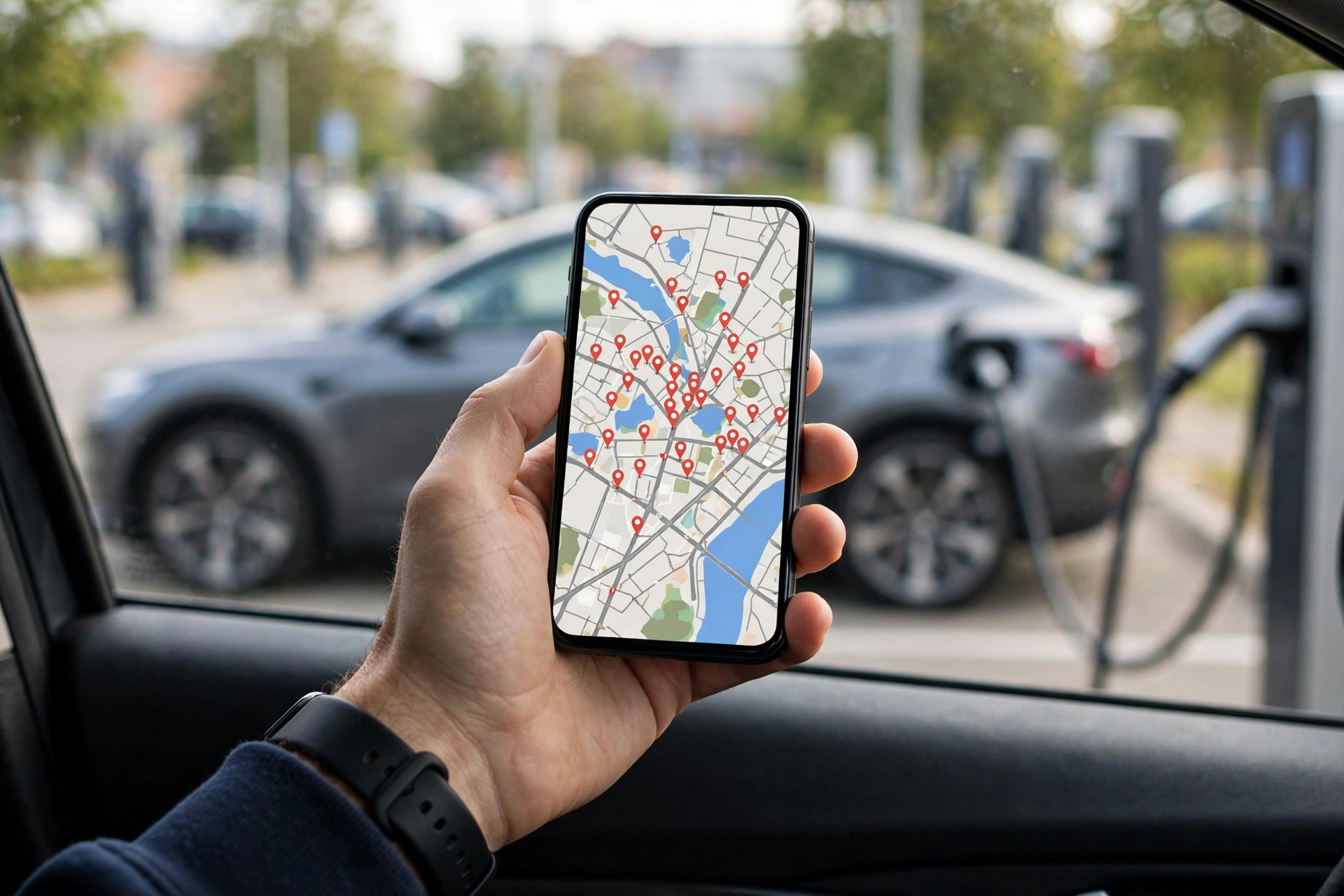
Google Maps quietly became one of the best ways to find EV charging stations near you, and it’s already on your phone. Search “EV charging stations near me” and tap the filter icon: you can narrow results by plug type (NACS, CCS, CHAdeMO, J1772), charging speed, and even whether stations are currently in use, thanks to live availability data Google pulls from participating networks.
It won’t replace PlugShare for granular detail, but for a fast “what’s closest right now” check while you’re already driving, nothing beats an app you don’t have to open separately. Google Maps also routes you there with one tap, which matters more than you’d think at night in an unfamiliar town.
Method 3: Check the DOE’s Official Station Locator
If you want the authoritative, no-marketing-spin database, the U.S. Department of Energy’s Alternative Fuels Data Center keeps an official map of public charging stations nationwide. It’s maintained by the National Renewable Energy Laboratory, and fleet operators and state agencies use the same data.
Search the DOE Alternative Fueling Station Locator here — you can filter by connector type, charging level, and network. It’s especially handy when you’re trying to confirm whether a station in a small town is real or a ghost listing on some other app. If you want a deeper explanation of how charging levels and connectors work, our Ultimate Guide to EV Charging Stations in the USA breaks it all down.
Method 4: Lean on Your Car’s Built-In Navigation
Don’t sleep on the navigation system that came with your car — it’s often the fastest option because it’s already integrated with your battery. Tesla’s trip planner routes you through Superchargers automatically, preconditioning the battery so it charges at full speed the moment you arrive. Ford’s Mustang Mach-E and GM’s EVs (like the Chevrolet Equinox EV and Blazer EV) have route planners that factor in charging stops along major corridors too.
Built-in nav shines on one front: accuracy about your actual state of charge. A phone app doesn’t know you hit a headwind for 40 miles. Your car does, and it adjusts its charging recommendations accordingly. My honest take: use your car’s planner for the backbone of a trip, then cross-check specific stops on PlugShare.
Method 5: Grab the Network Apps for the Chargers You’ll Actually Use
Aggregator apps find stations; network apps let you pay for them. If you drive a non-Tesla EV, download the apps for the two or three networks closest to your daily routes. Knowing which networks dominate your area saves real money and time.
Here’s the 2026 landscape in plain numbers. Tesla’s Supercharger network is by far the largest, with over 34,700 DC fast-charging ports in the US — more than half of the national total — and Tesla says 85,000+ stalls exist worldwide. More than 15,000 of those stalls are now open to non-Tesla EVs, and drivers from Ford, GM, Rivian, Hyundai, Kia, Mercedes-Benz, Volkswagen, Toyota, BMW, and Stellantis brands can charge at Superchargers, either with a native NACS (SAE J3400) port or an adapter. Electrify America runs 5,600+ DC fast chargers across 1,080 locations in 47 states plus DC and delivered over 20 million charging sessions in 2025. EVgo and ChargePoint each operate somewhere around 4,400–4,600 DC fast ports, and Blink sits under 1,900. A new multi-automaker network called IONNA is also rolling out stations with modern amenities.
Keep the Tesla app even if you don’t drive a Tesla — it’s how non-Tesla drivers start and pay for Supercharger sessions at most open sites. And the Electrify America, EVgo, and ChargePoint apps let you see live stall availability before you arrive, which is worth its weight in gold on holiday weekends.
Method 6: Filter by Plug Type and Speed Before You Drive
Showing up at a station you can’t plug into is the most avoidable mistake in EV ownership. In 2026, North America is mid-transition: NACS (now formally standardized as SAE J3400) is becoming the default, with most automakers shipping native NACS ports on 2025-and-newer models — the updated Hyundai Ioniq 5 was one of the first mainstream EVs to make the switch. Older EVs, like many Nissan Leafs and earlier CCS-equipped cars, still need CCS1 or CHAdeMO connectors, though adapters (often supplied by the automaker) bridge the gap at Superchargers.
Whatever app you use, set your plug type once and leave it. Then think about speed: for road trips, only DC fast chargers (usually 50 kW and up; the good ones run 150–350 kW) are worth your time. A Kia EV9 or Hyundai Ioniq 6 on a 350 kW dispenser can add hundreds of miles in the time it takes to buy a sandwich. Level 2 (around 7–11 kW) is for destinations — hotels, workplaces, shopping centers — where the car sits for hours anyway.
Method 7: Hunt Down Free Charging
Yes, free public charging still exists, though it’s thinner on the ground than it was five years ago. Hotels were early adopters — many still offer free Level 2 charging as a guest perk, and it costs nothing to ask at check-in. Car dealerships frequently have chargers they’ll let anyone use during business hours (they want you browsing the lot). Some workplaces, municipal parking garages, and grocery stores offer free or subsidized charging, and a few networks run promotional free-charging windows.
In PlugShare, there’s literally a “free” price filter — use it. Just set expectations: free stations are almost always slower Level 2 units, and they can be occupied or broken with nobody in a hurry to fix them. Treat free charging as a bonus, not a plan. If you mostly charge at home anyway, our home charger finder quiz can help you pick the right Level 2 setup so public charging becomes the exception rather than the rule.
Method 8: Plan Road Trips With A Better Route Planner
For anything longer than a day trip, A Better Route Planner (ABRP) is the gold standard. You enter your exact car model, its real-world efficiency, how much battery you’re willing to arrive with, and even weather and cargo — and it builds a stop-by-stop charging plan. It knows, for instance, that a Ford F-150 Lightning towing a trailer needs very different stops than a Tesla Model Y Long Range running empty.
ABRP’s real value is that it plans around charger reliability and speed, not just geography. It’ll route you past a flaky single-stall site in favor of a 12-stall station ten minutes further on, and it recalculates on the fly if you skip a stop. Pair it with your car’s built-in nav — ABRP for the strategy, the car for the execution — and long-distance EV travel stops feeling like an expedition. To estimate what those stops will cost, run the numbers through our EV charging cost calculator before you leave.
Method 9: Have a Backup Plan for Rural and Charging-Desert Areas
Here’s the honest part: coverage is still uneven. California, Texas, Florida, and New York hold nearly half of all US DC fast-charging ports, while states like Alaska have only a few dozen. If your route crosses a charging desert — parts of the rural Midwest, the Mountain West, or the Deep South off the interstates — plan like it matters, because it does.
The playbook: charge to 90–100% before leaving the last reliable fast charger (normally you’d stop at 80% for speed, but range beats speed here). Identify RV parks along your route — most have 50-amp NEMA 14-50 outlets that work with the mobile connector many EVs include, adding a respectable 20+ miles per hour overnight. Call ahead; some welcome EVs, some don’t. Download offline maps of your charging apps before you lose signal. And always have a Plan B station marked — if your primary stop is down, you don’t want to be discovering that with 30 miles left.
Which Method Should You Actually Use?
Different situations, different tools. For daily driving, Google Maps or your car’s nav is plenty. For unfamiliar areas, PlugShare’s check-ins are non-negotiable — they’re the only thing standing between you and a wasted detour. For road trips, ABRP plus the network apps. And the DOE locator is your fact-checker when apps disagree.
The underlying trend is firmly in your favor. With NACS becoming the standard connector, Tesla’s network opening to nearly every brand, and tens of thousands of new ports going in every year, the question is shifting from “can I find a charger?” to “which of these five nearby chargers is best?” Learn these nine methods once, and you’ll spend your energy enjoying the drive instead of hunting for electrons.