
Table of Contents
Do Electric Cars Need Oil Changes? The Short Answer: No. Never. Not Once.
Do electric cars need oil changes? No — electric cars never need oil changes, not at 5,000 miles, not at 50,000, not ever. There’s no engine oil because there’s no engine. No pistons, no cylinders, no combustion, no oil filter to replace, no dipstick to check, no “your oil change is overdue” sticker on the windshield.
It’s one of the cleanest wins of EV ownership: the average gas car needs 2–4 oil changes a year at $50–$100 each. Over ten years, that’s $1,000–$4,000 you simply never spend. But if “do electric cars need oil changes” is your way of asking whether EVs are maintenance-free, don’t confuse the two — “no oil changes” and “no maintenance” are very different things.
Why EVs Don’t Need Oil (The 30-Second Explanation)

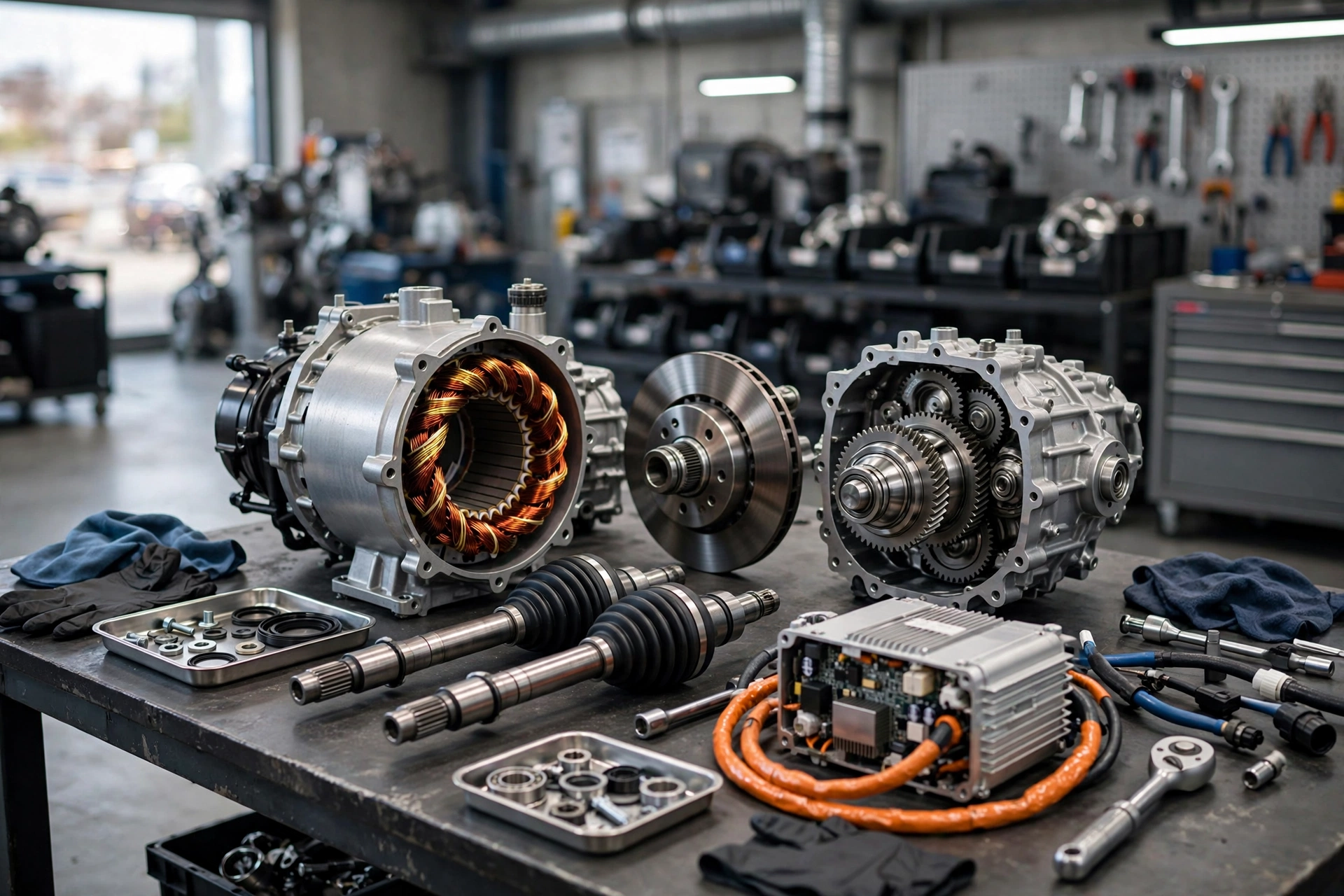
Engine oil exists to lubricate hundreds of metal parts sliding against each other inside a combustion engine — pistons, crankshafts, camshafts, valves. An electric motor has essentially one moving part: the rotor, spinning on sealed bearings. There’s nothing to lubricate, nothing burning fuel, nothing producing soot that contaminates oil.
The entire drivetrain of a typical EV has about 20 moving parts. A gas car has over 2,000. That difference is why the maintenance schedule looks so empty by comparison.
What EVs Actually Need Instead
Do electric cars need oil changes? No. But here’s the honest maintenance list of what they do need — shorter than gas, but not zero:
Reduction-gear fluid: EVs have a single-speed gearbox with oil inside it. Most manufacturers call it “lifetime” fluid, but many techs recommend changing it around 100,000 miles. Cost: $100–$200. Compare that to a gas car’s transmission service every 30,000–60,000 miles.
Coolant: The battery and power electronics are liquid-cooled. Coolant changes run every 4–5 years or ~100,000 miles on most EVs — roughly $150–$250. Less frequent than gas cars, but not never.
Brake fluid: Same as gas cars — every 2–3 years, ~$100. Though here’s the twist: EV brakes last dramatically longer because regenerative braking does most of the stopping. Many EV owners go 100,000+ miles on original brake pads.
Cabin air filter: Every 1–2 years, $30–$60, often DIY-able in five minutes.
12V battery: Yes, EVs still have a regular 12-volt battery running the electronics — and it still dies every 3–5 years, ~$150–$250. It’s the #1 cause of EV roadside assistance calls, which surprises everyone exactly once.
Tires: The big one. EVs are heavy and torquey, so they eat tires 20–30% faster than comparable gas cars. Budget for it — this is where a chunk of your oil-change savings goes.
Windshield washer fluid: The humblest maintenance item survives electrification. Top it up yourself.
EV vs Gas: Real 5-Year Maintenance Costs
Rough numbers for a typical driver (12,000 miles/year):
- Gas car: oil changes ($600–$1,200), transmission service ($200–$400), spark plugs ($200–$300), coolant, brake pads/rotors ($400–$800), air filters, 12V battery — roughly $2,500–$4,500 over 5 years
- EV: cabin filters ($150), brake fluid ($200), 12V battery ($200), coolant ($200), extra tire wear ($400–$800) — roughly $1,200–$2,000 over 5 years
So the “no oil changes” advantage is real — roughly $1,500–$2,500 saved over five years — but tires eat back a meaningful share. Anyone telling you EVs cost “nothing” to maintain is selling something. For the big-ticket what-if, see our EV battery replacement cost estimator.
What About Hybrids and Plug-In Hybrids?
Worth clarifying, since this confuses a lot of shoppers: hybrids and plug-in hybrids (PHEVs) DO need oil changes. They have gas engines, even if the engine runs less often. In fact, PHEVs driven mostly on electricity can be worse — the engine oil sits unused for weeks, absorbs moisture, and still needs changing on a time-based schedule (usually every 12 months regardless of miles).
If you’re asking “do electric cars need oil changes” because you want to ditch service visits entirely, you want a pure battery-electric vehicle (BEV), not a hybrid. It’s one of the underrated quality-of-life differences between the two.
What Happens If You Ignore EV Maintenance Entirely?
Honest answer: for the first few years, probably nothing dramatic — which is why some owners do exactly that. But the neglect compounds. Skipping tire rotations on a heavy EV means replacing a $1,000+ set of tires at 25,000 miles instead of 40,000. Ignoring the 12V battery means a dead car in a parking lot (the main battery can be at 80% and the car still won’t start — ask me how I know this surprises people).
Letting coolant go a decade is the real gamble: degraded coolant can corrode the battery cooling plates, and that’s a four-figure repair that makes an oil change look adorable. The EV maintenance list is short — which is exactly why each item on it deserves respect.
The Maintenance Schedule Myth
One more honest note: some dealers still push 6-month “service visits” for EVs out of habit (and revenue). For most EVs, the manufacturer schedule is basically: rotate tires, inspect brakes, replace cabin filter, check fluids — once a year or every 12,000 miles. If a dealer quotes you a $400 “EV service package” involving mystery inspections, ask exactly what’s included. The answer is usually: not much.
Tesla doesn’t even publish a fixed service schedule — it’s “as needed.” And if you’re still wondering “do electric cars need oil changes,” Tesla’s own maintenance page states it plainly: unlike gasoline cars, Tesla vehicles require no traditional oil changes.
Frequently Asked Questions
Do electric cars have transmission fluid?
They have reduction-gear oil (a small amount in the single-speed gearbox), but no conventional transmission and no transmission fluid changes on a schedule. Some owners change the gear oil once around 100k miles as preventive care.
Do EVs need coolant flushes?
Eventually — every 4–5 years or ~100,000 miles depending on the model. The coolant protects the battery and electronics, so don’t skip it indefinitely. It’s less frequent than gas cars but not lifetime.
Why do EV tires wear out faster?
Two reasons: weight (batteries are heavy — a Model Y weighs ~4,400 lbs) and instant torque (which is fun but shreds rubber if you use it). Rotating tires regularly and driving gently off the line extends their life significantly.
Is it true EVs never need brake replacements?
“Never” is strong, but regenerative braking means the physical brakes barely get used in normal driving. Many EV owners exceed 100,000 miles on factory pads. The brake fluid still needs changing on schedule, though — it absorbs moisture regardless of pad wear.
The Bottom Line
Do electric cars need oil changes? No — not ever. That’s $1,000–$4,000 saved over the car’s life and a handful of Saturday mornings back. But EVs aren’t maintenance-free: budget for tires, the 12V battery, and the occasional fluid service. The maintenance bill is roughly half of a gas car’s — just don’t let anyone tell you it’s zero.