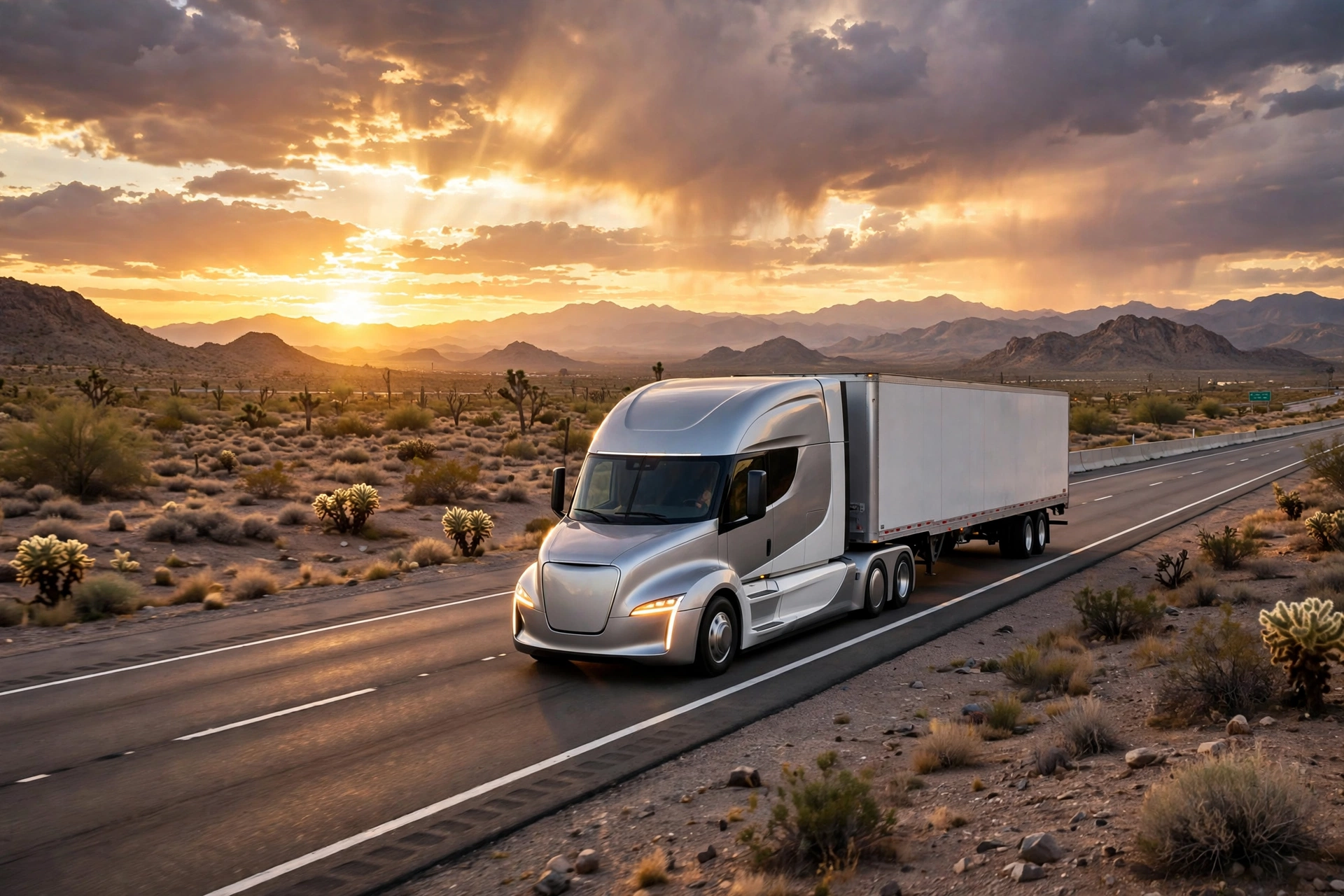

After nine years of delays, the Tesla Semi range story finally has factory-built trucks behind it. In April 2026, Tesla rolled the first volume-production Semi off a dedicated line in Sparks, Nevada — and with a sticker price reportedly near $290,000 for the 500-mile truck, the question is no longer whether Tesla can build an electric semi. It’s whether any fleet can actually run one.
This guide pulls together everything verifiable about the Semi in 2026: the official specs, what you’ll actually pay, where production stands, and how it compares to the electric trucks already hauling freight in North America. No hype — just the numbers.
Table of Contents
Tesla Semi Range and Official Specs: What’s Confirmed
Tesla revealed the final production specs in early 2026, and they’re notably more specific than anything the company said during the nine-year gestation. Two trims are confirmed:
- Long Range: ~500 miles of range, 822 kWh battery pack, ~23,000 lb curb weight
- Standard Range: ~325 miles of range, 548 kWh battery pack, under 20,000 lb curb weight
Both trims run on Tesla’s 4680 battery cells (NMCA chemistry, shared with the Cybertruck), three independent motors on the rear axles putting out up to 800 kW (about 1,073 horsepower), and a gross combination weight rating of 82,000 pounds — the same federal limit as diesel trucks. Tesla rates energy consumption at 1.7 kWh per mile, a figure third-party fleet tests have landed remarkably close to: DHL recorded 1.72 kWh/mi over 388 loaded miles in October 2024, and NFI logged 1.64 kWh/mi earlier that year.
What this means in plain terms: the 500-mile truck carries the energy equivalent of a small house battery farm between its frame rails, yet Tesla expects it to weigh about the same as a comparable diesel tractor. That’s the engineering achievement worth respecting, even if you’re skeptical about everything else.
How Much Does the Tesla Semi Cost in 2026?
The pricing story is a long one. At the 2017 unveiling, Tesla promised $150,000 for a 300-mile truck and $180,000 for the 500-mile version. Those numbers are museum pieces now.
Current 2026 reporting puts the Standard Range at roughly $260,000 and the Long Range at $290,000 — under $300,000, but about twice the price of a new diesel tractor. That still reportedly makes it roughly $100,000 cheaper than rival battery-electric Class 8 tractors, which is a meaningful advantage if it holds.
Here’s the honest caveat: Tesla has not published an official, itemized price sheet the way a truck OEM would. Quoted prices come from reporting and fleet disclosures, and they can shift with configuration. Compare that to diesel, where you can get a firm build quote from any dealer in an afternoon. Price opacity is one of the Semi’s real weaknesses right now — fleets budgeting 2026–2027 equipment cycles need firmer numbers than “roughly.”
The math Tesla is betting on: operating costs claimed at 20% below diesel nationally, and up to 50% lower in California where fuel prices and subsidies tilt the field. California fleet incentives have reportedly driven over 1,000 Semi orders alone. Whether those savings materialize for any given fleet depends on electricity rates, utilization, and how much of the truck’s promised uptime holds up at scale — which brings us to the factory.
Production Status: Is the Semi Actually on the Road?
Yes — finally, in growing numbers. The timeline went like this: unveiling in 2017, a handful of pilot-line trucks delivered to PepsiCo in December 2022, three more years of design refinement (Tesla says it cut roughly 1,000 lbs from the truck and improved aerodynamics by 7%), and then the milestone that matters: the first volume-production Semi rolled off the new dedicated line at Gigafactory Nevada on April 29, 2026. Tesla officially opened the ~1.7-million-square-foot facility in September 2026 and targets 50,000 trucks a year at full capacity.
Analysts are far more cautious about the near term, projecting somewhere between 5,000 and 15,000 deliveries in 2026 as the line ramps. That skepticism is earned: Tesla has missed every Semi timeline it ever set.
The pilot program wasn’t nothing, though. Before volume production, the prototype fleet logged more than 13.5 million miles with 95% fleet uptime, and the hardest-working truck passed 440,000 miles. Real freight companies — PepsiCo, Walmart, Costco, Sysco, Martin Brower, and US Foods — have all run Semis in live testing. DHL’s documented 388-mile loaded run is one of the strongest independent data points the electric trucking world has. So the trucks work. The open question is whether Tesla can build them in quantity and support them like a truck maker.
For fleet planners, that last part matters as much as the truck. Diesel fleets depend on dealer networks, parts depots, and overnight service coverage across the continent. Tesla has promised high uptime and says most breakdowns in the pilot program were resolved within 24 hours, but a handful of service centers is not a national support network. Yet.
The Megacharger Problem: Charging a 822 kWh Truck
A 500-mile truck needs 500 miles worth of electrons, and that’s the Semi’s hardest engineering problem. The answer is the Megacharger: up to 1.2 megawatts of charging power using the MCS (Megawatt Charging System) standard, recovering about 60% of range in roughly 30 minutes — timed, not coincidentally, around a driver’s mandatory rest break.
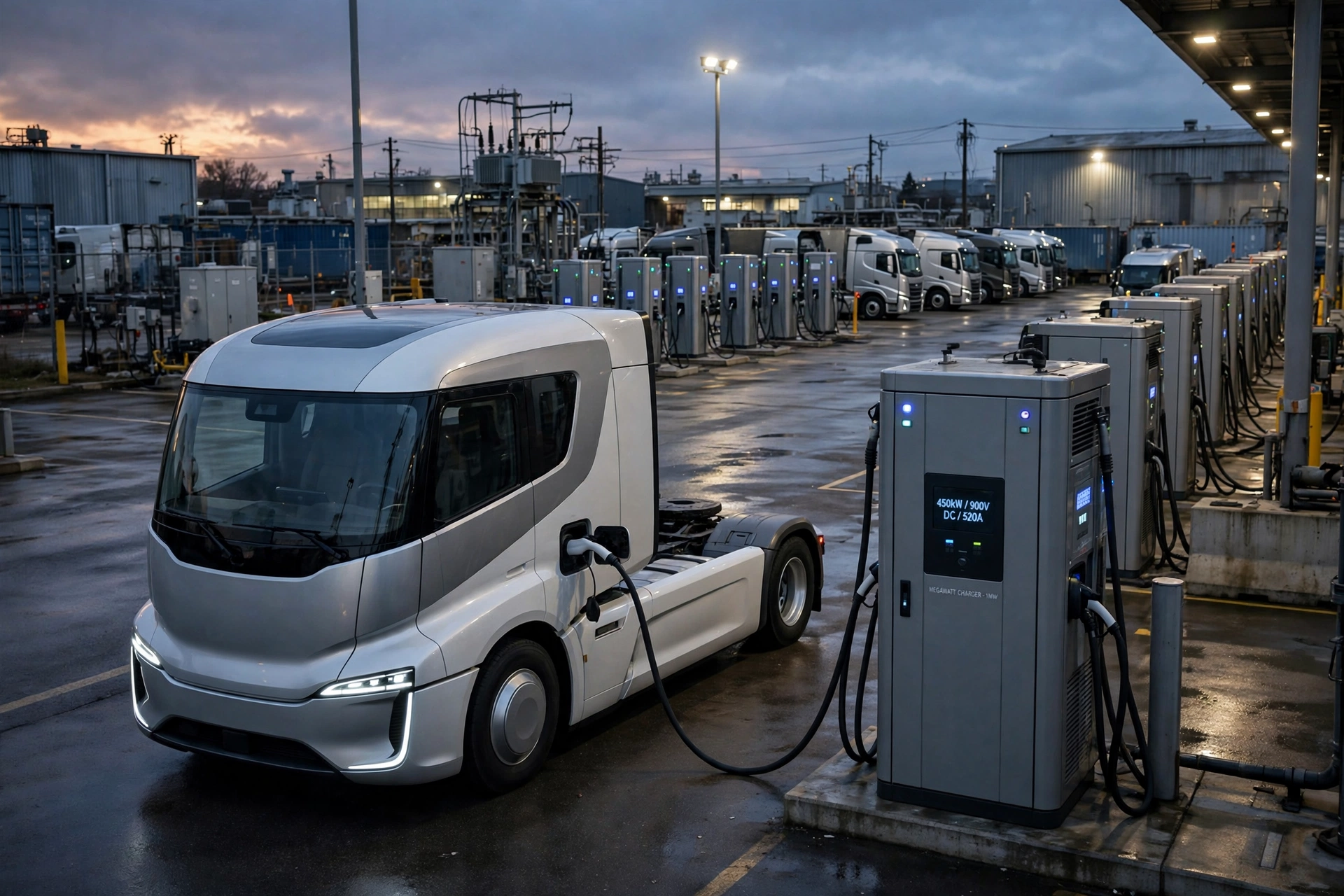
The network, though, is the weak link. Tesla announced plans for a public 46-station Megacharger network in 2025, has mapped 66 locations across 15 states, and opened its first station in Ontario, California. A corridor map with gaps is not a network. For now, most Semi operators will rely on private depot charging — which works for return-to-base routes but does nothing for the long-haul corridors where 500 miles of range would theoretically shine.
This is the paradox at the heart of the Semi’s 2026 value proposition: the truck that finally proves electric long-haul range is possible can’t yet do actual long haul, because the charging infrastructure to support it doesn’t exist. Fleets considering the Semi should plan routes around depot charging first and treat public Megachargers as a future bonus. If you want to sanity-check what weather and speed do to heavy-truck range claims, our EV cold weather range calculator gives a feel for how much temperature eats into any EV’s rated range — trucks included.
Tesla Semi vs the Competition: Freightliner eCascadia and Volvo VNR Electric
The Semi isn’t competing in a vacuum. Two serious Class 8 battery-electric tractors are already hauling real freight:
Freightliner eCascadia
Daimler’s Class 8 tractor offers three battery configurations with typical ranges of roughly 155, 220, or 230 miles, up to 730 peak horsepower, and an 82,000-lb GCWR. It charges from 0–80% in about 90 minutes on DC fast charging. Less range than the Semi, but Freightliner’s eCascadia has logged over 6 million real-world miles across more than 55 fleets — and it comes with something Tesla can’t match: Daimler Truck’s established dealer and service network across North America.
Volvo VNR Electric
Volvo’s Class 8 entry delivers up to 230 miles of range, an 80% charge in roughly 60 minutes, and has surpassed 10 million miles of zero-tailpipe customer operations since order books opened in 2020. Labatt Breweries recently ordered 10 units for daily beverage distribution routes in Canada. Like Freightliner, Volvo pairs modest range with a mature commercial support organization.
The pattern is clear: the established players chose shorter range, faster-to-market trucks built for regional and return-to-base routes, backed by service networks. Tesla chose to lead on Tesla Semi range and build the megawatt charging standard to feed it. Both bets are defensible. Only one of them requires you to bet on Tesla building truck-stop-grade electrical infrastructure nationwide.
The Honest Verdict: Who Should Buy a Tesla Semi in 2026?
After looking at the specs, the prices, the factory ramp, and the charging reality, here’s where the Semi actually fits right now:
The Semi makes sense today for: large regional and day-cab fleet operations with predictable routes under ~300–400 miles a day, private depot charging, and operations in states with strong incentives (California chief among them). Beverage distributors, grocery chains, port drayage, and hub-to-hub linehaul on fixed corridors are the sweet spot — exactly the fleets already testing it. At ~1.7 kWh/mi and 95% pilot uptime, the truck itself has earned a serious look on the operating-cost spreadsheet.
The Semi is not yet for: small carriers without depot-charging capital, owner-operators, irregular-route long haul, or anyone who needs a firm quote and a service truck within 50 miles tonight. The public Megacharger network is years from being a true network, and 50,000 trucks a year of capacity is a target, not a delivery record.
If you’re a fleet manager comparing electric truck economics against diesel, remember that the same range-versus-cost math applies to smaller commercial EVs too — our look at electric vans for businesses and delivery in the USA covers the segment where the payback math is already settled. And if you’re evaluating any EV’s range claims against real-world conditions, the real-world EV range estimator is worth a bookmark.
Bottom line: the 2026 Tesla Semi is the most range any electric truck has ever offered, at the lowest price any electric Class 8 has reportedly been offered for, from a company with no track record of building trucks at scale or servicing them afterward. Nine years late, it’s finally a real truck. It’s just not yet a mainstream one.
Frequently Asked Questions
What is the Tesla Semi’s range?
The 2026 production Tesla Semi comes in two trims: Long Range at ~500 miles and Standard Range at ~325 miles, both rated at the full 82,000-lb gross combination weight. For more on how the Semi fits into the broader history of Tesla’s truck program, see the Tesla Semi article on Wikipedia.
How much does a Tesla Semi cost?
2026 reporting puts the Standard Range at roughly $260,000 and the 500-mile Long Range at roughly $290,000 — about twice a new diesel tractor. Tesla hasn’t published a formal price sheet, so treat these as reported rather than official figures.
When did Tesla Semi production start?
Volume production began April 29, 2026, at a dedicated factory in Sparks, Nevada, with a target capacity of 50,000 trucks per year. Pilot deliveries to PepsiCo began back in December 2022.
How long does it take to charge a Tesla Semi?
On a 1.2-MW Megacharger, Tesla says the Semi recovers about 60% of its range in roughly 30 minutes. Public Megacharger stations remain limited, so most operators currently rely on depot charging.
Is the Tesla Semi better than the Freightliner eCascadia or Volvo VNR Electric?
It offers far more range (500 vs ~230 miles) and reportedly a lower price, but Freightliner and Volvo bring millions of fleet miles and established nationwide service networks — something Tesla is still building.
