Last updated: October 27, 2026
Every truck maker quotes range the same way: empty bed, mild day, test cycle written by optimists. Ignore all of it. The hummer ev range story only makes sense once you split it into three numbers — the window-sticker number, the 75-mph number, and the number with a trailer dragging behind the truck. The first one sells trucks. The third one decides whether you eat dinner at the campsite or at a charger.
Here is the shape of the problem. The Hummer EV is the thirstiest electric truck on sale. Edmunds measured the pickup using 57.8 kWh per 100 miles on its test loop, and the SUV at 62.6 kWh per 100 miles. A normal electric car uses about half that. GMC answers the thirst the only way it can: with the biggest battery in the business, 205 kWh usable in the 24-module pickup. So hummer ev range is never an efficiency story. It is a fuel-tank story.
I grade trucks by what they do with a hitch ball in the receiver, so that is how this guide runs. First the official ratings for every 2026 variant, pickup and SUV. Then what independent testers actually measured. Then the towing maths, done properly, with charge stops counted. Winter, mud tires and the off-road package get their own section, because each one quietly steals miles the brochure never mentions. Prices are the October 27, 2026 figures, destination included, and I checked the towing test results the same week.
One ground rule before the numbers. Figures GMC and the EPA publish are labelled as such. Figures nobody has published get “(est.)” and the basis for the estimate, right there in the sentence. Tested figures are named with the tester. A towing specialist who hides his assumptions is just another brochure.
The official hummer ev range ratings for 2026, pickup and SUV
Two batteries, two bodies, and one important asymmetry: the big 24-module pack is pickup-only. The SUV makes do with the 20-module pack in every trim. Here is the full board, from GMC’s Hummer EV pages and the EPA data mirrored in the 2026 Fuel Economy Guide at fueleconomy.gov.
| Variant | Battery (usable) | Official range | Price (incl. $2,695 destination) |
|---|---|---|---|
| Pickup 2X | 20-module, ~170 kWh (est.) | 318 miles, EPA-est. | $99,895 |
| Pickup 3X | 20-module, ~170 kWh (est.) | 312 miles, EPA-est. | $107,995 |
| Pickup 3X, 24-module | 24-module, 205 kWh | 363 miles, GM-est. | $117,990 |
| SUV 2X | 20-module, ~170 kWh (est.) | 315 miles, EPA | $99,895 |
| SUV 3X | 20-module, ~170 kWh (est.) | 312 miles, EPA | $107,995 |
| SUV 2X, mud-terrain tires | 20-module | 282 miles, EPA | Extreme Off-Road Package |
| SUV 3X, mud-terrain tires | 20-module | 289 miles, EPA | Extreme Off-Road Package |
Read the pickup table again, because it contains the line-up’s oddest fact. The standard 3X costs $8,100 more than the 2X and is rated six miles shorter, on the same battery. You are paying for a third motor and launch-control bragging, and the range ledger goes backwards. Efficiency tells the same story: 53 MPGe combined for the 2X, 52 for the 3X. Neither figure is respectable. Both are simply what nine thousand pounds and a barn-door face cost at speed.
Tow ratings matter more to me than any of that, and for 2026 they are genuinely strong: 12,100 pounds for the pickup 2X, 10,600 for the 3X, and 7,500 for the SUV. Tick the Extreme Off-Road Package on the pickup and the rating drops to 7,500 pounds — the trail hardware eats the tow number, a trade GMC does not exactly shout about. Our GMC electric truck buyer’s guide covers the rest of the hardware; this page is about how far the thing goes.
What testers measured: hummer ev range at real highway speed
Three published tests frame the honest numbers. InsideEVs ran the original big-battery pickup at a steady 70 mph in warm weather and got 343 miles, averaging 1.6 miles per kWh. Car and Driver ran its 75-mph highway test on the same class of truck and got 290 miles. Edmunds put the SUV 3X with the Extreme Off-Road Package through its slower mixed loop and recorded 325 miles — better than that variant’s 289-mile EPA rating, because a gentle loop flatters a truck that speed punishes.
Do the division on the Car and Driver result, because it hands you the only planning figure worth memorising. 290 miles ÷ 205 kWh = 1.41 miles per kWh at 75 mph. Apply that efficiency to the 20-module trucks: 170 kWh × 1.41 ≈ 240 miles (est.). So the honest highway board reads: big-battery pickup, about 290 miles; every 20-module variant, about 240 miles (est.). Not 318. Not 363. Plan fuel stops — sorry, charge stops — on 240 and 290 and you will never be the person pacing a charger at 4 percent.
Notice what the tests also say about speed. Seventy mph returned 343 miles; seventy-five returned 290. Five mph cost 53 miles. Air resistance is doing that, and a truck shaped like a garden shed has nowhere to hide from it. Slow down is the cheapest range option GMC sells, and it is not on the options list.
Hummer ev range with a trailer: the numbers that plan your day
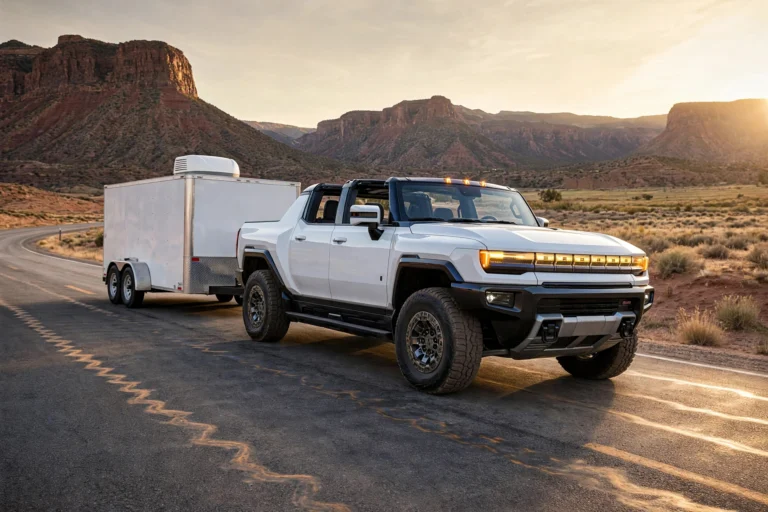
Now the section most range guides are too polite to write. In published towing testing, a Hummer EV pickup pulling a 6,100-pound camping trailer at 70 mph covered about 140 miles on a full charge — Car and Driver’s figure, and roughly half the unladen range. Credit where due: in the same test work, a Rivian R1T managed about 110 miles on the same trailer. The Hummer’s giant battery makes it the least-bad electric tow vehicle tested. Least-bad is still bad.
Work the consumption out and the planning rule falls out on its own. Towing burns 205 kWh ÷ 140 miles ≈ 1.46 kWh per mile. Sensible towing drivers do not run a battery from full to empty; they work the 10–80 percent window, where charging is fast. That window holds 205 × 0.70 = 143.5 kWh, and 143.5 ÷ 1.46 ≈ 98 miles. Call it 100-mile legs. That is your real towing range in a 24-module truck: a hundred miles between chargers, whatever the brochure says.
Now plan a 400-mile towing day, the kind people actually buy this truck for. Leave home at 100 percent: leg one, 140 miles. Remaining: 260 miles. At roughly 98 miles per 10–80 percent leg, that is three charging stops, near miles 140, 238 and 336. MotorTrend measured a 5–80 percent charge at 54 minutes on the SUV’s smaller pack; budget 55–60 minutes a stop (est.) on the big pack, so call it three hours plugged in. Driving time at a 65-mph average is about 6 hours 10 minutes. Total day: roughly 9 hours. The same 400 miles unladen needs one stop of about 50 minutes (est.) and lands near 6 hours door to door. The trailer costs you three hours. Not range anxiety. Range arithmetic.
Not every trailer is a 6,100-pound box, so here is the lighter end of the scale. Published towing guides put a trailer around 4,000 pounds at a 30–40 percent range loss rather than the tested trailer’s 50-plus. In energy terms that is roughly 1.0–1.1 kWh per mile (est., worked back from those published loss figures), which stretches the big pack’s 10–80 percent legs to about 130–137 miles (est.) and its full-charge towing reach to around 190 miles (est.). A low utility trailer or a pair of jet skis is a nuisance. A tall camper is a schedule. The dividing line is the trailer’s frontal area, not its weight — a fact diesel drivers learn from fuel gauges and Hummer drivers learn from state-of-charge readouts.
On a 20-module truck it gets severe. Full-charge towing works out at 170 ÷ 1.46 ≈ 116 miles (est.), and 10–80 percent legs shrink to about 81 miles (est.). Eighty-mile legs across a state with chargers every 60 miles is a puzzle, not a trip. If your trailer crosses state lines, the 24-module pack is not an upgrade. It is the entry ticket. And leave slack in every plan for the charger that is fenced, occupied, or simply not built for a truck with a trailer still attached — unhitching in a car park at midnight is a towing memory nobody wants twice.
Winter, mud tires and Extract Mode: three quiet taxes on hummer ev range
The tire tax is the only one GMC prints. Order the Extreme Off-Road Package’s 35-inch mud-terrains on the SUV and the EPA rating falls from 315 to 282 miles on the 2X, and from 312 to 289 on the 3X. Thirty-three miles, gone, for tread blocks. The same penalty pattern applies on the pickup (est., on the SUV’s published drop of roughly 25–35 miles). Buy the tires for the trail if you need them. Do not buy them for the school run and then write angry forum posts about range.
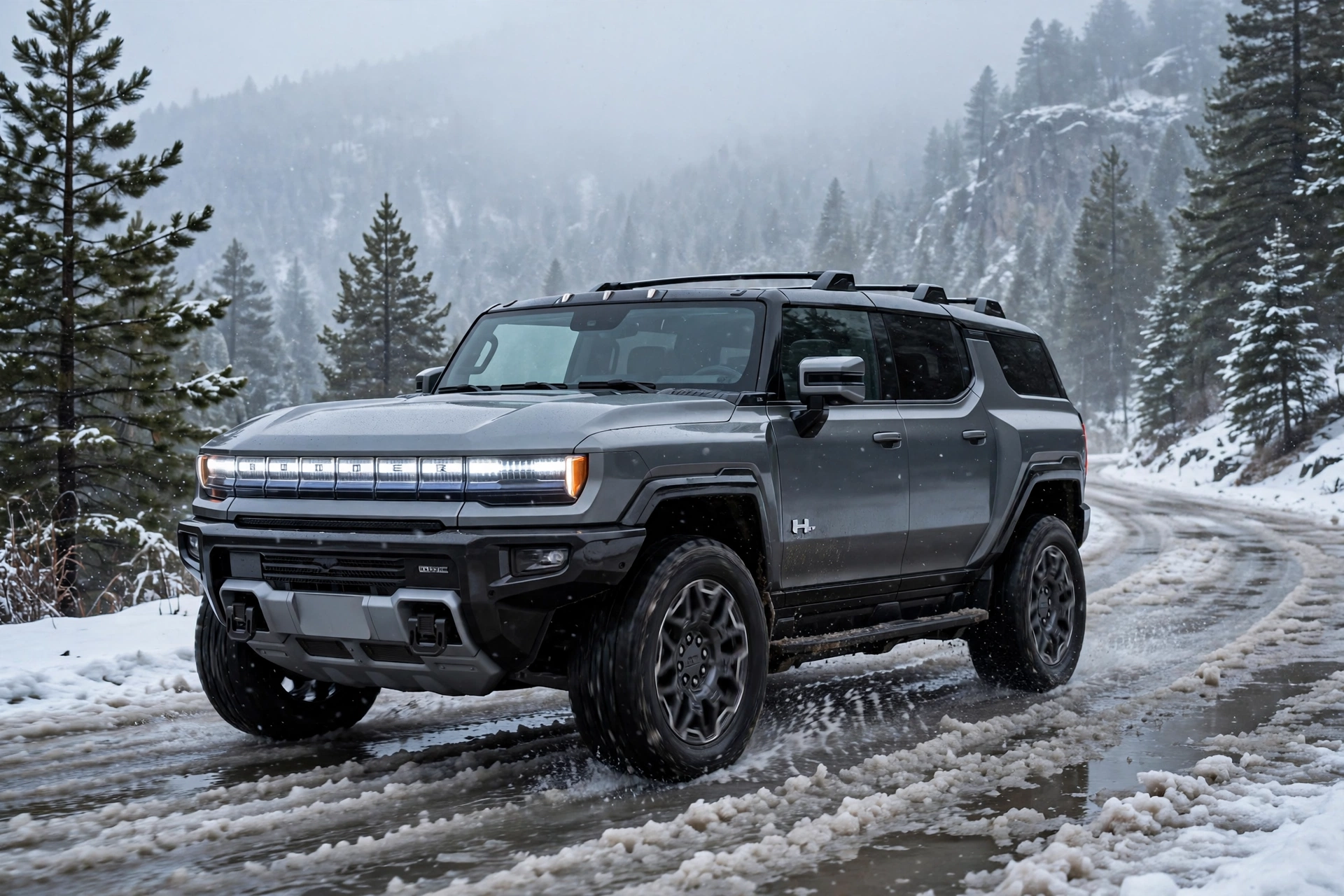
Winter is the tax nobody prints. No one has published a proper instrumented cold-weather test of this truck, so work with the class figure: EVs typically surrender 20–30 percent of range in hard cold, before a trailer enters the picture — the mechanisms are laid out in our guide to electric car winter range loss. Apply 25 percent (est.) to the honest highway numbers and the 20-module trucks are 180-mile vehicles (est.) at 75 mph in January, the big-battery pickup about 218 (est.). Tow in that weather and the 100-mile legs above shrink towards 75 miles (est.). That is a real constraint, and pretending otherwise helps no one.
Extract Mode, the suspension setting that lifts the truck some six inches to roughly 16 inches of clearance, carries no published range figure at all. It is a low-speed get-unstuck tool, not a driving mode, so the honest answer is that its range cost is a trail question, not a trip question: rock-crawling speeds burn energy on heat and tyre flex, not aerodynamics. The cost that matters on a trip is the rubber the trail package bolts on, and that one is on the window sticker, in the table above.
Charging speed: the range feature that decides towing days
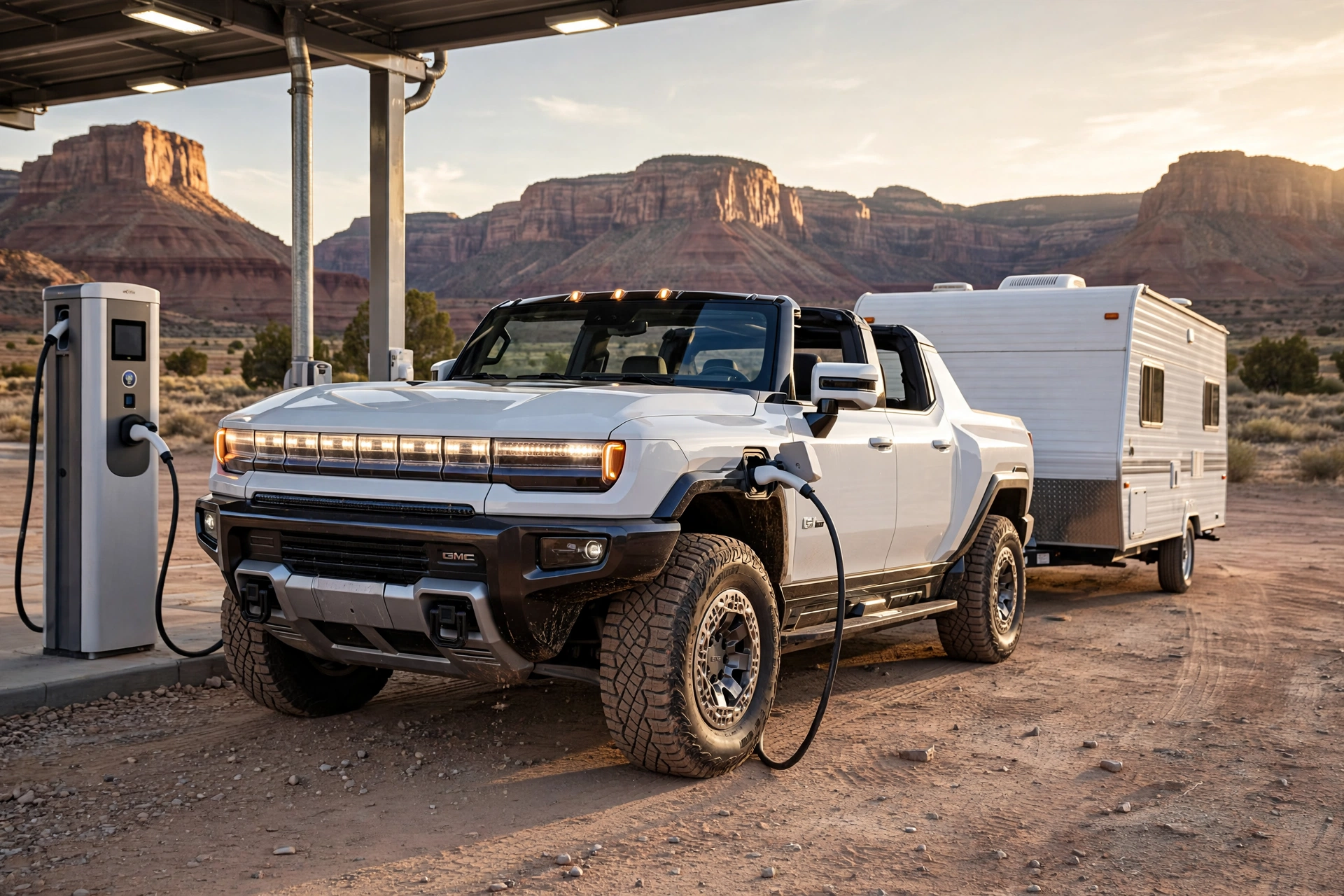
The 800-volt hardware peaks at up to 350 kW, and GMC’s claim of roughly 100 miles added in about 10 minutes holds up when the battery is warm, low, and the charger is honest. Hold the applause there. Car and Driver’s early test truck averaged just 98 kW across a 10–90 percent charge and took over two hours; later trucks charge better, but every Hummer EV curve falls hard past 80 percent, which is exactly why the towing maths in this guide is built on the 10–80 window. Charge to 80. Unplug. Drive. The last fifth of this battery is the most expensive parking in America.
Money, briefly, because it decides where you charge. A home fill of the 205 kWh pack at $0.17 per kWh (a common US residential rate, est.) costs 205 × $0.17 = $34.85, and at Edmunds’ measured 0.578 kWh per mile that is about 10 cents a mile. A full fill at public DC prices around $0.48 per kWh (est.) runs to about $98 (est.), and towing on that power costs 1.46 × $0.48 ≈ $0.70 per mile (est.). Seventy cents a mile is diesel-money territory with longer stops. Hummer ev range, in other words, is won or lost on home power: tow from a full battery you filled overnight for $34.85, and the economics look sane; tow on public DC and they do not. The EV total cost of ownership calculator will run your own rates through the same maths.
Home charging has a timing trap of its own. A true 100 percent fill of the 205 kWh pack takes 205 ÷ 19.2 ≈ 10.7 hours (est.) on the strongest home setup these trucks accept, and 205 ÷ 11.5 ≈ 17.8 hours (est.) on a common 11.5 kW wallbox. Leave at 90 percent because the truck needed two more hours on the plug and your first towing leg just lost about 14 miles (est.). Towing days in this truck are planned backwards from the departure charge, not forwards from the destination.
Hummer ev range verdicts: our scores, trim by trim
One last computation before the scores — price per mile of official range, because it reverses the pecking order. Pickup 2X: $99,895 ÷ 318 = $314 per mile. Standard 3X: $107,995 ÷ 312 = $346 per mile, the worst deal on the board. Big-battery 3X: $117,990 ÷ 363 = $325 per mile — the expensive truck is cheaper per mile than the mid-priced one. If range is what you are buying, buy it where it is sold by the mile at a discount. Shoppers cross-shopping the efficiency-first route should also read our Chevy Silverado EV guide; it goes further on less battery, and says so without blushing.
Pickup 2X — Our score: 7.0/10. Range (real): 7/10 · Towing range: 6/10 · Value: 8/10. The highest tow rating in the line (12,100 pounds) and the lowest price per mile of range. The 170 kWh pack (est.) keeps towing legs near 81 miles (est.), which caps its ambition, not its usefulness.
Pickup 3X (20-module) — Our score: 5.7/10. Range (real): 6/10 · Towing range: 6/10 · Value: 5/10. More money than the 2X, six fewer rated miles, a lower tow rating, the same battery. The middle child nobody should buy. Spend less, or spend properly on the big pack.
Pickup 3X (24-module) — Our score: 8.3/10. Range (real): 9/10 · Towing range: 9/10 · Value: 7/10. The only Hummer that tows like it means it: ~290 honest highway miles, ~140 tested towing miles, ~100-mile working legs. Still not a long-haul tow rig. It is simply the best of an inefficient bunch, by a clear margin.
SUV 2X and 3X — Our score: 6.0/10. Range (real): 7/10 · Towing range: 5/10 · Value: 6/10. Same official numbers as the pickup on paper, no big-battery option, a 7,500-pound tow ceiling, and the thirstiest consumption Edmunds recorded. A fine toy. A compromised tow vehicle. How we score and source every figure on this site is set out on our how we research page.
Frequently asked questions
What hummer ev range should I actually plan on at 75 mph?
About 290 miles in the 24-module pickup and about 240 miles (est.) in any 20-module variant. The basis is Car and Driver’s 75-mph test result of 290 miles, which works out to 1.41 miles per kWh; the 20-module figure applies that same efficiency to the smaller pack. The window stickers say 312–363. Plan on the tested numbers.
How far can a Hummer EV tow a travel trailer between charges?
A tested 6,100-pound camping trailer at 70 mph gave about 140 miles from a full charge in the big-battery pickup. Working the 10–80 percent window, where charging stays fast, that becomes legs of roughly 98 miles — call it 100 and keep a margin. Lighter, lower trailers do better; tall, boxy ones do worse. Aero, not weight, is the main thief at highway speed.
Does the Extreme Off-Road Package hurt range?
Yes, officially. On the SUV, the package’s 35-inch mud-terrain tires cut the EPA rating from 315 to 282 miles (2X) and 312 to 289 miles (3X). It also cuts the pickup’s tow rating to 7,500 pounds. Buy it for trails you actually drive.
How much range does the Hummer EV lose in winter?
Nobody has published an instrumented winter test of this truck, so use the class-typical 20–30 percent (est.) and plan accordingly: roughly 180 honest highway miles (est.) for a 20-module truck at 75 mph in hard cold, and towing legs that shrink towards 75 miles (est.). Preconditioning while plugged in is the one free countermeasure.
Is the 24-module battery worth the money?
If you tow or run long highway days, yes — it is the only version whose towing legs reach 100 miles, and at $325 per mile of rated range it undercuts the standard 3X’s $346. If the truck lives on short local work, the 2X does the same job for $18,095 less. The standard 3X is the one to skip.
How long does a fast charge take on a road trip?
Plan around 10–80 percent. Peak rates touch 350 kW and GMC claims about 100 miles in roughly 10 minutes at the top of the curve; MotorTrend measured 5–80 percent in 54 minutes on the SUV. Past 80 percent the curve falls away sharply, so the fast strategy is shorter stops, more often — which is precisely how the towing legs in this guide were built.