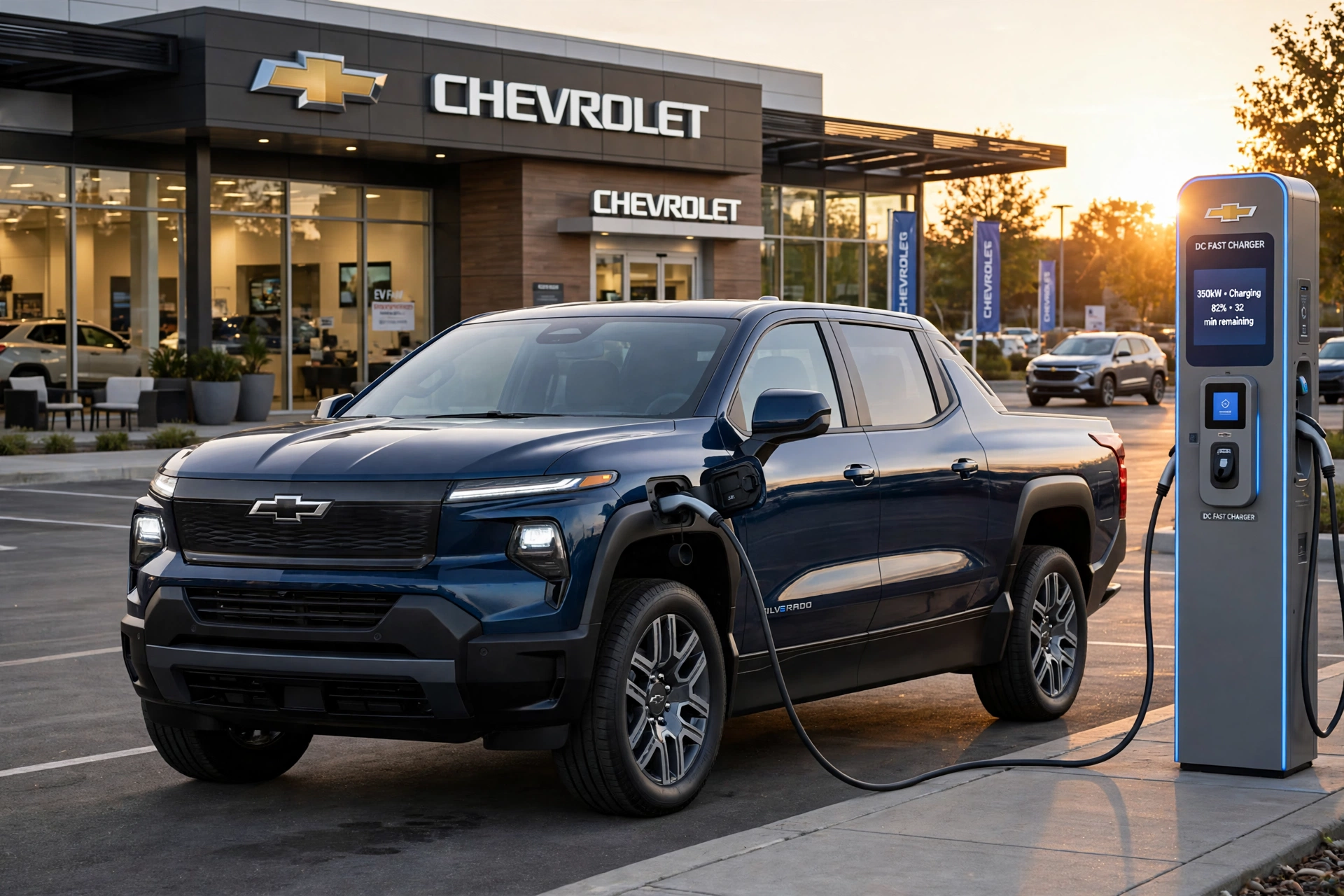

The Chevy Silverado EV has one headline that stops people mid-scroll: up to 493 miles of driving range. That’s not a typo, and it’s not a lab fantasy. It’s the EPA-rated range of the 2026 Silverado EV Work Truck with the Max battery pack — more range than any other electric pickup you can buy in America right now. But range is only the start of the story. This is a full-size truck that tows up to 12,500 pounds, charges at 350 kW, and can hit 60 mph in under 4.5 seconds. Here’s everything that matters about it — the honest numbers, the real-world caveats, and who should actually buy one.
Quick facts: EPA range 283–493 miles depending on trim and battery • 0–60 mph under 4.5 seconds (Wide Open Watts mode) • up to 760 hp / 775 lb-ft • 350 kW DC fast charging (~100 miles in 10 minutes) • max towing 12,500 lbs • max payload 1,800 lbs • battery up to 205 kWh • price from $54,895 (WT) before destination.
Table of Contents
Chevy Silverado EV Range: EPA Numbers vs the Real World
Let’s talk about the number everyone cares about first. The Chevy Silverado EV range ladder has three rungs, because Chevrolet sells it with three different battery packs:
Standard Range — 283 miles (LT) / 286 miles (WT). This is the fleet-friendly option: enough for daily work routes and regional deliveries, priced to keep the monthly payment manageable.
Extended Range — 410 miles (LT, Trail Boss) / 424 miles (WT). This is the sweet spot for most buyers, honestly. It covers a full workday of driving with buffer to spare, and it’s the pack most retail trims are configured with.
Max Range — 478 miles (LT, Trail Boss) / 493 miles (WT). The 205 kWh monster. This is the pack that makes headlines, and the one that genuinely changes how far an electric truck can go between charges.
Now, the honest caveats. EPA range figures are generated under controlled conditions. Real-world range drops with speed, cold weather, and weight — physics doesn’t negotiate. Independent testing and owner reports suggest the Max pack delivers 400+ miles of real highway driving in mild weather, which is still roughly double what the earliest electric trucks could manage. If you want to understand why battery size translates to range the way it does, our guide to EV battery basics walks through capacity, efficiency, and degradation in plain terms.
Battery Options: Three Sizes, Three Very Different Trucks
Picking a battery isn’t just about range — it changes the truck’s personality. The Standard pack keeps weight and price down. The Extended pack adds roughly 125 miles of range for the middle trims. The Max pack’s 205 kWh battery is one of the largest battery packs ever fitted to a production vehicle, and it weighs — well, GM doesn’t publish an official pack weight, but physics tells you a 205 kWh lithium pack is several thousand pounds of it. The upside: range anxiety effectively dies. The downside: that weight eats into payload and efficiency, and the Max pack trucks cost real money.
For most buyers, the Extended pack is the rational pick. The Max pack is for road-trippers, towers, and people who want to charge once and forget about it for days.
2026 Chevy Silverado EV Trims and Pricing
The lineup now runs five deep. With the federal $7,500 EV tax credit gone as of late 2025, these are the full sticker prices — what you see is what you pay (before dealer fees and state incentives, which vary). Our breakdown of buying an EV without tax credits covers how the math works in the new reality.
WT (Work Truck) — from $54,895. The fleet and workhorse trim. 11-inch touchscreen, 8-inch digital gauge cluster, up to 10,000 lbs of towing, AWD standard, available air suspension. Available in all three battery ranges (286 / 424 / 493 miles). If your business needs an electric work truck that can genuinely go all day, start here.
Custom — from $57,990 with destination. The new-for-2026 volume trim aimed at retail buyers who want value. Three battery options, EPA range of 283–493 miles depending on pack.
LT — from $62,995. The mainstream retail trim: 17.7-inch center touchscreen, 11-inch driver display, 300 kW DC charging capability on this configuration, illuminated gold bowtie, Multi-Flex Tailgate, and 12,500 lbs of towing with 1,800 lbs of payload. Range: 283 / 410 / 478 miles.
Trail Boss — from $72,095. The off-roader: 2-inch factory lift, 18-inch wheels wrapped in 35-inch all-terrain tires, red tow hooks, standard four-wheel steering with the Sidewinder diagonal-driving trick, and a Black/Artemis interior with red stitching. Range: 410 / 478 miles. This is the one for buyers who want to leave the pavement.
RST — top of the range. The performance flagship with Wide Open Watts launch mode: up to 760 hp, 775 lb-ft of torque, and 0–60 in under 4.5 seconds in a full-size pickup. It feels absurd, in the best way.
Charging: 350 kW Is Real, and It Matters
Here’s where the Silverado EV pulls away from its rivals. The Max battery trucks charge at up to 350 kW on a DC fast charger — more than double the 150 kW ceiling of the Ford F-150 Lightning. Chevrolet’s claim is up to 100 miles of range added in 10 minutes, which matches what independent tests have roughly borne out on 350 kW hardware.
That said, a 10–80% charge on the Max pack still takes roughly 40–45 minutes, because 205 kWh is simply a lot of electricity. The mid-size batteries are quicker. The practical takeaway: this truck charges fastest on high-power DC stations along interstates, and it’s one of the best long-distance EV trucks on sale because of it. At home, a 240V Level 2 setup (11.5 kW onboard charger) refills overnight — plenty for daily driving. A word on the plug: Chevrolet has adopted the NACS (Tesla-style) port, so Supercharger access is part of the deal.
Towing and Payload: What 12,500 Lbs Really Means
On paper, the Silverado EV out-tows the gas Silverado 1500 in some configurations — 12,500 lbs of max towing (LT with the right pack) and 1,800 lbs of payload put it squarely in work-truck territory. The bed is 5 feet 11 inches, and the clever Multi-Flex Midgate lets long cargo pass through into the cab for over 9 feet of load floor. The front trunk (frunk) adds 10.7 cubic feet of lockable storage — perfect for tools or gear you don’t want in the weather.
The catch, and you should know it before you buy: towing an 8,000-lb trailer cuts any EV truck’s range roughly in half. That’s physics — aerodynamic drag from a trailer is brutal — and it applies to every electric pickup, not just this one. With the Max pack, owners report towing range in the 200-mile neighborhood, which means planning charging stops every couple of hours on long hauls. For regional towing (boats to the lake, equipment across town), it’s a non-issue. For cross-country towing, it’s a plan-around.
Interior, Tech and Super Cruise
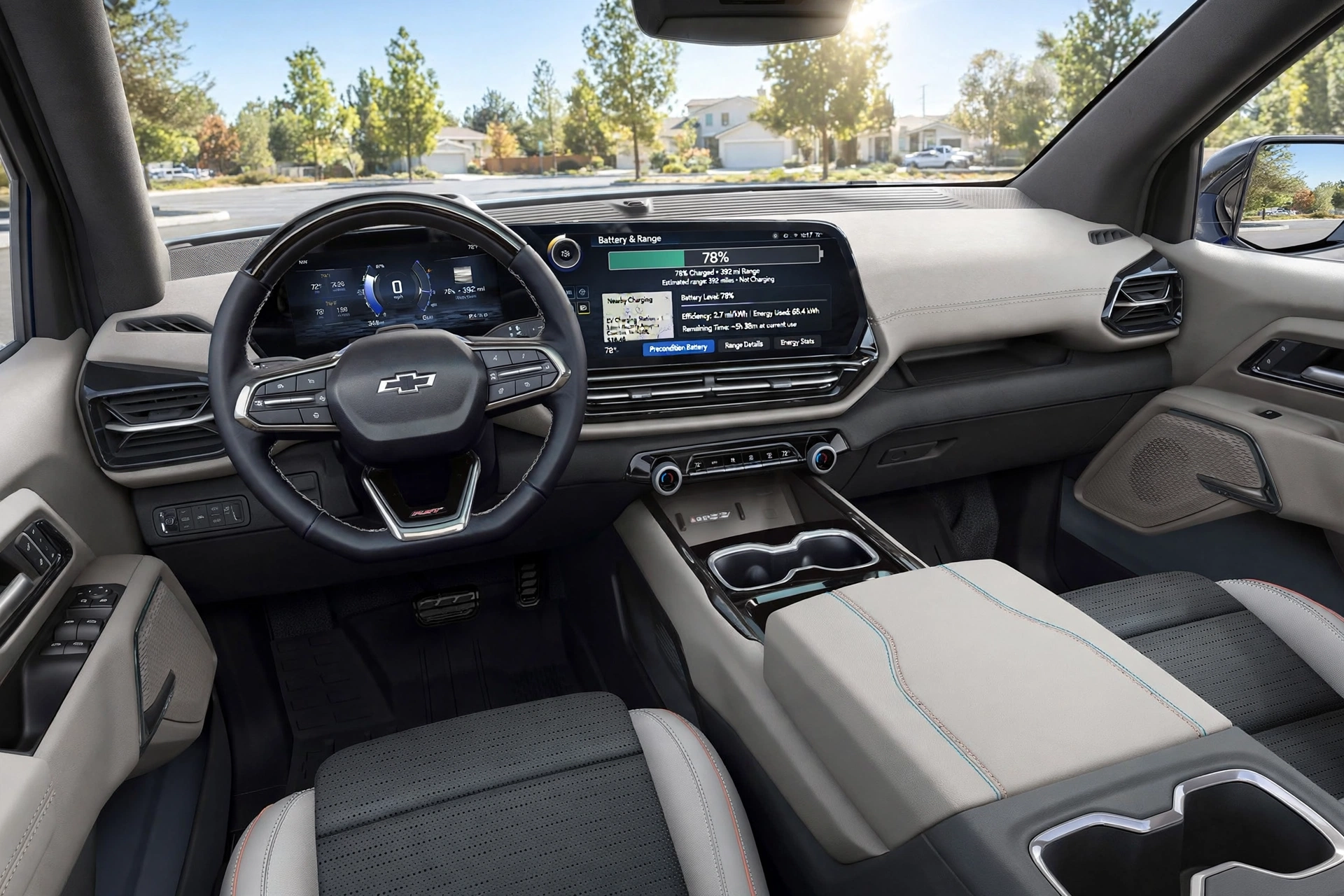
Step inside and the Silverado EV feels like a modern GM product, not a science project. The LT and up get the 17.7-inch center screen paired with an 11-inch driver display — big, crisp, and reasonably intuitive. One-Pedal Driving and Regen on Demand paddles make city driving almost lazy. Apple CarPlay and Android Auto are notably absent (GM’s call — the native system does navigation with charge planning built in).
Super Cruise hands-free driving is available on higher trims and works on compatible highways, including with a trailer attached — trailering support is something GM has invested in heavily. The four-wheel steering on Trail Boss and RST tightens the turning circle noticeably, which matters a lot when you’re parking a full-size truck.
Chevy Silverado EV vs the Ford F-150 Lightning
The honest comparison shoppers actually want: the Lightning is cheaper at the volume trims (the gap is roughly $10,000 at comparable spec), has a bigger frunk (14.1 cu ft), and offers CarPlay. The Silverado EV counters with dramatically more range (493 vs ~320 miles max), more than double the charging speed (350 vs 150 kW), and higher max towing (12,500 vs 10,000 lbs). If your priority is road trips and towing range, the Chevy wins. If your priority is value and daily usability, the Ford is a serious contender. There’s no wrong answer — just different priorities.
Who Should Buy the Chevy Silverado EV (and Who Shouldn’t)
Buy it if: you drive long distances and want the longest-range electric truck on sale; you tow regionally and want 200+ miles of towing range without stopping; you have home charging and want a daily driver that doubles as a work truck; you’re a fleet buyer electrifying work routes.
Think twice if: you mostly want a commuter — this is a big, heavy, expensive truck and a smaller EV will cost you far less per mile (see our cost-per-mile comparison); you tow cross-country regularly and don’t want to plan around charging; you need Apple CarPlay, full stop.
Frequently Asked Questions
How much does the 2026 Chevy Silverado EV cost? From $54,895 (WT) to $72,095 (Trail Boss), plus $2,095 destination, with the RST sitting above. The Custom trim at $57,990 is the new value play for 2026.
What is the real-world range of the Chevy Silverado EV? Expect roughly 85–90% of the EPA figure in normal driving — so a 493-mile WT Max realistically delivers 400+ miles on the highway in mild weather. Cold weather, speed, and towing reduce it further.
How long does it take to charge a Silverado EV? On a 350 kW DC fast charger, the Max pack adds up to 100 miles in about 10 minutes; a 10–80% charge takes roughly 40–45 minutes. At home on a 240V Level 2 charger, it refills overnight.
Can the Silverado EV really tow 12,500 lbs? Yes — that’s the rated max on properly equipped LT trims. But expect towing to roughly halve your range, so plan charging stops accordingly on long trips.
Does the Silverado EV qualify for a federal tax credit in 2026? The $7,500 federal EV tax credit ended in late 2025, so current pricing reflects the full sticker. Check your state for local incentives, which vary widely.
Is the Silverado EV better than the F-150 Lightning? It has more range, faster charging, and higher max towing; the Lightning is cheaper and has a bigger frunk and CarPlay. Choose based on whether range or value matters more to you.
The Honest Verdict
The Chevy Silverado EV is the range king of electric trucks, and that title isn’t close — 493 miles is a genuine breakthrough that changes what an electric pickup can do. It charges faster than any rival, tows properly, and the trim range finally covers both fleets and retail buyers. The downsides are real too: it’s expensive without the federal credit, it’s enormous, and towing range is still the segment’s shared weakness. But if you want one electric truck that can do truck things all day without the charger dictating your schedule, this is the one to beat in 2026. Official efficiency and range data for every EV is published at fueleconomy.gov if you want to compare trims yourself.