Last updated: October 27, 2026
Put the 2026 GMC Hummer EV SUV on a fleet spreadsheet and it looks like a rounding error with a light bar. Nine thousand pounds. A battery the size of a compact car’s fuel budget for a month. A sticker that starts six dollars short of a hundred grand once destination is in. And yet operators keep asking about it, because on paper it does three jobs at once: crew transport, gear hauler, and a rolling advertisement that clients photograph. This guide reads the 2026 GMC Hummer EV SUV the way an operator should — as a working asset with a downtime ledger, a door-label payload, and a charging bill — not as a poster.
What changed for 2026 matters more than the headline numbers. King Crab mode is new: the rear wheels steer at up to twice the front angle, so the truck can swing its tail around on a tight site instead of doing a nine-point turn. CrabWalk, the diagonal-drive party trick from launch, carries over. Bidirectional charging arrives too, which means the SUV can feed a properly equipped building or another EV — a genuine line item for a depot that loses power twice a winter.
Super Cruise gains automated lane changes and a hands-on lane-change assist for unmapped roads. And there is a Carbon Fiber Edition, a limited run with Magnus Gray Matte paint, 22-inch carbon-fiber wheels and the Velocity Ember interior. Prices checked October 27, 2026: the 2X starts at $97,200 before destination, $99,895 with the $2,695 destination charge included; the 3X is $105,300, or $107,995 delivered.
The hardware underneath is one configuration, not a menu. Every 2026 GMC Hummer EV SUV runs the 20-module Ultium pack — roughly 170 kWh usable (est.; GM publishes gross figures, not a clean usable number) — on an 800-volt architecture. There is no 24-module big-battery SUV. That option exists only on the pickup, and it is the single most common spec-sheet error we see repeated about this vehicle, so let us be plain: if a listing promises you a 363-mile SUV, it is describing a truck that does not exist.
The 2X uses two motors for 570 hp, rising to 635 hp with the Extreme Off-Road Package and its Watts to Freedom launch mode. The 3X adds a third motor and makes 830 hp. Not 1,160 hp — that figure belongs to the pickup’s 24-module 3X, and importing it into an SUV buying decision is how budgets get embarrassed. Five seats, two rows, no third row, ever.
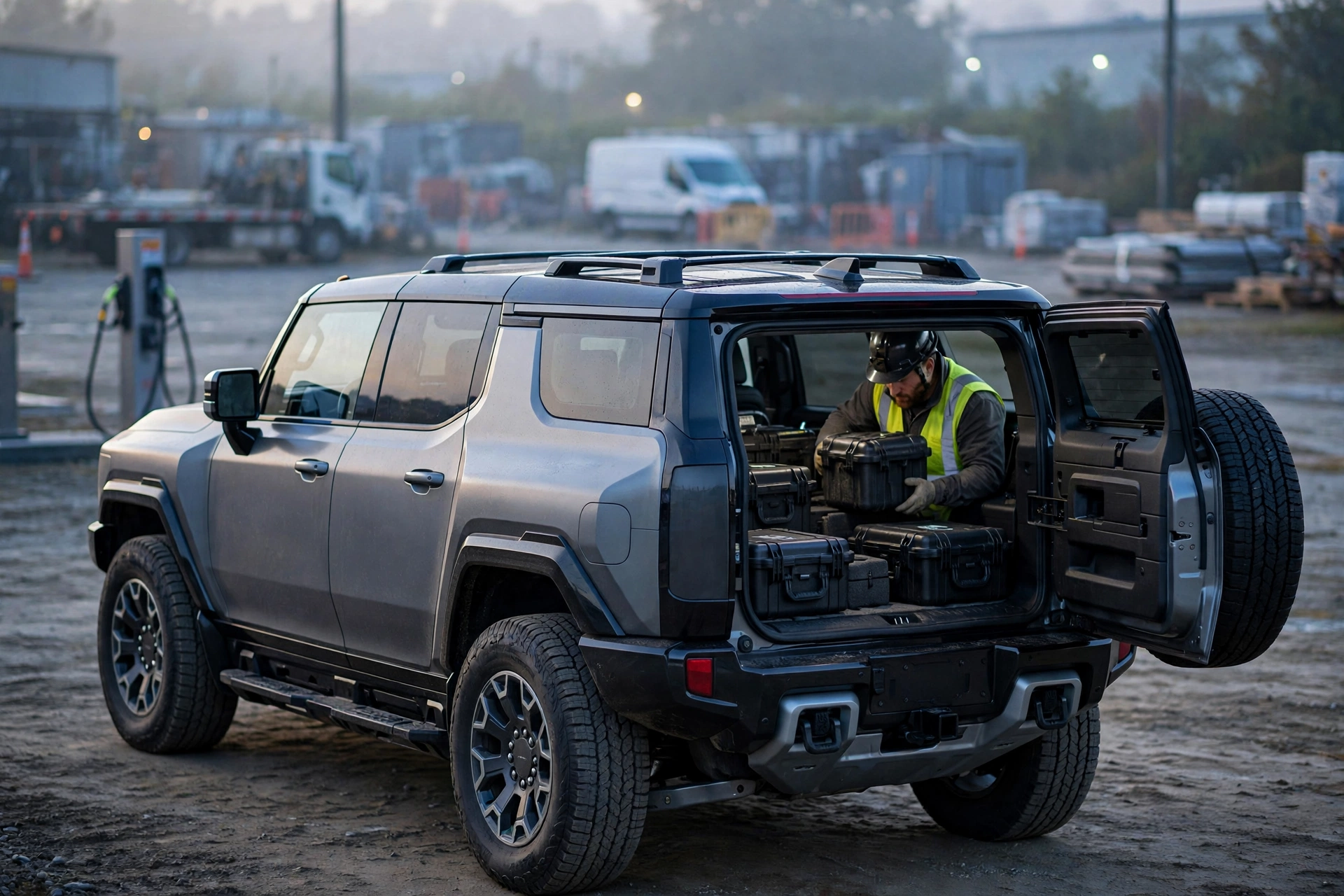
The physical reality sets the operating envelope. The SUV is 86.5 inches wide before mirrors, 206.7 inches long including the rear spare, and it weighs close to 9,000 pounds. Standard parking bays, older depot doors and light-duty lifts all need checking before purchase, not after. The enclosed rear is the SUV’s whole argument: a power-operated, side-hinged tailgate carrying a full-size spare tire, with a drop-down rear glass panel above it. Swing gates are slower than liftgates and the spare eats rear visibility, but the cargo behind it stays dry, locked and insured as contents rather than as an open bed load.
2026 GMC Hummer EV SUV range: the sticker, the test loop and the working day
The EPA rates the 2X at 315 miles and the 3X at 312 miles, on 53 and 52 combined MPGe respectively — figures you can cross-check on fueleconomy.gov, where this SUV sits at the thirsty end of the entire EV table. GMC’s own marketing quotes up to 319 miles for the 2X and 310 for the 3X on its official Hummer EV SUV page; the EPA numbers are the ones to budget against.
Fit the Extreme Off-Road Package with its 35-inch mud-terrains and the EPA figures fall to 282 miles (2X) and 289 miles (3X). That is a 33-mile daily tax on the 2X for tires most operators will use at full aggression six days a year.
Then there is the planning window, because nobody with a schedule runs a pack from 100 to zero. A 2026 GMC Hummer EV SUV that lives between 10 and 80 percent — the band that keeps the battery healthy and the DC sessions short — works with 70 percent of its 170 kWh, about 119 kWh. At the tested 0.626 kWh per mile, that is roughly 190 miles between charging stops on a working day (119 ÷ 0.626 ≈ 190). Budget against 190, not 315, and the vehicle stops surprising you.
Cold weather tightens it further: the class-typical 20–30 percent winter loss (est.) takes that planning figure toward 135–150 miles on the worst mornings, which is why the depot charger is not an accessory for this vehicle but part of the purchase. Extract Mode and the raised air suspension are for obstacles, not cruising — driving tall costs drag, and drag at this frontal area is paid for in kilowatt-hours at a rate no other SUV on sale can match.
Tested consumption is worse than the sticker implies, which is normal for a brick with a nine-thousand-pound habit. Edmunds measured the SUV at 62.6 kWh per 100 miles on its real-world loop — 0.626 kWh for every mile, against the roughly 0.54 kWh per mile the EPA rating suggests. Run a working day on the tested number: a 180-mile round trip to a remote site consumes about 113 kWh, two-thirds of the pack, before you have run a heater, climbed a grade or towed anything.
Winter takes its usual cut on top. Towing takes the biggest cut of all: at highway speed with a boxy trailer, plan on half the rated range, so 150 miles (est.) between charges for the 2X, and schedule the day around it. The Chevy Silverado EV makes an instructive contrast here — a similar brief answered with a bigger battery and efficiency the Hummer never attempts.
Charging: the downtime ledger an operator actually pays
Peak DC rate is the brochure number; session time is the invoice. GMC quotes up to 300 kW DC fast charging for the SUV on its 800-volt system, and independent testing has recorded a 5-to-80 percent session at about 54 minutes. That window — 75 percent of a 170 kWh pack, call it 127.5 kWh — is roughly 204 miles of working range at the tested 0.626 kWh per mile. Fine on a schedule. Expensive as a habit. Here is the arithmetic, with our assumptions stated: 25,000 working miles a year, depot electricity at $0.17 per kWh (est.), public DC at $0.45 per kWh (est.), and a driver’s loaded time at $35 an hour.
Depot case. Energy: 25,000 × 0.626 = 15,650 kWh, × $0.17 = $2,660.50 a year, or 10.6 cents per mile, with charging done overnight and zero paid waiting. DC case. Energy at $0.45: 15,650 × $0.45 = $7,042.50, or 28.2 cents per mile.
Downtime: 25,000 ÷ 204 ≈ 123 sessions, × 0.9 hours = about 111 hours a year of a paid human sitting still, × $35 = $3,885, or 15.5 cents per mile. Total DC-reliant cost: roughly 43.7 cents per working mile against 10.6 cents from the depot — the same truck, the same miles, a fourfold difference in fuel-and-waiting cost. That gap, not the peak kilowatt figure, is the charging story of this vehicle. If your operation cannot depot-charge it overnight on its 19.2 kW AC capability, the business case thins fast.
Our EV total cost of ownership calculator lets you rerun this ledger with your own rates and wages.
The overnight side of the ledger is friendlier. The SUV accepts up to 19.2 kW of AC charging on a 100-amp circuit, so even a fully flattened pack — all 170 kWh — refills in about nine hours (170 ÷ 19.2 ≈ 8.9), and a typical working day’s 113 kWh top-up takes under six. One depot charger per vehicle is enough; one per two vehicles works if the duty cycles alternate.
The 2026 addition of bidirectional capability changes the depot conversation too: with the right GM Energy hardware, the SUV can power a building through an outage or top up another EV on site. A 170 kWh battery is a small generator fleet parked in one bay, and for an operator with a critical-loads problem, that standby value belongs in the purchase justification next to the cargo figures.
Cargo: an enclosed box against an open bed
Behind the second row the SUV gives you 35.9 cubic feet; fold the seats and it is 81.8, plus an 11.3-cubic-foot power frunk up front. The pickup, at the same $99,895 delivered price for a 2X, offers a five-foot bed of roughly 37 cubic feet (est.) plus the same frunk — about 48 cubic feet in total, none of it lockable without a tonneau.
Do the operator’s division: the SUV’s 93.1 enclosed cubic feet (81.8 + 11.3) ÷ 9.99 ten-thousand-dollar units of price ≈ 9.3 cubic feet of secure volume per $10,000. The pickup returns roughly 4.8. For tools, instruments and survey gear that cannot get wet or walk away, the SUV doubles the secure volume per dollar, and that is the strongest argument it has.
The counter-argument is shape, and it is decisive for some trades. A bed swallows long, tall and dirty loads — pipe, ladders, a muddy compressor — that no enclosed box accepts gracefully, and the SUV’s swing gate needs lateral clearance a liftgate does not. Our wider look at GMC’s electric truck lineup covers the pickup’s bed-and-frunk arrangement in detail if your loads lean that way. Judge by the load manifest, not the brochure: sealed and valuable goes in the SUV; long and filthy goes in the truck.
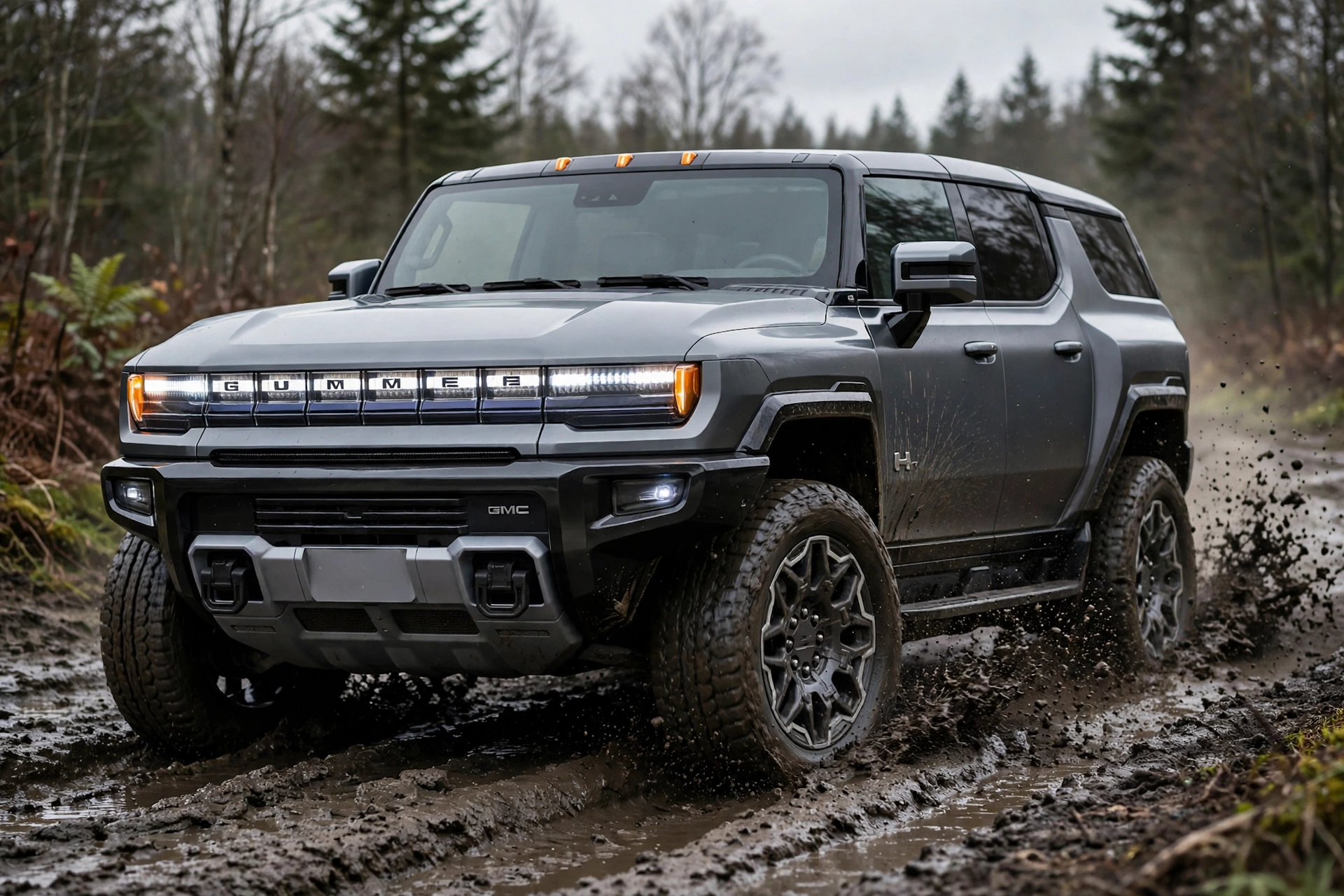
Towing and payload: read the door label, not the headline
For 2026 the two-motor 2X is the tow rating leader of the SUV range at 10,000 pounds — genuinely strong, and stronger than the 3X, which is rated at 7,500 pounds. Tick the Extreme Off-Road Package on a 2X and its rating also drops to 7,500 pounds. Read that again before ordering: the expensive off-road hardware costs you 2,500 pounds of trailer and 33 miles of range in exchange for lockers and armor.
Payload is the quieter trap. It tops out around 1,300 pounds (est.) and falls on heavier builds, so use the specific vehicle’s door-jamb label, never a brochure. Now the tongue-weight arithmetic every operator should run: a 10,000-pound trailer puts 1,000 to 1,500 pounds on the hitch at the standard 10–15 percent. Against a 1,300-pound payload, the trailer alone can consume the entire legal carrying capacity before a driver, a passenger or a single toolbox boards.
The 10,000-pound headline is real; the usable version of it, with crew and kit aboard, is a 6,000–7,000-pound trailer (est.). Size your fleet standard accordingly.
Running a 2026 GMC Hummer EV SUV as a fleet asset: tires, lifts and downtime
The purchase price is the easy part of owning this vehicle commercially; the running gear is where the budget leaks. A 2026 GMC Hummer EV SUV rides on tires that cost real money — the standard 22-inch all-terrains run roughly $400–$500 a corner fitted (est.), and the Extreme Off-Road Package’s 35-inch mud-terrains cost more and wear faster on pavement. At close to 9,000 pounds, expect to budget a set every 30,000–40,000 working miles (est.) and to check that your lift is rated for the weight before the first service, not during it.
Many two-post workshop lifts are rated at 9,000–10,000 pounds; this SUV sits at the top of that class before a single accessory is bolted on, and upfitters should confirm the rating plate rather than assume it.
Warranty cover is standard GM fare: 3 years or 36,000 miles of bumper-to-bumper, 8 years or 100,000 miles on the battery. The operator’s exposure is not the warranty — it is parts lead time on a low-volume vehicle. Body panels, glass and the carbon-fiber trim pieces are not stocked the way Silverado parts are stocked, and a damaged swing gate with its spare carrier is a specialist repair.
None of this disqualifies the vehicle; all of it argues for buying it with a spare-vehicle plan rather than as the single point of failure in a two-vehicle operation. It also argues for the standard finishes over the special edition: a scratched gloss panel is an afternoon at the body shop, while a scratched matte panel with carbon trim is a correspondence.
Verdict: our scores for the 2026 GMC Hummer EV SUV, trim by trim
2X — Our score: 7.4/10. Range: 7/10. Work utility: 8/10. Value: 7/10. The 2X is the only specification we would sign a purchase order for. It has the best range (315 miles EPA), the best tow rating (10,000 pounds), the same battery, the same gate, the same cargo box as the 3X, and it leaves $8,100 in the budget for a depot charger install. Our position is unqualified: for work, buy the 2X and stop shopping the trim ladder.
3X — Our score: 6.6/10. Range: 7/10. Work utility: 6/10. Value: 6/10. The third motor buys a 3.4-second launch and torque vectoring, and it costs you 3 miles of range and 2,500 pounds of tow rating. As a halo vehicle for a principal who wants it, fine. As an asset, it is a downgrade wearing a premium.
Carbon Fiber Edition — Our score: 5.8/10. Range: 6/10. Work utility: 5/10. Value: 4/10. Expect a sticker near $122,000 (est.). Carbon-fiber wheels on a vehicle that will meet curbs, ruts and site debris are a repair bill written in advance, and matte paint cannot be spot-repaired like gloss. It is a collector specification, and it should be bought as one — knowingly.
One more operator note on the off-road package, because it recurs in every fleet conversation about this vehicle: the mud-terrain tax is not a one-time fee. You pay it every day, in range, in tire replacement cost, and in the reduced tow rating — for capability that matters on a handful of days. If your sites genuinely demand lockers and armor weekly, pay it gladly. If they do not, the standard all-terrain setup on air suspension, with Extract Mode’s six extra inches of lift in reserve, covers more ground than most operators honestly face.
Frequently asked questions
How much does the 2026 GMC Hummer EV SUV cost with destination included?
Prices checked October 27, 2026: the 2X is $97,200 MSRP, $99,895 including the $2,695 destination charge. The 3X is $105,300 MSRP, $107,995 delivered. The limited Carbon Fiber Edition sits near $122,000 (est.).
Does the 2026 GMC Hummer EV SUV offer the big 24-module battery?
No. Every SUV uses the 20-module pack, roughly 170 kWh usable (est.). The 24-module pack and its 363-mile rating are pickup-only. Any SUV listing quoting 363 miles is mislabeled.
How many people does it seat, and is there a third row?
Five, in two rows. There is no third-row option at any price. Cargo space is 35.9 cubic feet behind the second row and 81.8 cubic feet with it folded, plus an 11.3-cubic-foot frunk.
Which trim tows the most?
The 2X, at 10,000 pounds. The 3X is rated 7,500 pounds, and a 2X with the Extreme Off-Road Package also drops to 7,500. Check the door-jamb label on any specific vehicle before committing a trailer to it.
How long does a fast charge take on a working day?
About 54 minutes for 5 to 80 percent at a strong DC charger — roughly 204 miles of working range at tested consumption. That is why the depot case in our cost ledger beats the DC case by about 33 cents a mile once driver time is priced in.
For operators weighing a large electric SUV, the 2026 GMC Hummer EV SUV is best judged on depot charging, payload and secure cargo rather than headline range alone. The 2026 GMC Hummer EV SUV rewards a planned charging routine, and the 2026 GMC Hummer EV SUV makes most sense where its enclosed cargo and towing strength are used every week.