Last updated: October 27, 2026
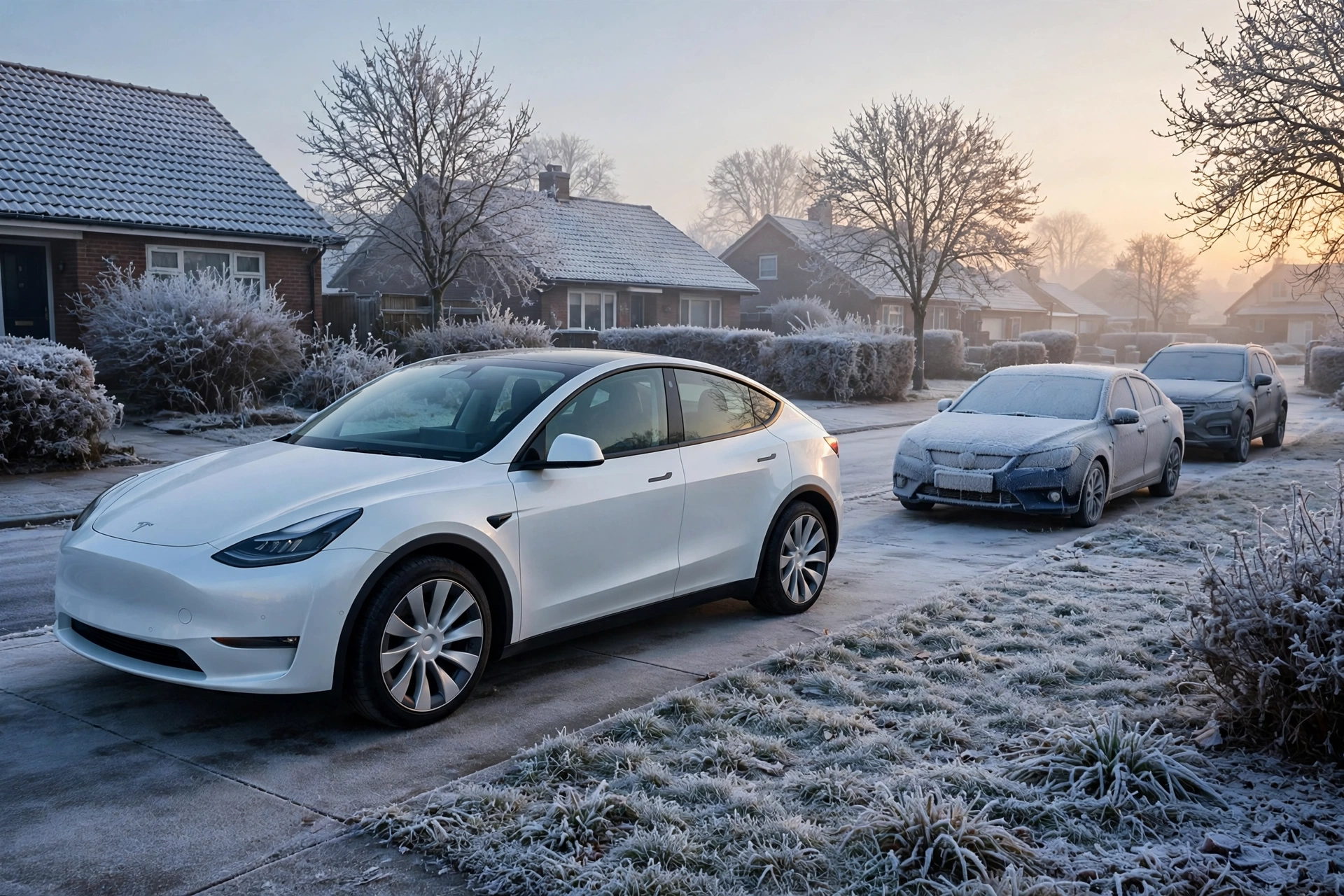
There is a particular pleasure in opening a car door on a January morning and finding that someone has already done the cold work for you. The glass is clear. The seat is not a slab of chilled leather. The steering wheel does not sting. Outside, the neighbours are scraping windscreens in the blue half-light, and your car sits there quietly finished with winter, as though it had a valet. That small, civilised luxury is what tesla scheduled departure exists to arrange, and it costs nothing, because it is not an option, a trim, or a subscription. It is a setting, buried a few taps deep, that most owners set once and then simply live inside.
The idea is simple enough to state in one breath. You do not tell the car when to start. You tell it when you intend to leave, and the car works backwards from that hour — deciding when to begin charging, when to warm the battery, and when to bring the cabin to the temperature you left on the dial the night before. Set it for your weekday mornings and it repeats, week after week, at the place where you set it. Everything else in this article is refinement: what it does well, what it quietly costs, and the handful of mornings when it does not happen at all.
What tesla scheduled departure actually does overnight
Plug in during the evening with a departure time set, and the car does something faintly endearing: it takes a sip. Tesla’s owner’s manual describes the vehicle briefly drawing power when you plug in — you may hear a soft clicking from beneath the floor — purely to measure how fast your home circuit can feed it. From that sip it calculates the latest moment it can begin charging and still be finished by your departure. A charge that could take three hours might not begin until the small hours, and that delay is deliberate, because a battery that finishes early simply cools back down in the driveway and the warmth has to be bought twice.
Closer to the hour, the second act begins. The battery is warmed toward the temperature at which it performs properly, which restores the regenerative braking that a cold pack withholds and removes the little blue snowflake that marks energy as temporarily unavailable. The cabin is heated or cooled to your set temperature. On cars with a heat pump, Tesla notes that heat stored in the battery can then be used to warm the cabin while driving, so the morning’s warmth is spent twice rather than once. None of this is visible drama. It is fans, a faint hum, and glass that clears from the inside out.
Start lines and finish lines: scheduled charging versus a departure
Tesla offers two kinds of schedule, and owners routinely confuse them because both involve a clock. Scheduled Charging answers the question when should charging begin? You name an hour — the start of your cheap electricity, usually — and the car waits for it, then charges to your limit. Tesla scheduled departure answers a different question entirely: when should everything be finished? Charging complete, battery warm, cabin comfortable, at the minute you walk out of the door. One is a start line. The other is a finish line with a warmed seat waiting at it.
Tesla’s own manual is unusually direct about which it prefers. Even where off-peak prices do not exist, the manual recommends charging so that the session ends at your departure time, because a battery charged at seven in the evening and left to sit will be stone cold by seven the next morning. Folded into the departure idea is the older Off-Peak Charging behaviour: the car aims to finish by the end of your off-peak window, which is set to 6 a.m. unless you change it. Two honest caveats ride along. Schedules are ignored at fast chargers, Superchargers included, so a departure set at home does nothing at a roadside stop. And a departure schedule is saved for the location where you created it, a detail that matters more than it first appears, as the failures section below explains.
Setting up tesla scheduled departure in the car and in the app
On current software the path runs Controls > Schedule, and you can also reach it from the Climate screen, the Charging window, or the Tesla app — the app must be version 4.34.5 or newer to show it. Choose the location first: Current Location, for which the car must be parked, or your saved Home or Work. Tap Precondition and give it the time you want the car ready by, plus the days. Tap Charge and set a Start at time, an End by time, or simply the End by that mirrors your departure. Then create the schedule, and — this is the step that quietly undoes people — make sure Repeat Weekly is on, because a schedule without it performs once and then disables itself.
If your car shows the older layout, you will find the same machinery under Controls > Charging > Scheduled Departure, with two switches named Preconditioning and Off-Peak Charging. Tesla renamed and reorganised the feature in recent software; the vocabulary changed, the behaviour did not. For weekday and weekend lives, build two schedules: a 7:20 a.m. weekday departure at Home, and a lazier 9:30 one for Saturday and Sunday. They coexist without argument. What the schedule cannot fix is a circuit too small for the charge you need overnight, and if your panel only allows a modest amperage, our EV charger sizing calculator will tell you honestly what your wiring can deliver before the morning maths disappoints you.
Where tesla scheduled departure meets the 80 per cent rule, and the 100 per cent exception
A schedule changes when the battery fills. It never changes how full, and the limit remains yours to set. For the nickel-based packs in most Long Range and Performance cars, Tesla’s guidance is a daily limit around 80 per cent, with 100 per cent reserved for trips. Here the departure finish shows an elegance that is easy to miss: a car that reaches 80 per cent at 11 p.m. sits at that ceiling for eight hours, while a car scheduled to finish at 7:20 a.m. arrives at the same ceiling minutes before being driven away. Batteries dislike lingering at high charge, so the finish-line schedule is also the gentler pattern, arrived at by accident.
Our position is firm on the mirror-image mistake. A standing schedule that fills a nickel pack to 100 per cent every single night contradicts Tesla’s own daily guidance, and the defence that “the car allows it” is not a defence. Set 100 per cent for the morning of the long drive, as a one-off, and let the weekly routine live at the recommended limit. The exception is the LFP pack in standard-range Model 3 and Model Y cars, where Tesla’s instruction runs the other way entirely: keep the limit at 100 per cent, and complete a full charge at least once a week so the charge gauge stays calibrated — guidance we have seen set out clearly in a careful summary of Tesla’s own charging advice. For an LFP owner, a weekday departure routine performs that weekly full charge without being asked, which is the rare case of a feature and a chemistry agreeing perfectly.
The winter arithmetic: what the warmth actually costs
Comfort is easier to judge when it has a number attached, so here is the arithmetic for tesla scheduled departure on a cold week, with every assumption on the table. Take a hard frost morning, around −7 °C. Preconditioning runs for roughly 35 minutes (est.), and owner measurements of deep-cold warm-ups put the average draw near 6 kW (est.), the motors helping as heaters alongside the heat pump. That is 6 × 35 ÷ 60 = 3.5 kWh drawn from the wall. A mild frost morning near freezing is cheaper: about 15 minutes at roughly 3 kW (est.), which is 0.75 kWh. A five-morning week of three hard frosts and two mild ones comes to 3 × 3.5 + 2 × 0.75 = 12 kWh, and at a home rate of $0.17 per kWh (the EIA residential average class of figure we use across this site) that is $2.04 for the week, or about $24 across a twelve-week winter.
The money is not buying heat from nothing. A cold-soaked battery spends its own stored energy on exactly the same warming during your first miles, with the added indignities of limited regenerative braking and a cabin heated from the pack — the pattern behind the losses in our guide to electric car winter range loss. Spend the 3.5 kWh from the wall instead and roughly 3.5 ÷ 0.30 ≈ 11 to 12 miles (est.) of battery energy stays where it belongs, available for the road, with full one-pedal braking from the first corner. The scheduling itself saves money separately. A typical nightly top-up of 35 kWh costs 35 × $0.17 = $5.95 at a flat rate; finished inside an off-peak window at $0.09 per kWh (est.) it costs $3.15. The saving is $2.80 a night, $14.00 a week, roughly $670 across a 48-week working year (est.) — real money, and the reason the finish time deserves as much care as the departure time. Our breakdown of electric car cost per mile shows how heavily that nightly rate choice weighs on the whole ownership sum.
Unplugged, the same comfort is drawn from the battery instead of the wall. The coldest morning costs about 3.5 kWh (est.) of stored energy — those same 11 miles or so — and there is a floor beneath which the courtesy stops: on current cars, preconditioning while unplugged operates only while the charge level stays above 20 per cent. Arrive home low on a Friday, leave the car unplugged, and Monday’s schedule will pass in silence. The feature is not broken. It is declining, politely, to strand you.

When tesla scheduled departure lets you down
The failures of this feature are almost never mechanical. They are clerical, and they share a theme: the car did precisely what it was told, in a place or on a day the owner had forgotten about. The most common is the disappearing schedule, and Tesla’s manual states the cause without embarrassment. If Repeat Weekly is not toggled on, the car performs the schedule once and then disables it until you re-enable it manually. The first morning is warm. The second morning is the complaint.
The location lock is the second trap. A schedule belongs to the place where it was created — the manual is explicit that a Current Location schedule can only be used when you return to that same approximate spot — so a departure lovingly set at a holiday rental stays at the rental, and your home routine does not travel with you. Owners who work away during the week report this confusion often enough that it deserves plain statement: check which location a schedule belongs to before blaming the car. Third, the 6 a.m. finish: with off-peak charging engaged, the car aims to complete charging by the end of the off-peak window, which can leave an 8 a.m. departure with a battery that finished hours earlier and cooled. Change the off-peak end time to match your real tariff and the problem dissolves. Fourth, and reported rather than documented: an overnight software update occasionally leaves a schedule un-fired the next morning, a pattern that surfaces in owner forums after most large releases and also underlies several entries in our log of Tesla Model Y problems. The remedy is unglamorous — glance at the Schedule screen after an update. Tesla’s own manual, incidentally, is the reference worth keeping: the Model Y owner’s manual sets out the Schedule screens, the location rules and the one-run behaviour in full.
Buying used: the feature is free, the hardware underneath is not equal
Because tesla scheduled departure is software, it is present on every Model 3 and Model Y of the last several years, standard, with no trim, pack or connectivity tier to unlock it. Nothing about it should add a dollar to a used car’s price, and a seller presenting it as a premium extra is decorating the ordinary. What a buyer can usefully check on a viewing is whether it works: open Controls > Schedule, set a precondition ten minutes ahead, and wait by the car. You should hear the fans stir and feel warmth at the vents by the appointed minute. A schedule that can be demonstrated is worth more than a schedule described.
The honest difference between cars lies one layer down, in the heating hardware. Model Y has carried a heat pump from the start, and Model 3 gained one with its 2021 refresh; earlier cars warm themselves with resistive heat and the motors, and spend noticeably more energy doing it (est.). The menus look identical. The winter arithmetic does not. If your mornings are cold and your commute is long, the heat-pump car is the one whose departure schedule you will feel in the electricity bill as well as at the door handle, and that — not the presence of the feature — is the thing worth paying for.
Our verdict
Judged as what it is — a free setting, not a product — tesla scheduled departure is among the most civilised things Tesla ships. It converts the worst minutes of winter motoring into a non-event, it treats the battery more gently than the naive alternative, and on a time-of-use tariff it pays a small weekly dividend for having been set up once, carefully.
Our score: 7.5/10 — Comfort delivered: 9/10. Energy cost honesty: 7/10. Reliability of the schedule: 6/10.
It loses its marks in the clerical margins. The one-run default punishes exactly the new owner least likely to know about it. The location lock is logical and almost nowhere explained at handover. And Tesla’s decision to rename the feature sent a generation of owners hunting through menus for a phrase that no longer exists, which is a small annoyance entirely in keeping with this elegant, slightly careless company.
Frequently asked questions
Can tesla scheduled departure warm the car if it is not plugged in?
Yes, on current cars, provided the battery holds more than 20 per cent charge. The warmth is drawn from the pack rather than the wall, so on the coldest mornings expect to spend roughly 11 miles of range (est.) on the courtesy. Below 20 per cent the car will not precondition at all, and it will not warn you loudly that it has declined.
Why did my schedule work once and then stop?
Almost certainly the Repeat Weekly toggle. Without it, Tesla’s design is to perform the schedule a single time and then disable it until you switch it back on. Open Controls > Schedule, find the greyed-out entry, and turn the repeat on. Your car was not being difficult. It was being literal.
Why did charging finish at 6 a.m. when I do not leave until eight?
Because with off-peak charging enabled, the car aims to finish by the end of the off-peak window, and 6 a.m. is the default end. Set the off-peak end time to the hour your own tariff actually changes, or to your departure time, and the finish will follow your morning instead of the factory’s assumption.
I have an LFP Model 3. Should my routine be different?
Yes, and simpler. Tesla advises LFP owners to keep the charge limit at 100 per cent and to complete a full charge at least once a week, because the chemistry’s flat voltage curve leaves the charge gauge guessing without one. A weekday departure schedule at a 100 per cent limit performs that weekly calibration as a by-product of your ordinary mornings.
Does preconditioning save energy, or merely move it?
Mostly it moves the spending from the battery to the wall, which is precisely the point: the heat is bought at home rates, off-peak where possible, and the battery’s stored energy is reserved for driving, with warmer cells that also waste less in the first miles. Tesla’s manual recommends finishing charging at departure time for this reason, even where no off-peak tariff exists.
My app shows no Schedule screen. Has the feature been removed?
No. The Schedule screens in the app require Tesla app version 4.34.5 or newer, and in the car the feature now lives under Controls > Schedule rather than under its old Scheduled Departure name. Update the app, look under the new heading, and your routines — if they survived — will be listed by location.