Last updated: October 27, 2026
Start the clock. The honest lap time for rivian self driving, as of October 27, 2026, is this: there is no self-driving Rivian. Not one. What exists is a genuinely good hands-free highway system on the newest trucks, a wider hands-free mode that works on painted roads, and a stack of promises with dates attached. Some of those dates have already slipped. Rivian’s own fine print settles it in one line — the features “do not replace a driver’s judgment or the need to pay attention.” Everything below is split into two columns: shipped, and promised. Learn to read Rivian that way and you will never overpay for a headline.
Why the split matters: Rivian sells its best software as a subscription. Pay for the wrong column and you are funding development, not buying capability. The hardware in your truck decides which column you even get access to. Gen 2 or nothing — that is the first timing split, and it is brutal.
1. Shipped: Enhanced Highway Assist did the first real lap
The Gen 2 R1T and R1S (model year 2025 onwards) run the Rivian Autonomy Platform, and its first hands-free feature, Enhanced Highway Assist, shipped in 2025. Status: SHIPPED. It takes steering, braking and speed off your hands on mapped highways — 135,000 miles of them across the US and Canada at launch, per Rivian. Eyes stay on the road. A driver-monitoring camera checks. Wander mentally and the system nags, then quits.
The hardware jump is real. Gen 2 carries a multi-camera suite — Rivian’s current autonomy page lists 10 HDR cameras — plus five radars, with perception out to 1,000 feet and a compute platform rated at 200 trillion operations per second. Radar matters. It sees through rain and low sun in ways cameras alone do not, and Gen 2 put radar back at the centre of the stack. This is the part of rivian self driving that exists today, works today, and is free of subscription games at the Highway Assist level: plain Highway Assist and adaptive cruise are standard-fit, hands-on driver assistance.
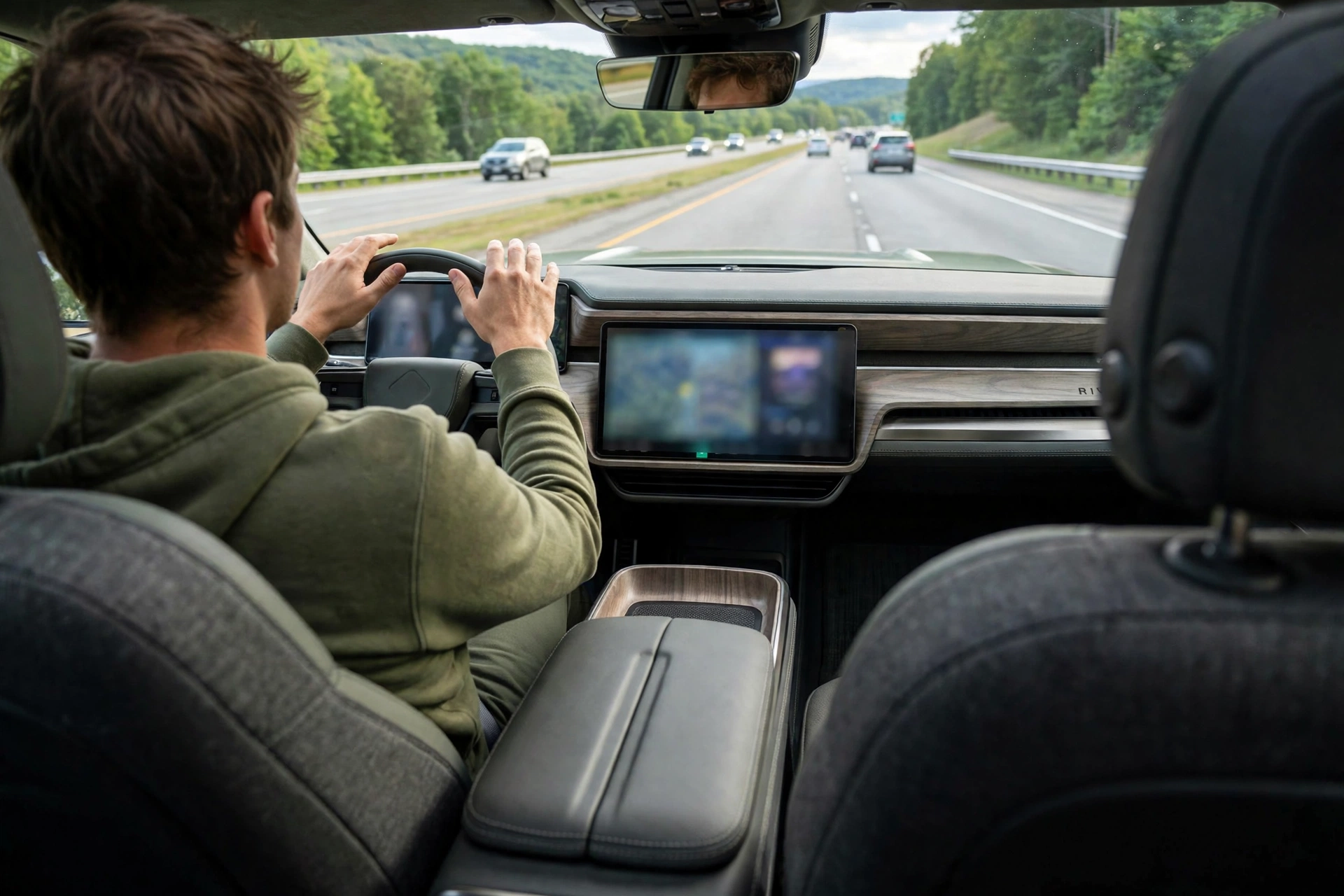
Performance check. Enhanced Highway Assist is smooth, centred, unhurried. It is not fast-thinking. It will not thread a closing gap or bully a merge. Think of it as a metronome, not a racing driver — relentless consistency over a 400-mile interstate day, zero flair. For the job it was timed to do, that is the correct personality.
The supervision rules are strict, and they should be. The cabin camera tracks your gaze. Look away too long and the warnings escalate — visual, then audible, then the system disengages and locks you out for the rest of that drive segment. Drop off the mapped network and rivian self driving hands you back to standard Highway Assist: same cruise and centring, hands back on the wheel. No drama, no negotiation. Respect the handover, because at 70 mph the truck covers 103 feet every second you spend arguing with it.
2. Shipped: Universal Hands-Free blew the map wide open
Early 2026 brought the bigger release. Universal Hands-Free — status: SHIPPED, as part of the paid Autonomy+ tier — deleted the map restriction. If a road has clearly marked lanes, the truck will drive it hands-free. Rivian quotes 3.5 million miles of roads across the US and Canada. Lane Change on Command came with it: flick the indicator, the truck finds the gap and moves. Co-steer lets you nudge around a pothole without cancelling the system. Drive Styles — mild, medium, spicy — set how assertively it accelerates and changes lanes.
Now the limits, because they are hard limits. Universal Hands-Free will not stop for traffic lights. It will not stop for stop signs. Rivian prints that in its own footnotes. It will not navigate a right-angle turn for you. On surface streets with tired paint, engagement can be brief and patchy — independent testing of the R2 found hands-free dropping out where markings faded. It is a lane-following system with enormous reach, not a driving brain with a destination. Call it what it is.
Underneath sits Rivian’s Large Driving Model, the end-to-end AI system the company unveiled at its first Autonomy & AI Day in December 2025. Instead of hand-coded rules for every scenario, the model trains on fleet data the way a language model trains on text, and every owner’s miles feed the next software drop. That architecture is why rivian self driving improves in steps rather than inches: each release is a retrained model, not a patch list. It is also why Point to Point runs on this model when it arrives — the capability is a data problem now, and data problems are solved by fleet size and time, not by press releases.
And note what has not shipped, even on Rivian’s own page. Checked October 27, 2026, Rivian’s autonomy page still lists Auto Parking and On-Ramp to Off-Ramp under the words “Coming 2026.” October is nearly done. Read that label the way you’d read a rival’s qualifying time that never got backed up in the race.
3. Gen 1 owners: your stopwatch stopped in 2024
Own a 2022–2024 R1T or R1S? Read this twice. Your truck runs Driver+ with Highway Assist. Hands on. Always. There is no hands-free mode, no upgrade path, no adapter, no future update that changes it. Rivian officials have said plainly that first-generation trucks lack the hardware capability for Universal Hands-Free. Gen 1 is excluded from Autonomy+’s headline features, excluded from Point to Point, excluded from everything in the promised column.
Frustration has already gone legal. A proposed class action filed in June 2026 in federal court in California alleges Rivian marketed hands-free capability to buyers of 2022–2024 trucks that the hardware could never deliver. Whatever the court decides, the engineering verdict is already in: if hands-free driving is why you are shopping, a Gen 1 truck is the wrong purchase at any discount. That is not a close call. Our wider guide to which EVs to buy and who should buy them makes the same point across brands: buy the hardware generation, not the brochure.
4. The money: rivian self driving costs $49.99 a month, and the maths picks a winner
Prices checked October 27, 2026, on Rivian’s official Autonomy+ page: $49.99 a month, or $2,500 as a one-time purchase. Every new R1 and R2 delivery includes a 60-day free trial. Two groups never pay: R1T Quad-Motor Launch Edition owners got lifetime Autonomy+ included, and R2 buyers who took the Launch Package got it for the vehicle’s lifetime too. Everyone else, run the numbers.
Five-year ownership, subscription route: 60 months × $49.99 = $2,999.40. One-time route: $2,500 flat. Difference: $499.40 saved by paying upfront. Break-even lands at $2,500 ÷ $49.99 ≈ 50 months — own the truck longer than four years and two months and the one-time purchase wins. Shorter than that, subscribe. One more advantage for the lump sum: Rivian confirms a one-time purchase stays with the vehicle when it is sold, so it props up your resale number. The subscription dies with your ownership.
Cross-shop it. Tesla’s Full Self-Driving (Supervised) went subscription-only in February 2026 at $99 a month. Five years of that is 60 × $99 = $5,940 — Rivian’s one-time price undercuts it by $3,440. GM’s Super Cruise asks $39.99 a month (or $399 a year) after a three-year included period. Rivian sits in the middle on monthly price and alone offers a permanent buy-out. Credit where the lap time earns it: this is fair pricing.
5. Coverage maths: 3.5 million miles sounds huge — do the division
Rivian’s favourite number deserves a calculator, not applause. Universal Hands-Free’s 3.5 million quoted road miles divided by Enhanced Highway Assist’s 135,000 mapped miles = roughly 26. A 26× coverage jump in one software generation is a serious engineering result. Against GM: 3,500,000 ÷ 750,000 ≈ 4.7, so Rivian claims about 4.7 times Super Cruise’s mapped network of roughly 750,000 miles.
Then the asterisk, and it is a large one. Super Cruise’s 750,000 miles are pre-mapped, lidar-scanned highways where the system is validated end to end. Rivian’s 3.5 million is any road where the paint is good enough for the cameras to read. Quantity versus verification. Tesla’s FSD plays a different sport entirely: no map gate at all, point-to-point through city streets today, supervised, with 1.74 million active subscriptions on Tesla’s Q3 2026 count. Rivian leads on claimed road miles. Rivian trails, badly, on what the car will actually do on those miles. Both sentences are true, and the second one matters more at purchase time.
6. Promised: Point to Point is a December beta, not a feature
Point to Point — the feature that links Universal Hands-Free to navigation and steers through junctions, interchanges and city streets — is the one Rivian fans are actually waiting for. Status: PROMISED, NOT SHIPPED to regular owners. CEO RJ Scaringe promised in August 2025 that 2026 would bring hands-free point-to-point driving. By June 2026, Rivian’s wording had shifted to a “limited rollout” later in the year with widespread rollout in 2027.
Here is where it actually stands, per Kelley Blue Book’s report on the Early Access launch: invitations opened on October 15, 2026 for an invite-only Early Access Program. The first outside testers get Point to Point in December 2026. Gen 2 R1 and R2 only. Paid Autonomy+ subscription required — trial users don’t qualify. California and Florida first. Testers sign an NDA, share camera and location data, file monthly surveys, and can be dropped without notice. Everyone else waits for the broad 2027 rollout. And when it lands, it is still supervised: hands off, eyes on. Rivian calls it “Level 2++.” Never Level 3. Not yet.
7. Promised: eyes-off driving needs hardware your truck does not have
The eyes-off chapter is the one to score hardest, because it decides whether today’s purchase ages well. Rivian’s roadmap runs: Point to Point, then eyes-off, then personal Level 4. The dates have already moved once. Scaringe confirmed in mid-2026 that eyes-off slipped to 2027. The hardware tells the same story: eyes-off is tied to Rivian’s next compute generation — its own RAP1 chip, a custom 5-nanometre processor rated at 1,600 trillion operations per second, plus lidar — arriving on the R2 line from late 2026 for validation, with customer cars following in 2027. Your Gen 2’s 200-trillion-operations platform is eight times down on that compute figure and has no lidar at all. No software update closes a sensor gap.
Level 4 — the car drives, you are a passenger — is a claim dated 2028 at the earliest, backed partly by a reported $1.25 billion deal to license the technology to Uber. Treat every word after “2028” in a Rivian autonomy pitch as marketing until a regulator signs something. GM, for scale, has publicly targeted eyes-off driving for 2028 in the Cadillac Escalade IQ. Nobody sells a Level 3 car in the US today. Rivian’s honesty about the sequence is better than most; the timeline discipline is not. For how we check claims like these before publishing, see how we research our guides.
The R2 sharpens the point. The smaller SUV runs the same Gen 2 autonomy stack and the same Autonomy+ pricing, and its Launch Package bundles the subscription for the vehicle’s life. Yet the R2 is also where the next hardware lands first — lidar-equipped versions enter validation late in 2026. So the R2 range will split in two: today’s cars, capped at supervised driving forever, and later cars built for eyes-off. Same badge, same showroom, different ceiling. If autonomy is your reason for buying, the build date on the door sticker matters as much as the trim.
How to test rivian self driving inside your 60-day trial
Do not judge this system on a dealer’s demo loop. Judge it on your clock, on your roads. The trial runs 60 days from delivery, which is enough for a proper test protocol. Week one: run your commute with Universal Hands-Free and count the disengagements — every dropout is a data point, and more than two per trip on your roads means the feature is not built for your life.
Week two: a 200-mile highway run, and time your fatigue honestly at the end of it against a hands-on baseline. Week three: your worst-lit, worst-painted local roads at night, where camera-based systems earn or lose their money. Week four: decide with the log, not the launch video. Rivian gives you the trial because the honest answer varies by owner. Use it like a stopwatch, not a honeymoon.
The verdict on rivian self driving
Time to score it. Today’s system is a top-tier highway companion with the widest hands-free footprint in the business and a pricing structure fairer than Tesla’s. The promised system is a year behind its own first headline and gated behind hardware that current trucks do not carry. Buy the shipped column. Rent the promised one month to month, if at all.
Our score: 6.5/10
Current capability: 7.5/10 — Enhanced Highway Assist and Universal Hands-Free are shipped, broad and genuinely relaxing on long runs; the refusal to read traffic lights caps the score.
Honesty of marketing: 6/10 — the footnotes tell the truth, the launch headlines ran ahead of the rollout, and Gen 1 marketing is now a courtroom question.
Value of the subscription: 7/10 — $2,500 once, transferable, undercuts Tesla’s five-year cost by $3,440; the free standard Highway Assist keeps non-subscribers functional.
One-sided, to close: if a salesperson pitches you a Rivian on Point to Point today, walk. The feature is a December beta for invited testers in two states. And if you are choosing between a discounted Gen 1 and a Gen 2 at the same money, take the Gen 2 every single time — autonomy hardware is the one part of an EV you cannot retrofit. Ownership maths across the whole vehicle, not just the software, is in our EV total cost of ownership guide.
FAQ
Is rivian self driving the same as Tesla Full Self-Driving?
No. Tesla FSD (Supervised) drives point-to-point through city streets today, handling turns, lights and junctions under supervision. Rivian’s shipped system follows lanes hands-free on highways and painted roads but will not stop for lights or navigate turns. Rivian’s equivalent, Point to Point, reaches invited testers in December 2026 and general owners in 2027.
Can a Gen 1 R1T or R1S get hands-free driving later?
No. Rivian has stated the first-generation hardware cannot support Universal Hands-Free, and Gen 1 trucks are excluded from Autonomy+’s advanced features and from the Point to Point program. Gen 1 keeps its hands-on Highway Assist permanently.
How much does Autonomy+ cost, and is the one-time price worth it?
$49.99 a month or $2,500 once, checked October 27, 2026, with a 60-day trial on new deliveries. Over five years the subscription totals $2,999.40, so the one-time price saves $499.40 and stays with the vehicle at resale. Break-even is about 50 months.
Does Universal Hands-Free stop at red lights?
No. Rivian’s own documentation states it will not stop or slow down for traffic lights or stop signs. You are the braking system in town. It controls steering and following distance on roads with clearly marked lanes.
When will Rivian offer eyes-off, Level 3 driving?
Rivian targets 2027, on next-generation hardware: its RAP1 chip plus lidar, starting with the R2. That date has already slipped once from earlier 2026 framing, and no Level 3 system is on sale in the US today. Count it when it ships, not before.
Is rivian self driving worth paying for if I mostly drive in the city?
Probably not yet. The shipped strengths are highway and clear-lane road driving; city value depends on Point to Point, which is a 2027 general release. Run the 60-day trial, measure your own roads, then decide — the trial is the honest test.
In short, rivian self driving is best judged on shipped hands-free driving, not promises. If rivian self driving fits your highway and well-marked roads, the 60-day trial is the honest test. Before you buy, weigh rivian self driving against your own routes, not the launch headlines. That is why rivian self driving deserves a real-world test, and why rivian self driving should be bought for what it does today.