Last updated: October 27, 2026
An off road electric bike earns its place in a family garage in very specific moments. The farm track to a cousin’s smallholding, muddy at the gate. The forest fire road where the picnic spot sits two miles past the car park. The sandy approach to a beach that no pushchair has ever survived. If your weekends look like that, you are shopping in the right category — and if they do not, this guide may talk you out of the money.
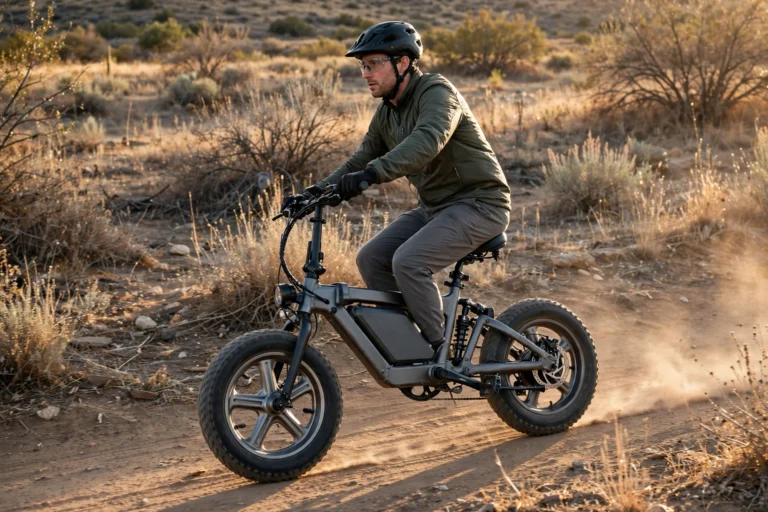
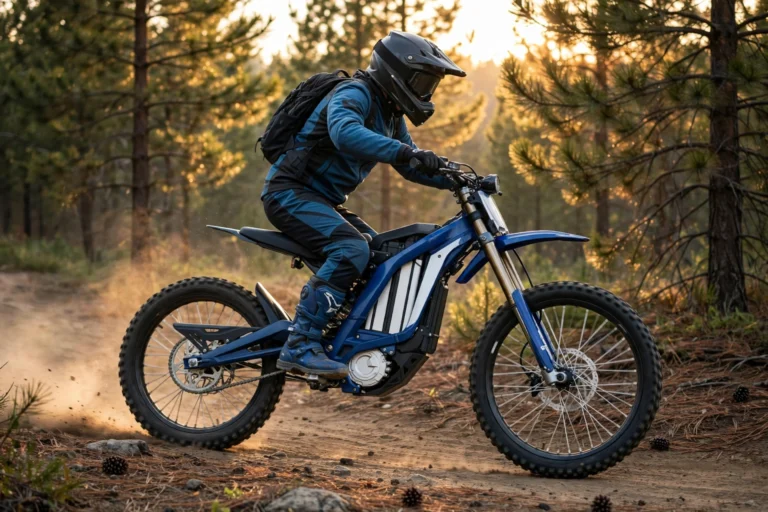
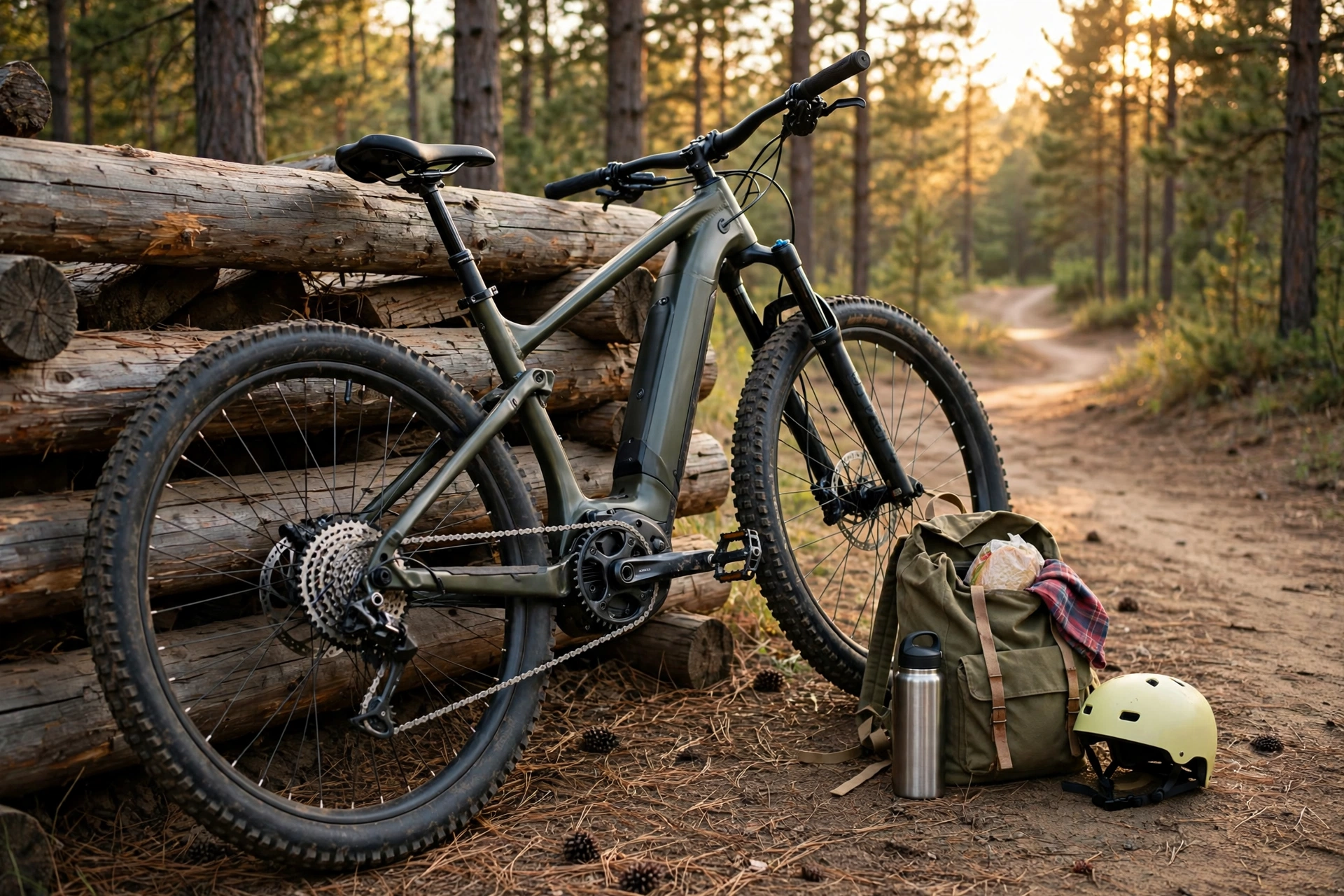
Here is the first thing to understand. “Off-road” covers two completely different machines that happen to share shelf space. One is the fat-tyre all-rounder: wide 4-inch tyres, a hub motor, a throttle, a big rack, built to carry a parent, a child seat and a bag of shopping across gravel, grass, sand and packed snow. The other is a proper electric mountain bike: a mid-drive motor, real trail geometry, a dropper post, built for singletrack. Families buy the first one and dream about the second. Sometimes they buy the second and then discover it cannot carry anything.
I write about bikes the way I load a car boot: what fits, what it weighs, and whether it replaces a trip you would otherwise drive. That is the lens for everything below. Prices were checked on October 27, 2026, against manufacturer stores and dealer listings, and every range figure is shown twice where I can manage it — the claim on the box, and what independent testers or simple battery maths say you will actually get.
One promise before the picks: no pretending a 76-pound fat-tyre bike is a trail weapon, or a 54-pound mountain bike a school-run tool. Each gets judged on family duty.
What counts as an off road electric bike for family duty?
Strip the marketing away and family off-road duty asks for five things. Tyres wide enough or knobbly enough to grip loose surfaces without washing out under a load. A motor with the torque to restart on a muddy slope with a trailer behind you — look for 80 Nm or more on hub motors, and treat anything under 60 Nm as a fair-weather bike. Hydraulic disc brakes, because a loaded bike plus trailer can weigh 400 lb rolling downhill and cable brakes fade. A frame and rack with honest weight ratings printed in the manual, not implied in the photos. And a removable battery, because these bikes live in sheds.
Weight matters more than most listings admit. The fat-tyre picks below weigh 69 to 80 lb. That is fine on a gravel road. It is not fine on a car roof rack (most top out at 60 lb per bike, and lifting 76 lb over your head is a slipped-disc story), and it is not fine up apartment stairs. A hitch rack with a ramp, or ground-level storage, is part of the real purchase price. Our research method page explains how we weigh claims like these.
Fat tyres or a proper e-MTB? An off road electric bike decision that changes everything downstream
Let me take a side early, because this is the decision the whole purchase hangs on: if your children are under ten and your dirt is farm tracks, towpaths, forest roads and beaches, buy the fat-tyre bike. It is not close. The fat bike has a throttle for restarting on loose climbs without wobbling a child seat, a rack rated for real cargo, a step-through option for shorter parents, and tyres that forgive bad lines. The mountain bike has none of those things, because it is designed to be ridden alone, fast, on trails where cargo would be dangerous.
The proper e-MTB wins exactly one family contest: the household where a parent rides real singletrack on Saturday and the “family ride” is a gentle fire road the same bike can soft-pedal on Sunday. Mid-drive motors put the weight low and central, the gearing multiplies torque on climbs, and the bike handles like a bicycle rather than a small motorcycle. Our guide to dirt e-bikes and where they fit goes deeper on that side of the family. What an e-MTB will not do is tow well, carry a child seat safely (most trail frames have no rack mounts at all), or forgive a rider who stops pedalling on a hill.
There is also a middle path: the hardtail trekking bike with 2.4–2.6-inch tyres, a rear rack and a mid-drive motor — the format European families tour on, covered in our electric trekking guide.
Where can an off road electric bike legally go?
This section decides purchases, so read it before the glossy picks. In the United States, the Forest Service classifies every e-bike — Class 1, 2 or 3 — as a motor vehicle. On national forest land, that means e-bikes are allowed on motorized trails and roads, full stop; a trail open to ordinary mountain bikes is not automatically open to you. The Forest Service’s own e-bike page sets this out plainly, and adds that local forests can open specific non-motorized trails to e-bikes only after a designation process with environmental analysis and public involvement.
Designations happen trail system by trail system — Tahoe National Forest opened 35 miles to Class 1 bikes that way — but a proposal is not a designation. Until the Motor Vehicle Use Map says so, it is not law.
Bureau of Land Management and National Park Service land, both under the Interior Department, is friendlier: e-bikes are generally treated like bicycles where bicycles are allowed, with local managers able to restrict specific trails, and Class 3 often limited to roads in parks. Wilderness areas ban all e-bikes under every agency. State parks are a patchwork: many allow Class 1 on trails, some allow all classes, some allow none, and the rule can differ between two parks in the same state. Private land, farm tracks and most rail-trails follow the landowner’s or trail authority’s posted rule.
The practical family translation: your fat-tyre Class 2 bike is welcome on forest roads, gravel county roads, permitted beaches and private land. It is not welcome on most singletrack, though switching it to Class 1 in the settings (several picks below can) widens your options where Class 1 is designated. Buy for the land within an hour’s drive. A bike bought for trails it cannot legally enter is a very expensive gravel-road bicycle.
Comfort on an off road electric bike: tyres, pressure and suspension
Comfort on dirt is mostly tyre pressure, and the maths is friendlier than people expect. Ground pressure under a tyre roughly equals the air pressure inside it, and the size of the contact patch is simply the load divided by that pressure. Take a family fat bike: a 180 lb parent on a 76 lb Aventon Aventure 3 gives 256 lb all-in. At 10 psi, the contact patch totals 256 ÷ 10 = 25.6 square inches spread across both tyres — a broad, soft footprint that floats over sand and gravel instead of cutting into it.
Now the mountain bike: 180 lb of rider on a 54 lb Ramblas ADV is 234 lb, but its narrower tyres run about 28 psi, so the patch is 234 ÷ 28 = 8.4 square inches. One third of the footprint, roughly three times the pressure on the ground. That is why the fat bike feels calm on a beach track and why the trail bike feels precise on a rooty climb. Neither is better. They are answering different questions.
For a child in a trailer or seat, run fat tyres at the low end of their printed range on dirt — often 8–12 psi (est., from the sidewall ranges on the picks below) — and check pressure weekly; a tyre sagged to 5 psi will fold on a corner.
Suspension helps the rider more than the passenger. A suspension fork (80–100mm on every fat pick here) and a suspension seatpost take the sting out of washboard gravel for the adult; the child behind gets their comfort from the trailer’s own space and a low, wide tow. Full suspension, like the Velotric Nomad 2X offers at the rear, is genuinely kinder on rough farm tracks — just know you are paying about $400 extra for it.
Carrying children and kit: trailers yes, singletrack child seats no
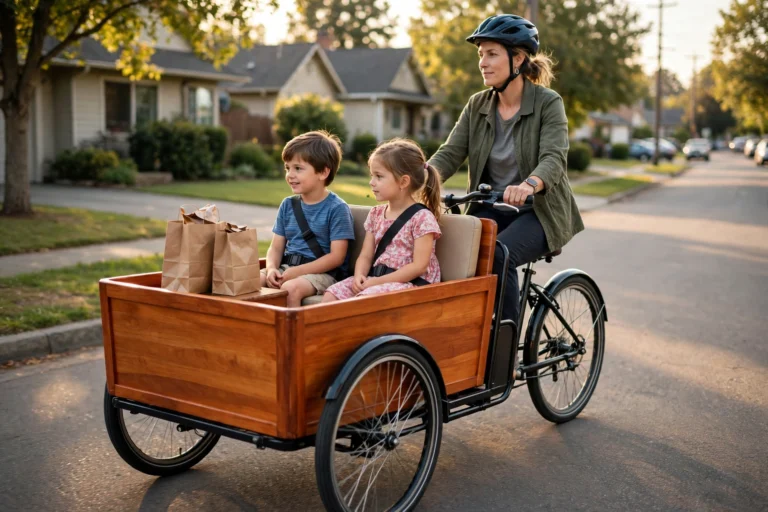
Second firm opinion of this guide: a child seat does not belong on singletrack. Not on a hardtail, not on a full-suspension bike, not at walking pace. Singletrack demands sudden weight shifts, the seat raises your centre of gravity exactly when the trail tilts, and no child-seat maker rates their product for it. On wide gravel roads and forest tracks, a seat on a rated rear rack is a different matter — that is squarely inside what racks like the Aventure 3’s (rated to 59 lb) and the Nomad 2’s (66 lb) are built for, and it is how thousands of families ride.
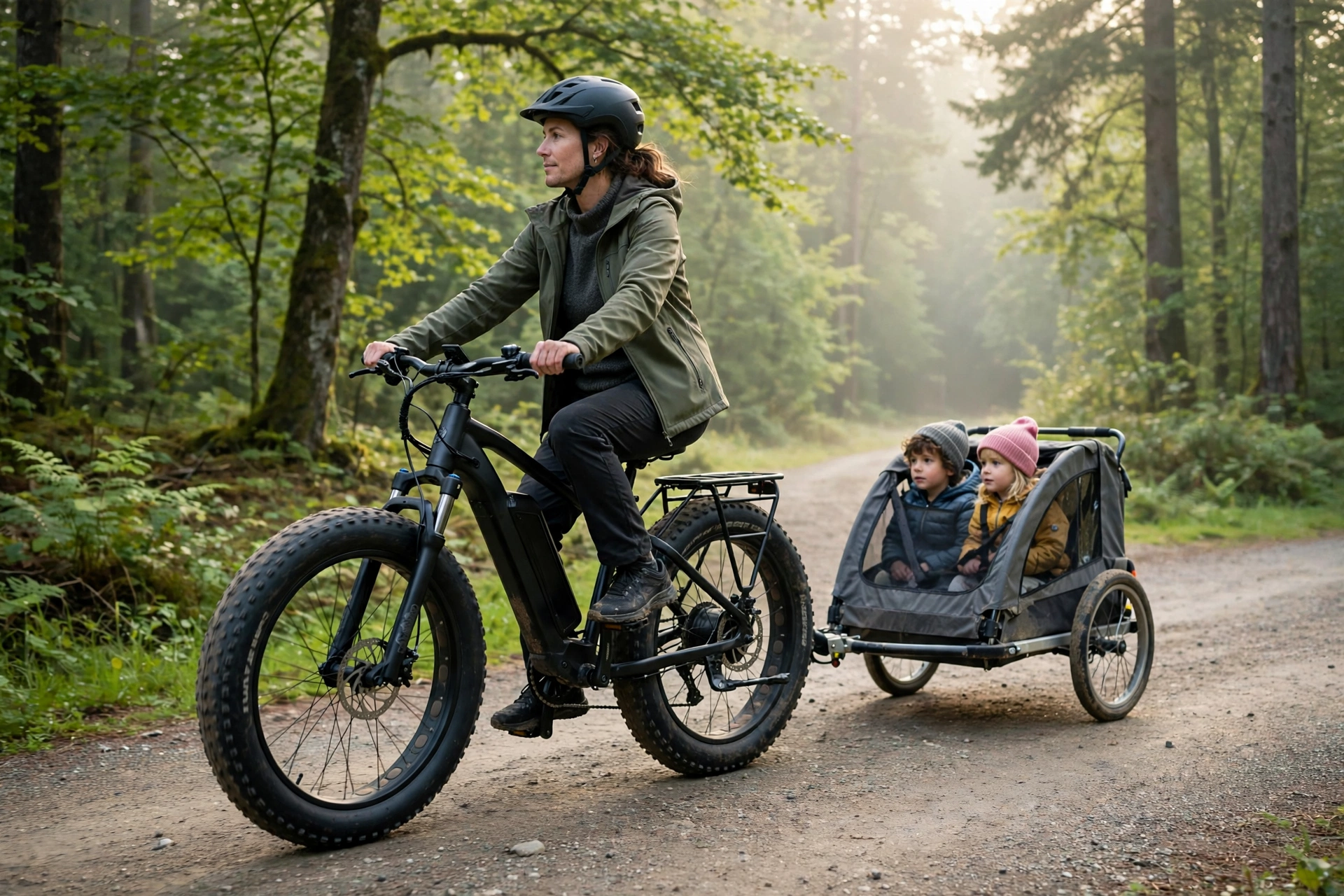
The trailer is the better tool for rough ground, and the numbers show why. A Burley Bee double trailer carries two children up to a 100 lb total capacity, weighs about 20 lb, costs $399.95 at list (checked October 27, 2026), and OutdoorGearLab scored it 80/100 with a perfect 10 for the towing bike’s experience in their testing.
The trailer’s low centre of gravity keeps the outfit stable when a fat tyre slips on wet grass, and it swallows the picnic, the coats and the inevitable bag of collected stones. Check the manual before hitching: most fat-tyre frames accept an axle hitch happily, thru-axle bikes may need an adapter, and a trailer plus two children can add 130 lb behind you — which is why the hydraulic brakes and 80 Nm-plus torque above are not decoration.
Kit carrying splits by surface. On gravel and fire roads, panniers on a rated rack are perfect. On anything narrow or technical, weight on the bike becomes a handling problem and weight behind you becomes a braking problem, so the honest family answer for singletrack day is: the children ride their own bikes or walk. Save the loaded hauling for the wide tracks, where an off road electric bike genuinely replaces the car.
Range: the claim, the test, and the trailer tax
Range claims on dirt bikes are measured the way all e-bike claims are measured: a light rider, low assist, flat ground, no wind, no trailer. Plan on roughly half to two-thirds of the headline number for loaded family riding, and less again on sand or in cold weather. The Lectric XPeak 2.0 claims up to 60 miles from its 720Wh battery; OutdoorGearLab’s instrumented testing recorded 24.6 miles in their range protocol — the hardest-use end of the scale, but the honest anchor for a parent planning a day out with a trailer.
The Aventon Aventure 3 claims up to 65 miles from 733Wh, and independent testing reported by Electric Bike Review ran it to 62 miles in Eco on gentler going, which tells you Aventon’s claim is one of the straighter ones in this class.
The Velotric Nomad 2 claims 65 miles of pedal assist and — credit where due — publishes a separate 45-mile throttle figure, which is the number to plan towing days around.
The Ramblas ADV claims up to 90 miles from its 708Wh battery, but Aventon’s own fine print prices that at a 165 lb rider on flat pavement in Eco. On real trail with a 180–200 lb rider, expect something like 708 ÷ 18 ≈ 39 miles (est.; basis: 15–20 Wh per mile is the consumption band testers typically record for mid-drive trail riding at mixed assist, and loaded family riding sits at the thirsty end of it). Towing a trailer on gravel, use the bottom of every estimate. If you plan to charge other things from the bike, our charger compatibility checker covers the home-charging side of the garage.
The picks: four off road electric bike options for family duty
Lectric XPeak 2.0 — the value pick. $1,499 in standard form and $1,699 with the long-range 960Wh battery (Lectric’s store, checked October 27, 2026). You get a 750W hub motor (1,310W peak, 85 Nm), a torque sensor, an RST Renegade fork with 80mm of travel, a 203mm front brake rotor, and a frame tested to e-MTB safety standards — a spec sheet that embarrasses bikes at twice the price. It can be configured as Class 1, 2 or 3, which matters for the access rules above.
The compromises are weight (about 69 lb (est.), varying by configuration) and that sobering tested range. As a family gravel-and-fire-road machine that can also behave itself where Class 1 is designated, nothing undercuts it. Lectric’s own XPeak 2.0 page lists the current configurations.
Our score: 7.6/10 — Trail ability: 7/10 · Family load: 6/10 · Value: 9/10
Aventon Aventure 3 — the comfort pick. $1,999 at list, with a $1,799 promotion showing in September 2026 (checked October 27, 2026). A 750W hub motor with 80 Nm of torque, a 733Wh battery, 26×4-inch tyres, an 80mm fork plus a suspension seatpost, built-in GPS security, and a 400 lb total weight limit with that 59 lb rack. The torque sensor makes it pedal like a bicycle, not surge like a scooter — kinder with a child seat behind you. At 76–77 lb it is the heavyweight here, and the rack rating rules out carrying a bigger child plus shopping at once.
For farm tracks, beach paths and school runs that end on gravel, this is the calmest ride in the group.
Our score: 8.2/10 — Trail ability: 6/10 · Family load: 9/10 · Value: 8/10
Velotric Nomad 2 — the hauler. $1,999 (Velotric’s store, checked October 27, 2026), with a free second battery appearing in October promotions, which would double the 705.6Wh on board. The headline is payload: 505 lb total and a 66 lb rack, with a 750W motor making 90 Nm, a 100mm hydraulic fork, 203mm front rotor, and the ability to switch between torque and cadence sensing and between Class 1, 2 and 3. Families carrying a heavier parent, a child seat and a week of farm-shop produce should start here. The full-suspension Nomad 2X ($2,399–$2,499) raises the rack rating to 120 lb; pick it if your tracks are genuinely rough, not just unpaved.
Our score: 8.4/10 — Trail ability: 7/10 · Family load: 9/10 · Value: 8/10
Aventon Ramblas ADV — the proper trail bike. $2,899 (checked October 27, 2026). A mid-drive motor with 100 Nm, a 708Wh battery, 29×2.4-inch Maxxis tyres, a 130mm RockShox fork, four-piston brakes and a dropper post, at 54 lb. It ships as Class 1, which is the class most likely to gain trail designations over time. It is also, for family hauling, close to useless: a 300 lb total limit, no rack, no throttle, no child seat. I include it because some families split their riding — trail days for one parent, a second bike for hauling — and for that job it is the best trail tool here.
Our score: 7.8/10 — Trail ability: 9/10 · Family load: 4/10 · Value: 7/10
What the whole family set-up costs, honestly totalled
Here is the computation I wish every listing page would print. A complete two-parent, two-child dirt set-up: two Aventon Aventure 3s at $1,999 = $3,998, plus a Burley Bee at $399.95, plus four helmets and a hitch-rack with a ramp at about $600 (est., mid-range accessories). Total on day one: roughly $4,998. Five years of running: charging costs about 0.733 kWh × $0.17 ≈ 12 cents per full charge per bike, so even 100 charges a year across both bikes is about $25 a year; tyres, chains and brake pads at $150 per bike per year (est.) adds $1,500 over five years. Five-year total: roughly $6,500 (est.).
Now the second car it replaces on local tracks: a used hatchback at $8,000 (est.), fuel at 8,000 miles a year ÷ 30 mpg × $3.50 a gallon = about $933 a year ($4,667 over five), insurance at $1,400 a year (est., $7,000 over five) — roughly $19,700 before a single repair. The bikes do not replace the car for the motorway or the February school run in sleet. For the 100-plus days a year when the trip is a track, a towpath or a beach path within ten miles of home, they replace it completely. That is the entire case for this category, and it is a good one.
Frequently asked questions
Can an off road electric bike tow a child trailer on gravel?
Yes — this is the set-up trailers are designed for. Use a bike with hydraulic brakes and a printed trailer or rack policy in the manual, keep speeds under about 15 mph on loose surfaces, and budget the trailer tax into your range: expect consumption to rise by a third or more (est., based on the added rolling weight and drag reported in trailer testing). Wide gravel and fire roads only; never singletrack.
Are fat-tyre e-bikes legal on mountain bike trails?
Usually not, in US national forests: the Forest Service treats all e-bikes as motor vehicles, so non-motorized trails are closed unless a specific designation opens them, most often to Class 1 only. On BLM and National Park land, e-bikes are generally allowed where bicycles are, subject to local restrictions. State and local trail rules vary widely. Check the managing agency’s current map for the exact trail, every time.
Fat tyre or mid-drive — which is better for a beginner parent?
The fat-tyre hub-motor bike, and it is not a hard call. The throttle gets you moving again on a loose slope without a wobble, the upright position and wide tyres forgive beginner mistakes, and the rack carries the family kit. A mid-drive trail bike rewards skill a new rider has not built yet.
How far will one of these bikes really go with a trailer attached?
Plan on half the brochure figure and you will rarely be stranded. A 705–733Wh battery that claims 65 miles should be planned as roughly 30 miles of loaded gravel riding, and 20–25 miles on sand or in cold weather (est., derived from the tested figures cited above).
Can a child ride on the rear rack of a fat-tyre e-bike?
Only in a proper child seat, only if the seat and child together stay under the rack’s printed rating (59–66 lb on the picks above), and only on surfaces where you would happily ride one-handed for a moment — because you will, at a gate, and that is the honest test. Above about 48 lb of child, or on any technical ground, switch to a trailer.
What should I check before buying a used off road electric bike?
Battery health first: ask for a full-charge range test ride, and distrust any pack that will not demonstrate most of its expected range. Then the fork stanchions for rust, the frame around the rack mounts for cracks, and whether the motor’s class settings match what the seller claims. Budget for a battery at $400–$700 (est.) if the pack is tired, and price the bike accordingly.
For most families, an off road electric bike is at its best on wide, forgiving ground. Choosing the right off road electric bike comes down to tyres, torque and brakes rather than top speed, and the best off road electric bike for you is the one that fits your tracks, your rack and your storage.
Before you buy, check the brakes, tyres and battery on the off road electric bike you plan to ride, then load the trailer and take that off road electric bike for a short gravel test. A good off road electric bike should feel steady under load, and the right off road electric bike will make the return trip with a trailer feel easy, not exhausting, on an off road electric bike.