Last updated: October 27, 2026
Short version first, because nobody reads a dirt bike review for suspense: the segway x260 is discontinued, you cannot buy one new from Segway in the US, and the used ones are still some of the most fun you can legally have on a trail for around two grand. It is a proper electric dirt bike built on the Sur-Ron Light Bee platform, with a 60-volt swappable battery, a 46.6 mph top speed and a claimed 74.6-mile range that deserves immediate suspicion. This guide covers what it really does, what it costs to charge and own, how not to get it stolen if you live in a city, and who should still buy one in 2026.
One framing note before the numbers. This is Zoe Carter territory normally: folding bikes, train platforms, things you can carry up two flights of stairs. A 121-pound dirt bike is none of that. And yet the city angle matters more for this machine than for almost any e-bike we cover, because a segway x260 has no pedals, no practical way to drag it into a hallway, and a resale value that makes it a genuine theft target. Storage is not a footnote here. It is half the buying decision.
The segway x260 in one spec sheet
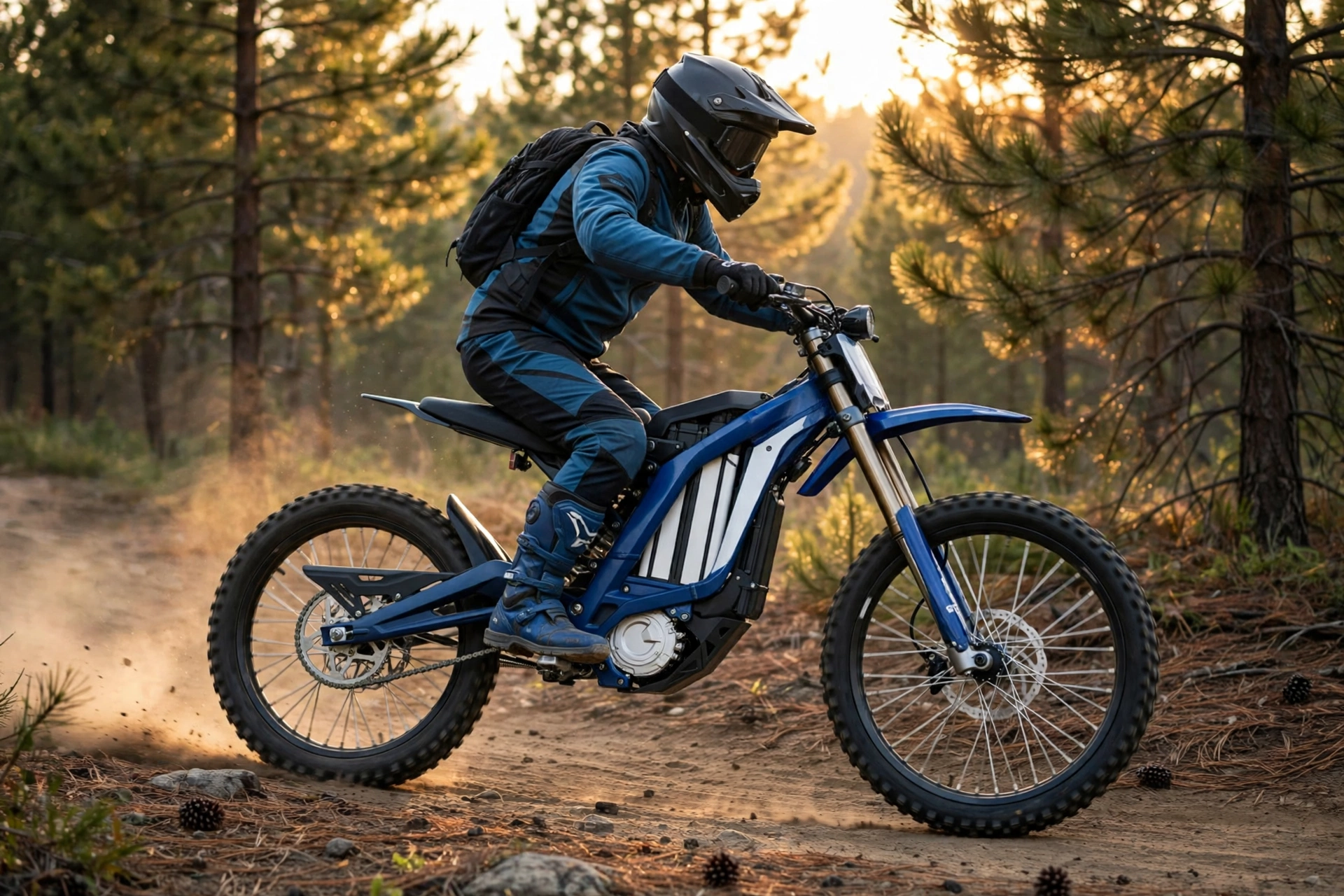
Segway-Ninebot launched the Dirt eBike X260 at SEMA in November 2019, with sales starting in early 2020 at $4,499. The bones are Sur-Ron: Segway was Sur-Ron’s largest shareholder at the time, and the X260 shares the Light Bee’s forged aluminium frame, mid-mounted motor, belt primary drive and chain secondary drive. Segway said it re-engineered weak points rather than simply rebadging the bike, and the X260 got its own controller tuning, a headlight as standard, and the Segway-Ninebot app for ride modes and stats.
The numbers, from Segway’s own manual: 60V 32Ah battery, which is 1,920 watt-hours. Peak motor power 5 kW. Quoted torque at the rear wheel 250 Nm (184 lb-ft), which is a geared figure, not motor-shaft torque, but the shove is real either way. Top speed 46.6 mph. Weight 121.3 lbs with the battery fitted, 97 lbs without it, so the pack alone is roughly 24 lbs. Seat height 31.9 inches, ground clearance 10.6 inches, 19-inch front wheel, max rider weight 220 lbs. Colours were blue, black, red and silver. Three ride modes (Novice, Standard, Sport) let you strangle the output down for a newer rider or a tight trail.
Can you still buy a segway x260 new?
No. Not from Segway, anyway. The X260 quietly vanished from Segway’s US store, and the old product URL now serves a different machine entirely, the Segway Xaber 300, billed on that page as “The Evolution of X260”. Read that as the official obituary: the nameplate moved on. Prices while it lived were a ride of their own. It launched at $4,499 in 2020, big-box retailers later listed it around $5,525, and Segway’s own store at one point showed $6,499.99. None of those numbers matter now except as a warning.
The warning is this: the internet is full of storefronts offering a “brand new 2026 segway x260” for $500 to $1,350. Those are not bargains. They are the standard too-cheap scam pattern that has trailed this model for years, and consumer-protection writers have flagged fake X260 stores specifically. Segway is not shipping new X260s at a quarter of the old price through a website registered last month. If you want an X260 in October 2026, you are shopping used, on the usual marketplaces, from a person, ideally within driving distance so you can test the battery. More on that below, because the battery is the whole deal.
Real range: what the segway x260 actually does
Segway claimed 74.6 miles. Electrek noted at launch that the range figure was calculated in low-power mode, and that single footnote does a lot of work. Seventy-four miles is what the bike returns if you ride it at a gentle, steady pace on friendly ground, which is not how anyone rides a dirt bike twice. Owners consistently report around 30 miles in Sport mode and around 45 miles in Eco on real trails. Plan on those numbers. A 30-mile Sport figure from a 1,920 Wh pack is about 64 Wh per mile, which is thirsty, honest dirt-bike consumption, and it matches what the same platform returns in Sur-Ron clothes.
How does that compare? Our fastest e-bike guide covers the wider speed class, and the X260’s 46.6 mph still sits respectably in it years after launch. But speed was never this bike’s problem. Range per outing is the limit: a 30-mile Sport loop is a solid morning, and then you are charging. The swappable pack is the workaround. Pop the 24-pound battery out, drop a charged spare in, keep riding. That is a genuinely city-friendly feature, by the way. A spare pack charges indoors, on a desk, from a normal wall outlet, while the bike sits locked in the garage. Try that with a fixed-battery machine.
A word for the smaller sibling, because used shoppers will trip over it. The X160 used a 48V 20Ah pack, a 3 kW motor, 17-inch wheels and a 31 mph top speed, at 106 lbs. It is the same idea in a smaller, friendlier size, and for tight woods or a smaller rider it is arguably the better tool. But the X260 is the one to hunt for. The bigger battery, the stronger motor and the 19-inch front wheel make it the complete version of the concept, and used prices for the two have collapsed towards each other, so the bigger bike is usually only a couple of hundred dollars more. The Segway-Ninebot app deserves a mention too: it sets the modes, shows battery state and records rides. It is useful, not essential, and the bike rides fine if you never open it, which is the correct amount of app for a dirt bike.
Charging a segway x260: four hours, 33 cents
The pack maths, shown properly. 60 volts × 32 amp-hours = 1,920 watt-hours, or 1.92 kWh. Segway’s charger pushes 67.2V at 10A, roughly 672 watts, so the theoretical minimum charge time is 1,920 ÷ 672 = about 2.9 hours. In practice the charge tapers at the top, and Segway quoted 4 to 5 hours from flat. Call it four hours, overnight or over lunch, from any standard outlet. Wondering whether some other charger could speed that up? Our charger compatibility checker explains why mixing voltages and connectors on lithium packs is a bad hobby. Use the charger the bike came with.
And the cost, because this is the part people always overestimate. A full charge at 17 cents per kWh (roughly the current US household average) is 1.92 × $0.17 = $0.33. Thirty-three cents. Run the Sport-mode range through it and a 30-mile trail morning costs about 1.1 cents per mile in electricity. A 20-mile loop uses around two-thirds of the pack, call it 22 cents. Even if you ride every weekend of the year and drain it fully each time, you are looking at roughly $17 in electricity annually. The segway x260 is not cheap to buy and not cheap to insure or repair, but feeding it is close to free. Tyres, chains and brake pads will cost you more than electrons ever will.
Storing a segway x260 in the city: the theft-proofing bit
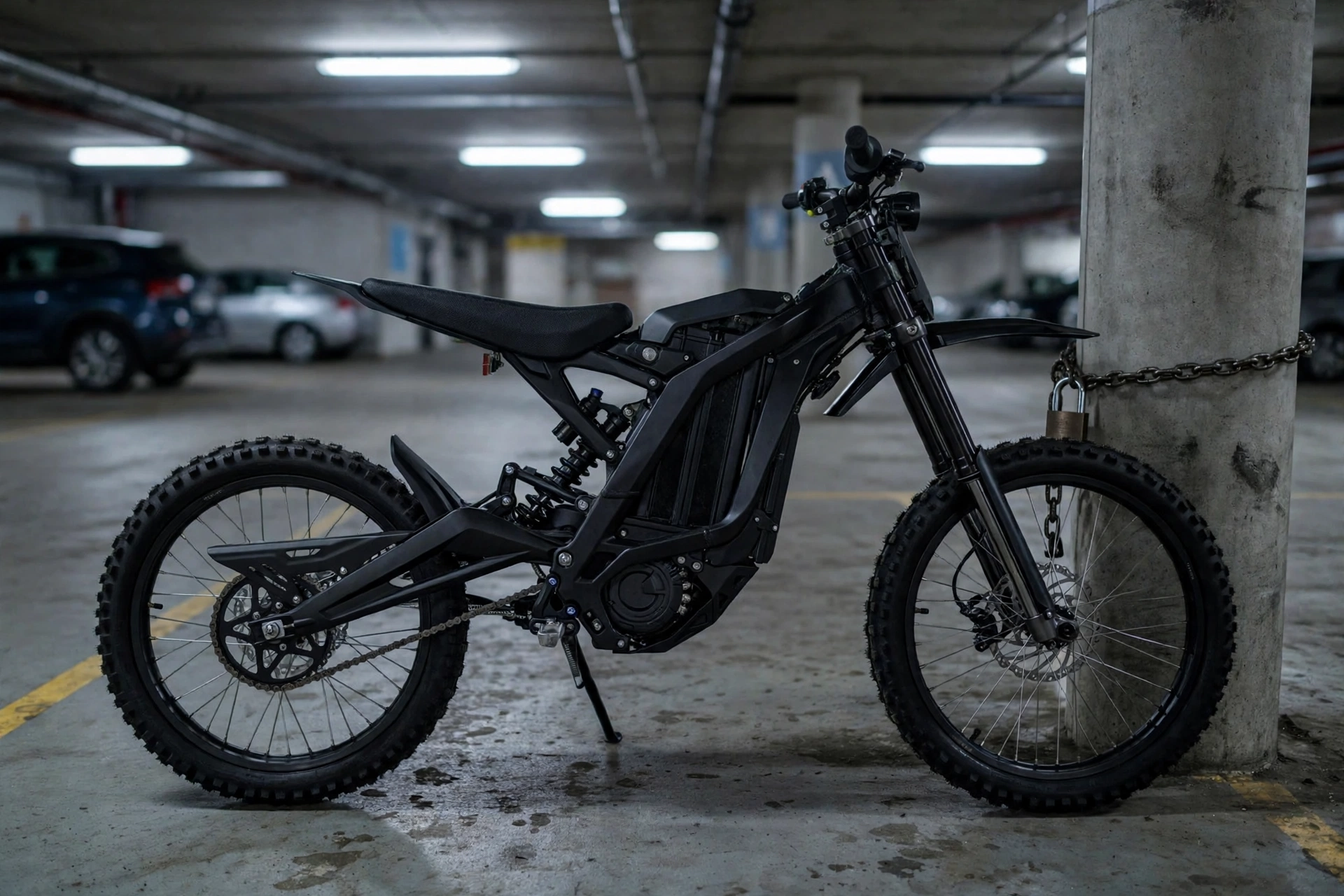
Here is where my usual obsessions earn their keep. The X260 is 74 inches long and weighs 121 lbs. It does not fold. It will not go in a lift comfortably, it will not go up apartment stairs unless you are a competitive strongman, and it absolutely cannot live on a balcony. If your storage plan is “the shared bike room,” understand that you are storing a $2,000, instantly resellable, mostly untraceable machine in a room whose code is known by every delivery rider in the postcode. These bikes get stolen. The platform is famous, parts interchange with the Sur-Ron fleet, and there is no title or registration trail on most used examples to slow a resale down.
So the rules. One: the battery comes out, every time. It is 24 lbs, it has a handle’s worth of grip, and indoors it is both safer for the pack and a theft deterrent, because an X260 without its battery is a heavy bicycle-shaped paperweight that a thief cannot test-ride away. Two: a proper ground anchor and a heavy chain through the frame, not a cable lock through the front wheel. Three: a discreet GPS tracker under the seat costs little and this class of bike is exactly what trackers are for. Four: photograph the serial number and keep the original paperwork from your purchase, because if it does vanish, that is all you have. Do all four and city ownership is workable. Skip them and you are, in my firm opinion, just holding the bike for someone else.
Is the segway x260 street legal?
No, and it never was. There are no pedals. The motor peaks at 5 kW, which is nearly seven times the 750W ceiling of the fastest legal e-bike class in the US. Top speed is 46.6 mph against a 28 mph Class 3 limit. By every definition that matters, the X260 is an off-road motorcycle, sold for trails and private land, exactly as our electric dirt bike guide lays out for the whole category. Some states let you register machines like this as OHVs for designated trail systems, and dual-sport conversion kits exist in the Sur-Ron ecosystem, but a stock X260 on a public road is illegal in every state, and riding one on a bike path is the fastest way to get paths closed for everyone. Do not be that person.
The maths: a used segway x260 versus buying new
Used X260 asking prices, checked October 27, 2026, generally land between $1,500 and $2,500 (est., based on current US marketplace listings, with clean low-hour examples at the top). Take a fair middle figure of $2,000 and divide by the tested Sport range: $2,000 ÷ 30 miles = $66.67 per mile of real range. Now the new alternative. A current Sur-Ron Light Bee X from a US dealer runs $3,999 to $4,499, and its real trail range is in the same 30-to-40-mile band, so even using its claimed 46 miles you get $4,499 ÷ 46 = $97.80 per mile, and on realistic range nearer $128 per mile. The used Segway delivers the same platform, the same ride, at roughly half the cost per mile of range. For contrast, remember the X260’s own launch maths: $4,499 ÷ 74.6 claimed miles looked like $60 a mile on the brochure, but at the tested 30 miles it was really $150 a mile. Depreciation has done today’s buyer a genuine favour.
The catch, and it is one catch with a price tag: the battery. A 2020 or 2021 pack is now five or six years old. Lithium packs age whether they are ridden or not, and a tired X260 pack that delivers 18 miles instead of 30 is a $2,000 bike that needs a replacement costing roughly $1,200 to $1,600 (est., for a quality 60V pack from the Sur-Ron ecosystem; genuine Segway-branded packs are scarce). So test before you pay. Meet the seller with the bike fully charged, ride it hard for 20 minutes in Sport, and watch the gauge. Check the charger is included, check the belt and chain, and walk away from any seller who will not let you ride it. Our research method page explains why we weight tested figures over brochure ones, and nowhere does that policy pay for itself faster than in used battery shopping.
One more check that costs nothing: hours and honesty. Ask where the bike has lived. A garaged example with a dusty charger and an owner who can talk about charge habits is worth more than a shiny one stored outdoors under a tarp, because outdoor storage attacks connectors, chain and battery seals in ways a wash hides well. Trust the boring seller. Boring is a feature.
Running costs: the unglamorous ledger
Electricity is nearly free, so the real budget is wear parts, and the Light Bee platform is kind here precisely because it is bicycle-adjacent. A drive chain is a $20-to-$35 part and lasts a season of muddy riding if you clean it. The primary belt runs roughly $30 to $50 and typically outlasts several chains. Brake pads are $15 to $25 a set, and a hard Sport-mode rider will eat a rear set in a few months, because regen braking on this platform is modest. A rear knobby tyre costs $60 to $90 and is the single biggest recurring expense if you ride on rock. Budget roughly $150 to $250 a year (est.) for consumables on a regularly ridden example, and compare that with a petrol 250’s appetite for oil, filters, valve checks and fuel. There is no engine to rebuild, no clutch to burn, and no exhaust to dent. The expensive failures are electrical: a controller or a tired battery. That is the trade, stated cleanly. Cheap routine costs, one big ageing component, and your job as a buyer is to price that component honestly before money changes hands.
Our verdict on the segway x260
Our score: 7.0/10. Trail ability: 8.5/10, because the platform remains brilliant, light, torquey and genuinely beginner-friendly in Novice mode. Used-buy confidence: 5.5/10, because everything hinges on one ageing battery and a seller’s honesty. City storage and security: 6/10, because the removable pack helps enormously and the 121 lbs hurts almost as much. Buy one if you have ground-level secure storage, trails within reach, and the patience to test a used example properly. Skip it if your plan involves stairs, a bike room, or riding to the trailhead on public roads. A new Light Bee X with a warranty is the better buy for anyone who cannot store this bike properly. That is my clear position, and the theft statistics of every city I have ever lived in back it up.
Frequently asked questions
Is the segway x260 still sold new in 2026?
No. Segway discontinued it in the US and the old store page now presents the Xaber 300 as its successor. Any website offering a new X260 at a deep discount should be treated as a scam until proven otherwise. The genuine route is the used market at roughly $1,500 to $2,500 (est.).
How far does an X260 really go on one charge?
Plan on about 30 miles in Sport mode and around 45 miles in Eco on real trails, based on consistent owner reporting. The 74.6-mile claim was measured in low-power conditions. Cold weather, deep mud and a heavy throttle hand all pull the number down further.
Can I ride an X260 on the road or a cycle path?
No. It has no pedals, peaks at 5 kW and tops out at 46.6 mph, which puts it outside every US e-bike class. It is an off-road machine for trails and private land, with OHV registration possible in some states for designated trail systems.
Do Sur-Ron parts fit the X260?
Largely yes, which is the best news in this whole article. The X260 shares the Light Bee platform, so wheels, chains, belts, many suspension parts and 60V batteries from the Sur-Ron ecosystem generally fit. That parts supply is the main reason a discontinued Segway is still a sensible used buy.
How long does an X260 take to charge, and what does it cost?
About four hours from flat on the standard 67.2V 10A charger, and about 33 cents of electricity at 17 cents per kWh, because the pack holds 1.92 kWh. The removable battery can be charged indoors away from the bike, which city owners should treat as standard practice.