Last updated: October 27, 2026
Right. Cards on the table. You are not just choosing a car — you are choosing between electric vehicle makers, and that choice now matters more than the badge on any single model. I referee head-to-heads for a living, so here is the field scored properly: one maker sells more EVs in America than every rival put together, three companies control seven of every ten sales, and four makers that launched to magazine covers are bankrupt. If your shortlist ignores that scoreboard, your shortlist is wrong.
Judging electric vehicle makers on sales, rather than slogans, is the clearest starting point. The whistle blew on the old market a year ago. The $7,500 federal tax credit expired on September 30, 2025, the rush quarter that followed it was fake volume, and 2026 is the first honest year the US EV market has had. What is left is smaller, harder and much easier to read. This guide walks the whole field — the legacy giants, the pure-EV specialists, the Chinese makers you cannot buy, and the casualty list — and it scores every group as it goes. No points for effort. No points for a nice keynote.
Every group of electric vehicle makers here is judged on the same three tests. How I score: three sub-scores per group, each out of 10. Scale and staying power (sales, cash, a parent company that will still exist in 2031). Lineup (can you actually buy the size and price of EV you need?). Buyer safety (higher means safer: service network, parts supply, the odds the maker answers the phone in five years). The method matches how we research every guide on this site, set out on our research page. Argue with the scores if you like — the numbers underneath them are published, and you can check every one.
The Scoreboard: Electric Vehicle Makers by US Sales
Sales are the fairest way to rank electric vehicle makers in the United States. Start with the count, because the count settles most arguments. Cox Automotive’s Kelley Blue Book estimates for the third quarter of 2026 — the full table is in the Cox Automotive Kelley Blue Book Q3 2026 EV sales report — put total US EV sales at 266,630 for the quarter, about 6.5% of all new vehicles. Tesla took 144,094 of them. That is a 54.0% share, and it means Tesla outsold the other thirty-plus brands combined by 21,558 cars (144,094 against 122,536 — do the subtraction yourself, it holds up).
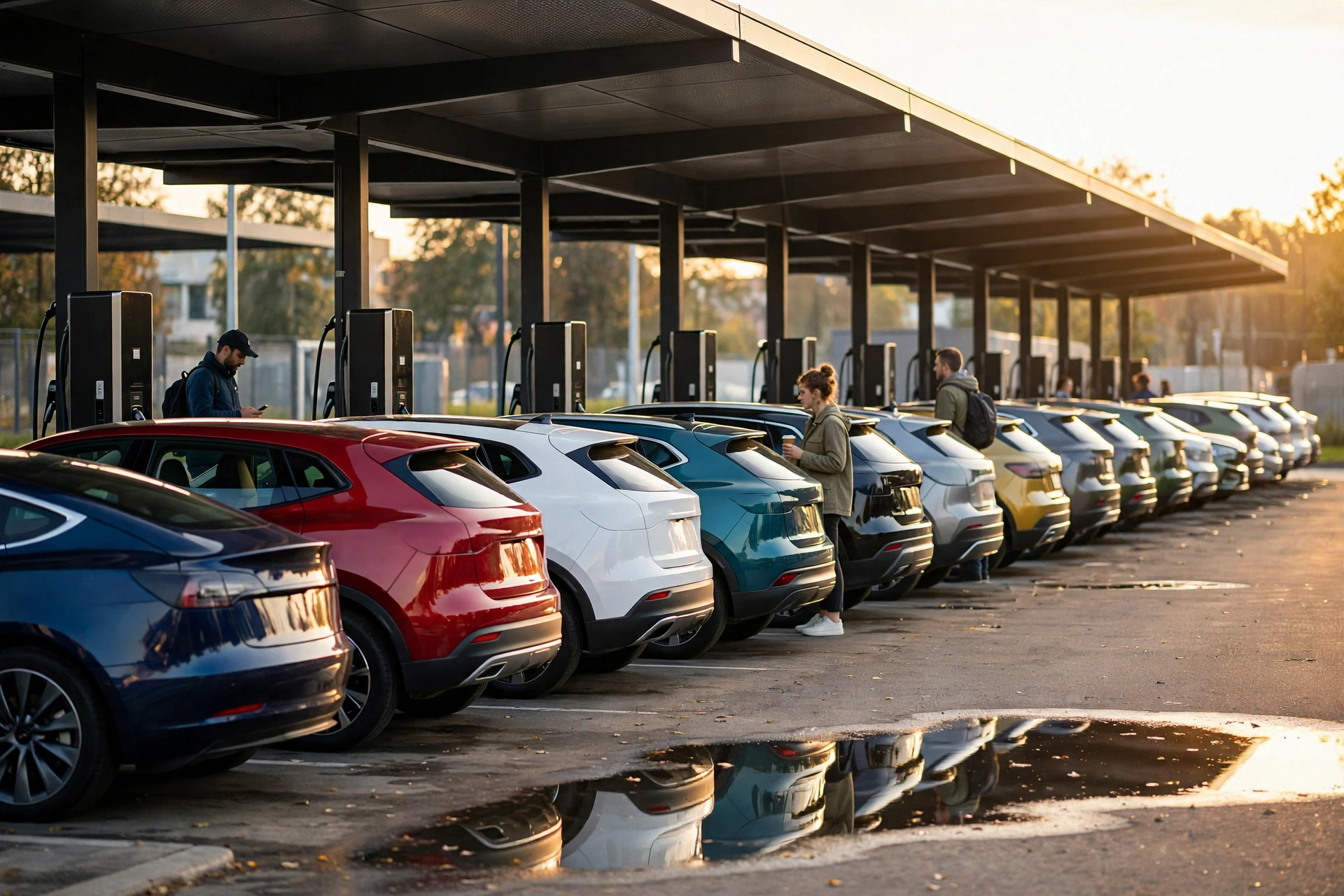
Concentration matters when comparing electric vehicle makers across the market. Now the computation nobody in the dealer ads wants printed. Add up the top three automakers, not brands: Tesla’s 144,094, plus General Motors across Cadillac (12,358), Chevrolet (10,031) and GMC (3,084) for 25,473, plus Rivian’s 19,239. The sum is 188,806. Divide by the market: 188,806 ÷ 266,630 = 0.708, or 70.8%. Three companies sell seven of every ten EVs in America. Everyone else — more than thirty brands, centuries of combined car-making history — splits the remaining 29.2%. When a salesman tells you the market is wide open, that is the number he is hoping you never see.
Year to date the picture barely softens: 729,869 EVs sold in the first nine months of 2026, Tesla on 52.9%. The Model Y alone took 99,037 sales in the quarter, 37.2% of the entire EV market — one model outselling most makers’ full lineups. Hold that thought. It decides several scores below.
Tesla: The Electric Vehicle Maker the Rest Are Chasing
Even the strongest electric vehicle makers have bad quarters. Tesla’s third quarter was, by its own standards, a bad one. US sales fell 19.7% year on year. The Model S and Model X have effectively left the table — 215 and 173 sales, rounding errors in a silver jacket. The Cybertruck managed 4,323. And Tesla still won the quarter by a margin so large the word “rival” stops working: 97% of its volume is two cars, the Model Y (99,037) and Model 3 (40,346), and those two cars outsell every other maker in the country, individually, several times over.
Charging is where Tesla separates itself from other electric vehicle makers. The network effect is the real moat, and I score it as one. The Supercharger network is the largest and most reliable fast-charging system in the US, and the rest of the industry has spent two years admitting it — Ford, GM, Hyundai and most others now ship cars with Tesla-style NACS ports or adapters.
When your competitors plug into your fuel stations, you are not a car company any more; you are the grid with a car attached. Add direct pricing with no dealer markup games, over-the-air updates that actually arrive, and resale values propped up by sheer fleet size, and the buyer-safety case makes itself. Tesla’s own store lists the Model 3 from $38,990 (est.) and the Model Y from $44,990 — mid-market money, not moon money (prices checked October 27, 2026).
The deductions are real, so take them: a two-car lineup wearing different hats is not a lineup, service wait times are the complaint I hear most, and the flagship pair are old designs in a market that rewards fresh metal. Globally, the crown already moved — BYD sold 2,256,714 battery-electrics in 2025 against Tesla’s 1,636,129. In the US, though, this is still Tesla’s league and everyone else is playing for second.
Our score: 9.0/10 — Scale & staying power: 10/10 · Lineup: 6/10 · Buyer safety: 9/10
The Legacy Giants: Big Parents, Uneven Homework
Score the legacy electric vehicle makers as a group and you get a split decision, so let me referee it maker by maker inside the block. General Motors is the clear number two automaker: 25,473 EVs in the quarter across its three brands. But read the split before you applaud. Cadillac did 12,358 of those — nearly half — while Chevrolet’s Equinox EV, the volume hope, collapsed to a fraction of its credit-era numbers and the Blazer EV fell harder still. GM’s EV business is now a luxury business with a mainstream badge problem.
Legacy electric vehicle makers can fall fast. Ford is worse: 6,047 sales, down 80.2%, after it ended F-150 Lightning production in late 2025 (289 sold all quarter) to chase an extended-range replacement. That is not a strategy pivot; that is a retreat with a press release wrapped around it.
Two legacy groups earned their points back. Hyundai Motor Group — Hyundai (12,185), Kia (9,575) and Genesis (494) — combined for 22,254 sales, 8.3% of the market, with the broadest sensible lineup in the business: a car at nearly every price from the low $30,000s to a three-row EV9. And Toyota, the industry’s most famous EV sceptic, sold 12,904 cars under its own badge (up 328% year on year) plus 8,464 as Lexus — 21,368 combined, roughly three and a half Fords, powered by a refreshed bZ range that finally charges and drives like it was designed this decade.
This is how quickly legacy electric vehicle makers can lose ground in a single quarter. Meanwhile Volkswagen managed 1,421 sales, down 90.5%, and Stellantis has effectively left the ring (Jeep 181, Dodge 233 — those are not typos). Nissan, the company that started all this with the Leaf, sold 638 cars all quarter while it reloads.
The legacy safety argument is the balance sheet: GM, Toyota and Hyundai are not going bankrupt, their dealers exist in your town, and parts will be cast for decades. If you want the full money picture before you pick a side, our guide to whether EVs are worth buying without the tax credit runs the post-incentive numbers honestly. The legacy deduction is commitment: Ford’s retreat and VW’s collapse show that a giant parent is no guarantee the EV division keeps its funding when the quarter turns ugly.
Our score: 7.2/10 — Scale & staying power: 9/10 · Lineup: 8/10 · Buyer safety: 7/10
The Pure-EV Specialists: Rivian and Lucid, Scored Separately from the Dream
Only two of the pure-bred electric vehicle makers are left standing in the US with real volume, and they had opposite quarters. Rivian sold 19,239 vehicles in Q3, up 45.7%, which makes it the number two EV brand in America — ahead of every legacy nameplate except none; read that again.
The fine print matters, so here it is: 8,469 of those were commercial delivery vans (Amazon’s fleet order is doing heavy lifting), and 3,456 were the new R2, the $45,000 SUV that is Rivian’s actual future. Strip the vans out and Rivian is still growing while the market shrinks, with a Georgia plant and a Volkswagen joint venture paying real money for its software. That is a survivor’s profile.
Smaller electric vehicle makers face a different test: survival, not scale. Lucid sold 2,708 cars, 1.0% of the market, roughly one for every fifty-three Teslas. The Air is by most measures the best-engineered EV sedan on sale, and the Gravity SUV is now in the mix, but engineering has never been Lucid’s problem. Volume is.
Smaller electric vehicle makers often survive on outside backing. What keeps the lights on is the Saudi Public Investment Fund, which has funded Lucid through years of losses and shows no sign of stopping — so the staying-power question is really a question about one shareholder’s patience. As a buyer you are underwriting that patience with your deposit. Price it accordingly: the Air starts at $70,900 (est.) and there is no cheap Lucid coming to rescue the volume line.
Referee’s call on the tier: Rivian is the only startup I would let a careful friend buy from without a warning label, and even Rivian gets one — a two-model consumer lineup and a service network still thinner than any legacy rival’s. Lucid builds the better car and carries the bigger risk. Both statements can be true, and the scores below say exactly that.
Our score: 6.8/10 — Scale & staying power: 5/10 · Lineup: 5/10 · Buyer safety: 6/10
The Chinese Electric Vehicle Makers: World Champions, American No-Shows
Chinese electric vehicle makers already lead the world. Now the part of the field you cannot buy from. Globally, the centre of gravity already moved: BYD is the world’s largest EV maker (2.26 million battery-electrics in 2025, against Tesla’s 1.64 million), Geely’s group is second in China, and brands like NIO, XPeng and Li Auto fill out a top ten that US buyers mostly cannot name. BYD builds its own batteries and semiconductors, sells a hatchback in China for around $10,000, runs factories in Hungary, Brazil, Thailand and Turkey, and is a normal sight on European and Mexican roads. On product and scale, this tier wins the world title and it is not close.
For American buyers, Chinese electric vehicle makers are a global story, not a showroom option. In the United States their score is zero, and the reason is a wall, not a product. A 100% tariff on Chinese-built EVs, layered on top of connected-vehicle rules that bar Chinese software and hardware from US roads, keeps every Chinese-brand passenger EV out of American showrooms. The exceptions prove the rule: Volvo and Polestar are Chinese-owned (Geely) and sell here because they are Swedish-branded and increasingly US-built — Polestar’s cars roll out of South Carolina as well as China. So when someone tells you Chinese makers are “coming for” the US market, ask them one question: through which door? Until trade policy changes, the answer is none.
My call, and I will not soften it: if that door opened tomorrow, the US value segment would be Chinese inside two years, because nobody in Detroit or Texas can build a $25,000 EV at a profit and BYD already builds them at $10,000. The tariff is currently the best-selling feature on every affordable American EV. Score the tier on what a US buyer can actually do with it.
Our score: 4.5/10 — Scale & staying power: 10/10 · Lineup: 9/10 · Buyer safety: 2/10
The Casualty List: Makers That No Longer Exist
Every score above exists because of this section. Lordstown Motors filed for bankruptcy in June 2023. Fisker followed in June 2024, leaving Ocean owners to organise their own parts swaps and software workarounds when the servers and the company behind them went dark. Canoo — NASA supplier, magazine darling — chose Chapter 7 liquidation in January 2025, the harshest ending on the list; our Canoo coverage elsewhere on this site scores its support at 1/10, and that is generous.
Nikola, once valued higher than Ford, filed in February 2025. The list of failed electric vehicle makers is now long enough to show its own pattern. Four makers, four different products, one shared cause of death: the cash ran out before the scale arrived. The product was never the whole game. It was barely half of it.
The casualty list is a warning for anyone shortlisting smaller electric vehicle makers. Pin the pattern to your shortlist. An orphaned EV is not a bargain; it is a car whose software keys, body panels and battery modules now depend on eBay and optimism. Ask the Fisker owners. The lesson is not “never buy from a small maker” — Rivian above is the counterexample — it is “make the maker prove it can survive, the same way you make the car prove it can charge.”
Choosing Between Electric Vehicle Makers: What Actually Deserves Your Money
So, your move. Here is the order of operations I would referee any buyer through, and the order is the argument: pick the maker first, the model second, the trim last. Run the entry-price maths to see why. The cheapest EV on sale in America is the 2026 Nissan Leaf at $29,990. The cheapest car from a pure-EV specialist, the Lucid Air, is $70,900 (est.). The spread is $40,910 — you could buy two Leafs ($59,980) and still have $10,920 left over against one Lucid.
Every maker’s full range is listed on fueleconomy.gov, so check the entry price of any maker before falling for its flagship (prices checked October 27, 2026). Price bands tell you who a maker is for; the scoreboard tells you whether it will still be there.
Weight these four things, in this order. One: survival — sales trend, cash, and who the parent or anchor investor is. Two: service reach — count the authorised service points within an hour of your house; if the answer is one, that is your answer about the maker too.
Three: charging — a native NACS port or a proper adapter deal in 2026 is table stakes, not a feature. Four: total cost, not sticker — our total cost of ownership calculator and our breakdown of the cost per mile of an electric car will run your real numbers, and our model guide to EV cars, their range, charging and costs shows what the same money buys across makers.
Final whistle. The EV market in late 2026 is a three-company business with a long, interesting tail. Buy from the top of the scoreboard if you want the quiet life. Buy from the tail if you want the better car — Rivian and Lucid both build one — but go in with your eyes open and the casualty list fresh in your mind. That is the whole game with electric vehicle makers: the maker is the warranty behind the warranty. Choose it like it matters, because the last four years say it is the only choice that does.
Frequently Asked Questions
Which electric vehicle makers sell the most EVs in the US?
Tesla, and it is not close. Cox Automotive’s Kelley Blue Book estimates put Tesla at 144,094 US sales in Q3 2026, a 54.0% share. General Motors is the second automaker at 25,473 across Cadillac, Chevrolet and GMC, and Rivian is the second brand at 19,239. Tesla, GM and Rivian together account for 70.8% of the market.
Who is the biggest EV maker in the world?
BYD. The Chinese company is the largest of all electric vehicle makers by volume: it sold 2,256,714 battery-electric cars in 2025 against Tesla’s 1,636,129, taking the global title on an annual basis for the first time. Tesla remains the largest EV maker in the US market by a wide margin, because BYD does not sell passenger cars in the United States.
Can I buy a Chinese EV in the US in 2026?
No Chinese-brand passenger EV is on sale in the US. A 100% tariff on Chinese-built EVs and federal connected-vehicle rules keep them out. The closest options are Chinese-owned brands with non-Chinese badges and US production — Volvo and Polestar, owned by Geely — which sell here normally.
What happens to my EV if its maker goes bankrupt?
When electric vehicle makers fail, owners feel it in support, not in driving. The car keeps driving, but support decays fast: warranty claims may go unpaid, parts supply shrinks to salvage and third parties, and connected services can shut down, as Fisker Ocean owners found after June 2024. In a Chapter 7 case like Canoo’s there is no reorganised company left to call. That risk is exactly what the buyer-safety sub-score in this guide prices in.
Which maker is safest for a first EV?
On the scores above: Tesla for network, scale and resale depth, or one of the three committed legacy groups — GM, Hyundai Motor Group or Toyota — for dealer coverage in smaller towns. The makers to cross-examine hardest are the low-volume specialists; make them prove service reach and funding before you sign.
Choosing between electric vehicle makers is easier once you compare the electric vehicle makers on survival, service and charging, not just on price. Use the scores above, shortlist the electric vehicle makers that will still support your car in five years, and let that maker-first choice guide the model you buy.