How long does it Take to Charge an Electric Car? (Honest Answers)
How long does it take to charge an electric car? The honest answer is: anywhere from 20 minutes to 2 days — and the difference is not the car, it is the charger. Ask “how long does it take to” fill a battery without naming the charger and you get every EV myth ever printed. This guide gives the real numbers for all three charging levels, model by model, explains why the last 20 percent takes so long, and shows how owners actually live with charging — which turns out to be the easiest part of EV ownership.
How Long Does It Take to Charge at Home? (Level 1 and Level 2)
| Charging method | Power | Range added per hour | Full charge (typical 60–80 kWh car) |
|---|---|---|---|
| Level 1 (regular 120V outlet) | 1.2–1.9 kW | 3–5 miles | 40–70 hours |
| Level 2 (240V home charger) | 7.2–11.5 kW | 25–45 miles | 6–12 hours |
| DC fast charging (public) | 50–350 kW | 100–900+ miles (at peak) | 10–80% in 18–45 minutes |
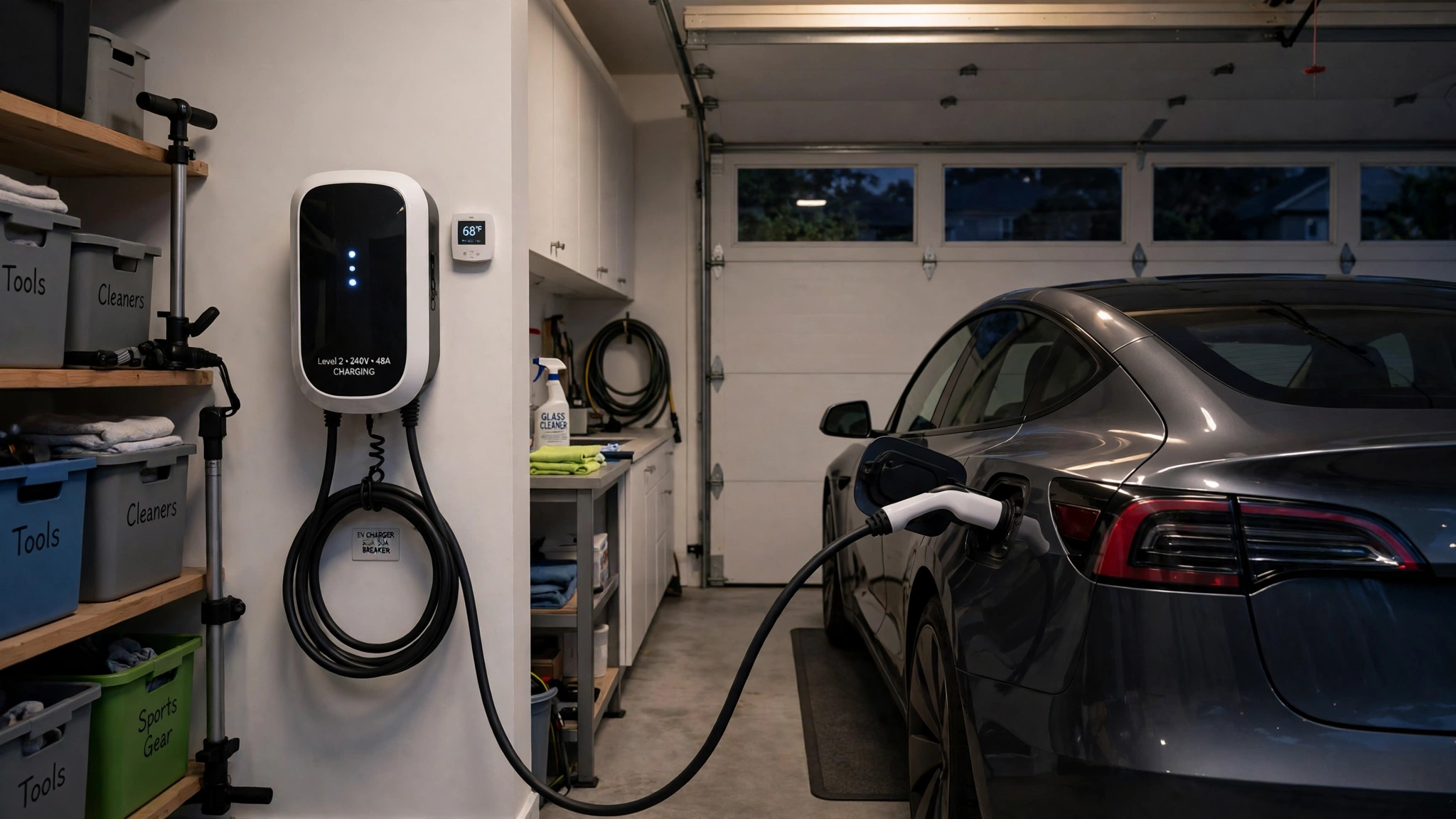
Level 1 is the wall outlet your car can sip from with the included cable: painfully slow for a full charge, yet perfectly adequate if you drive under 40 miles a day, because the car refills while you sleep. Level 2 is how most owners actually charge — a 240V home unit that returns a full battery overnight, every night. The question “how long does it take to” charge at home only matters on day one; after that, the routine is five seconds to plug in at night and five seconds to unplug in the morning. Our guide to finding EV charging stations covers the public side, and the cost side is smaller than people think — see the cost per mile breakdown.
How Long Does It Take to Fast Charge? Model by Model
| Car | Peak DC rate | 10–80% time | Notes |
|---|---|---|---|
| Hyundai Ioniq 5 / Kia EV6 | Up to 240 kW | About 18–20 minutes | 800V system — the benchmark |
| Tesla Model 3 / Model Y | Up to 250 kW | About 25–30 minutes | Fastest at low battery; preconditioning helps |
| Volkswagen ID.4 | Up to 175 kW | About 28–30 minutes | Strong, flat curve |
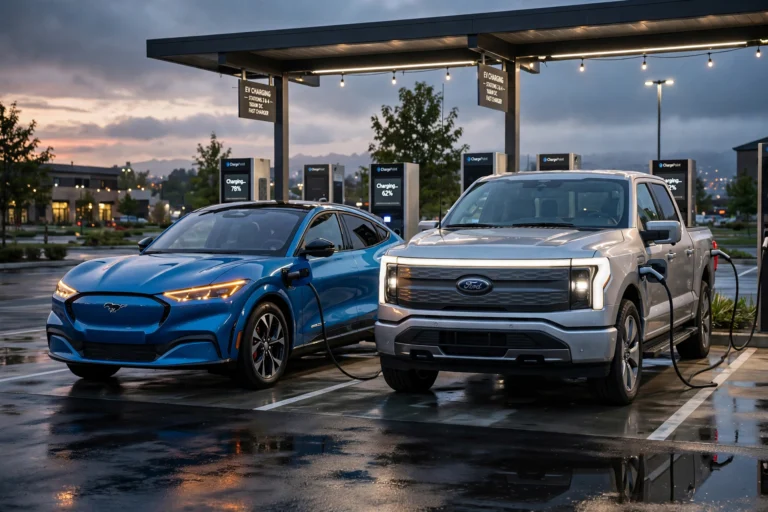
| Ford Mustang Mach-E | Up to 150 kW | About 33–36 minutes | Plus Tesla Supercharger access via adapter |
| Chevrolet Equinox EV | Up to 150 kW | About 35 minutes | Adds ~70 miles in 10 minutes per GM |
| Nissan Leaf (CHAdeMO) | Up to 100 kW | About 40–60 minutes | Older standard, no battery cooling on early cars |
| Chevrolet Bolt EV (older) | 55 kW | About 60+ minutes | The slow-charging cautionary tale |
Notice the pattern: when people ask how long does it take to charge on a road trip, the real-world answer for modern cars is “about as long as a coffee and a stretch” — 20 to 35 minutes for the 10-to-80-percent window that road trippers actually use.
How Long Does It Take to Charge the Last 20 Percent? (The Curve)
Here is the fact that explains every confusing charging story: EVs charge fast when the battery is low and slow as it fills, for battery-health reasons. A car that peaks at 250 kW near empty may accept under 50 kW above 80 percent. So how long does it take to go from 80 to 100 percent? Often as long as the entire 10-to-80 sprint — which is why experienced drivers unplug at 80 on road trips and charge the last bit at home, where time does not matter. The 10–80 window is the honest unit of EV charging; any quote of a “full charge time” on a DC fast charger is measuring something nobody should do.
How Long Does It Take to Charge in Winter or Summer?
Temperature bends every number in this article. A cold-soaked battery charges slowly until it warms — DC sessions can start at half speed or worse — which is why navigation-linked battery preconditioning is the most valuable cold-weather feature an EV can have. Our explainer on winter range loss covers the same physics from the range side. Extreme heat is gentler on charging but harder on the battery long-term; cars manage it with cooling, and parking in shade before a fast charge is a small, real help. As for the battery itself, modern packs are built for a decade and more of this — the durability data in our EV battery explainer shows degradation is a slow slope, not a cliff.
What Changes How Long It Takes to Charge?
Five variables, in order of impact. First, the charger: a 350 kW station cannot make a 150 kW car charge faster — the car’s peak is the ceiling. Second, battery size: big packs take longer to fill but add miles faster at the same percentage rate. Third, state of charge when you plug in, per the curve above. Fourth, temperature, as covered. Fifth, sharing: some stations split power between two stalls, halving your rate when a neighbor plugs in. Knowing these five explains nearly every “charging was slow today” story you will ever hear.
How Long Does It Take to Charge? Time-Saving Habits That Work
Experienced EV drivers quietly shave hours off their road trips with five habits. They arrive at fast chargers low — 10 to 20 percent — where the car charges fastest, instead of topping up from 60. They navigate to the charger in the car’s own system so the battery preconditions on the way. They leave at 80 percent, or earlier if the next charger is close, banking the slow top-end for home. They pick the right stall: the highest-power cabinet their car can use, unpaired when possible. And they plan charging around food and rest stops they wanted anyway, so the net time cost of a 600-mile day is one relaxed lunch. Follow those five and the question “how long does it take to” charge stops being a planning problem and becomes what it is for most owners: a non-event.
Frequently Asked Questions: How Long Does It Take to Charge?
How long does it take to charge an electric car at home?
On a Level 2 home charger, 6 to 12 hours for a full battery — irrelevant in practice, because you charge overnight and wake up full. On a regular outlet, 40 to 70 hours for a full charge, but still 30 to 50 miles of range per overnight session.
How long does it take to charge a Tesla?
At a Supercharger, about 25 to 30 minutes for 10 to 80 percent on a Model 3 or Model Y. At home on a Wall Connector, roughly 8 to 11 hours from empty — or, as owners actually do it, a few hours a night to replace the day’s driving.
Can you charge an electric car in 5 minutes?
Not to full — but you can add 60 to 100 miles in 5 minutes on the fastest cars at low battery. For most drivers, the useful comparison is a gas stop: 5 to 10 minutes buys meaningful range in a modern EV, too.
Does fast charging damage the battery?
Occasional fast charging is fine — the car manages heat and rate to protect the pack. Making DC fast charging your only method for years does accelerate degradation modestly, which is one reason home Level 2 charging is the recommended default.
How long does it take to charge an electric car with a regular outlet?
About 3 to 5 miles of range per hour — 40 to 70 hours for a full large battery. It suits low-mileage drivers and works as a stopgap for everyone else while a home charger is installed.
The Bottom Line: How Long Does It Take to Charge an Electric Car?
So, how long does it take to charge an electric car? At home: overnight, while you sleep, and you will never think about it. On the road: 20 to 35 minutes for the charge that matters, in a modern car on a proper fast charger. On a wall outlet: days — don’t. The owners who struggle with charging are the ones trying to use an EV like a gas car, visiting a “station” once a week. The ones who plug in at home find charging takes less of their time than fueling ever did. For official efficiency and charging data by model, the U.S. Department of Energy’s Alternative Fuels Data Center is the neutral source to check.