Ford Electric Cars: Everything You Need to Know
Ford electric cars have had a turbulent few years — a best-selling electric truck, a Mustang that purists loved to argue about, a price war, and a major strategy reset. If you are shopping in 2026, the result is actually good news: the surviving lineup is focused, the discounts are real, and Ford’s next chapter — a $30,000 electric pickup on an all-new platform — is the most interesting story in the industry. This guide covers every Ford electric car you can buy now, what each one costs, how far it goes, the Lightning situation explained honestly, and what is coming next.
The Current Ford Electric Lineup at a Glance
| Model | Type | Starting MSRP | Max EPA range | Status in 2026 |
|---|---|---|---|---|
| Mustang Mach-E | Electric SUV | About $37,995 | Up to 320 miles | On sale, full range of trims |
| F-150 Lightning | Electric pickup | About $54,780 (2025) | Up to 320 miles | Production wound down; dealer stock |
| E-Transit | Electric cargo van | About $51,600 | About 159 miles | On sale, fleet-focused |
Mustang Mach-E: The Volume Player
The Mach-E is now the center of Ford’s electric world. For 2026 it spans the Select at about $37,995 up through Premium, the track-flavored Rally, and the GT — whose 480 horsepower and roughly 3.5-second sprint still embarrass sports cars. Range runs from 211 miles on the standard-range all-wheel-drive car to a maximum of 320 miles on the extended-range rear-drive Premium. DC fast charging peaks at 150 kW, taking the battery from 10 to 80 percent in about 32 to 36 minutes. Every Mach-E now ships with access to Tesla’s Supercharger network via an adapter or native arrangements depending on build date, which fixed the car’s one big early weakness. Our dedicated guide, Electric Mustang: 7 things to know before you buy, covers trims, charging, and ownership in depth. BlueCruise hands-free highway driving remains one of the best-calibrated systems you can buy at this price.
F-150 Lightning: What Actually Happened
The Lightning deserves a straight answer, because the headlines confused a lot of shoppers. Ford’s electric F-150 launched to huge demand in 2022, won every truck-of-the-year award going, and then ran into the same wall as every expensive EV truck: buyers loved it at $40,000 and balked at $70,000. Ford cut prices, demand steadied, but the economics never fully worked. In late 2025 Ford paused Lightning production at the Rouge Electric Vehicle Center and signaled the current generation’s run was ending as it redirects investment toward smaller, cheaper EVs and a future range-extended truck. Ford continues to support Lightning owners with parts, service, and warranty — this is a production decision, not an abandonment. For shoppers, the practical effect is a buyer’s market on remaining dealer stock: a 320-mile, 580-horsepower electric truck with a powered front trunk and home-backup capability, often at deep discounts. If you tow long distances weekly it was never the right tool; for mixed family and work duty at the right price, it is a lot of truck. Our coverage of its closest rival, the Chevy Silverado EV, shows how the segment looks from the other side of the fence.

E-Transit: The Quiet Workhorse
The E-Transit rarely makes headlines, but for delivery fleets, trades, and shuttle operators it is one of the most sensible EVs sold. Range is about 159 miles — modest, until you learn that the average commercial van drives under 75 miles a day and returns to a depot every night, where charging costs a fraction of diesel. Ford Pro’s fleet software, telematics, and service network are the real product here. If your business runs predictable local routes, the E-Transit business case basically writes itself; our guide to electric vans for business runs the fleet math in detail.
What Is Coming: The $30,000 Ford EV
Ford’s future is a skunkworks-developed Universal EV Platform, announced in August 2025 and built in Louisville, Kentucky. The first product is a midsize four-door electric pickup starting around $30,000, targeted for 2027 — roughly the size of a Maverick, with a target price near it too. Ford is chasing manufacturing simplicity: far fewer parts, a structural battery pack, and lithium-iron-phosphate cells for durability and cost. A sedan and other body styles are expected to follow on the same platform. Just as important is what Ford killed to fund this: the planned three-row electric SUV was cancelled in favor of hybrids, and the next-generation electric F-150 was pushed out and rethought as a range-extended vehicle. Read together, Ford’s strategy is now simple — win the affordable end, keep hybrids for big vehicles, and let the Mach-E hold the middle.
Charging and Ownership Across the Lineup
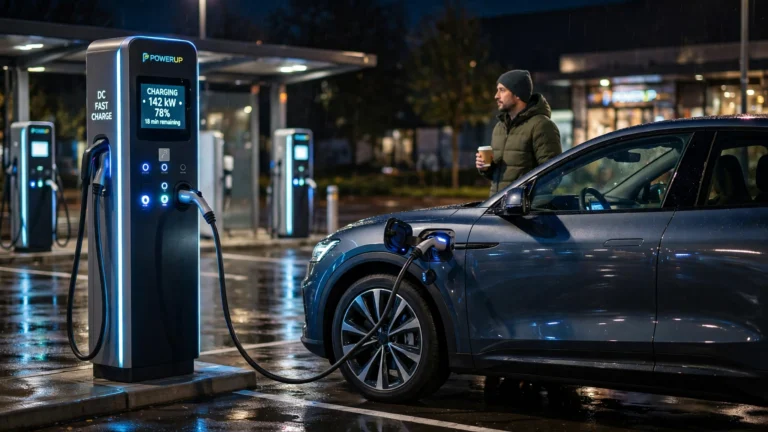
All current Ford EVs charge at home on Level 2 overnight — the pattern that makes ownership cheap — and fast-charge on the road at up to 150 kW (Mach-E) or about 177 kW (Lightning). Ford’s BlueOval Charge Network bundles access to most major public networks into one account, and Supercharger access via adapter has closed the gap with Tesla on road trips. Ownership costs follow the standard EV pattern: home charging at roughly 5 cents a mile against 10-plus for gasoline, minimal scheduled maintenance, and an 8-year/100,000-mile battery warranty. Ford’s dealer footprint — the largest in the country — remains a genuine advantage for service outside big cities.
Frequently Asked Questions
What electric cars does Ford sell in 2026?
The Mustang Mach-E SUV is the core model, joined by remaining F-150 Lightning pickup stock and the E-Transit cargo van for fleets. A new $30,000 midsize electric pickup on Ford’s Universal EV Platform is targeted for 2027.
Is Ford discontinuing the F-150 Lightning?
Ford wound down production of the current Lightning in late 2025 as it shifts investment to affordable EVs and a future range-extended truck. Owners keep full parts, service, and warranty support, and remaining dealer stock is being sold — often at strong discounts.
How far can the Mustang Mach-E go on a charge?
Between 211 and 320 miles EPA depending on battery and drivetrain. The extended-range rear-wheel-drive Premium delivers the maximum 320 miles.
Can Ford EVs use Tesla Superchargers?
Yes. Ford arranged Supercharger access for Mach-E and Lightning owners, supplied via an adapter, alongside Ford’s BlueOval Charge Network for other public charging.
What will Ford’s $30,000 EV be?
A midsize four-door electric pickup built in Louisville on the new Universal EV Platform, targeted to start around $30,000 in 2027, with more body styles planned on the same platform.
The Bottom Line
Ford electric cars in 2026 are a study in focusing: one strong SUV carrying the brand today, a great truck bowing out with its head high and its prices low, a van quietly saving fleets money, and the industry’s most credible shot at a $30,000 EV waiting in 2027. If you are buying now, the Mach-E is the safe, discounted, well-supported choice, and a negotiated Lightning may be the best-value electric truck left in America. If you can wait, Ford’s affordable platform is worth watching. For neutral, government-published data on every model here, FuelEconomy.gov is the reference we trust most.