Last updated: October 27, 2026
Yes, free car charging stations still exist in 2026, and there are more of them than most drivers realise. They sit behind grocery stores, along the back wall of hotel car parks, in office garages and outside libraries. The catch is simple, and it shapes everything in this guide: almost all of them are Level 2 posts, they add range slowly, and they only pay off when the car is parked somewhere you already needed to be. Treat free charging as a parking perk and it is genuinely useful money; treat it as a fuel strategy, and you will spend your evenings driving to it.
All plan terms, network details and prices in this guide were checked on October 27, 2026.
Here is the short version before the steps. A typical free Level 2 post delivers about 6 to 7.7 kilowatts, which works out at roughly 20 to 28 miles of range for every hour you stay plugged in. Two hours at the supermarket is a meaningful top-up. Twenty minutes is a gesture. So the whole game is matching charger stops to dwell time you already have: the weekly shop, the gym, the office day, the hotel night. Where the match is good, free charging quietly covers a large slice of a normal driver’s year. Where the match is bad, the electricity is free and everything around it costs you.
One thing did change this year, and it explains a lot of confused trip reports. The biggest free network in the country, the Volta posts with the tall advertising screens, has changed hands for the second time in three years. The screens are still standing, the posts mostly still work, and a growing share of them now ask for payment. Section four below walks through what happened, because a charger you remember as free is the one most likely to surprise you. Retailers still install posts to attract shoppers, employers still install them to attract staff, and towns still install them to bring drivers into local centres.
This guide is written for three readers. If you rent or live in an apartment with no home charger, free destination charging may be the backbone of your routine, and the finder steps near the end matter most to you. If you have a driveway, free charging is bonus money, and the maths section sizes the bonus. If you are buying a new EV, the bundled charging plans in section five are worth real cash and expire if you forget to enrol.
Step One: Start With the Free Car Charging Stations Already on Your Route
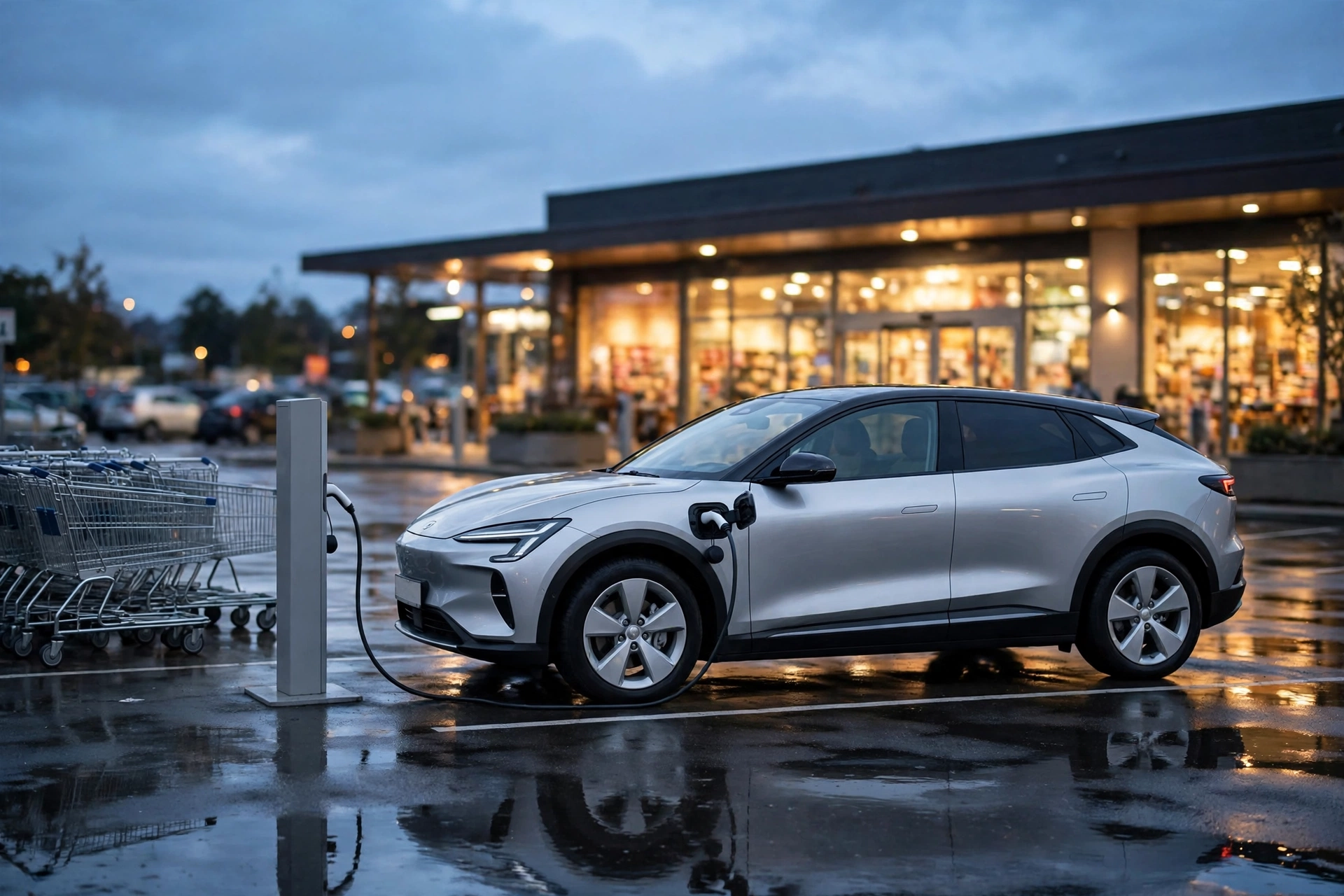
Open your week in your head before you open any app. Where does your car already sit still for one to four hours? For most households the honest list is short: a supermarket, a gym or pool, a workplace, a school run car park, a cinema, a place of worship, a Saturday sports ground. Free charging works when it attaches itself to that list. It fails when it invents new trips, because a Level 2 post repays patience, not enthusiasm.
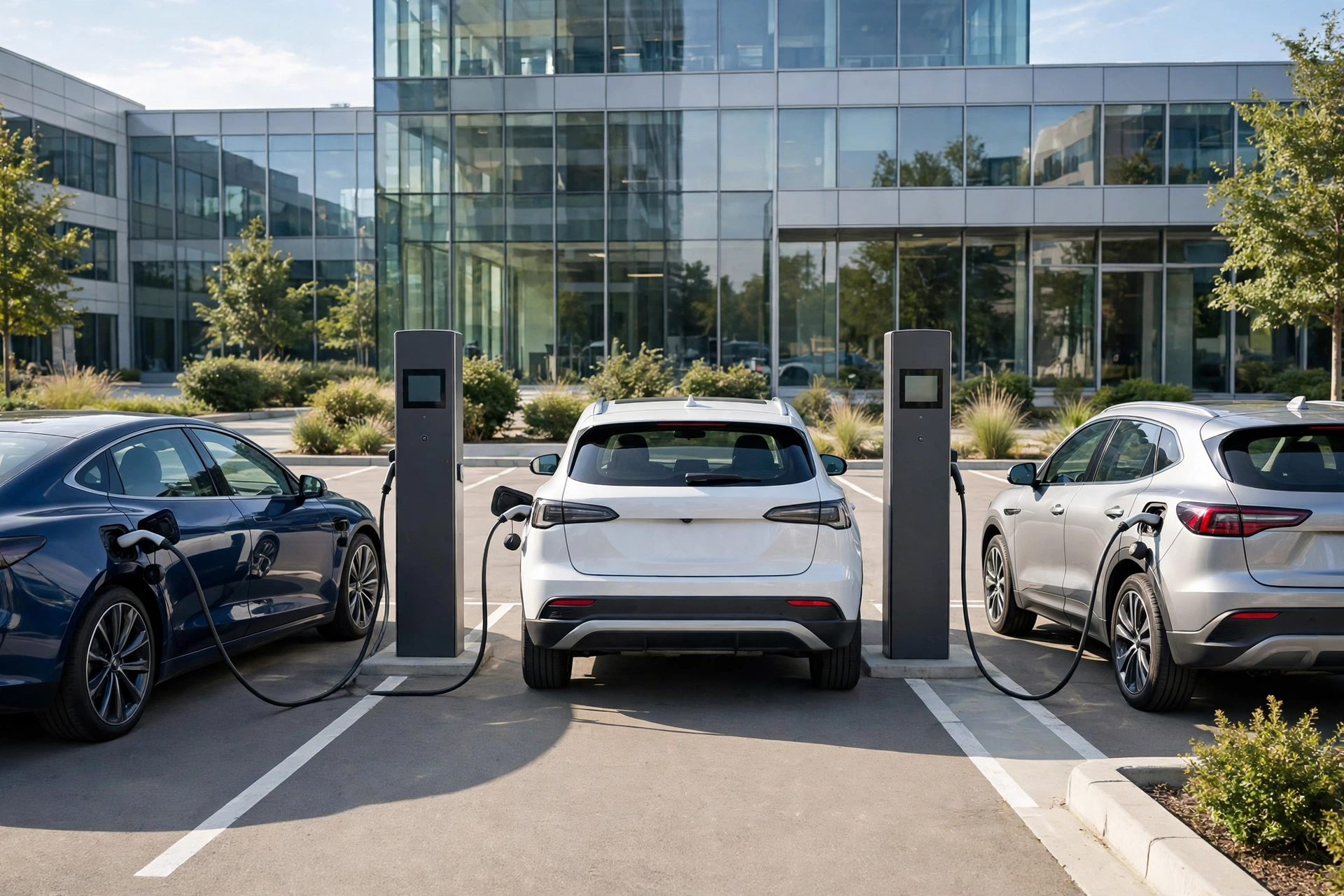
At existing stops, the routine is deliberately dull. Park in the charging bay, plug in, tap the app or card the host uses, and go and do the thing you came to do. Many retail posts run through networks such as ChargePoint, where the site host sets the price and plenty of hosts set it to zero; the app shows $0.00 per hour or per session before you start — check it there rather than discover a fee afterwards. Some posts are limited to two or four hours, some are for customers only, and a few ask you to register at a front desk. Read the sign on the post once, the first time. After that it is muscle memory.
Speed expectations need setting early, because disappointment with free charging is usually disappointment with arithmetic. A car that uses about 0.30 kWh per mile gains roughly 23 miles from a one-hour session at 7 kW, and around 46 miles from a two-hour shop-and-cinema stop. That is a school run, a commute leg, a day of errands. Drivers who plug in at the gym four times a week and at the supermarket once can cover a surprising share of a 30-mile-a-day life without paying a cent for energy — and they never wait for the car. The waiting is the part people picture; with destination charging it simply does not happen.
Where Free Car Charging Stations Hide: The Six Places Worth Knowing
The six categories below account for nearly every one of the free car charging stations you will ever plug into.
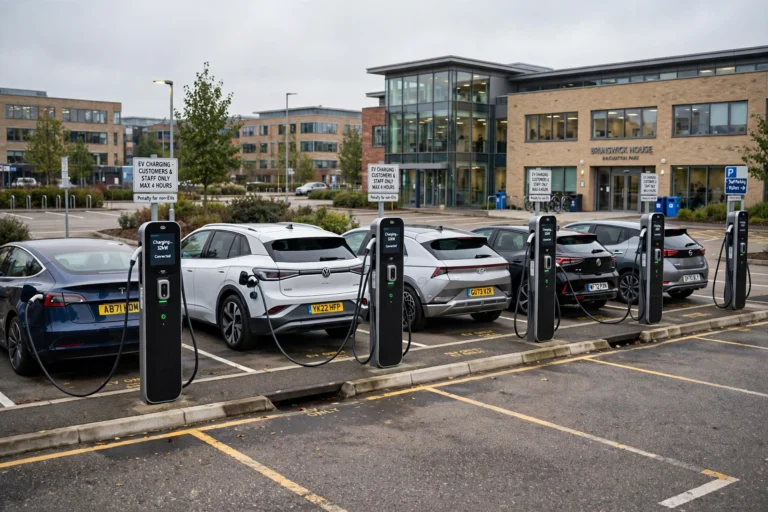
Retailers and malls remain the largest category. Grocery chains, outlet centres and big-box stores fund posts as a customer perk, frequently through ad-supported or network-operated posts in the car park. Sessions are usually Level 2, often limited to two hours, and occasionally tied to a minimum spend or a store app during promotions. Reliability is the weak point: retail posts get knocked, blocked by non-charging cars, or left broken for weeks, so treat any single retail post as a pleasant surprise rather than a promise.
Hotels are the most underrated category on any road trip. A large and growing share of US hotels now run free Level 2 posts for guests, and an overnight stay is the one dwell time that perfectly suits slow charging: plug in at dinner, unplug at breakfast with a full battery. This is a firm opinion you are welcome to steal — when two hotels are equal on price and location, book the one with free charging, and tell the front desk it decided your booking. Hosts expand perks that guests name. Call ahead to confirm the post works and whether it needs a key card.
Casinos fund free charging for the same reason hotels do, with longer sessions and, often, valet or garage posts that stay free for players and guests. Municipal chargers are the quiet achievers: city halls, libraries, community centres and park-and-ride lots in many towns still run free posts, often grant-funded, sometimes simply priced at zero years ago and never revisited. Car dealers commonly let owners of their own brand charge free at the dealership, and some extend it to any EV while you browse; opening hours are the limit. Universities, hospitals and large employers’ visitor bays round out the list — patchy, locally variable, and exactly the sort of thing the finder tools in section seven surface well.
Step Two: Your Workplace Might Be the Best Charger You Never Pay For
Of every category in this guide, workplace charging is the one worth asking for by name. It is the only category of free car charging stations bolted to the longest, most predictable dwell time in your week, it repeats two hundred-plus times a year, and employers increasingly treat posts as a cheap, visible staff benefit. If your workplace has posts in the car park, use them as your primary charger and let home charging become the backup. If it has none, the business case below is the one to put in front of your facilities manager, because the numbers are smaller than most people assume.
Run the value first, with plain arithmetic. Say your car takes a 20 kWh top-up during a workday — roughly what a 65-mile round commute uses. You are in the office three days a week, 48 weeks a year:
20 kWh × 3 days × 48 weeks = 2,880 kWh per year.
2,880 kWh × $0.17 per kWh (est., about the current US residential average) = $489.60.
That is roughly $490 a year of home electricity you never buy, for plugging in a car you had already driven to work. Measured against public DC fast charging at around $0.48 per kWh (est.), the same energy would cost about $1,382 a year. Even at two days a week the saving lands near $326, which is a real bill, not a rounding error.
Our full electric car cost per mile breakdown shows how these per-kWh gaps compound across a year of driving. Some employers charge a small fee instead, and plenty cap sessions at four hours with a rotation list; a small fee still leaves most of the saving intact, so do the same two sums with your employer’s rate before dismissing it.
Practical notes, because workplace posts have their own etiquette. Ask facilities how the posts are activated — many run on ChargePoint with a free employee group you join once. Move the car at lunch if your site runs a rotation; nothing kills a workplace scheme faster than one car camping all day at 100%. And if you are the one proposing the scheme, start small: two posts and a waiting list is a pilot any manager can approve, and the second year sells itself with the usage data from the first.
Step Three: What Happened to the Free Car Charging Stations With the Big Screens?
The tall posts with advertising screens were built by Volta, which grew to more than 3,000 charge points across 31 states on a simple model: the screen earned the money, so the driver paid nothing. Shell bought Volta in 2023 for $169 million, then wound the company down in early 2024 and folded its posts into the Shell Recharge network, keeping the Volta Media name only for the advertising side. In November 2025 Shell agreed to sell a substantial portion of that media network to JOLT, an ad-funded charging operator from Australia, and the deal closed on January 1, 2026, covering thousands of sites across up to 34 states.
What does that mean at the kerb in October 2026? The posts are still there, mostly at the same grocery stores, pharmacies and malls. The branding above the screen may say Volta, Shell Recharge or JOLT depending on your state, and the pricing is now set site by site: many posts still include a limited free session, and a growing number bill by the hour or the kilowatt-hour. JOLT’s model in its other markets pairs the ad screen with a modest free daily allowance for drivers, which is a fair template for where this network is heading — free survives, unlimited free does not.
The habit to build is checking the price on the post or in PlugShare before you plug in, especially at a screen post you have used free for years.
Step Four: Free Charging That Arrives With the New Car
Bundled charging plans are a different species from public free car charging stations: they are prepaid fast charging bundled into a new car’s price, delivered through the Electrify America network, and they are the most valuable form of free charging most owners will ever hold. The shapes differ by brand, and the differences matter, so here are the verified structures as of October 27, 2026.
Hyundai Ioniq 5 buyers get two years of unlimited 30-minute complimentary DC fast charging sessions (60 minutes at Level 2), starting on the purchase date, with a 60-minute wait required between free sessions and idle fees still billed to the owner — Electrify America’s published disclosure for the Hyundai Ioniq 5 charging plan spells out those terms in full; read it before your first session.
Genesis goes further on time: the GV60 and the Electrified GV70 each carry three years of complimentary 30-minute charging sessions. Kia chose energy over time: EV6 buyers receive 1,000 kWh of complimentary charging to use within three years, which Kia equates to roughly 3,500 to 4,000 miles of driving. Ford kept it small, with 250 kWh of DC fast charging included for Mustang Mach-E and F-150 Lightning buyers, used through the FordPass app.
Put a price on these before you shrug at them. At an (est.) $0.48 per kWh for public DC fast charging, Kia’s 1,000 kWh is about $480 of electricity. The Hyundai and Genesis session plans are worth more to a road-trip driver: a single 30-minute session on a high-power charger can deliver 40 kWh or more, worth around $19 (est.) a time.
Three habits protect the money. Enrol in the plan in the app within the window your dealer paperwork states, because the clock runs from the purchase date regardless. Learn where your nearest Electrify America site sits on your regular routes, since a plan you have to detour to is a plan you will underuse. And watch the idle-fee rule: the electricity is free, the ten minutes after a full charge are not.
The Maths Nobody Does: What a Free Charge Is Actually Worth
Now the section that saves you from the one genuinely bad free-charging habit: the special trip. A free car charging station 15 minutes out of your way sounds like a bargain until the stopwatch joins the conversation. Take a typical case. You drive 15 minutes each way to reach it — about 8 extra miles (est.) — and sit through a two-hour Level 2 session at 7.2 kW.
Energy gained: 2 hours × 7.2 kW = 14.4 kWh.
Energy burned getting there: 8 miles × 0.30 kWh per mile = 2.4 kWh.
Net gain: 14.4 − 2.4 = 12 kWh, worth 12 × $0.17 = $2.04 at home prices.
Time spent: 30 minutes of driving. Value your time at just $15 an hour and that is $7.50.
Result: $7.50 − $2.04 = $5.46 spent to collect free electricity.
Compare the grocery stop on your normal route. A 45-minute shop at the same 7.2 kW post adds 5.4 kWh, worth about $0.92, and costs you zero extra minutes because the shopping was happening anyway. Ninety-two cents is small money. It is also real money, repeated weekly for years, with no effort attached. That contrast is the whole philosophy in one pair of sums: free charging pays when it rides along with your life and charges you when it asks for its own trip. Driving across town to save two dollars of electricity is a hobby. Hobbies are fine. Just budget for it as one.
Our Verdict on Free Car Charging
Our score: 6/10 — Real availability: 7/10. Money saved: 6/10. Hassle: 4/10 (expect apps, time limits and the odd dead post).
The score needs its sentence of defence. Free charging in 2026 is neither the generous early-days giveaway nor a dead idea; it is a solid perk with sharp edges. Availability scores well because retail, hotel, municipal and workplace posts keep multiplying. Money saved scores mid because the honest ceiling for most drivers is a few hundred dollars a year, not the thousands “free fuel” suggests. Hassle scores lowest because every network wants its own app, its own activation ritual and its own time limit. Drivers without home charging should still build their routine around it; the finder steps below are written with you in mind.
How to Find Free Car Charging Stations Near You in About Five Minutes
Step 1. Start with the map you can trust most. The US Department of Energy’s Alternative Fuels Data Center guide to electric vehicle charging stations leads into its Station Locator, whose listings include each station’s pricing — free posts are labelled as such — along with connector type, access hours and network. Search your home, your workplace and your three most common destinations rather than your whole city.
Step 2. Cross-check the shortlist in PlugShare. Its price filter isolates free stations, and the check-in comments underneath each listing are where you learn that a post is broken, blocked after 6 pm, or reserved for customers. A free charger with three recent successful check-ins beats a free charger with a silent page every time.
Step 3. For any post on a network such as ChargePoint, open the session screen before you plug in and confirm the price reads $0.00. Hosts can change pricing at any time, and the app always knows before the sign on the post does. Our own step-by-step guide to finding EV charging stations walks through the same tools with road trips in mind if you want the longer version.
Step 4. Save your confirmed posts into one list in your maps app, labelled by where they fit your week: shop, gym, work, hotel route. Five minutes of sorting now is what turns “there might be a free one somewhere” into a routine that quietly pays you back every week.
Frequently Asked Questions
Are free car charging stations really free, or is there a catch?
Mostly, really free. The catches are conditions rather than charges: time limits of two to four hours, customers-only rules, an app registration, or a free first session followed by a per-hour fee if you stay longer. A smaller number run promotions that end, which is why the ten-second price check in the app before you plug in matters.
How fast do free charging stations charge?
Slowly, by design. Nearly all are Level 2 posts between about 6 and 11.5 kW, adding roughly 20 to 40 miles of range per hour depending on the car. A handful of ad-supported DC fast chargers exist, and the bundled new-car plans in section four are genuinely fast; plan around Level 2 speeds and treat any fast session as a bonus.
Can I rely on free charging if I have no home charger?
Yes, with a routine rather than a hope. Anchor the week on the two or three posts matched to your longest regular stops — work first, then a supermarket or gym — and keep one paid public charger identified as a backup for the weeks the routine breaks. Apartment drivers do this successfully in every large US city; the ones who struggle are the ones improvising nightly.
Is it rude to charge at a business I am not buying from?
Follow the sign on the post. Posts marked for customers are part of that business’s offer, and using one while shopping elsewhere is the sort of behaviour that gets free posts switched off. Unmarked municipal and public posts carry no such expectation. When in doubt, a two-minute question at the desk settles it and often reveals the post needs a code or a key card anyway.
Will using free Level 2 charging harm my battery?
No. Gentle Level 2 charging is the kindest way to fill an EV battery, kinder than repeated DC fast charging. The honest limit is convenience, not battery health: fill when the stop suits you, unplug when the session ends, and your pack will not know the electricity was free.
One last piece of ordering before you go hunting. Free charging works best as the second layer of a charging life, not the foundation. If you have any parking spot with power, even a plain household socket covers most overnight needs — our guide to charging an electric car with a regular outlet covers what that realistically delivers — and when you do fit a proper home charger, our EV charger sizing calculator matches the circuit size to your car and panel in about a minute. Build the home layer first, let free car charging stations pay you back on top of it, and the whole system runs itself.
If you are still weighing free car charging stations, start with the free car charging stations on routes you already drive, and let free car charging stations that fit your weekly stops do the quiet work. That routine is how free charging stays useful instead of becoming another errand.
For most drivers, the best free car charging stations are the free car charging stations you pass every week, not the free car charging stations you chase across town. Stick with free car charging stations that fit your routine, and free charging will stay a bonus rather than a chore.