Last updated: October 27, 2026
Most people shopping for a fast electric bike are looking at the wrong number. They read the top speed, nod, and hand over money. On a trail, top speed is nearly worthless. Descents are gravity. Flats are short. The speed that decides whether you clean a climb or push your bike up it in shame is climbing speed, and climbing speed is bought with torque, support percentage and traction — not with a brochure number measured on a closed road.
Here is the uncomfortable part nobody at the dealership volunteers. A current full-power e-MTB is already faster uphill than most riders are fit. The motors have outrun the trails, the tyres and, in plenty of places, the law. What has not kept up is the range honesty. Ride one of these bikes the way the marketing department rides it in the launch video and the battery dies in distances that would embarrass a commuter bike.
This guide does three things. It explains what fast actually means in newton-metres and watts per kilo. It runs the range maths using standardized tests instead of claims. And it draws the legal line in plain language, because a derestricted bike on the wrong trail is not a victimless shortcut — it is how trail systems get closed to every e-bike, including the legal ones.
Torque first. Everything else is decoration.
Fast Electric Bike Speed Is a Torque Number, Not a Top Speed
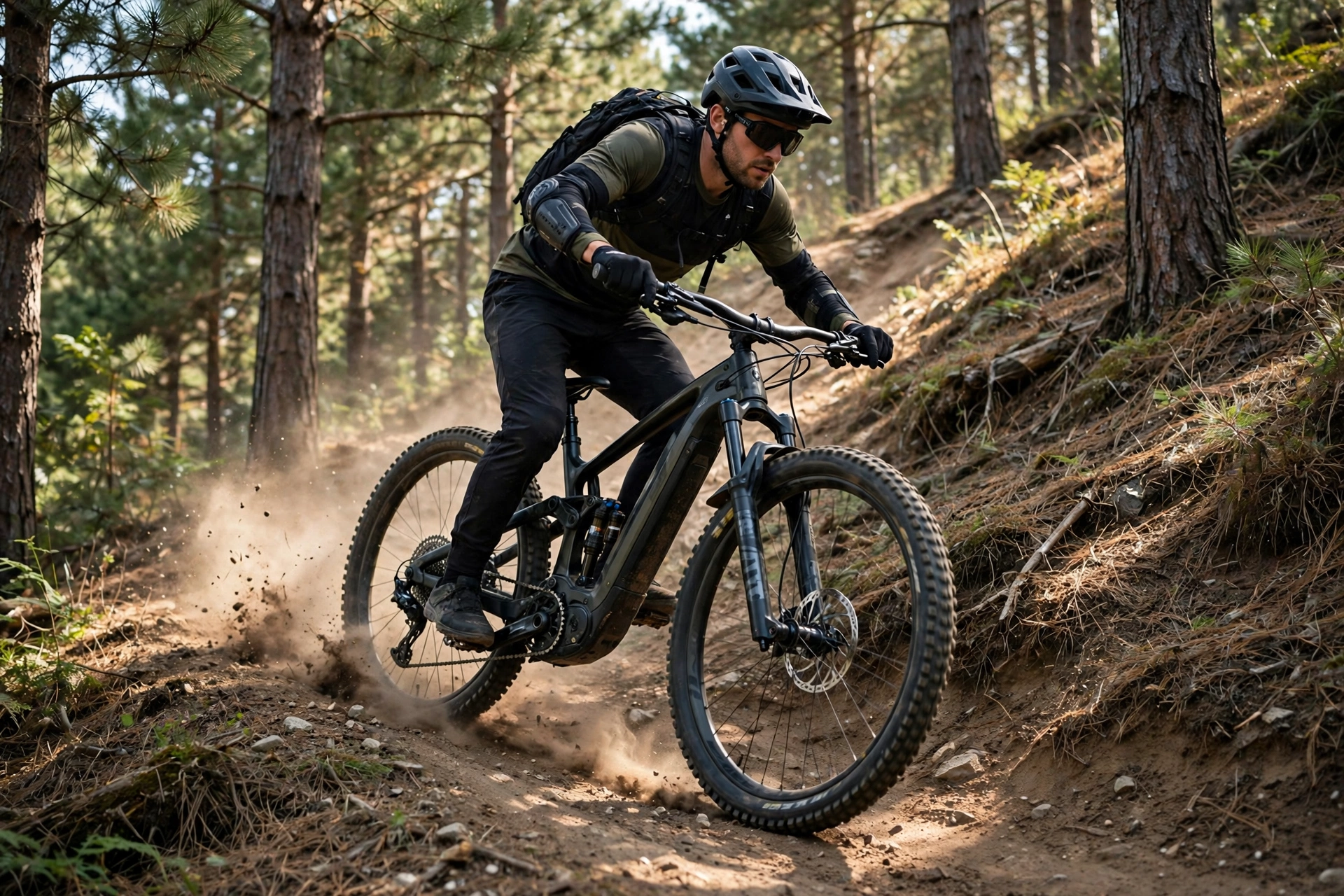
Torque is the twisting force the motor puts through the cranks, measured in newton-metres (Nm). Support percentage is how hard the motor multiplies your legs: 400% support means your 100 watts of pedalling becomes 500 watts at the wheel. On a 25% grade covered in wet roots, those two figures are the whole game. The motor either holds traction and drags you up, or it spins the wheel, stalls, and leaves you clipped in at the worst possible angle.
The current state of the art, checked October 27, 2026, looks like this. DJI’s Avinox M1, fitted to the Amflow PL Carbon, makes 105 Nm continuously with 850 watts of peak power, and a 30-second Boost mode that jumps to 120 Nm and 1,000 watts. Specialized’s 3.1 motor in the Turbo Levo 4 makes 101 Nm and 666 watts in standard tune and 111 Nm with 720 watts in S-Works tune.
Bosch’s Performance Line CX (fifth generation) left the factory at 85 Nm and 600 watts, was updated to 100 Nm and 750 watts in 2025, and Bosch’s own performance-upgrade page now lists a 2026 “upgrade 2.0” taking it to 120 Nm. Shimano’s EP801 sits at 85 Nm and has not joined the arms race.
Raw torque still lies, though, because it ignores the bike hanging off the motor. Divide torque by weight and the pecking order sharpens up:
Amflow PL Carbon Pro: 105 Nm ÷ 19.2 kg (Amflow’s claimed weight) = 5.5 Nm per kilo. Specialized S-Works Turbo Levo 4: 111 Nm ÷ 23.7 kg (weighed by Pinkbike at 52.3 lb) = 4.7 Nm per kilo. Norco Range VLT CX: 100 Nm ÷ 23.46 kg = 4.3 Nm per kilo as shipped, rising to 120 ÷ 23.46 = 5.1 Nm per kilo once the Bosch upgrade is applied. The DJI system wins this metric by a wide margin, and it wins it the honest way: a 2.52 kg motor and a light frame, not a fatter battery.
One more number matters on real climbs: traction control. Power you cannot put down is wheelspin. Specialized publishes a repeatable climb test in which the Levo 4 cleared a technical climb 92% of the time against 84% for its nearest rival. That gap — failed attempts doubling from 8 in 100 to 16 in 100 — is worth more on a greasy ledge than another 10 Nm on a spec sheet. Buy the delivery, not the headline.
The Legal Line Every Fast Electric Bike Sits Behind
Keep this section short in your head, because the rule is short. In the US class system, a bicycle-class e-bike has a motor of 750 watts or less. Class 1 is pedal-assist only, cutting out at 20 mph. Class 2 adds a throttle, still 20 mph. Class 3 is pedal-assist to 28 mph and belongs on roads and bike lanes, not singletrack.
The moment a bike exceeds those limits — more power, a throttle past 20 mph, a limiter that has been switched off — it stops being a bicycle in the eyes of the law and becomes an unregistered motor vehicle. Our fastest e-bike guide covers the road-speed end of that world; on dirt, the class label on the frame is your passport and your liability.
Europe draws the same line lower. A pedelec there is 250 watts of continuous rated power with assistance ending at 25 km/h, and it is treated as a bicycle. Anything stronger or faster is an L1e moped: registration plate, insurance, helmet, driving licence. There is no grey zone, and police in Germany and the Netherlands run roadside checks with roller test benches. A tuned pedelec caught in that net is an unregistered, uninsured motor vehicle, and the penalties are written for exactly that offence.
Honest Range: What a Fast Electric Bike Really Does in Turbo
Now the part the brochures hope you skip. Amflow advertises up to 157 km — 98 miles — from the PL Carbon’s 800Wh battery. That figure implies consumption of 800 ÷ 98 = 8.2 watt-hours per mile, a number achievable in Eco mode, on the flat, with a fit rider doing most of the work. It tells you nothing about riding the bike as a fast electric bike.
Outdoor Gear Lab runs the test the industry avoids: same course, same rider weight, battery-draining Turbo mode, rider pedalling at a steady 100 watts. In that test, the Amflow PL Carbon Pro covered 28.1 miles with 5,654 feet of climbing before the battery died. Do the division: 800 Wh ÷ 28.1 miles = 28.5 Wh per mile. The Specialized Turbo Levo 4, on its bigger 840Wh battery, managed 27.2 miles and 5,485 feet of climbing on the same protocol: 840 ÷ 27.2 = 30.9 Wh per mile.
MBR’s separate vertical test tells the same story in metres — a Turbo Levo 4 Pro climbed 1,633 m before expiring, an Amflow PL Carbon 1,430 m. Full assist, real trails: roughly 27 to 28 miles and about 1,400 to 1,600 metres of climbing. That is the honest ceiling for this entire class of bike, whatever the box says.
So the planning rule is simple. Take any full-power e-MTB, divide its battery by roughly 29 Wh per mile, and you have its full-assist trail range within a mile or two. A 750Wh bike gives you about 26 hard miles. A 600Wh bike gives you about 21. Drop to Trail mode and ride like a person on a long-distance route — the approach in our electric bike trekking guide — and consumption roughly halves. Turbo is a climbing tool, not a cruise setting, and riders who treat it as one spend their afternoons pushing a 50-pound bike uphill.
Three Fast Electric Bike Picks That Earn Their Numbers
DJI Amflow PL Carbon Pro — Our score: 8.6/10. Torque & drive: 10/10. Honest range: 7/10. Value: 8/10. The Avinox motor is the benchmark now: 105 Nm continuous, 120 Nm in Boost, 800% maximum support, in a bike Amflow claims at 19.2 kg. It posted the best tested range of this trio in Outdoor Gear Lab’s Turbo protocol, 28.1 miles, and its 800Wh battery charges from a 508W fast charger quicker than rivals.
US pricing checked October 27, 2026: $7,499 for the PL Carbon, $10,199 for the Pro. The base bike shares the motor and is the smarter buy; the Pro’s premium goes on components, not power. Weaknesses are real — a young dealer network and an unproven long-term parts pipeline — and neither is a reason to pretend the motor is anything other than the best currently sold.
Norco Range VLT CX C1 — Our score: 8.2/10. Torque & drive: 8/10. Honest range: 7/10. Value: 8/10. A 170/160 mm high-pivot e-enduro sled running Bosch’s fifth-generation CX and the biggest battery Bosch sells, 800Wh. It ships at 100 Nm and 750 watts; apply Bosch’s upgrades and the same motor reaches 120 Nm.
No standardized full-assist range test of this bike was available at the time of writing, so plan on 800 ÷ 29 = roughly 27 miles (est., using the 28.5–30.9 Wh-per-mile consumption Outdoor Gear Lab measured on comparable full-power bikes). Pricing checked October 27, 2026: $7,299 for the C2 build, $8,999 for the C1. Bosch’s dealer coverage is the deepest in the business, which matters when a motor fault appears two days before a trip.
Specialized S-Works Turbo Levo 4 — Our score: 7.8/10. Torque & drive: 9/10. Honest range: 7/10. Value: 5/10. The traction control is superb, the 840Wh battery is removable, and 111 Nm is plenty. But understand what the $13,499 price (checked October 27, 2026; the Levo 4 range starts at $7,999) actually buys.
The S-Works and standard 3.1 motors are the same hardware; the extra 10 Nm and 54 watts are a firmware setting, and Specialized offers no upgrade path from one tune to the other. Paying a four-figure premium for a software slider is a tax on impatience.
The standard-tune Levo 4 at 101 Nm is the same trail weapon with a fairer price. One caution if you park this bike next to a car charger in the garage: extender packs and second batteries multiply your charging kit fast, so run any shared setup through our EV charger compatibility checker before you start drilling holes in walls.
Off-Road Mode, Dongles and Derestriction: How It Works, What It Costs You
Derestriction comes in three flavours. Some budget brands hide an “off-road mode” in the display menu that lifts the speed limiter, sold with a wink and a “private land only” disclaimer. Tuning dongles intercept the speed-sensor signal and report half your real speed to the motor, so the 20 mph cutoff arrives at 40. And app-based tunes rewrite the motor’s limits directly on systems that allow it.
Contrast that with the front door. Bosch — the most conservative name in the industry — now sells its CX motor at 85 Nm and hands owners a free, manufacturer-approved path to 100 Nm, then 120 Nm, through its own performance upgrade programme. The upgrade keeps the warranty, keeps the speed limiter, and keeps the bike a bicycle. When the industry’s lawyers let you add 35 Nm legally, the dongle has no defence left.
What a dongle actually buys you: a voided motor warranty, because Bosch’s system logs implausible speed and cadence data and can throw error 504, dropping the motor into a limp mode that needs a dealer reset; accelerated wear on chains, cassettes and tyres that were specced for legal power; and personal liability, because the moment you crash an unregistered motor vehicle into a hiker, your insurance company will read the tuning forum posts too.
On public land the calculus is worse. Land managers already fighting over e-bike access treat every derestricted bike photographed on their trails as evidence against the entire category. Chip your bike if you like. Just know you are spending other people’s trail access to do it.
Where a Fast Electric Bike May Actually Be Ridden
Access is a patchwork, and the patch you are standing on decides. Start with the strictest landlord. The US Forest Service classifies every e-bike, Class 1 included, as a motor vehicle. On national forest land you may ride motorized trails and roads, plus any non-motorized trail a forest has specifically designated for e-bikes — and the Motor Vehicle Use Map, not an app, is the legal document. A proposed Forest Service rule that would reclassify Class 1 e-bikes alongside ordinary bicycles went through public comment in 2026 and remains a proposal, not the law on the ground. Ride to the MVUM, not to the press release.
Interior Department land is friendlier. Since Secretarial Order 3376, the BLM, National Park Service and Fish & Wildlife Service generally allow e-bikes where ordinary bikes are allowed, with local managers free to restrict — many parks limit Class 3 to paved roads, and superintendents publish their own lists. Designated Wilderness is the absolute line: no e-bikes of any class, anywhere, ever. State parks, trail associations and bike parks mostly converge on one rule: Class 1 only, pedal-assist, 20 mph. That is why every serious pick in this guide is a Class 1 machine in its US tune. The full access picture, including throttle bikes and dirt-specific rules, sits in our e-bike dirt guide.
The pattern to internalise: power is rarely what gets a bike banned. Speed differential and throttles are. A 120 Nm Class 1 bike ridden at bicycle speeds bothers nobody. A derestricted throttle bike carving up a hiking trail at 35 mph gets a whole trail network re-signed by spring.
Fast Electric Bike Questions, Answered Straight
How far does a fast electric bike really go on one charge in Turbo mode? About 27 to 28 miles with roughly 5,500 feet of climbing, for the current 800–840Wh generation. That is not opinion; it is Outdoor Gear Lab’s standardized range testing, where the Amflow PL Carbon Pro recorded 28.1 miles and the Turbo Levo 4 recorded 27.2. Any claim north of 60 miles assumes Eco mode and a rider doing most of the work.
Is torque or top speed more important on an e-MTB? Torque, and it is not close. Trail speed is set by terrain and nerve, not by the limiter. Torque plus traction control decides whether steep, loose climbs are rideable at all. A 105 Nm bike at 5.5 Nm per kilo will out-climb a heavier 111 Nm bike on anything technical.
Is it legal to derestrict an e-bike for private land? On genuinely private land with the owner’s permission, land-use law is usually not the problem. Your warranty, your insurance and the motor’s own anti-tuning software still are. The instant the bike touches a public road or trail in derestricted form, it is an unregistered motor vehicle in the US framework and an unregistered moped under EU rules.
Does the Bosch 120 Nm upgrade cost anything? No. The performance upgrades for the fifth-generation Performance Line CX are delivered free through the eBike Flow app, in stages: 100 Nm and 750 watts from the 2025 upgrade, 120 Nm from upgrade 2.0. Your bike’s manufacturer has to enable the upgrade for your model, and Bosch warns plainly that higher output means faster drivetrain wear and shorter range per charge.
Can I ride a Class 1 e-MTB on national forest singletrack? Only where that forest has designated the trail for e-bike use or where the trail is already open to motorized vehicles. The Forest Service treats e-bikes as motor vehicles by default, and its Motor Vehicle Use Map is the authority. Check the map for the specific forest and district before you load the car.
Why do brands quote range in hours instead of miles? Because hours sound bigger. “Up to 4.75 hours” of range, as Specialized quotes for the S-Works Levo 4, could mean 47 miles of gentle trail or 19 miles of Turbo-mode climbing, and the brochure is under no obligation to say which. Convert every claim to watt-hours per mile yourself, or trust a draining test from someone who did.
The Bottom Line on Fast
A fast electric bike in 2026 is a torque delivery system with a battery problem. The motors — Avinox at 105 Nm continuous, Bosch’s CX upgradable to 120 Nm, Specialized’s 3.1 at up to 111 Nm — have more climbing force than tyres can use. The batteries have not kept pace, and at full assist every one of these machines is a 27-mile bike wearing a 98-mile brochure.
Ride them in Trail, save Turbo for the climbs that need it, keep the limiter where the law put it, and the current generation is the best off-road machinery ever bolted to a set of cranks. Derestrict one, and you are not a rebel. You are a closure notice with a helmet on.