Last updated: October 25, 2026
Start with the only numbers that matter. The grant pays up to £500 per socket. It covers at most 75% of your purchase and installation bill, VAT included. You can claim for up to 40 sockets across every site you operate, and the scheme shuts for good on 31 March 2027. If you arrived here searching ozev workplace charging scheme how to apply without wading through installer sales pages, this guide walks the whole route: who qualifies, what the money really covers, the exact order of steps, and the mistakes that get claims rejected.
One thing to fix in your head before anything else. This is a United Kingdom scheme, run by OZEV (the Office for Zero Emission Vehicles) and administered day to day by the DVLA. Every figure below is in pounds sterling, checked October 25, 2026 against GOV.UK, following the checking process we set out on our how we research page. Reading from outside the UK? The grant itself will not apply to you. The arithmetic habits in this guide still will.
Now the warning. Install first and apply later, and you receive nothing. The grant is never retrospective, not for one socket, not ever. Your application has to be approved before your installer drills a single hole.
There is also a clock, and it is shorter than most facilities managers expect. From 1 April 2026 the scheme is in its final year. That sounds generous until you price in surveys, landlord consent, an installer with a free slot, and a voucher that expires 180 days after it is issued. Work backwards from 31 March 2027 and the comfortable window is really the next few months.
So. The money first, then eligibility, then the application steps in the only order that works.
The money: £500 per socket, 75% of the bill, whichever is smaller
Two limits govern every claim, and the smaller one wins. Limit one: the scheme pays 75% of the total cost of buying and installing your chargepoints, including VAT. Limit two: it pays no more than £500 per socket. Divide £500 by 0.75 and you get the break-even point: £666.67 per socket. Install a socket for less than that and the 75% rule decides your grant. Install for more — which most real installs do — and the £500 cap decides it.
Run the cheap end. A simple wall-mounted 7kW socket installed for £600 earns 75% of £600, which is £450. Run a typical end. A socket installed for £2,000 (est., a mid-range figure for commercial posts once cabling and groundworks are in) has a 75% value of £1,500, but the cap cuts the grant to £500. At that point the state is covering 25% of your bill, not 75%. The 75% headline is real only on bargain installs. Budget on £500 and treat anything above it as fiction.
Sockets are counted per socket, not per post. A dual-socket post on a single pedestal counts as two sockets, so it can attract up to £1,000. The 40-socket ceiling applies per applicant across all sites: 40 sockets at one head office, or four sockets at each of ten depots, or one socket at each of 40 sites. All of it comes out of the same pot. Maximum theoretical grant: 40 × £500 = £20,000.
You never touch the cash. The grant works as a discount administered through your installer, who claims it back from the DVLA after the work is done and evidenced. Your invoice arrives with the grant already netted off. Any installer asking you to pay in full and “sort the grant out later” is telling you, in plain language, that they do not understand the scheme.
Schools, sit up for one paragraph only. State-funded schools, academies and colleges have a separate version of the scheme with a far bigger number attached: up to £2,000 per socket from 1 April 2026, down from £2,500 before that date, also ending 31 March 2027. Independent schools use the standard scheme described here. GOV.UK’s guidance on the April 2026 grant changes sets out the rate rises and closures across the whole grant portfolio, and it is the page to re-check before you commit money, because rates have already moved once.
Ozev workplace charging scheme how to qualify: the checks that actually decide it
Eligibility is a list of gates, and every gate has to open. The applicant must be a registered business, a charity, a public sector organisation or a small accommodation business — hotels and B&Bs were added to that list, which surprises people. The organisation must be based in England, Scotland, Wales or Northern Ireland. The Channel Islands and the Isle of Man are out.
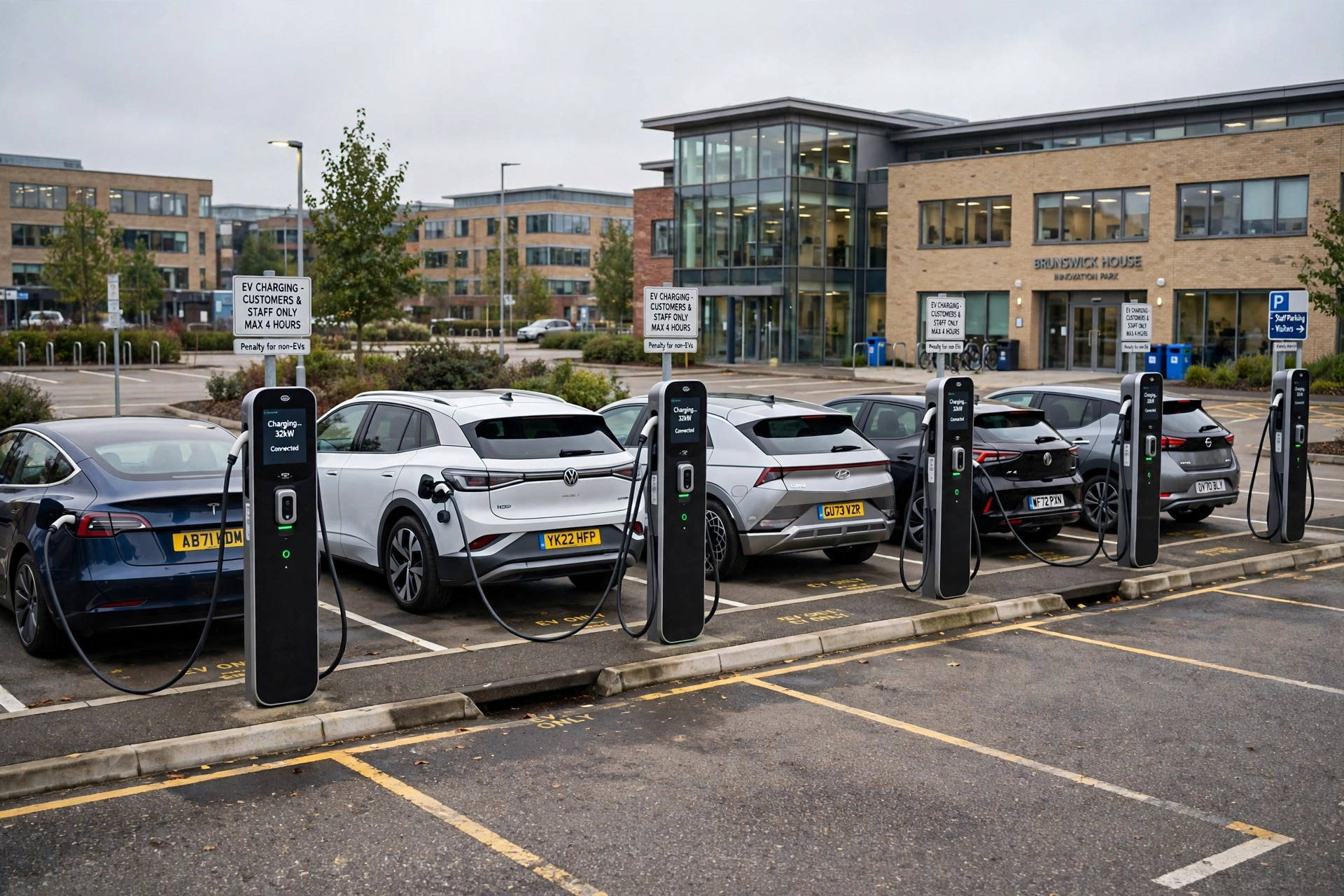
Your site needs dedicated off-street parking that is clearly associated with your premises. A leased corner of a shared public car park will not do. The chargepoints are for staff and fleet vehicles; this is not a grant to build a public charging business. You must own the property, or hold written consent from the landlord for the installation at every site on the application. No consent letter, no voucher. Start that conversation early, because landlords move at landlord speed.
You also declare a need: vehicles you already charge, vehicles on order, or a genuine intent to encourage staff uptake of electric cars. You do not need a fleet of EVs sitting outside on day one. What you cannot do is install speculatively at a site with no connection to your organisation and hope nobody asks.
Two further gates catch people out. First, the installer must be authorised by OZEV for this scheme, and authorised before the work starts. A competent local electrician who is not on the authorised list kills the claim stone dead.
Second, the chargepoints themselves must be models on the scheme’s approved list, and the technical specification sets a floor: each socket must be capable of delivering at least 3kW, and chargepoints need smart functionality so charging can be managed and measured. Finally, expect to declare other public funding your organisation has received; there are cumulative limits on state support, and the application asks. That is the whole of the ozev workplace charging scheme how to qualify checklist — and nothing on it is optional.
Ozev workplace charging scheme how to apply: the six steps, in order
People fail this process by reordering it. Knowing the ozev workplace charging scheme how to apply sequence matters because steps two and five cannot be swapped: approval first, installation second, every time. Here is the sequence that works.
Step 1: Survey the site before you touch a form
Get an OZEV-authorised installer to walk the car park first. They confirm the parking qualifies, count the sockets the site can sensibly take, and — the part everyone skips — check whether your electrical supply can feed them. Ten 7kW sockets firing at once is a 70kW draw before load management. If your incoming supply cannot carry that, your real choices are fewer sockets, managed sockets, or a supply upgrade that costs more than the chargers. Sizing the load properly at this stage is exactly what our EV charger sizing calculator is built to sanity-check before quotes arrive.
Step 2: Apply through the government’s grant service
The application itself lives on the government’s Find a grant service, on the Workplace Charging Scheme page, which carries the current eligibility text and the route into the application. You will give the organisation’s details (a Companies House reference, VAT registration or equivalent evidence for charities and public bodies), the sites involved, and the number of sockets you want at each. One application can span several sites, but remember the 40-socket ceiling is shared across all of them.
Step 3: Wait for the eligibility decision — and install nothing
GOV.UK estimates that applications and claims on the current platform take up to 10 working days to assess (checked October 25, 2026). Two weeks, roughly. During that window your only job is patience. The rule is blunt: your chargepoints must not be installed before OZEV confirms you are eligible, and your installer gets notified at the same time you do.
Step 4: Receive your voucher and watch the clock
Approval arrives as a unique voucher code. From the day it is issued you have 180 days to get the installation completed and the claim submitted. Vouchers cannot be transferred to another organisation, and work done before a replacement voucher exists does not count if yours lapses. If a project slips, talk to the scheme administrators at the DVLA before expiry, not after — a part-finished install can be claimed for the sockets that were completed, with a fresh application for the rest.
Step 5: Install, using approved chargepoints only
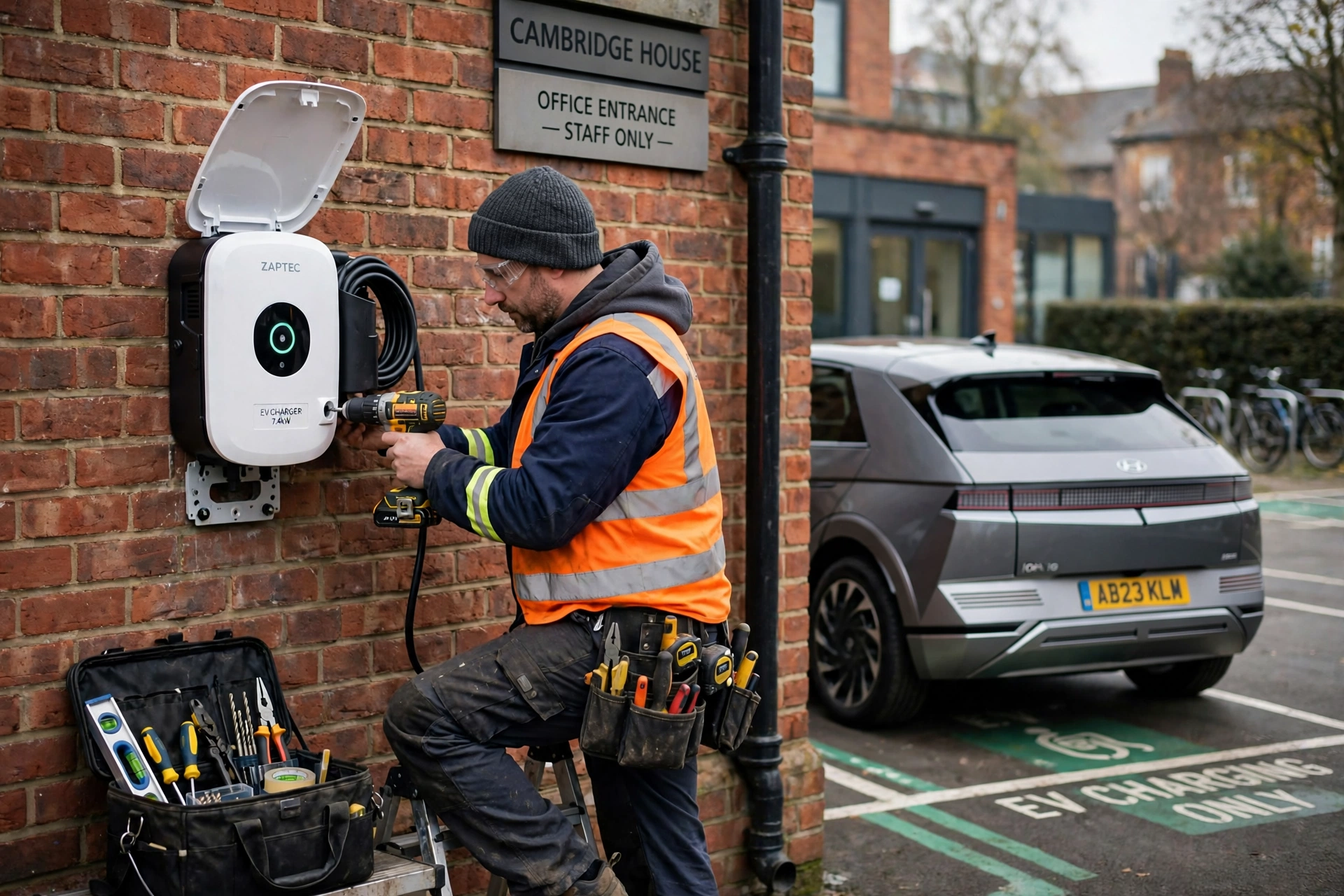
Your authorised installer fits chargepoints from the approved list, at the sites and socket counts on your voucher. Keep the paperwork trail tidy as the work proceeds: invoices that separate hardware from installation, and photographs taken as part of the evidence pack, not as an afterthought.
Step 6: Your installer claims, and the grant comes off your bill
You do not file the money claim yourself. The installer submits it to the DVLA with photographic evidence for each chargepoint — clear shots showing the model, the serial number, and the unit in place serving its off-street parking space. OZEV can audit installations before or after payment, and it does. Once the claim clears, the grant value is settled with the installer and your final invoice reflects the reduced amount. Your involvement ends with a cheaper bill and a set of working sockets.
Ozev workplace charging scheme how to work out your grant: a 20-space car park, priced out in full
Enough theory. Take a small business park unit with 20 staff parking spaces and a plan for 10 dual-socket posts — 20 sockets, one per space. Assume an installed cost of £2,000 per socket (est., mid-range for commercial hardware, cabling and modest groundworks):
- Total project cost: 20 sockets × £2,000 = £40,000
- The 75% test: 0.75 × £40,000 = £30,000
- The cap test: 20 sockets × £500 = £10,000
- Grant paid: £10,000 (the cap wins)
- Your net cost: £40,000 − £10,000 = £30,000, which is £1,500 per socket
Read that again. A grant advertised around “75%” covered 25% of this project. That is not a scam; it is a capped scheme doing capped-scheme things. But anyone who budgeted £10,000 as their share of a £40,000 job, because they skimmed the headline percentage, is now having a difficult meeting with their finance director.
Now the small end. Four sockets at a compact office, installed at £900 each (est., short cable runs, wall-mounted, no trenching): total £3,600. The 75% test gives £2,700; the cap gives 4 × £500 = £2,000. Grant: £2,000. Net: £1,600, or £400 per socket. On cheap, simple installs this scheme is genuinely strong. On heavy groundworks projects it is a contribution, not a solution. Price the trenching before you celebrate the voucher.
Charger speed: ignore the peak number, count the parked hours
Here is where the numbers-first approach saves you the most money. A staff car arrives at 8:40 and leaves at 17:15. That is roughly eight and a half hours plugged in. A basic 7kW socket delivering a steady 7kW across that dwell adds about 55–60kWh (est., allowing for tapering and losses) — more energy than most EVs can even accept overnight at home, and enough for around 190 miles of driving at a typical 3.5 miles per kWh (est.). Your workforce does not need faster. Nobody commutes 190 miles each way.
So when an installer quotes you 22kW posts at double the price, ask what problem they solve. Three-phase 22kW only delivers 22kW to cars whose onboard chargers accept it; a large share of the UK fleet caps AC charging at 11kW or 7.4kW, and those cars will sip at their own limit no matter what the post advertises.
Marketing peaks are not charging curves. For depot fleets turning vehicles around fast, the maths changes — and if you run vans, our guide to electric vans for business covers the fleet side; note the old standalone depot scheme has closed, so the Workplace Charging Scheme is now the route depots use too. For a staff car park, spend the savings on more 7kW sockets instead of fewer fast ones. Coverage beats speed, every working day of the week.
One technical point worth insisting on: load management. Twenty sockets sharing a supply that cannot feed twenty simultaneous full draws is normal, not a defect — smart chargepoints throttle and rotate the available power across the cars plugged in. Over an eight-hour dwell, every car still leaves full or near it. Confirm in writing that your quote includes managed charging. A quote without it, on a tight supply, is a quote for tripped breakers.
Five ways claims die
1. Installing before approval. The classic. The kit is on the wall, the photos are lovely, the claim is worthless. There is no appeals process that resurrects a retrospective install.
2. Using the wrong installer. Your usual electrician may be excellent. If they are not OZEV-authorised for this scheme before work begins, the grant is gone. Check authorisation first, in writing.
3. Fitting chargepoints that are not on the approved list. A bargain unit from an online marketplace that OZEV has not approved earns exactly £0 per socket. The approved list is not a suggestion.
4. Letting the voucher expire. 180 days sounds long in February. It is not long when the groundworks contractor is booked out for six weeks and the supply upgrade needs the network operator’s diary. Installation completed and claim submitted, inside the window.
5. Planning sockets site by site. Your second depot is not a fresh 40. The ceiling follows the applicant, so a multi-site rollout has to be planned as one pot of 40 sockets and £20,000 from the start — another reason the ozev workplace charging scheme how to apply guides that skip the arithmetic set readers up to fail.
Our verdict on the scheme
Our score: 7/10 — Generosity: 6/10. Paperwork: 8/10. Speed: 5/10. The voucher model is genuinely good design: the state pays the installer, the discount lands on your invoice, and the applicant never files the money claim. The £500 cap, though, has only just caught up with what installations actually cost, and on a £2,000 socket it is a quarter of the bill. The speed score takes the hit for the calendar, not the administrators: a final-year scheme, a 180-day voucher, and a hard stop on 31 March 2027 means the ozev workplace charging scheme how to timeline rewards organisations that start this quarter and punishes the ones that form a committee.
My blunt advice? If your car park qualifies, apply now and install the sensible version: plenty of managed 7kW sockets, a surveyed supply, a landlord letter already signed. Do not gold-plate it, do not wait for a better scheme — there is no successor announced, and this one has an expiry date printed on it.
Frequently asked questions
Ozev workplace charging scheme how to apply if we lease our premises?
The same way, with one extra document: written consent from your landlord covering every site on the application. Get it before you apply, because the application expects you to own the property or hold that consent, and chasing a landlord mid-voucher eats your 180 days.
Can we claim for chargepoints we installed last year?
No. The scheme never pays retrospectively. Only installations approved in advance, fitted after your eligibility is confirmed and completed within your voucher’s validity, can be claimed.
How many sockets can one organisation claim?
Up to 40 sockets in total across all sites, worth a maximum of 40 × £500 = £20,000 at the current rate for installations completed on or after 1 April 2026. Installations completed before that date are capped at £350 per socket.
Do visitors and customers get to use the chargers?
The scheme funds chargepoints for staff and fleet vehicles at your premises. It is not designed to fund public charging, and if you start charging the public fees for access you step into a separate set of public chargepoint regulations. Keep workplace charging for the workplace.
We are a state-funded school. Is our grant really bigger?
Yes. State-funded education institutions have a parallel scheme worth up to £2,000 per socket from 1 April 2026 (vouchers issued earlier can be worth up to £2,500), with the same 40-socket ceiling and the same 31 March 2027 end date. Independent schools apply under the standard £500 scheme covered in this guide.
What happens if our voucher expires before the work is finished?
Your installer claims for the sockets completed in time, and you submit a fresh application for the remainder. Work carried out before the new voucher is issued does not qualify, so sequence the phases carefully and contact the DVLA administrators before the deadline rather than after it.
Last word. Grants like this reward the organised and quietly tax everyone else through delay. The sums are simple — £500 a socket, 75% at the cheap end, 40 sockets, one hard deadline. Get the survey booked this week, and the ozev workplace charging scheme how to question answers itself in about ten working days.