Last updated: October 25, 2026
If you only understand one part of an electric scooter, make it this one. The electric scooter battery decides how far you can go, how heavy the scooter feels on the stairs, how long it sits plugged in each night, and — a few years from now — whether the scooter is worth repairing or replacing. Motors get the headlines. The battery does the work, quietly, on every single ride.
Here is the gentle truth that saves people money: you do not need the biggest battery. You need the right size for your actual trips, in a pack built from decent cells, that you can charge somewhere safe and convenient. A pack that is too small leaves you anxious at every hill and every headwind. One that is too big adds weight you will haul up every step and through every doorway. For riders who value comfort and stability, that carrying weight matters far more than the brochure admits.
This guide walks through the numbers slowly, in plain language. What watt-hours actually mean. How far each battery size really goes, using tested figures instead of catalogue promises. How long a pack lasts, what a replacement costs, and how to store yours so it stays healthy for years. At the end we score each battery class honestly, because a clear verdict beats a spec sheet.
One comfort note before the maths. On most scooters the battery sits low in the deck, between your feet, and that low weight actually helps stability while you ride. You feel a big battery when you lift the scooter, not when you ride it. Keep that in mind whenever a large pack sounds intimidating — the riding is fine. The carrying is the real test.
Electric scooter battery sizes: the three numbers that matter
Every pack is described by three numbers, and only one of them tells you how much energy you are buying. Volts (V) describe the electrical pressure of the system — 36V on most commuters, 48V or 52V on stronger models, 60V and 72V on performance machines. Amp-hours (Ah) describe how much charge the pack holds at that voltage. Multiply the two and you get watt-hours (Wh), the size of the fuel tank. Wh is the only fair way to compare packs across brands.
The arithmetic is simple enough to do on any spec sheet. The Segway Ninebot Max, the commuter benchmark, runs a 36V pack rated at 15.3Ah. So: 36 × 15.3 = 550.8, which Segway rounds to a 551Wh battery — Segway’s own specification page lists exactly that figure for both the Max G30 and the newer Max G2. Our detailed Segway Ninebot Max G30P guide covers the scooter built around that pack.
Real packs on real scooters fall into four rough bands. Entry-level scooters carry about 187 to 281Wh — the common 36V 7.8Ah commuter pack works out to 280.8Wh. Mainstream commuters sit between roughly 350 and 650Wh: the TurboAnt X7 Pro carries 360Wh, the Ninebot Max carries 551Wh. Long-range models run from about 650Wh up past 1,500Wh. And the performance flagships are in another world entirely — the original Dualtron Thunder stored 2,100Wh (60V × 35Ah), the Kaabo Wolf King GT stores 2,520Wh (72V × 35Ah), and the Dualtron Thunder 2 stores 2,880Wh (72V × 40Ah). That is more energy than some small e-bikes carry, five times over.
Voltage deserves one calm warning. A higher voltage does not automatically mean a better scooter for you. It usually means a faster, heavier, more expensive one. For flat city trips at legal speeds, a well-built 36V pack is not a compromise. It is often the sensible choice.
From watt-hours to real miles: what an electric scooter battery really delivers
Range claims are where buyers get misled, so let us convert energy into distance the way testers do. A scooter ridden gently, in an eco mode on flat ground, uses roughly 15 to 20 watt-hours per mile. Ridden briskly — full commuting speed, stop-and-go traffic, a few hills — consumption climbs to about 25 to 35 watt-hours per mile. Independent range testers such as RiderGuide use that same band, and their ride-to-empty testing across a dozen models found real-world range landing at roughly 60 to 70 percent of the manufacturer’s claim.
Now apply it to the Ninebot Max and its 551Wh pack. At a brisk 25Wh per mile: 551 ÷ 25 = 22 miles. At a calmer 18.5Wh per mile: 551 ÷ 18.5 = 29.8 miles. That second figure is not a guess — ERideHero’s instrumented test of the Max G2 recorded exactly 29.8 miles in its regular riding mode, and 21.3 miles when ridden with speed as the priority. Segway’s advertised maximum is 40.4 miles. The tested numbers and the simple division agree with each other, which is why the division is worth learning.
The same maths scales up. Take the Dualtron Thunder 2 and its 2,880Wh pack. Big dual-motor scooters burn energy faster, around 45Wh per mile at high settings (est., based on published full-speed test consumption for this class). So: 2,880 ÷ 45 = 64 miles — close to the roughly 60 miles testers report at maximum settings, against a headline claim of about 106 miles. Big battery, same honest discount.
Three things shrink your range further, and none of them are faults. Cold is the big one: below about 40°F, lithium cells temporarily give up 20 to 30 percent of their range (est., consistent across published winter tests), and it comes back when the pack warms up. Rider weight matters — every 20 lb over 150 lb trims roughly 5 to 10 percent. Hills and headwinds take their share too. The kindest planning rule is simple: work out your longest regular round trip, add half again, and buy a battery whose tested range — not claimed range — covers it. A scooter that arrives home with charge to spare is a scooter you will trust, and trust is what keeps people riding.
Inside the pack: cells, brands and the quiet electronics
A scooter battery is not one big battery. It is dozens of small cylindrical cells — the same basic format as a large AA — wired together inside a sealed case. Two cell sizes dominate. The older 18650 cell (18mm wide, 65mm long) is the industry workhorse: the Ninebot Max carries 60 of them, made by LG. The newer 21700 cell is slightly larger and holds roughly 47 percent more energy per cell, which is why the Dualtron Thunder 2 uses LG 21700 cells and the Kaabo Wolf King GTR Max uses Samsung 21700 cells. Fewer, bigger cells also cope better with the heavy current that dual motors demand.
Cell brand is the single best clue to pack quality, and here is a firm opinion: a pack that names its cells — LG, Samsung, Panasonic — is worth paying extra for. Brand-name cells hold their capacity longer, deliver steadier power on hills, and behave predictably as they age. An unbranded pack built from mystery cells might match the watt-hour figure on day one. Six months later it often cannot match much of anything, and there is no way to tell from the listing.
Watching over the cells is a small circuit board called the battery management system, or BMS. It stops the pack overcharging, cuts power before the cells drain dangerously low, balances the cells so they age evenly, and shuts things down if the pack gets too hot. You will never see it and never think about it. It is, quietly, the reason a good pack survives years of daily charging while a careless one does not.
How long an electric scooter battery lasts
Two clocks are ticking: cycles and years. A cycle is one full charge’s worth of energy, whether that came from one long ride or three short ones added together. Typical lithium scooter packs are rated around 500 or more cycles before capacity fades to roughly 80 percent of new (est., based on manufacturer and cell-supplier ratings), which for most commuters works out to three to five years of regular use. That is a respectable working life for an electric scooter battery, provided the cells were decent to begin with. After that the pack does not die. It simply holds less, so rides get shorter and hills feel steeper.
It helps to see what that lifespan costs per mile, so let us run the Ninebot Max numbers. A genuine replacement pack costs about $350 (est., based on retailer listings checked October 25, 2026). Assume 500 cycles at a realistic 22 miles per charge: 500 × 22 = 11,000 miles of riding. Battery wear per mile: $350 ÷ 11,000 = about 3.2 cents. The electricity is almost an afterthought — a full 551Wh charge at a typical household rate of $0.17 per kWh (est.) costs 0.551 × 0.17 = roughly 9 cents, or about 0.4 cents per mile. Your tyres will cost you more per mile than your battery does.
Gentle habits stretch those years. Let the pack cool for half an hour after a hard ride before plugging in. Avoid leaving it at 100 percent for weeks, and never leave it sitting empty — both extremes quietly age the cells. Partial charges are perfectly fine; lithium packs do not need to be emptied before refilling, whatever older relatives remember about rechargeable batteries. And if your range drops noticeably in January, do not panic and do not buy a replacement. Cold packs recover in spring.
Charging times, chargers and gentle habits
Charge time follows the same simple division: watt-hours divided by charger watts gives a rough hour count, with the last portion always slower as the pack tops off. The Ninebot Max needs about 6 hours on its built-in 121W charging system — worth noting, because Segway built the charger into the scooter, so you carry only a light power cord in your bag. That is a genuinely kinder design for anyone who charges at work. The TurboAnt X7 Pro takes about 6 hours for its smaller 360Wh pack on a conventional external charger.
Big packs change the picture completely. The Dualtron Thunder 2’s 2,880Wh battery needs more than 23 hours on the single standard charger in Minimotors’ specification, around 12 hours on two chargers, and roughly 7 hours on the maker’s quick charger. If you are considering a long-range scooter, ask about charge time before you buy, not after. A battery you cannot refill overnight is a battery that will eventually leave you stranded on the one morning you forgot.
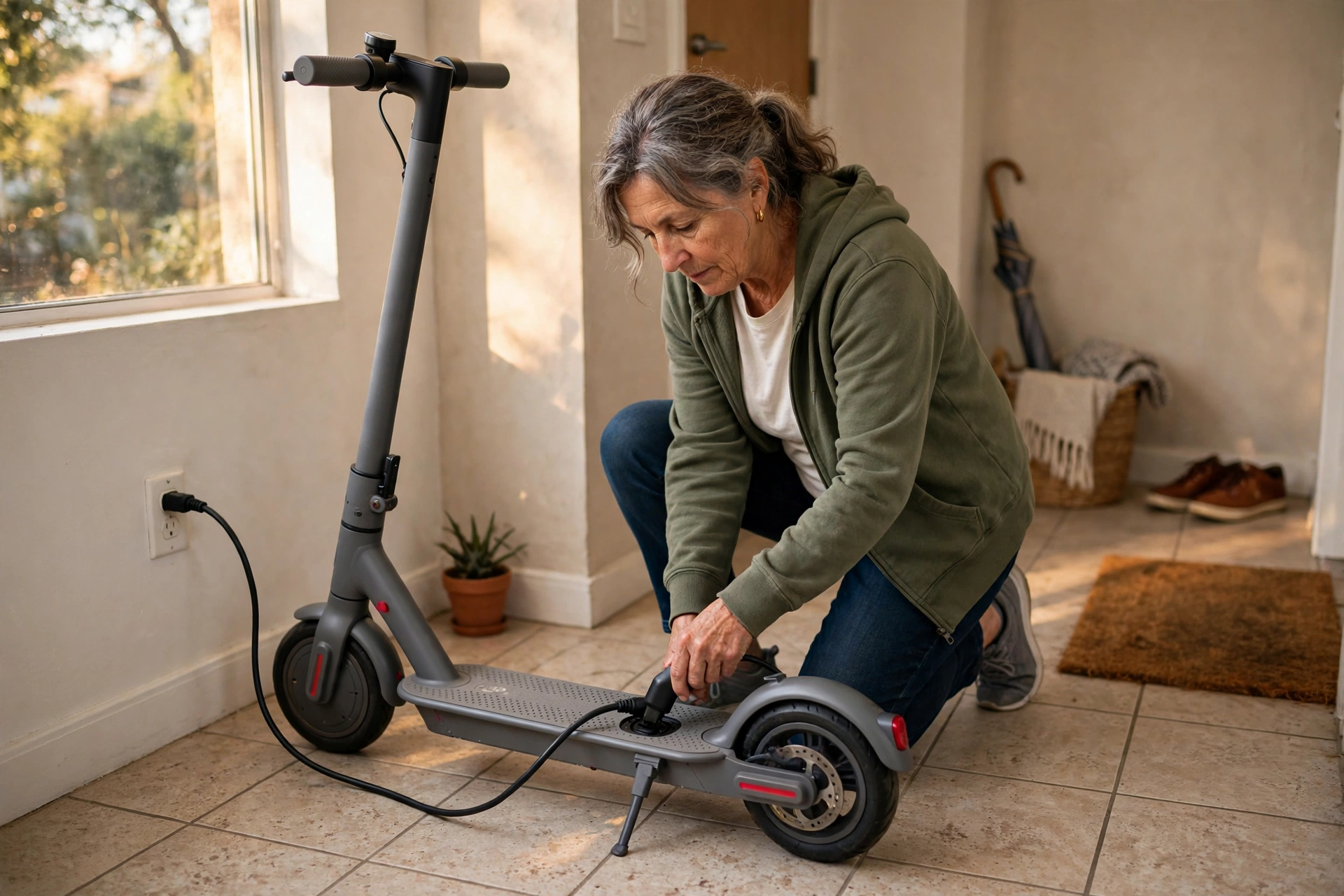
One rule here has no exceptions: use the charger the manufacturer supplied, or its exact specified replacement. A charger with the wrong voltage can damage a pack or worse, and cheap universal chargers are a recurring theme in fire investigations. Treat the charger as part of the electric scooter battery system, because electrically it is. Plug in on a hard, clear surface, charge while you are home and awake, and unplug when the light turns green. Simple habits, done every time.
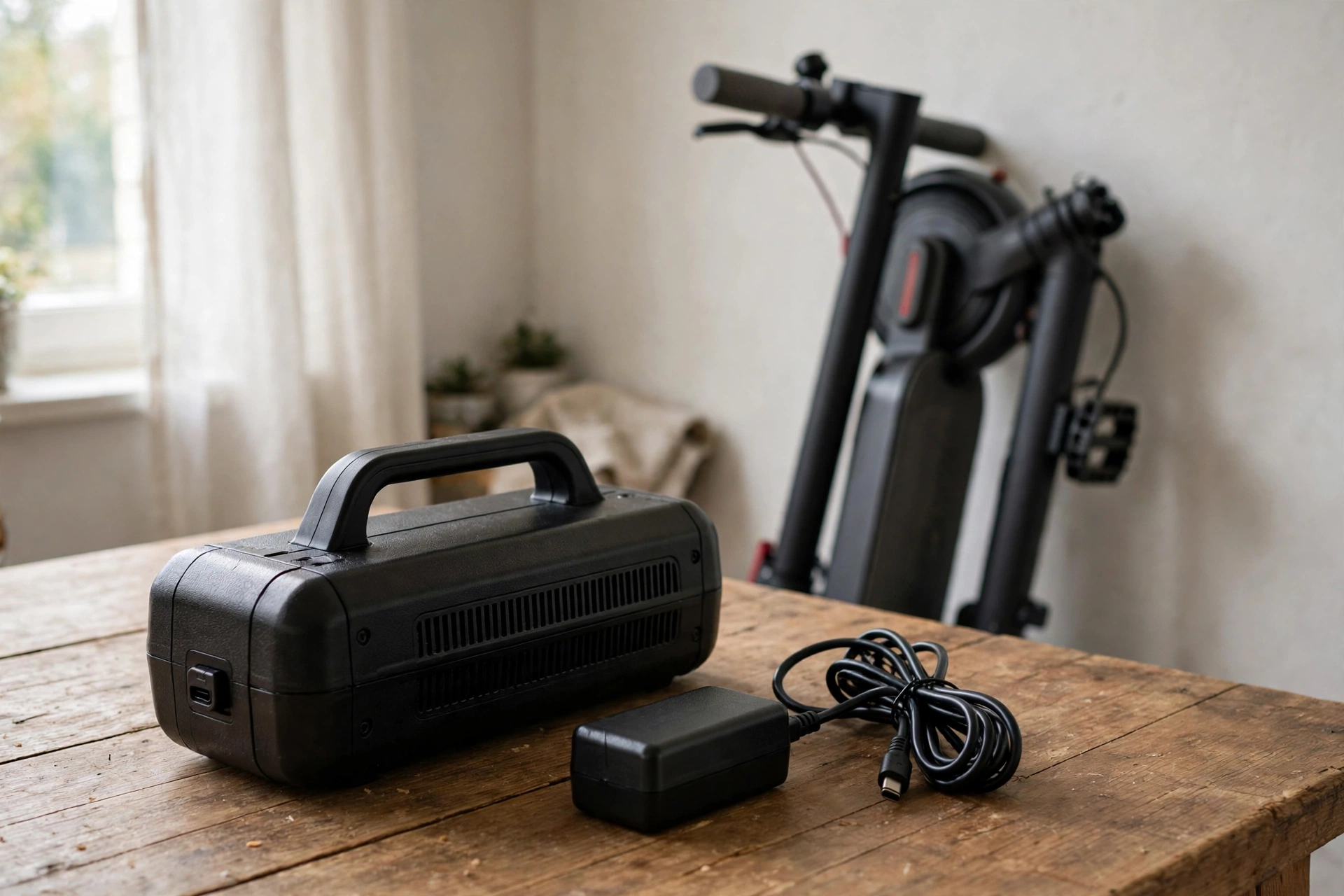
Removable or fixed: which electric scooter battery layout suits your home
Most commuter scooters have fixed packs, sealed inside the deck. The Ninebot Max is one — you charge the scooter where it sleeps, and that is that. Fixed packs are usually better sealed against rain, and there is nothing to align, latch or drop. If you have a garage, a ground-floor corner or a building that lets you bring the scooter inside, fixed is simple and fine.
Removable packs solve a different problem: stairs. The TurboAnt X7 Pro mounts its 360Wh battery on the stem, where it clicks off with a button press and can charge on any desk or kitchen counter — TurboAnt’s specification page lists the detachable mount and a roughly 6-hour charge. The scooter itself weighs 33 lb; the pack alone is a fraction of that (est.). For a rider in a walk-up apartment, or anyone who cannot comfortably carry a whole scooter, that difference decides whether e-scooting is practical at all. A second pack, a few hundred dollars (est.), doubles your range and doubles as your replacement years later.
Our honest leaning: if you live above ground floor without a lift, put a removable pack at the top of your shortlist, even above motor power. You will handle that battery twice a day, every day. Convenience you feel daily beats performance you feel twice a month. Just check the latch feels solid, and remember the big performance scooters are all fixed-pack designs — packs above about 1,000Wh are simply too heavy to carry in one hand, which is why the Kaabo Wolf King GTR’s roughly 2,845Wh pack is serviced in place, as our Kaabo King GTR guide explains.
Storage and safety: looking after your electric scooter battery
Lithium batteries are safe when they are well made and treated plainly, and the standards world exists to prove the “well made” part. Look for certification to UL 2272, the safety standard for personal e-mobility electrical systems, before you buy anything. The U.S. Consumer Product Safety Commission has counted hundreds of battery-related micromobility incidents and has proposed making the UL standards mandatory nationwide; New York City already requires UL 2272 certification for scooters sold there under Local Law 39. The background is set out in the CPSC’s lithium-ion battery regulatory analysis, and it makes sober, worthwhile reading.
Storage is mostly about temperature and patience. Keep the scooter or pack somewhere cool and dry, out of direct sun — TurboAnt, for example, specifies a storage range of 14 to 104°F and warns against storing beyond about three months without attention. For a winter lay-up, charge the pack, check it every month or two, and top it up if it has drifted low. Never charge a pack that is swollen, cracked, hissing or hot to the touch, and never charge one that has just taken a hard crash until it has been inspected. If balance is part of your life, park the scooter so a falling pack or a toppling scooter cannot trap you — small arrangements, real peace of mind.
Replacement prices: what a new pack costs (checked October 25, 2026)
Sooner or later the question arrives: repair or replace? Genuine commuter packs like the Ninebot Max’s run about $350 (est., based on retailer listings checked October 25, 2026). Third-party packs for the same scooters appear from roughly $100 to $200 (est.), and we would be cautious — a replacement pack is the one component where saving money can cost you the scooter, or worse. Big performance packs are a different league, commonly $800 and up (est.), sometimes available only through the importer, plus workshop labour because the pack is fixed inside the deck.
Before paying anything, run the numbers the way we did in the lifespan section: cost of the pack divided by the miles it will realistically give you. If a $350 pack returns a scooter you like to another 11,000 miles (est.), that is cheap transport. If the scooter also needs a motor, a stem and tyres, the honest answer may be a new machine. The maths works the same for bikes — our battery replacement cost estimator walks through it step by step.
Our scores: battery classes, honestly rated
Small packs, under about 300Wh — Our score: 5.5/10 (Range 3/10 · Lifespan 6/10 · Value 7/10). Fine for flat, short hops and light riders. Most people outgrow them within a year, and a bargain stops feeling like one.
Commuter packs, roughly 300 to 650Wh — Our score: 8.5/10 (Range 8/10 · Lifespan 8/10 · Value 9/10). The sweet spot. Enough tested range for real commuting, sensible weight, fair replacement costs. If you buy one scooter for daily life, buy it in this class.
Extended packs, roughly 650 to 1,500Wh — Our score: 8/10 (Range 9/10 · Lifespan 8/10 · Value 6/10). For long commutes and heavier riders, the extra energy is genuine comfort. You pay for it in price and in carrying weight.
Performance packs, 1,500Wh and up — Our score: 6.5/10 (Range 10/10 · Lifespan 7/10 · Value 4/10). Spectacular range, serious machines — and the pack dominates both the price and the replacement bill. Wonderful for enthusiasts. Too much battery for almost everyone else.
Electric scooter battery questions, answered
How long does an electric scooter battery take to charge? Most commuter packs need 4 to 6 hours — the 360Wh TurboAnt and the 551Wh Ninebot Max both sit near 6. Very large packs take far longer on standard chargers; the 2,880Wh Dualtron Thunder 2 needs over 23 hours on one, which is why its maker sells a quick charger.
Can I replace an electric scooter battery myself? If it is a removable pack, yes — it clicks off by design. If it is fixed inside the deck, treat it as a workshop job: the case is sealed, the connectors are not consumer parts, and your warranty will have opinions.
Why does my scooter travel less far in winter? Cold slows the chemistry inside the cells, so the pack temporarily delivers less — often 20 to 30 percent less below 40°F (est.). The capacity is not lost. It returns when the pack warms up, and storing the scooter indoors helps more than any setting.
Should I charge to 100 percent every night? If you ride in the morning, charge away — that is what the scooter is for. The habit to avoid is leaving the pack sitting at 100 percent, or sitting empty, for weeks at a time. For storage, partial charge and a monthly check are kinder.
Is a bigger battery always better? No. Match the pack to your longest regular trip with room to spare, and stop there. Every extra watt-hour you never use is weight on the stairs, money on the receipt, and hours on the charger.
What does UL 2272 certification actually tell me? That the scooter’s electrical system — battery, charger and wiring together — passed independent safety testing for fire and shock risks. It is the single most reassuring line on any spec sheet, and in some cities it is now the law.
Our final word on the electric scooter battery is simple: choose the size that covers your real trips, check the cells, and look after the pack. An electric scooter battery that fits your daily routine will feel effortless, while an electric scooter battery chosen only for its headline range can feel heavy and slow to charge. If you remember one thing, let it be this: the right electric scooter battery is the one you can carry, charge and afford to replace.