Last updated: October 25, 2026
My commute has one hill that sorts scooters into two piles: the ones that climb it, and the ones I end up walking beside. The segway gt3 pro is the first scooter I have priced up that treats that hill as a rounding error. It is Segway’s flagship SuperScooter, a dual-motor machine with a 72-volt battery, a claimed 50 mph top speed and a $2,699.99 price (checked October 25, 2026). That is motorcycle money for something you stand on, so the only question that matters is what you actually get for it.
Here is the short version before the detail. The power is real. The range claim is not, at least not at any speed you will actually ride. The build quality is the best I have seen numbers for in this class, and it still has niggles. And at 117 pounds, this is a garage scooter that happens to fold, not a portable scooter that happens to be fast.
On paper, per Segway’s official GT3 Pro page, the spec sheet reads like this. Two motors rated at 1,700W each, peaking at 3,500W apiece for 7,000W of total peak output. A 72V, 30Ah battery holding 2,160Wh. Eleven-inch self-sealing tubeless tires. Hydraulic suspension at both ends. A maximum payload of 330 pounds, an IPX6 water-resistance rating for the body, and a claimed climb angle of 38 percent.
Claims are cheap, though. Segway says 86 miles of range and 50 mph. Independent testers with GPS units and range courses say something less flattering and much more useful. So this guide puts a tested figure beside every big claim, and where no test exists, the number gets an (est.) label and a reason.
Seven things, then. What it does on hills, what the range really is, what the price buys you per mile, where the build quality grates, how it stops, what 117 pounds does to your daily routine, whether you can legally ride it, and what it costs to run. That is eight. Fine — the running costs are a bonus, because they are the one place this scooter is genuinely cheap.
Thing 1: The segway gt3 pro has serious power, and hills are where it shows
Most scooters quote one motor number and hope you do not ask questions. The segway gt3 pro runs two hub motors, one in each wheel, rated at 1,700W continuous each and peaking at 3,500W each. Together that is 3,400W of sustained output and 7,000W at full attack. You feel the difference most at the exact moment cheap scooters give up: halfway up a steep grade, at speed, with a heavier rider aboard.
Segway claims a 38 percent maximum climb angle and a 0 to 30 mph sprint of 3.9 seconds in Ultra Boost mode. Owners who have upgraded from the old GT2 back the hill story up, reporting that the GT3 Pro holds speed on grades that had the older scooter fading, and Segway’s range figures for Race mode (covered below) assume the motors are working hard the whole way. On top speed, the claim is 50 mph. Freshly Charged’s testers saw 49 mph on GPS. Electric Scooter Guide lists the scooter at up to 48 mph in its testing. So call it 48 to 49 mph honest, which is close enough to the claim that I am not going to complain about the rounding.
What matters more for commuting is how the power arrives. You can run the front motor, the rear motor, or both, and the traction control (Segway calls it SDTC) keeps the front wheel from spinning itself silly on wet paint and manhole covers. Testers describe the launch as strong but controlled rather than twitchy. For a hill commuter, that is the correct kind of fast: full torque on the climb, no drama at the lights.
Thing 2: Range — believe the testers, not the 86 miles on the box
Segway’s headline says the segway gt3 pro covers 86 miles per charge. Read the footnote and the trick appears: that figure comes from Eco mode, one motor, a 165-pound rider, at a steady 15.5 mph on flat ground. Segway’s own numbers get honest fast once you ride at real speeds: 45 miles in Sport mode at 31 mph, and 34 miles in Race mode at 50 mph. Speed eats range. It always has.
The independent number I trust most comes from Electric Scooter Guide’s instrumented range testing, where a 235-pound rider on a demanding hilly course got 35.6 miles from the GT3 Pro. That is a heavy rider, on hills, riding briskly — close to a worst case for a performance scooter. At the other end, a long-term test by RV.com saw a larger rider clear 65 miles on gentler roads at moderate pace. Both numbers are real. They are just measuring different rides.
So here is my planning math for commuters. Ride it like a performance scooter, in Sport, on a hilly route: budget 36 miles. Mix your modes and keep speeds sensible: 45 miles is a fair planning figure (est., based on Segway’s Sport-mode figure and the tested results above). Either way, the honest summary is that this is a 36-to-45-mile scooter wearing an 86-mile badge. Segway should print 35.6 on the box. It will not, so I am doing it for them.
Some context helps here. The 2,160Wh battery is roughly four times the 551Wh pack in a Ninebot Max G30P, the scooter half the commuting world rides. That is why the GT3 Pro can post a tested 35.6 miles while being ridden hard on hills, where the G30P posts its similar tested figure only when ridden gently on the flat. Big battery, big motors, big appetite: the range story of this scooter is not that it sips power. It is that the tank is enormous.
The maths nobody prints: price per mile of tested range
Performance scooters all claim huge range, so the fairest comparison is price divided by independently tested miles. Here is the arithmetic, using Electric Scooter Guide’s tested figures and prices checked October 25, 2026.
The segway gt3 pro costs $2,699.99 and tested at 35.6 miles. $2,699.99 ÷ 35.6 = $75.84 per tested mile. The Kaabo Wolf King GTR costs $3,995 and tested at 43.2 miles on the same style of hilly course. $3,995 ÷ 43.2 = $92.48 per tested mile. The Kaabo gives you more miles and a far higher tested top speed — 65.8 mph, genuinely absurd — yet you pay about 22 percent more for every real mile it delivers.
One more sum for GT2 owners wondering about the upgrade. The old GT2 carried a 1,512Wh battery. The GT3 Pro carries 2,160Wh. That is 648Wh more, a 42.9 percent bigger tank, in a scooter that costs less than the GT2 did at launch. If you want our full take on the Kaabo before deciding, our Kaabo King GTR guide runs through its specs and real-world range in the same tested-first way.
Thing 3: Build quality is excellent, and I still found niggles
The polish is the point of this scooter. The battery is UL 2272 certified, the finish is a step above the kit-built feel of rival performance scooters, and the tech list is long: a 2.4-inch color TFT display with navigation prompts and call alerts, Apple Find My tracking, AirLock proximity locking, turn signals, and an automatic headlight. The front suspension is a double-wishbone linkage with 15 steps of hydraulic adjustment; the rear is a hydraulic trailing arm. Riders crossing over from cheaper machines consistently say the same thing: it feels stable at 40 mph in a way that makes other scooters feel nervous.
Now the nitpicks, because a value commuter notices these things. Owners report the deck is narrower than it looks in photos, so big feet sit at an angle. One rider who upgraded from a GT2 reckons the front suspension travel is shorter than the old scooter’s, so bigger hits stop you instead of soaking up. The traction control can interrupt power abruptly on loose surfaces. And the twist-grip throttle divides people — some love the motorcycle feel, others find it tiring on a long cruise. None of these are deal-breakers. All of them are the sort of thing you only learn after the return window closes, which is why they are in this article.
Thing 4: Braking and safety at 50 mph are not optional extras
A scooter that reaches 49 mph needs brakes from the motorcycle world, and the segway gt3 pro mostly has them: hydraulic disc brakes at both wheels on 140mm rotors, backed by an S-ABS anti-lock system that pulses the brakes to stop the wheels locking and sliding. Freshly Charged measured a 20 to 0 mph stop in just 12 feet, which is a strong result for a standing scooter. The SegRide stability system lengthens the steering trail and adds damping, and testers single out the high-speed stability as the scooter’s best trick.
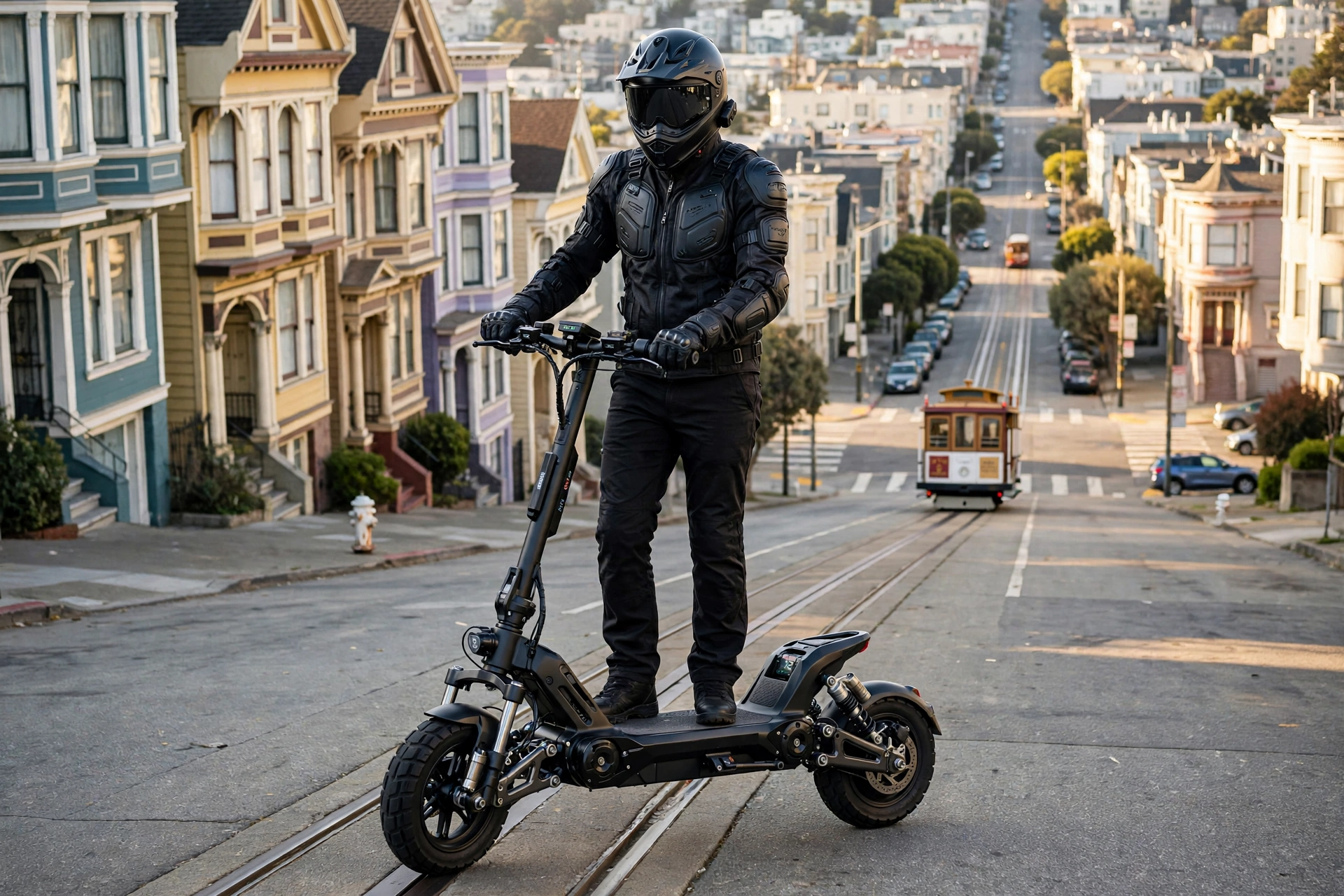
Here is my firmest opinion in this whole guide, and I will not soften it: a bicycle helmet on a 50 mph scooter is a costume, not protection. If you buy this machine, budget for a full-face motorcycle helmet, gloves, and a jacket with armor, the same kit you would wear on a small motorbike. At 30 mph the scooter is already travelling at moped speeds. At 49 it is a motorcycle that happens to lack a seat, and it deserves motorcycle respect.
Two more safety notes a hill commuter learns fast. First, wet roads: the self-sealing tires grip well for scooter rubber, and the traction control earns its keep on painted lines and steel plates, yet 140mm discs on a 117-pound machine still need earlier, gentler braking when the surface is greasy. Second, visibility: you are a narrow, fast, silent object in traffic that expects scooters to do 15 mph. Ride like every driver has misjudged your speed, because most of them have.
Thing 5: The segway gt3 pro weighs 117 pounds, and that shapes your whole routine
Let us talk about the number nobody puts in the adverts. The GT3 Pro weighs 117 pounds (53.1 kg) and measures 53.7 inches long. Yes, the stem folds, bringing the height down to about 27.6 inches. No, that does not make it portable. Folding a 117-pound scooter makes it a smaller 117-pound scooter. You will not carry it up apartment stairs daily, you will not take it on a crowded train, and getting it into a car trunk is a two-person job with real back strain involved.
Plan around it instead. It lives in a garage, a ground-floor storage room, or a workplace parking spot. It rides from your door to your destination and back, full stop. If your commute involves stairs, elevators with weight limits, or a bus leg, this is the wrong tool — our Segway Ninebot Max G30P guide covers the scooter we recommend for that life, at roughly half the weight. Match the scooter to the commute you actually have, not the one in the advert.
Thing 6: At 50 mph, the law has opinions about your scooter
Segway’s own European store listing carries a blunt warning: this scooter “can only be used on private property.” That is the legal reality peeking through the marketing. In most US states, electric scooters are regulated as low-speed devices, commonly capped at 15 to 20 mph for bike lanes and shared paths. A 50 mph dual-motor machine does not fit that definition anywhere I know of.
What happens instead depends entirely on where you live. Some jurisdictions will treat anything this fast as a motor vehicle, which can mean registration, a license, insurance, and a ban from bike infrastructure. Others barely regulate scooters at all, until something goes wrong. Rules also change street by street in some cities. So before you buy, check your state and city rules for high-powered scooters, and be honest with yourself about where you will ride. Bought as a private-land and quiet-road machine with full knowledge of the rules, it is a riot. Bought as a bike-lane commuter, it is an expensive legal problem.
Thing 7: Running costs are tiny; charging is slow
The running-cost maths is the friendliest part of this scooter. A full charge takes 2.16 kWh of electricity. At $0.17 per kWh (est., around the current US residential average), a fill-up costs about $0.37. Spread over the 35.6 tested miles, that is roughly one cent per mile. Even if your electricity costs double the average, you are arguing about two cents. Tires are self-sealing, so most punctures fix themselves, and consumables like brake pads should run to perhaps $60 to $120 a year (est., based on typical performance-scooter parts prices and wear at this weight).
The sting is charging time. Segway quotes roughly 7.5 to 8.5 hours for a full charge on the single supplied charger. Ride home at 7 pm with an empty battery and the scooter is ready again around 3 am. Fine for overnight charging. Useless for a midday top-up before an evening ride. There is also one cost nobody can quote you: Segway does not publish a replacement battery price, so treat the pack as the expensive heart of the machine (est.), charge it between roughly 20 and 80 percent for daily use, and store it half-charged if it sits for weeks.
Verdict: who should buy the segway gt3 pro?
If your commute is hilly, five to fifteen miles each way, and starts at a garage door, this is the most convincing performance scooter on sale. The power delivery is sorted, the brakes are strong, the tested range covers real commutes, and at $75.84 per tested mile it undercuts its fastest rival on value. If your life involves stairs, trains, or a trunk, buy something else and keep the change.
Segway GT3 Pro — Our score: 8.4/10 (Range 7/10 / Charging 5/10 / Value 9/10). The range sub-score reflects the gap between the 86-mile claim and the 35.6 tested miles, even though 35.6 honest miles is plenty. Charging loses points for the 8-hour fill. Value earns its 9 honestly: nothing this polished goes this fast for this money.
Kaabo Wolf King GTR — Our score: 8.1/10 (Range 9/10 / Charging 7/10 / Value 6/10). Faster (65.8 mph tested), longer-legged (43.2 tested miles), and even heavier at 137.6 pounds. It is the better open-road weapon and the worse purchase for almost everyone reading a commuter guide. And if your riding runs more to dirt and trails than tarmac, our Segway Xyber guide covers Segway’s off-road machine instead.
Segway GT3 Pro FAQ
How fast is the segway gt3 pro in real testing?
Segway claims 50 mph. Freshly Charged recorded 49 mph on GPS, and Electric Scooter Guide lists up to 48 mph from its testing. Budget on 48 to 49 mph as the honest top speed in Race mode.
How far does it actually go on one charge?
Electric Scooter Guide tested 35.6 miles with a 235-pound rider on a hilly course. Segway’s own figures are 45 miles in Sport mode and 34 miles in Race mode, and gentle riding at moderate speeds has produced 65 miles in long-term testing. For a fast commute, plan on 36 to 45 miles.
How long does the battery take to charge?
About 7.5 to 8.5 hours from empty on the supplied charger, according to Segway. This is an overnight scooter; there is no fast-charge shortcut.
Is it legal to ride on public roads?
It depends on your state and city, and in many places a 50 mph scooter falls outside the low-speed scooter rules entirely, which can mean motor-vehicle requirements or private-property-only use. Check your local rules before buying, not after.
Can I carry it up stairs or fit it in a car?
Realistically, no. It weighs 117 pounds and is 53.7 inches long unfolded. It folds down to about 27.6 inches tall, which helps with storage, but lifting it is a two-person job.
Is it worth upgrading from a Segway GT2?
For range and refinement, yes. The battery grows from 1,512Wh to 2,160Wh (42.9 percent more), the suspension and stability systems are improved, and the GT3 Pro costs less than the GT2’s launch price. If your GT2 still covers your commute, though, your money stays happier in your pocket.