Last updated: October 25, 2026
Start with the honest bit: a rambo ebike is not a city bike that put on camo for fashion week. It is a hunting machine with pedals attached, built to slide silently down a forest track at 5 a.m. with a pack on the rack and frost on the fenders. I spend most of my time measuring folded bikes and worrying about hallway storage, so reviewing a brand whose lightest adult bike weighs 73 pounds felt like reviewing a refrigerator. A capable, quiet refrigerator.
Rambo Bikes is an American brand selling exactly one idea: electric bikes for hunters. No commuters. No folders. No cute step-throughs for the bakery run. Every model wears fat tires, most wear real camouflage from Mossy Oak or TrueTimber, and the kit list is pure hunting: rear racks, gun and bow mounts, a game cart trailer rated for a 300-pound load.
So why should a city rider care? Because people keep buying these for mixed use — a cabin bike, a farm bike, a snow bike, a “one bike for everything” bike — and then discovering the trade-offs the hard way. Weight. Width. Power that overshoots the legal classes. This guide walks through the seven things that actually decide whether a Rambo fits your life: the current lineup, tested range beside claimed range, and the running-cost math done out loud.
Ground rules: every spec comes from Rambo’s own pages or named independent reviews; unconfirmed figures are marked (est.) with the reason. The scores are ours alone. And no brochure language — if a number smells optimistic, we say so.
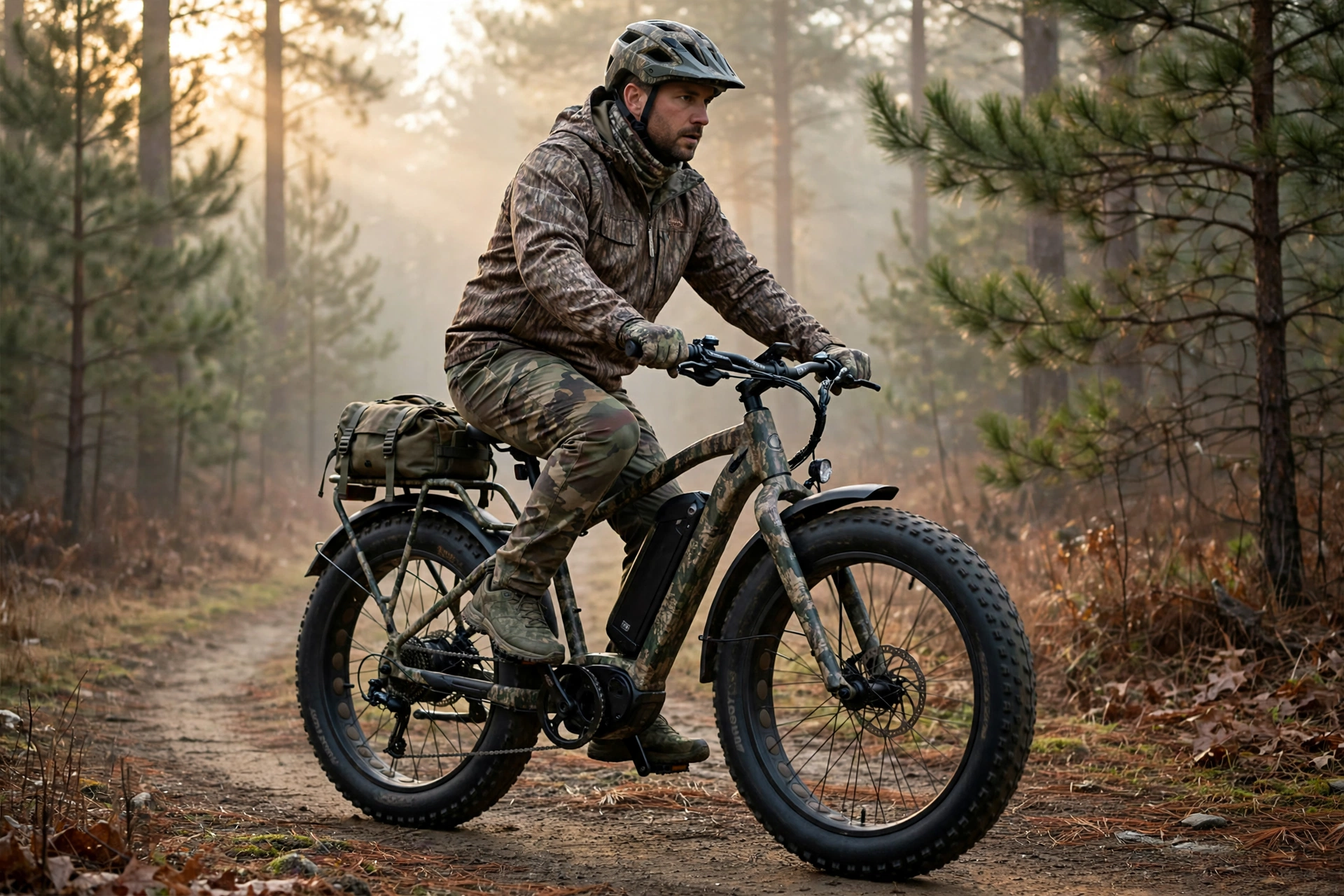
Thing 1: A rambo ebike is a hunting tool first, and everything else second
This sounds obvious until you price one as a commuter. The design priorities run in a specific order: quiet, then traction, then hauling, then everything a city rider wants. The motors are chosen for silence on approach — Rambo leans on the Bafang BBSHD mid-drive in its pricier bikes precisely because it is one of the quietest high-power motors you can buy. The tires are 4-inch fat tires because mud, snow and sand do not care about your rolling resistance. The finishes are camo because a deer does not need to see your down tube.
None of that is a flaw. It is a brief, executed well. But the things city riders obsess over — weight, folded size, quick-release wheels, neat storage — get no attention at all. Rambo publishes no folded dimension for any model, for the simple reason that no Rambo folds. Remember that when we reach Thing 4.
What the hunting brief gets you
- Stealth: quiet motors, thumb throttles for silent rolling, matte camo or earth-tone paint (FDE, OD Green).
- Traction: 24 x 4.0 or 26 x 4.8 inch knobby fat tires, and on the flagship, motors in both wheels.
- Hauling: bolt-on rear racks across the range, load capacities of 300 to 350 pounds, and that 300-pound-rated game cart for the trip back out.
My take, unsoftened: if your riding is 90 percent pavement, this brief works against you every day. If your riding is a hunting lease, a farm, a snow-covered acreage or a fishing camp down a dirt road, the brief is exactly right and most city bikes would embarrass themselves. Know which person you are before you read another spec.
Thing 2: The current lineup — four bikes that actually matter
Older Rambo names — Pursuit, Cruiser, Ryder, Krusader, Nomad — still float around dealer sites, but the current core, sold on Rambo’s own store (prices checked October 25, 2026), is four bikes. The entry point, detailed on Rambo’s official Savage 2.0 page, is this one:
Savage 2.0 — the original, and the sensible one
The Savage built the brand, and it is still the value pick. A Bafang hub motor rated 750 to 1,000 watts (1,200W peak, 90Nm), a 48V 15Ah battery with LG cells (720 watt-hours), claimed range up to 48 miles, and a 20Ah upgrade that stretches the claim to 65. Top speed is listed at up to 30 mph. Kenda 24 x 4.0 anti-puncture tires, Logan two-piston hydraulic brakes, no suspension fork — simple front end, lower price. Weight is 68 pounds with the battery removed; add the 7-pound battery and you are lifting 75 pounds. Prices run $2,099.99 for the Mossy Oak Bottomland camo 15Ah version to $2,499.99 for a 20Ah bike. Load capacity: 300 pounds.
Roamer 2.0 — the mid-drive all-rounder
The Roamer swaps in a 750W Bafang mid-drive (1,000W peak, around 120Nm of torque) driving an 8-speed Box drivetrain, and it climbs the way hub motors simply cannot. Batteries are 48V 15Ah or 20Ah, claimed range 48 or 65 miles, top speed 28 mph. It rolls on Kenda 24 x 4.0 tires, with an air front fork, factory rear rack and full fenders, in OD Green or Realtree Original camo. The catch is mass: 75 pounds before the battery, 84 to 87 with one fitted. Rambo’s store price was unconfirmed at writing; dealer listings put it around $2,999.99 (est.).
Rebel 2.0 — the torque monster
The Rebel runs the 1,000W Bafang BBSHD mid-drive with a frankly silly 160Nm of torque, a Shimano wide-range 9-speed drivetrain and the same 48V 15Ah LG-cell battery. Rambo lists range at up to 32 miles on the standard battery — a rare moment of honesty in this industry — and top speed at up to 32 mph. It is also the lightest of the serious bikes: 64 pounds without the battery, about 73 with it. Price: $2,999.99 (checked October 25, 2026). If you haul game out of steep country, this is the one the hunting press keeps coming back to.
Megatron 5.0 — all-wheel drive, all in
The flagship is a step-thru with a motor in each wheel, switchable between front, rear and all-wheel drive. The battery is a 52V 25Ah unit (1,300 watt-hours, LG cells); Rambo claims up to 65 miles on one battery and 110 with the dual-battery setup. Top speed up to 36 mph, load capacity 350 pounds, weight 89 pounds without the battery and 102 with the 13-pound pack fitted. Prices: $3,959.99 in FDE, $4,179.99 in TrueTimber Viper Western camo (checked October 25, 2026). BikeRide calls the Megatron line a behemoth with stupendous dual-battery range potential — reviewer language for “magnificent, and completely over the top.”
Thing 3: Range — what a rambo ebike claims vs what testers actually got
Claimed range in this industry is a fairy tale told at low speed with a light rider on a warm day. Hunting range is worse: cold mornings, soft ground, heavy packs, long throttle crawls at 5 to 15 mph.
On the Savage 2.0, Rambo claims up to 48 miles from the 15Ah battery. Independent review roundups of real hunting use put the Savage at about 45 miles of pedal-assist range in mixed conditions — close to the claim, which is genuinely unusual. The Rebel is rated at up to 32 miles on the standard 15Ah battery; Mountain Weekly’s hands-on test bike carried the larger 21Ah battery behind their 48-mile figure. The Megatron’s 110-mile dual-battery claim? Treat it as a ceiling, not a plan. Two motors drinking from two batteries on soft ground will not double your distance, and no independent tester has published a measured 110-mile run.
- Throttle-only riding cuts range by roughly a third. Expect 30 to 40 percent less than the pedal-assist figure once you stop pedaling.
- Cold costs you. LG cells hold up better than generic ones — reviewers note around 80 percent capacity retained at minus 10°C — but a frosty dawn still shrinks your day.
- Fat tires at low pressure are range poison on pavement. Wonderful in mud. Costly on the road home.
The running-cost math, done out loud
Here is the computation nobody at the dealership will do for you. A full charge on the Savage’s 720Wh battery is 0.72 kilowatt-hours. At the US average residential electricity price of about 17 cents per kWh (est., national average), that charge costs 0.72 × $0.17 = $0.12. Twelve cents. The Megatron’s 1,300Wh pack is 1.3 × $0.17 = $0.22 per charge, and even the dual-battery setup is 44 cents for a claimed 110 miles. We run the same maths for ordinary commuter bikes in our guide to how much it costs to charge an electric bike, and a rambo ebike lands in the same place: fuel is not the cost. The battery is.
So price the bike per mile of tested range instead. The Savage at $2,199.99 divided by 45 tested miles is $48.89 per mile of range. The Rebel at $2,999.99 divided by 48 tested miles (21Ah configuration) is $62.50 per mile. And per pound? The Megatron costs $3,959.99 ÷ 102 pounds = $38.82 for every pound you will one day lift onto a rack, against the Savage’s $2,199.99 ÷ 75 pounds = $29.33 per pound. Electricity is pennies. Iron is where the money goes.
Thing 4: Weight, size and storage — where a rambo ebike gets awkward
Now the city-practicality audit, because this is where these bikes lose people. The lightest adult Rambo here, the Rebel, is 73 pounds with its battery. The Savage is 75. The Roamer is 84 to 87. The Megatron is 102 pounds — the weight of a large adult passenger, except the passenger is a bicycle and you carry it up the cabin steps.
None of them fold. Frames are one-piece hydroformed aluminum; wheels are 24 or 26 inches in 4-inch rubber; bars are wide. If your storage plan is “the hallway,” your hallway disagrees. If your transport plan is a city bus rack, forget it — most transit racks cap out around 55 to 65 pounds per bike (est., typical agency limits), and fat 4-inch tires often do not fit the wheel slots anyway. You need a hitch rack rated for heavy e-bikes, a truck bed, or a trailer. Budget for the rack too — the cheap trunk rack from your hatchback days will fold before the bike does.
One genuine convenience: the batteries come off — 7 pounds on the Savage, 9 on the Rebel, 13 on the Megatron — so charging indoors is easy. Just know that removing 7 pounds from a 75-pound bike leaves a 68-pound problem, not a solution.
Thing 5: Theft-proofing a rambo ebike — the problem nobody mentions at the expo
A camo bike in the woods is invisible. A camo bike locked outside a grocery store is the most interesting object on the street, and it costs three to four thousand dollars. Theft-proofing one is a different job from theft-proofing a commuter, because you cannot carry it inside.
- Take the battery with you. It is the most valuable single part, it makes the bike far less rideable, and on the Savage it is a 7-pound carry — annoying, not impossible.
- Lock frame and a wheel to something immovable with a heavy chain or a top-tier U-lock. A cable lock on a $3,000 bike is decoration.
- Hide a GPS tracker in the frame or under the bottle-cage mounts (est., accessory-dependent), and register the serial number the day you buy.
- Store it indoors or in a locked outbuilding. These bikes are too heavy to steal casually and too valuable to leave out; the realistic threat is a planned lift into a van, and a locked door is the real defence.
One wallet note that belongs here: batteries age whether you ride or not. Before buying any Rambo, new or used, run the pack size and age through our e-bike battery replacement cost estimator so the replacement bill, when it comes, is a plan and not a surprise.
Thing 6: The hunting kit is the whole point — racks, trailers and mounts
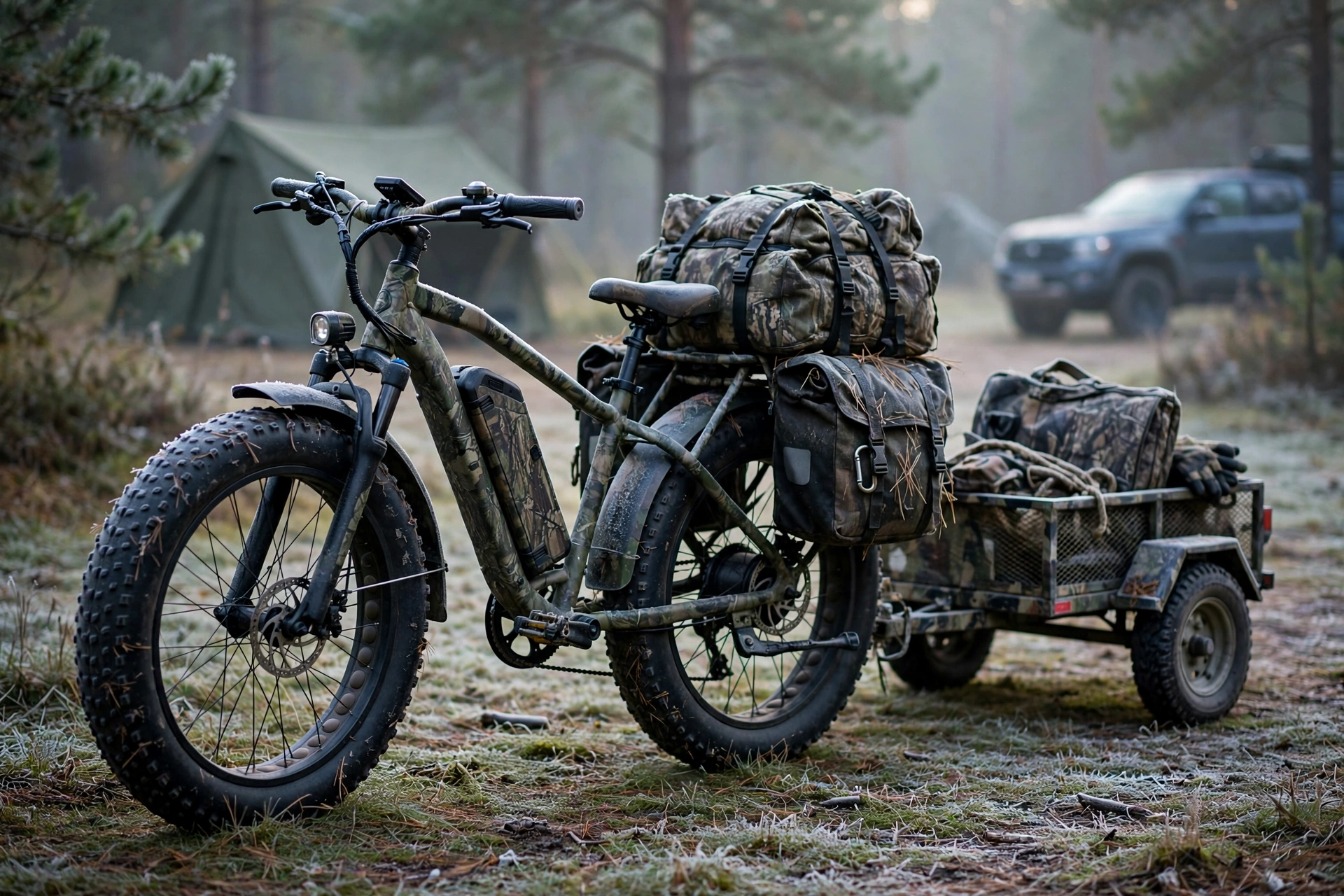
Strip the accessories away and a Rambo is a heavy fat bike. Add them back and it becomes a system, and the system is the strongest argument for the brand. Rear racks are standard or factory-fit across the range and rated for real loads, not a sandwich and a paperback.
The signature piece is the game cart: a 6061 aluminum trailer that hitches to the rear rack, rated for up to 300 pounds, with fenced tire guards so a load cannot foul the wheels and a grab handle so it works as a hand cart away from the bike. Field testers have dragged whole deer out on one. Try that with a commuter pannier. Add the gun and bow mount, mud-shedding fenders and boot-friendly pedals, and you see why hunters forgive the weight. The bike is not the product. The pack-out is the product.
The flip side for city riders: the kit adds pounds to already heavy bikes, and wide bars plus 4-inch tires make the rig a squeeze through a standard doorway. It earns its keep in the woods or it does not earn it at all.
Thing 7: Power, classes and where you may legally ride
Here is what surprises buyers most: much of the Rambo range is not, strictly speaking, a legal e-bike on public trails. The familiar three-class system caps motors at 750 watts and assisted speed at 20 or 28 mph. The Savage’s motor is rated up to 1,000 watts and 30 mph. The Rebel does 32. The Megatron, 36. Rambo’s answer is its ACS (Adjustable Class System) display, which lets you dial the class setting down for where you ride. Use it — a 1,000-watt bike at full chat on a shared trail is how trails get closed for everyone.
Private land, hunting leases and work ground are where these bikes are fully in their element, no asterisks. Public land rules vary by state, agency and trail, so read our Class 1 e-bike guide for how the classes work, then check your local rules before assuming an ACS setting makes you trail-legal everywhere. My position is blunt: buy a Rambo for the land you can ride it on, not the land you hope nobody polices.
Our scores: each rambo ebike, rated
Scores follow our standard method — see how we research for the detail. Range is judged on tested figures, not claims; Charging on practicality and battery flexibility; Value on spec per dollar against the hunting-bike field.
Savage 2.0 — Our score: 8.1/10
- Range: 7.5/10 — 45 tested miles against a 48 claim is honest; the 20Ah option fixes the rest.
- Charging: 8.0/10 — one removable 720Wh pack, simple charger, a dual-battery path exists.
- Value: 8.8/10 — the cheapest way into a real hunting bike, and the camo version is oddly the cheapest of all.
Roamer 2.0 — Our score: 7.6/10
- Range: 7.8/10 — mid-drive efficiency helps; claims of 48 to 65 miles are plausible at low assist.
- Charging: 7.5/10 — same battery family as the Savage; nothing fancy, nothing broken.
- Value: 7.4/10 — mid-drive money and mid-drive weight; the climbing justifies it only if you climb.
Rebel 2.0 — Our score: 8.4/10
- Range: 7.6/10 — the honest 32-mile standard rating and the 48-mile tested big-battery figure bracket the truth.
- Charging: 8.0/10 — removable pack, plus upgrade and dual-battery routes keep it flexible.
- Value: 8.6/10 — 160Nm of torque at $2,999.99 is the best grunt-per-dollar in this lineup.
Megatron 5.0 — Our score: 7.9/10
- Range: 8.5/10 — 1,300Wh on board, 2,600Wh in dual trim; the ceiling is real even if 110 miles is not your day.
- Charging: 7.2/10 — two big packs take time, and the second battery is a serious extra spend.
- Value: 7.6/10 — nothing else does switchable all-wheel drive at this price; you pay for capability most riders use twice a year.
So, should you buy one?
Buy a rambo ebike if you hunt, farm, fish or work land and you are tired of announcing your arrival with an ATV. Buy the Savage if the budget is real, the Rebel if the hills are, and the Megatron if mud and snow have genuinely stopped you before. The Roamer is the pick for rolling country and long gravel approaches where a mid-drive stretches a charge.
Walk away if your life is stairs, hallways, bus racks and bike rooms. Walk away if you need a folder — Rambo will never sell you one. And walk away if your trails are class-restricted public land where a 1,000-watt bike at full power makes you the problem. The only shame is spending $3,000 before admitting it.
Frequently asked questions
How far can a rambo ebike really go on one charge?
In honest hunting use — low speeds, soft ground, gear on board — plan on 30 to 48 miles from a standard 15Ah battery with pedal assist, and roughly a third less on throttle alone. Independent testing put the Savage near 45 miles and a big-battery Rebel at 48. Dual-battery Megatron setups claim up to 110 miles; treat that as a best-case ceiling.
Do Rambo bikes fold or fit on a normal car rack?
No Rambo folds, full stop. For transport you need a hitch-mounted rack rated for heavy e-bikes — a per-bike rating above your model’s weight, which runs from 73 pounds (Rebel) to 102 pounds (Megatron) with batteries fitted — or a truck bed or trailer.
Can you ride a Rambo on public bike trails?
Sometimes. The ACS display lets you set the bike to a lower class, but motors rated above 750 watts and top speeds of 30 to 36 mph sit outside the standard classes, and rules differ by state and land agency. Private land is unrestricted; public trails are a check-first situation, every time.
How long does a Rambo battery take to charge?
Rambo does not headline a charge time for the standard packs. With the supplied smart charger, expect roughly 4 to 6 hours for a 15Ah battery (est., based on typical 2 to 3 amp charging for a 720Wh pack). The Megatron’s 25Ah pack takes proportionally longer; the removable packs at least charge indoors.
Is the camo finish worth paying extra for?
Depends on the model, oddly. On the Megatron 5.0, TrueTimber Viper Western camo adds $220 over FDE. On the Savage 2.0, the Mossy Oak Bottomland 15Ah bike is actually the cheapest in the range at $2,099.99. If you hunt, camo is functional, not cosmetic. If you do not, FDE and black are easier to resell.
What does it cost to run one for a season?
Almost nothing in electricity — about 12 cents per full charge on a Savage, as the maths above shows. The real costs are tires (4-inch rubber is not cheap), brake pads worked hard by heavy bikes, and eventually a replacement battery. Hunters riding 40 days a season will spend more on boot leather than on charging.
Final word, then. A rambo ebike is a specialist tool that refuses to pretend otherwise, and I respect that more than a dozen do-everything bikes that do nothing well. Match it to land you can ride, storage you actually have and hills you actually face, and it will earn every pound it weighs. Buy it for the life you wish you had, and it will sit in the garage — all 102 pounds of it — reminding you.
Our verdict on a rambo ebike is simple: judge it as a hunting tool, not as a commuter. A rambo ebike makes sense when quiet approach, fat-tire traction and heavy hauling matter more than light weight or easy storage. If those priorities match your land, a rambo ebike will earn its keep season after season. If they do not, no rambo ebike, however capable, will make stairs, hallways or crowded bike rooms easier. Choose the rambo ebike that fits the ground you actually ride, and the rest of the decision gets much simpler.