Last updated: October 25, 2026
Verdict first, because that is how this site works. The aventon level 2 is the most honest commuter e-bike Aventon has ever sold: a torque sensor instead of a cheap cadence switch, hydraulic brakes instead of cable discs, and a proper 672Wh battery. It is also, in 2026, a discontinued bike. The Level 3 replaced it, and Aventon’s own product page listed the Level.2 at $1,499 with every step-over variant out of stock when we checked on October 25, 2026. Neither fact should scare you off. The second one is exactly why you should look at it.
Here is the catch, and it is the same catch as always. The box says 60 miles of range. Independent testing says otherwise: BikeRide ran the battery to empty and recorded 30.45 miles. Both numbers are “true.” Only one of them is useful for planning a commute. This guide works from the tested number everywhere it matters, because a range claim measured at 13 mph in the lowest assist level, under a 165-pound rider on flat ground, is not a range. It is a laboratory result wearing a range’s clothes.
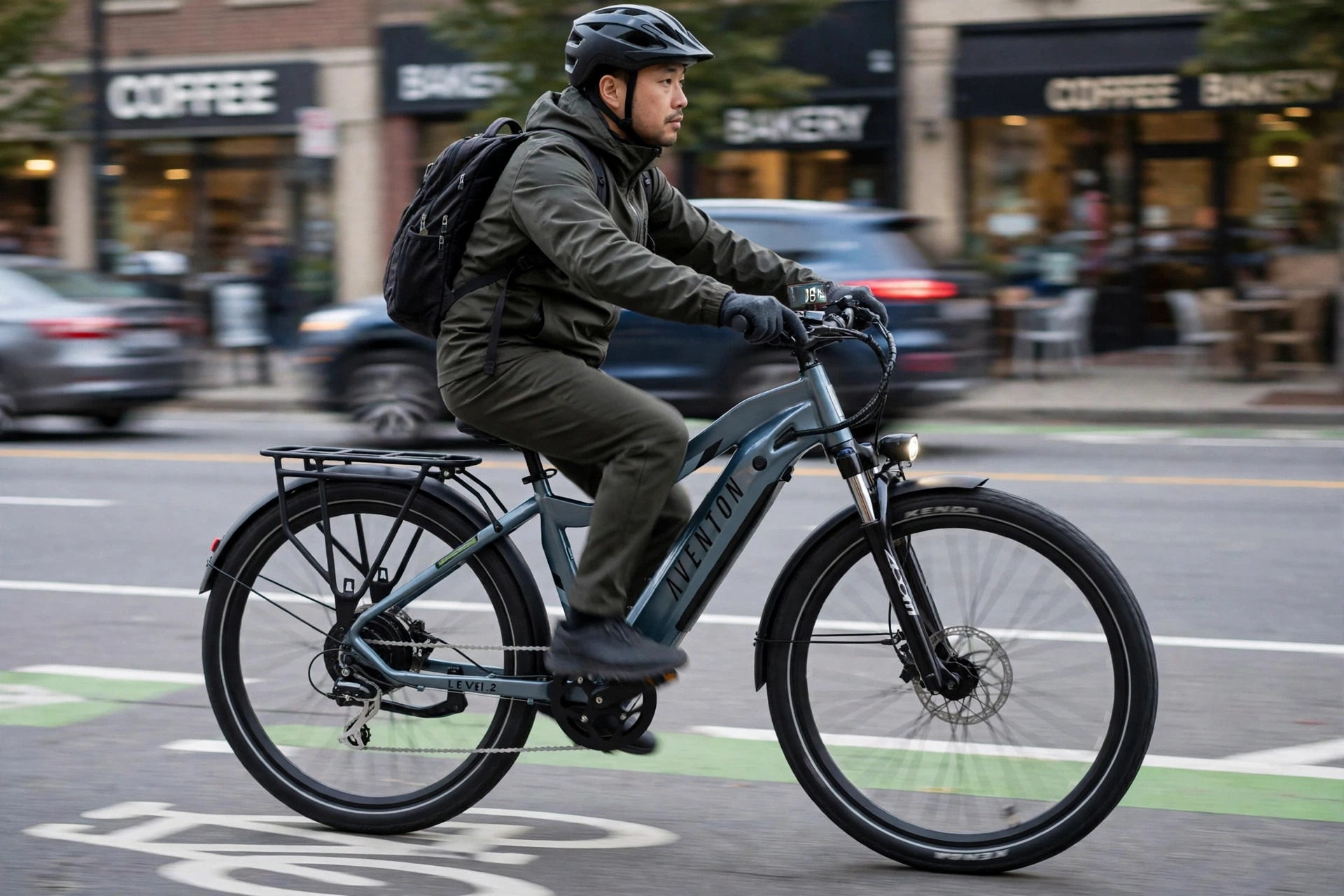
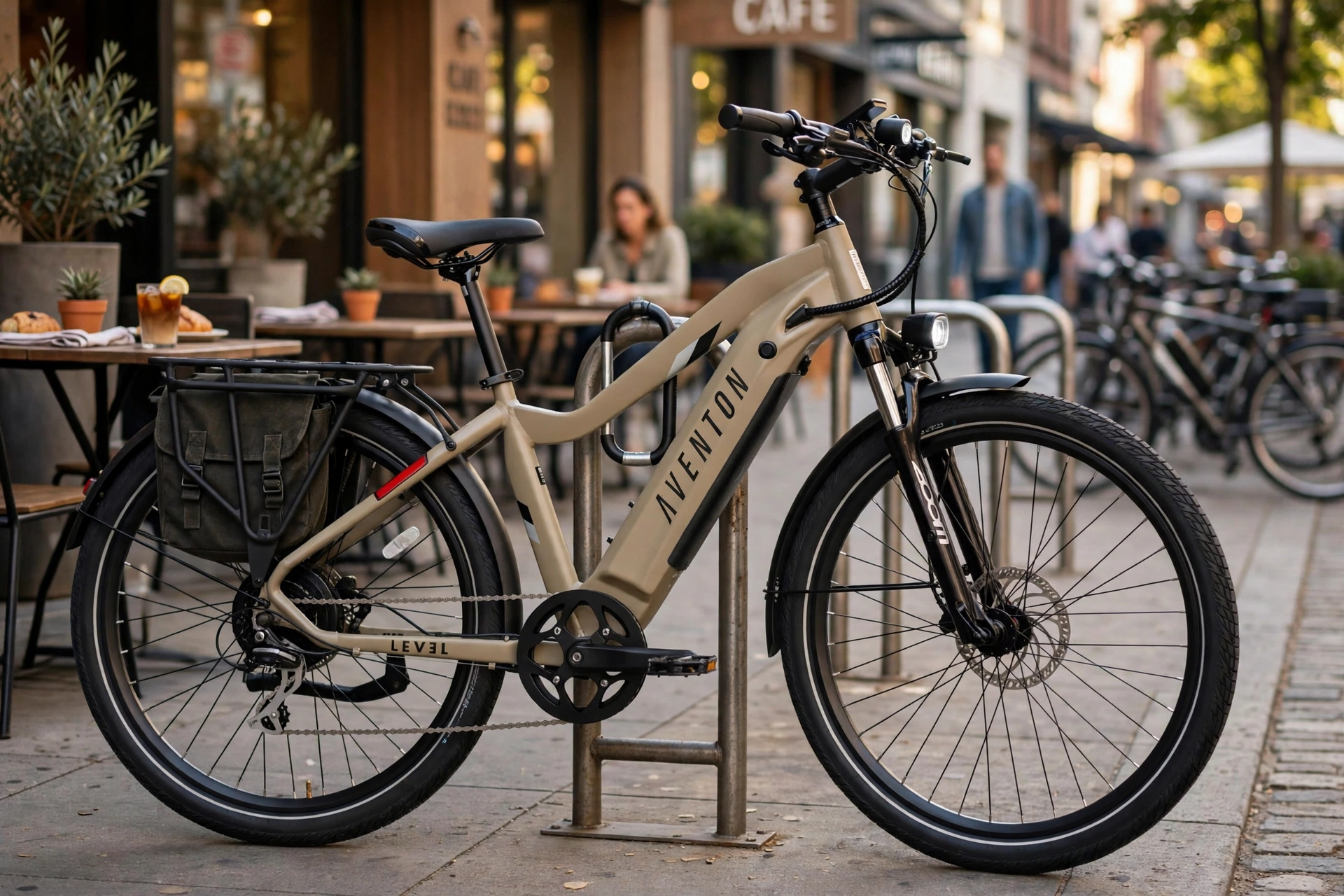
Quick orientation. The Level.2 launched in late 2022 as Aventon’s flagship commuter, one rung above the original Level. It came in two frame styles: a step-over with a gently sloping top tube, and a step-through. The step-over came in Clay and Glacier Blue; the step-through added Polar White and Himalayan Pink. Under the paint sits a 500W rear hub motor with a torque sensor, a 48V 14Ah (672Wh) battery buried in the downtube, an 8-speed Shimano drivetrain, and a coil suspension fork with 65mm of travel. Rack, fenders, and integrated lights are in the box, not on an options list. Four lights, in fact: a headlight, and taillights tucked into the seatstays that double as brake lights.
One design detail matters more than the rest: the battery disappears into the downtube, so from ten paces the Level.2 reads as an ordinary bicycle. The second detail is weight. Aventon’s spec sheet said 54 pounds for the step-over and 52 for the step-through. BikeRide put a complete bike on a scale — rack, fenders, everything fitted — and read 62 pounds. Believe the scale. Spec-sheet weight is measured in a world without accessories, and you do not live in that world. If your commute ends with a flight of apartment stairs, that eight-pound gap is the difference between fine and miserable.
Aventon Level 2 Specs: Torque Numbers Over Styling
Strip away the marketing adjectives and this is the hardware list, taken from Aventon’s official specification and cross-checked against independent reviews.
- Motor: 500W sustained rear hub motor, 750W peak, torque sensor
- Battery: 48V 14Ah, 672Wh, integrated into the downtube, removable, UL 2849 certified system
- Claimed range: up to 60 miles (assist level 1); about 30 miles throttle-only
- Top speed: 20 mph on throttle; pedal assist to 20 mph as shipped, unlockable to 28 mph
- Class: Class 2 out of the box; Class 3 behaviour once unlocked in the app
- Brakes: Tektro hydraulic disc, 180mm rotors front and rear
- Drivetrain: Shimano 8-speed, 46-tooth chainring, 12–32 cassette
- Fork: coil suspension fork, 65mm travel, lockout
- Tires: 27.5 x 2.1 inch
- Display: BC280 backlit colour LCD, battery shown as a percentage, Aventon app connectivity, USB charge port
- Weight: 54 lb claimed (step-over); 62 lb as weighed by BikeRide, fully dressed
- Payload: 300 lb maximum total capacity
- Warranty: 2-year limited
Two gaps in that list deserve a hard look. First, Aventon never published a torque figure for this motor. Comparable 500W geared hub motors produce roughly 50–65 Nm (est., based on the motor class and independent testing of similar units). That is plenty for city grades and marginal on long 10 percent climbs, where a mid-drive’s gearing advantage is real physics, not preference. Second, the 750W “peak” figure in the marketing is a burst number. Sustained output is 500W. Judge the bike by 500.
The torque sensor is the whole story
A cadence sensor is a switch: pedals turning, motor on; pedals stopped, motor off. It feels like being pushed by an invisible hand that knows only two speeds. A torque sensor measures how hard you are pressing and meters out power to match. Pull away from a light and the assist arrives in proportion to your effort — no lurch, no lag, no ghost-pedalling at full power while you soft-pedal like a fraud. On the aventon level 2, that sensor is the single biggest upgrade over the original Level, and it is the reason the bike feels like a bicycle with help instead of a moped whose pedals are decoration.
It also buys range. Because the motor only works as hard as you do, easy cruising sips power instead of gulping it. That is how a 672Wh pack can post a 57-mile figure in Aventon’s own pedal-assist table at level 1: the sensor makes low-assist riding tolerable, so riders actually use low assist. Riders on cadence-sensor bikes live at level 4 and 5 because the lower settings feel broken. Sensor quality shows up in the range column whether the brochure admits it or not.
Brakes, gears, and the bits you touch daily
Tektro hydraulic discs with 180mm rotors at both ends. No cable stretch, no monthly adjustment ritual, consistent bite in the rain. The Shimano 8-speed setup is spaced for city work: low enough for a loaded start on a grade, tall enough that 25 mph does not turn your legs into a sewing machine. The 65mm coil fork is a comfort item, not a performance item; it takes the sting out of cracked pavement and broken tarmac, and it weighs what cheap steel coils weigh. The BC280 display shows the battery as a percentage rather than a vague five-bar guess. That should be mandatory on every e-bike sold. It is not. Credit where due.
Fit is refreshingly uncomplicated. Two sizes per frame style: the step-over Regular suits riders roughly 5’3″ to 5’10”, the Large covers 5’10” to 6’4″, and the step-through splits at similar heights with a lower standover for skirt-and-step-through convenience. The riding position is upright-commuter rather than roadie crouch, with a 680mm bar that threads traffic gaps without drama. Nothing about the geometry is exotic, and for a bike whose job is 240 commutes a year, boring geometry is a compliment.
Aventon Level 2 Range: 60 Miles Claimed, 30.45 Miles Tested
Let us do the arithmetic the brochure hopes you will skip. Sixty miles from a 672Wh battery means consuming 11.2 watt-hours per mile (672 ÷ 60). That is achievable — at 13 mph, in assist level 1, on flat ground, under a rider who weighs what Aventon’s test rider weighs. It describes almost nobody’s commute, and Aventon’s own fine print agrees: their published table says 57 miles at assist level 1 and 25 miles at level 5, spinning at 28 mph.
BikeRide’s instrumented range test ran the aventon level 2 at high assist until the battery died: 30.45 miles. That is 22.1 watt-hours per mile (672 ÷ 30.45), double the brochure’s implied consumption, and entirely believable for a 62-pound bike being ridden hard. OutdoorGearLab’s throttle-only test of the first-generation Level step-through, which used the same 672Wh pack size, returned 28.4 miles. Three different lenses, one consistent picture: ride it hard and you get about 30.
Normal riding lives between the two numbers. Mixed assist levels 2 and 3, a squirt of throttle at the lights, a rider who actually pedals: expect 35–45 miles (est., extrapolated from BikeRide’s max-assist result and Aventon’s per-level range table). If your round trip is 20 miles, you will charge every second night and never think about range again. If it is 30 miles with hills, you will arrive on fumes in January, when a cold battery surrenders another chunk of capacity. Plan around 30 miles of guaranteed range and treat everything above it as a bonus. My rule is simple: a range claim you cannot repeat on your worst day is not range. It is advertising.
What eats the battery fastest, in order: speed, throttle, hills, cold, and soft tires. Aerodynamic drag roughly quadruples between 13 mph and 26 mph, which is why the 28 mph unlock is so expensive in watt-hours. Throttle-only riding throws away the efficiency the torque sensor works to create. And check your tire pressure monthly — a 2.1-inch commuter tire run 15 psi low is a quiet range thief nobody suspects. None of this is unique to Aventon. It is physics, and physics does not read brochures.
Class 2 in the Box, Class 3 in the App: Read This Before You Unlock It
The aventon level 2 ships as a Class 2 e-bike: pedal assist plus a thumb throttle, both capped at 20 mph. Through the Aventon app you can raise the pedal-assist ceiling to 28 mph, while the throttle stays capped at 20. That one settings change moves the bike into Class 3 territory, and Class 3 is a different legal animal with different paperwork attached to your ride.
The details that actually bite: many states and cities bar Class 3 bikes from multi-use paths and certain trail systems entirely, regardless of how slowly you are riding them. Several states set a minimum age of 16 for Class 3 operation, and some require a helmet for Class 3 riders even where adult helmet laws do not otherwise exist. If your route mixes road and path — most commutes do — the unlocked bike can be legal on one segment and illegal on the next. If your local paths are Class 1 only, our complete guide to Class 1 e-bikes lays out how the three-class system divides up, because buying the wrong class for your route is an expensive way to learn the rules.
My position, stated plainly: 28 mph on a shared path is how e-bikes get banned from shared paths. Unlock the speed for road commuting where your state allows it, ride it like traffic, and knock it back to 20 on the path. The extra pace is genuinely useful on a wide arterial with a real bike lane — it closes the speed gap to cars and shortens the time you spend being overtaken. Everywhere else it is a liability generator wearing a feature’s clothes.
What the Aventon Level 2 Costs to Run: 13 Cents a Charge
Electricity first, with the maths shown. The battery holds 672Wh, which is 0.672 kWh. Chargers waste some power as heat; assume 85 percent efficiency (est.) and the wall supplies about 0.79 kWh for a full charge (0.672 ÷ 0.85). At an average US residential rate of roughly $0.17 per kWh (est.), a full charge costs 0.79 × $0.17 = $0.134. Call it 13 cents. Our breakdown of how much it costs to charge an electric bike runs the same sums across other battery sizes if you want the wider picture.
Now the purchase-price maths, because this is where the clearance price changes the story. Price per mile of range, using BikeRide’s tested 30.45 miles: at the $1,499 clearance price, $1,499 ÷ 30.45 = $49.23 per tested mile. At the original $1,949 launch price it was $64.01 per tested mile. Run the same division with the fantasy 60-mile claim and you get $24.98, which is precisely why manufacturers print the fantasy number. You are buying 30.45 tested miles of bicycle. Price it that way and the aventon level 2 at $1,499 is fairly priced. At $1,949 it never was.
Annual commuting maths. A 12-mile round trip on 240 working days is 2,880 miles a year. At the tested consumption rate that is roughly 95 full charges (2,880 ÷ 30.45), costing 95 × $0.134 ≈ $12.73 a year in electricity. The same miles in a 30 mpg car at $3.45 a gallon (est.) burn 96 gallons and cost $331.20. The bike saves about $318 a year on fuel alone, before the car’s oil, brakes, and parking enter the ledger. Bike consumables are brake pads, roughly one chain a year, and tires every couple of seasons. When the battery eventually fades, a replacement Level/Level 2 pack lists at $499 on Aventon’s site, and our e-bike battery replacement cost estimator will model the long-term numbers against your own mileage.
Charging itself is a solid, unglamorous seven out of ten. The supplied 3-amp charger refills the pack in about five hours, which means overnight or across a workday, not during lunch. The pack unlocks and slides out of the downtube, so apartment riders can charge indoors while the bike lives in a hallway or a rack downstairs — the correct design, and still not universal at this price. No fast-charge option exists. Plan your day around that, or buy the spare battery and stop planning.
Aventon Level 2 vs Level 3: Buy the Old Bike, Pocket the Difference
The Level 3 is the better bicycle. Say that first. It carries a larger 733Wh battery with an up-to-70-mile claim, Aventon’s ACU electronics with 4G GPS tracking, auto-lock and unusual-movement alerts, a suspension seatpost, and Ride Tune motor adjustments that Aventon credits with up to 10 extra miles of range. It lists at $1,899, with dealer pricing spotted at $1,699 (checked October 25, 2026). If you are buying new, full price, no discounts in sight, the Level 3 is the rational purchase.
Now the cold water. The battery gain is 61Wh — nine percent. Tested in the real world, nine percent of 30 miles is under three miles, not the ten the marketing implies, because the same physics taxes the bigger pack too. The ride feel is the same torque-sensor recipe, the brakes and drivetrain are the same class of hardware. The one genuinely meaningful upgrade is the GPS security suite, and it is worth exactly as much as your parking situation demands: locked in a garage, it is worthless; chained to a rack outside an apartment block every night, it is the whole argument.
So the 2026 play is this. Remaining Level.2 stock, where a dealer still holds one, moves at clearance money, and refurbished examples on Upway were listed between $949 and $1,299 (checked October 25, 2026). A refurbished aventon level 2 at $1,099 with a healthy battery beats a new Level 3 at $1,899 for any rider whose bike sleeps indoors. Vet the battery before you buy used: charge it full, then ride a hard 10 miles — the gauge should not drop by much more than a third (est., based on the tested consumption figures above). Walk away from any seller who will not let you run that test. A cheap e-bike with a tired battery is not cheap. It is a $499 battery purchase wearing a bicycle.
Our Verdict on the Aventon Level 2
Our score: 7.5/10 — Range: 6/10 · Charging: 7/10 · Value: 9/10
Range loses points because the claim-to-tested gap is the worst kind of marketing: technically sourced, practically misleading. Thirty tested miles is fine for the job this bike does. Pretending it is sixty is not fine, and the score reflects the pretending, not the miles. Charging earns its seven for the removable pack and the honest percentage display; five hours is merely average. Value is the headline at clearance money: a torque sensor, hydraulic brakes, and integrated everything at a price that used to buy a cadence-sensor bike with cable brakes and a parts-bin display.
Buy the aventon level 2 if your commute is under 25 miles round trip, your bike parks somewhere secure, and you find one at $1,499 or less. Skip it if you need genuine 40-plus-mile days, if stairs feature in your daily routine — remember, 62 pounds as it actually ships — or if outdoor overnight parking makes the Level 3’s GPS the deciding feature. There is no shame in buying last year’s flagship. There is only shame in paying this year’s price for it.
Aventon Level 2 FAQ
Is the aventon level 2 a Class 2 or Class 3 e-bike?
Both, depending on a setting. It ships as Class 2, with throttle and pedal assist capped at 20 mph. Unlocking it in the Aventon app raises pedal assist to 28 mph, which makes it a Class 3 bike in the eyes of most state laws, with the path restrictions and age and helmet rules that follow. The throttle never exceeds 20 mph in either mode, and the class you ride in is your legal responsibility, not Aventon’s.
How far does the Level.2 really travel on one charge?
BikeRide measured 30.45 miles riding hard at high assist. Typical mixed riding returns 35–45 miles (est.). The 60-mile claim holds only in assist level 1 at about 13 mph on flat ground: Aventon’s own table says 57 miles under those exact conditions, and 25 miles at full assist and 28 mph. Budget for 30 guaranteed miles and you will never be stranded by arithmetic.
Is the Level.2 discontinued?
Effectively, yes. The Level 3 is the current model, Aventon’s own Level.2 page showed $1,499 and out of stock on October 25, 2026, and deal trackers list it among the legacy models being cleared out. Support continues — parts and the $499 replacement battery remain listed — so a clearance buy is not an orphan buy. Just confirm your size and colour exist before you fall in love with the price.
Can I charge the battery indoors, off the bike?
Yes. The 672Wh pack unlocks and slides out of the downtube, which is the correct design for apartment riders and office charging alike. A full charge takes about five hours on the supplied 3-amp charger. Charge it on a hard surface, away from bedding and exits, like every large lithium battery you own.
How heavy is the Level.2, honestly?
Aventon’s sheet says 54 pounds for the step-over. BikeRide weighed a complete bike at 62 pounds with the rack and fenders fitted — the form you will actually lift. Trust 62. If stairs are part of your commute, that number, not the motor and not the range, is your deciding specification.