Last updated: October 25, 2026
Audi electric cars start at $50,600 and run to $170,500 before options, and here is the part the brochure skips: the cheapest one is not the best value, the biggest one is dead, and the smartest buy in the whole range is a sedan most shoppers walk straight past on their way to the SUVs. I price cars the way I price everything else. Dollars per mile of range. Dollars per minute saved at a charger. What the thing costs you every single month, not how it photographs.
Five model families make up the range Audi actually sells in the US right now: the Q4 e-tron, the Q6 e-tron, the A6 Sportback e-tron, the S6 Sportback e-tron, and the e-tron GT twins. Two body styles sit under several of those names. One famous nameplate is missing entirely, and if a salesperson tries to sell you a “new” one, you are looking at old stock wearing a confident smile.
Every price in this guide was checked October 25, 2026, against Audi’s US price lists, and every range figure that carries an EPA label comes from fueleconomy.gov, the federal site that publishes the official ratings. MSRPs exclude destination charges ($1,295–$1,395 depending on model), taxes and the options Audi will absolutely try to sell you. The destination fee alone is a quiet $1,300 handshake you pay on every single car. One more money note: the $7,500 federal clean vehicle credit ended on September 30, 2025. Gone. So the sticker price is now the real price in a way it never was during the credit years, and your only discounts are the ones you negotiate yourself or find on a leftover.
Underneath the badges, the range splits into two engineering generations, and the split is the whole story. The Q4 rides on the older 400-volt MEB platform shared with Volkswagen. Everything else newer — Q6, A6, S6 — sits on the 800-volt PPE platform co-developed with Porsche, and the e-tron GT uses Porsche’s J1 hardware. That voltage gap decides how long you stand at a fast charger, and standing time is money.
The lineup at a glance: what audi electric cars cost in 2026
Here is the full US range on one screen, cheapest first. Sticker prices are starting MSRPs checked October 25, 2026; ranges are EPA figures for the version named.
| Model | Starts at | Power | EPA range | Peak DC charging |
|---|---|---|---|---|
| Q4 45 e-tron | $50,600 | 282 hp | 288 miles | 175 kW |
| Q4 55 e-tron quattro | $56,000 | 335 hp | 258 miles | 175 kW |
| Q6 e-tron quattro | $64,500 | 456 hp | 307 miles | 270 kW |
| A6 Sportback e-tron | $66,700 | 375 hp | 392 miles | 270 kW |
| SQ6 e-tron | $73,200 | 509 hp | 285 miles | 270 kW |
| S6 Sportback e-tron | $79,600 | 543 hp | 324 miles | 270 kW |
| S e-tron GT | $127,700 | 670 hp | 300 miles | 320 kW |
| RS e-tron GT performance | $170,500 | 912 hp | 278 miles | 320 kW |
A naming wrinkle worth knowing: Audi skipped the 2026 model year for the Q6 and A6 families in the US, so the cars on dealer lots are badged as 2027 models on Audi’s current price list, while the Q4 and the e-tron GT carry 2026 badges. The metal is what matters. Audi’s own official electric models page shows the same families, with the Q6 e-tron listed at up to 325 miles of EPA-estimated range on its smallest wheels.
Q4 e-tron: the cheapest ticket in, priced like it knows it
The Q4 e-tron is the doorway. $50,600 for the rear-drive Q4 45 with 282 hp and an EPA-rated 288 miles from its 82 kWh battery (77 kWh usable). It is a tidy, honest compact SUV with a proper Audi interior and none of the weirdness some EVs use to announce themselves.
Now the parts where the bill shows up. The Q4 charges at a peak of 175 kW and needs about 28 minutes for a 10–80% fast charge. Fine in 2022. Ordinary now. Hyundai and Kia EVs costing $10,000 less charge faster, and they will not apologise for it either.
Skip the Q4 55 quattro upgrade. It costs $5,400 more, and the second motor cuts your range from 288 miles to 258. Read that again. You pay five grand extra to arrive with less. All-wheel drive matters in a Minnesota January; everywhere else it is a subscription to worse numbers. Buy the 45, keep the change, spend $900 of it on proper winter tires if your postcode demands them.
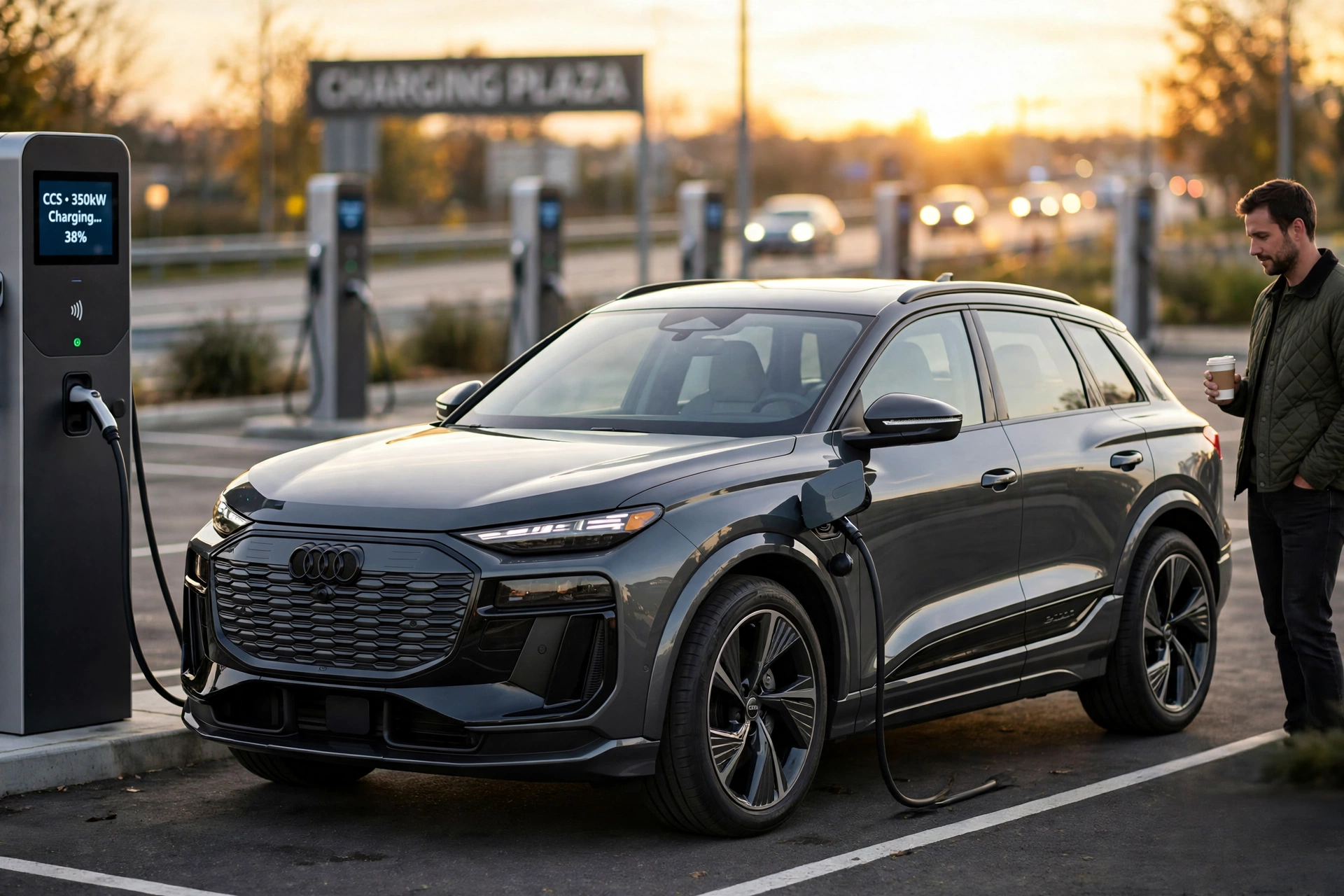
One quiet line in the Q4’s favour: current cars include a 250 kWh Electrify America charging credit for the first year. At a $0.48/kWh public rate (est.), that is roughly $120 of road-trip fuel, or about 735 miles of driving at the Q4’s consumption. Not a fortune. Still real money, and it softens the slow 175 kW charging on the trips where you feel it most. Among audi electric cars, the Q4 is the only one where a buyer cross-shops Hyundai and Kia on the same spreadsheet — and that pressure is exactly why it stays honest on price.
Our score: 6.5/10 — Range 6/10 · Charging 5/10 · Value 7/10. The Q4 is the only Audi EV a careful budget can touch new, and it earns that score on price discipline alone.
Q6 e-tron: the one the money people should test-drive first
The Q6 e-tron is the first Audi on the PPE platform, and it fixes the Q4’s biggest weakness in one move: 800 volts, a 270 kW peak, and a 10–80% charge in about 21 minutes. The quattro model starts at $64,500 with 456 hp and a 307-mile EPA rating on 19-inch wheels; fueleconomy.gov rates that version at 99 MPGe combined (34 kWh per 100 miles). Pick the 20-inch wheels and the EPA figure drops to 295 miles. Wheels are a range tax. Always check which ones your quote includes.
A rear-drive Q6 launched the range at $63,800 with a 321-mile rating on the ultra package, and leftover cars may still sit on lots. Hunt one down if you can. Same charger speed, more range, less money — that combination does not need a committee.
The SQ6 e-tron costs $73,200, makes 509 hp, and trades range down to 285 miles. Quick? Yes. Sensible? Only if your commute involves a drag strip. Our score for the SQ6: 7/10 — Range 7/10 · Charging 10/10 · Value 5/10.
Charging is where the Q6 earns its keep over a 5-year loan. Run the numbers on 12,000 miles a year at fueleconomy.gov’s 34 kWh per 100 miles: that is 4,080 kWh annually. At a $0.17/kWh home rate (est., near the current US residential average) you pay $694 a year. At a $0.48/kWh public fast-charge rate (est.), the same miles cost $1,958. The gap is $1,264 a year, every year. A home wallbox pays for itself before the second set of tires.
Our score: 8.5/10 — Range 8/10 · Charging 10/10 · Value 8/10. This is the sweet spot of the current range: real 800-volt hardware at a price that has not yet wandered into theatre.
A6 Sportback e-tron: the range king nobody brags about
Sedans are unfashionable. Sedans are also slippery, and slippery is free range. The A6 Sportback e-tron posts a 0.23 drag coefficient and an EPA rating of 392 miles in rear-drive form — the longest legs of any Audi EV ever sold in the US. It starts at $66,700, carries a 100 kWh battery (94.4 kWh usable), charges at 270 kW, and does the 10–80% stop in about 21 minutes. Against its German rivals it is not even close: our BMW i5 guide covers a car that tops out at 321 miles.
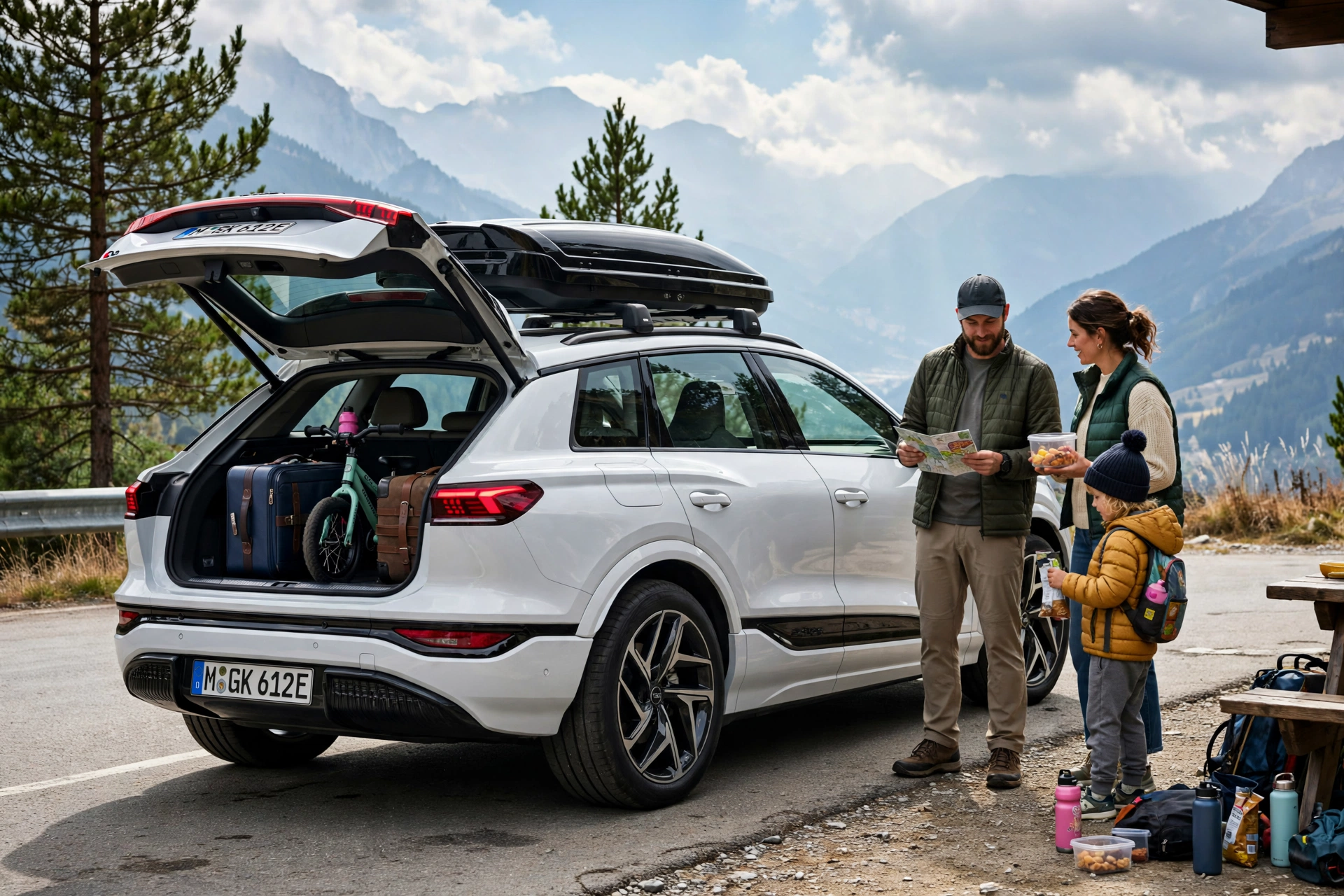
The quattro version costs $68,700, adds a front motor for 456 hp, and still returns 377 EPA miles. The S6 Sportback e-tron at $79,600 brings 543 hp and 324 miles. All three share the same Sportback hatch, which swallows 39.9 cubic feet with the seats folded. It is an SUV’s cargo bay wearing a sedan’s coat, and the coat is doing measurable work at 75 mph.
My verdict is not subtle. If your driving is mostly highway and your budget reaches the mid-$60,000s, this is the Audi to buy, full stop. The Q6 gives you a taller seating position. The A6 gives you 85 extra miles of range for $2,200 more than the Q6 quattro, and range is the thing you cannot retrofit.
Our score: 9/10 — Range 10/10 · Charging 10/10 · Value 8/10. S6 Sportback e-tron: 7.5/10 — Range 8/10 · Charging 10/10 · Value 6/10; you are paying $12,900 over the A6 quattro for speed you will use at on-ramps.
e-tron GT: beautiful, brutal, and a financial decision you make with your heart
The S e-tron GT starts at $127,700, makes 670 hp, and carries a 300-mile EPA rating. The RS e-tron GT performance starts at $170,500, makes 912 hp, hits 60 mph in 2.5 seconds (est., Audi’s launch-control figure), and drops to 278 miles. Both charge at up to 320 kW on the 800-volt J1 platform they share with the Porsche Taycan. Both are gorgeous. Neither survives contact with a spreadsheet.
Depreciation will do to these cars what it does to every six-figure German performance EV: a quiet, efficient demolition. The person who buys a 2-year-old RS e-tron GT gets 912 hp at a discount the first owner funded. Be the second person.
Our score: 6/10 — Range 7/10 · Charging 10/10 · Value 3/10. RS e-tron GT performance: 5/10 — Range 6/10 · Charging 10/10 · Value 2/10. Wonderful machines. Terrible allocations of $170,500.
The Q8 e-tron is gone, and the used market is the only door left
Ask about the flagship and you get a short answer: discontinued. Audi ended Q8 e-tron and SQ8 e-tron production on February 28, 2025, when its Brussels plant closed, and 2024 was the final US model year. There is no 2026 Q8 e-tron. Any “new” example a dealer offers is leftover 2024 stock, and it should be priced like leftover stock — the last ones listed from $74,400 with up to 285 EPA miles and a 170 kW charging peak that already looked dated next to the PPE cars.
As a used buy, a low-mile Q8 e-tron in the $40,000s (est., typical asking range for 2023–24 cars) is a lot of hushed, leather-lined SUV for the money. Just walk in knowing parts and software support now belong to a closed program. Compare any big-SUV shortlist against our Mercedes electric car guide before you sign; Mercedes will happily sell you a current flagship, at current flagship prices.
Price per mile of range: audi electric cars ranked cheapest first
Here is the computation I run on every range, Audi included. Take the starting MSRP. Divide it by the EPA range. You get the cost of each mile of range you are buying — a crude number, and crude numbers are the ones that survive a sales pitch.
| Model | Price ÷ EPA range | Cost per mile of range |
|---|---|---|
| A6 Sportback e-tron RWD | $66,700 ÷ 392 | $170 |
| Q4 45 e-tron | $50,600 ÷ 288 | $176 |
| A6 Sportback e-tron quattro | $68,700 ÷ 377 | $182 |
| Q6 e-tron quattro | $64,500 ÷ 307 | $210 |
| Q4 55 e-tron quattro | $56,000 ÷ 258 | $217 |
| S6 Sportback e-tron | $79,600 ÷ 324 | $246 |
| SQ6 e-tron | $73,200 ÷ 285 | $257 |
| S e-tron GT | $127,700 ÷ 300 | $426 |
| RS e-tron GT performance | $170,500 ÷ 278 | $613 |
Look at the top of that table. The A6 Sportback e-tron — not the entry-level Q4 — sells you range at the lowest price in the entire lineup, $170 a mile, and it throws in the fastest charging Audi makes this side of the GT. The RS e-tron GT charges you $613 for the same unit. That is a 3.6× spread inside one showroom, for the same electricity.
Ownership math matters as much as sticker math, so run your own totals with our EV total cost of ownership calculator before you fall for a trim walk. At home rates, every car in this guide runs on roughly 4–6 cents of electricity per mile.
Charging: one free year, then the meter runs
Most audi electric cars include one year of unlimited Electrify America fast charging (the Q4 gets a 250 kWh credit instead — read your window sticker, because the difference is real money). Price that perk honestly. A Q6 driver covering 12,000 fast-charged miles would burn roughly 4,080 kWh, worth about $1,958 at $0.48/kWh (est.). If you road-trip heavily, year one is a genuine four-figure gift. If you charge at home, it is worth close to nothing, so do not let it justify a pricier trim.
After the free year, the 800-volt cars protect your wallet in a sneakier way: time. A 21-minute stop against the Q4’s 28 minutes looks small once. Across 40 road-trip stops a year (est. for a heavy highway user), it is nearly 5 hours of your life back — and hours are the one currency you cannot earn more of.
Ownership costs: warranty, tyres and the options trap
The purchase price is the loud cost. The quiet ones arrive later, so price them now. Every model here carries a 4-year/50,000-mile new-vehicle warranty and an 8-year/100,000-mile battery warranty, and the 2027-model-year cars include Audi Signature Care scheduled maintenance for 3 years or 30,000 miles. That maintenance bundle is worth having; on the older cars it was another line item.
Tyres are the expense nobody budgets. The PPE cars ride on wide, staggered fitments, and a set of quality replacements in SQ6 or S6 sizes can run $1,400–$1,800 (est., fitted). The Q4’s narrower rubber costs closer to half that. Over 100,000 miles, that difference buys a home wallbox and the electrician to fit it.
Then there is the options list, my least favourite document in the automotive world. Audi will offer you a passenger-side touchscreen, digital light signatures you can customise like a phone wallpaper, and wheel upgrades that cut your EPA range while raising your tyre bill. Across audi electric cars, the pattern never changes: the base trim holds the value, and every Prestige bundle is a small second car payment wearing a nicer name. Buy the trim below the one the salesperson recommends. You will not miss the wallpaper.
Which of the audi electric cars should you actually buy?
Tight budget, new car, no debate: the Q4 45 e-tron at $50,600, in rear-drive form, on its standard wheels. Family SUV with road-trip duties: the Q6 e-tron quattro, and haggle — the model-year skip means dealers hold mixed 2025 and 2027 stock, and mixed stock is negotiation fuel. Highway miles above all: the A6 Sportback e-tron, the value champion of this entire guide. Speed as a hobby: a used e-tron GT, bought after somebody else paid the depreciation. The Q8 e-tron belongs on that used list too, priced as the orphan it now is. Ranked purely on money, audi electric cars sort themselves into one clear order: A6 first, Q4 for the strict budget, Q6 for the family, and the GT twins for people who have stopped pretending the spreadsheet is in charge.
Audi electric cars: questions buyers ask us
How many audi electric cars are there in the US range?
Five families: Q4 e-tron, Q6 e-tron, A6 Sportback e-tron, S6 Sportback e-tron and the e-tron GT pair, with Sportback body styles inside the Q4 and Q6 lines. The Q8 e-tron left the range when production ended in February 2025.
Which Audi EV has the longest range?
The A6 Sportback e-tron in rear-drive form, EPA-rated at 392 miles. The quattro version follows at 377 miles, and no Audi SUV gets within 70 miles of either figure.
Do Audi EVs still get the $7,500 federal tax credit?
No. The federal clean vehicle credit ended on September 30, 2025, for every brand. Some states still run their own incentives, and dealer discounts on leftover stock are the other lever you control.
How fast do Audi EVs charge?
The PPE cars (Q6, A6, S6) peak at 270 kW and quote about 21 minutes for 10–80%. The e-tron GT peaks at 320 kW. The Q4 peaks at 175 kW and needs roughly 28 minutes — the slowest of the range, on the oldest platform.
Are used audi electric cars a good buy?
The GT twins and the Q8 e-tron are the used-market gifts: heavy first-owner depreciation, strong hardware, and prices in the $40,000s (est.) for clean Q8 examples. Get a battery health report and confirm the warranty position before you wire anything.