Last updated: October 25, 2026
A family car that does the school run in silence, costs pennies per mile and still has years of battery warranty left — that is the promise of a tesla second hand purchase, and for once the promise mostly survives contact with the real market. Used Teslas are now the cheapest way into a genuinely long-range electric car. A three-year-old Model 3 with a heat pump and 300-odd miles of range costs less than a new petrol family hatch. The catch is that no two used Teslas are alike. One car has been charged gently at home and garaged; the next one lived on Superchargers and airport runs.
This guide walks through real asking prices, measured battery data, the warranty maths, the traps that catch buyers out, and the exact checks to run before money changes hands.
Start with the measuring unit that matters in our house: the school run. It is 3.2 miles each way, twice a day, plus swimming on Thursdays. A car that covers a week of that — 45 miles or so, with a frozen-boot Friday supermarket detour — on a single overnight charge is a car that fits family life. Almost every Tesla sold since 2020 clears that bar with room to spare, even after years of battery wear. That is why the second hand market for these cars deserves a calm look rather than the fear it usually gets.
Two things changed the market in the last year. First, the flood of ex-lease Model 3s and Model Ys pushed prices down hard through 2025. Second, the US federal used-EV tax credit — worth up to $4,000 on qualifying cars — ended on September 30, 2025, and prices firmed up almost immediately afterwards. Data firm iSeeCars tracked the average used Tesla price rising from $30,040 in September 2025 to $31,329 by January 2026, a 4.3% climb while most rival used EVs kept sliding. The bargain window has not slammed shut, but it is no longer widening. Clean 2021–2023 cars are the ones to hunt, and they are not getting cheaper.
Honesty box, before the numbers: we have not bought any of these cars ourselves. Every figure below comes from published market data, fleet battery studies and Tesla’s own warranty documents, checked on October 25, 2026, and our method is set out on our research methods page. Where a number is our estimate rather than a published figure, it is marked (est.) with the basis shown. Prices move weekly; treat the tables as a map, not a quote.
The short verdict, up front: buy the newest Model Y or Model 3 your budget stretches to, insist on seeing the battery health figure before you pay, and walk away from any seller who will not let you charge the car to 100%. The long version — with the arithmetic — follows.
Tesla second hand prices: what each model year really costs
Tesla second hand prices split neatly by model year, because the cars changed a lot between 2018 and 2024. The listings averages below come from CarGurus market data across all trims, prices checked October 25, 2026. Long Range and Performance cars sit above these averages; Standard Range cars sit below.
| Model year | Model 3 average | Model Y average |
|---|---|---|
| 2020 | $22,562 | $26,162 |
| 2021 | $23,287 | $26,705 |
| 2022 | $25,339 | $30,070 |
| 2023 | $27,624 | $33,346 |
| 2024 | $35,346 | $37,008 |
| 2025 | $37,567 | $39,263 |
Read the table the family way. A 2021 Model Y at $26,705 is within $39 of a 2020 car, yet it brings the updated interior, double-glazed front windows and a quieter cabin on the motorway — worth far more than $39 on a wet February school run. The 2018 Model 3, averaging $19,670, looks tempting, and it is the one we would skip: no heat pump, a noisier cabin, and its battery warranty expires during 2026. Cheap to buy, expensive to own in winter.
Model S and Model X play a different game. iSeeCars put the average used Model S at $51,249 and the average Model X at $57,306 in early 2026 — luxury money for cars that may be five or six years old, with air suspension and powered doors that do not repair cheaply. Fine cars. Family bargains they are not.
One more price trap: advertised prices on marketplace sites frequently assume incentives that no longer exist, or quietly exclude dealer fees of $500–$1,200 (est., based on typical US dealer documentation charges). Always compare the out-the-door figure, and remember that private sellers usually price 5–10% below dealers for the same car (est.).
Battery health decides every tesla second hand deal
Forget the odometer for a moment. On a petrol car, mileage is the story. On a used Tesla, the battery’s state of health is the story, and the mileage is a footnote. The good news is that measured fleet data is far kinder than the scare stories.
Recurrent, which tracks battery health across thousands of connected EVs, found that a Tesla Model 3 keeps about 95% of its original range after three years and about 93% after five. Losses run at roughly 1–2% a year, fastest in the first 50,000 miles, then flattening into a slow, shallow line.
A separate set of more than 600 hands-on battery health tests, published by the RSymons channel, landed in nearly the same place: 95% capacity under 50,000 miles, 92% between 50,000 and 100,000 miles, 90% beyond 100,000 miles and 85% beyond 200,000 miles. Tesla’s own fleet figures show roughly 80–85% retention at 200,000 miles. Three sources, one conclusion: these packs age slowly.
Translate that into family units. A 2022 Model 3 Long Range left the factory with a 334-mile EPA rating. At 93% health (est., applying Recurrent’s five-year figure), a full charge shows about 311 miles. At our 6.4-mile round-trip school run, that is 48 school runs per charge — nine and a half school weeks.
Even a hard-used example at 88% health gives 294 miles, or 46 school runs. Degradation, at these levels, changes your charging routine by roughly one extra plug-in a month. It does not change whether the car works for your life.
Real-world range is a separate question, and here honesty matters. EPA ratings flatter every EV. Recurrent’s real-driving observations show three-year-old Model 3s and Model Ys delivering around 64% of their EPA figure in everyday use — not because the batteries have lost a third of their capacity, but because the EPA number was optimistic on day one.
A car showing 311 miles at 100% might cover 215–240 real miles at motorway speeds in mild weather (est., from that observed ratio), and less in January. Plan your life around the smaller number and the car will never surprise you.
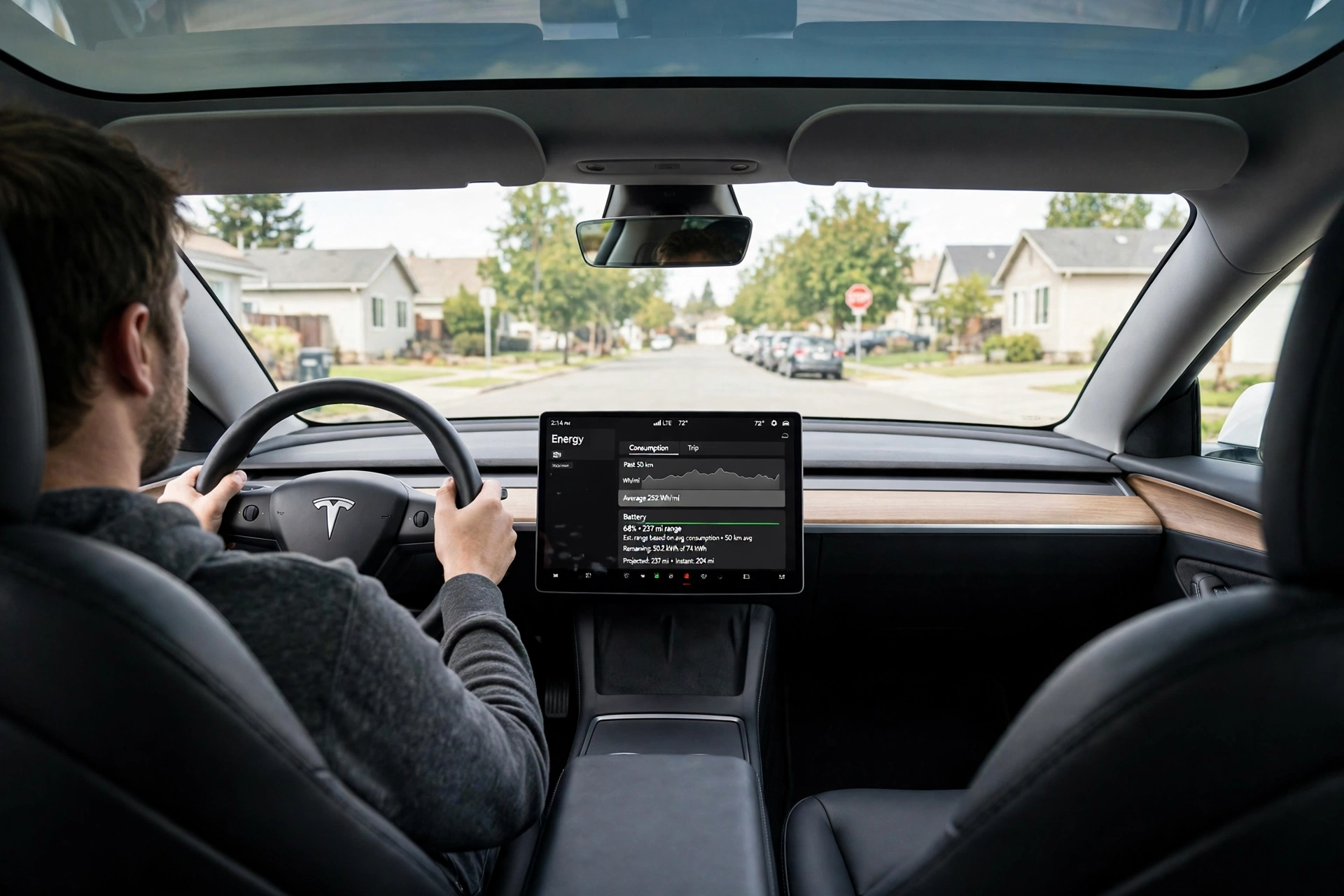
How do you check a specific car? Three ways, in order of strength. Best: ask the seller to run the car’s own battery health test, found in the Service section of the car’s settings on current software, and send you a photo of the result percentage — Tesla itself treats that figure as a better measure than the range on the screen.
Second: charge the car to 100%, note the displayed miles, and divide by the model’s original EPA rating; 300 shown miles on a 334-mile car means roughly 90% health. Third: look for a Recurrent Range Score on the listing — several large marketplaces now show one — and ask our battery replacement cost estimator what a worst-case pack would cost before you fall in love with a cheap high-miler.
What warranty is left on a tesla second hand car?
Warranty is where a tesla second hand purchase quietly beats almost every other used EV, for one reason: the cover follows the car, not the first owner. Tesla’s warranty documents confirm the remaining terms transfer to subsequent owners at no cost, and Tesla’s official vehicle warranty page sets out the full structure.
Two clocks are ticking on every used car, and both started on the day the car was first delivered — not the day you buy it.
The basic vehicle warranty runs 4 years or 50,000 miles. On a 2022 car it is already gone; on a 2024 car you may have a year or so left. The battery and drive unit warranty is the one that matters, and it runs 8 years with a mileage cap that depends on the version: 100,000 miles for Standard Range Model 3 and Model Y, 120,000 miles for Long Range and Performance versions, and 150,000 miles for Model S and Model X. Throughout that period Tesla guarantees the battery will hold at least 70% of its original capacity. Given the fleet data above — cars sitting in the high 80s and low 90s, percent-wise, at 100,000 miles — a claim under that 70% floor is rare, but the floor itself is a genuine safety net under any car still inside its window.
Do the date maths before you view a car. A Model 3 delivered in March 2021 keeps battery cover until March 2029 or 120,000 miles, whichever arrives first. A 2018 car’s battery cover ends during 2026 — which is a large part of why those cars are cheap. If a seller cannot tell you the car’s original delivery date, the warranty screen in the Tesla app or a call to Tesla with the VIN will.
Buy through Tesla’s own used inventory and you get one extra layer: cars sold by Tesla that are still inside their original basic warranty gain an additional used-vehicle warranty of 1 year or 10,000 miles once the original cover ends.
It is a modest cushion, not a new-car warranty, but on a four-year-old car it covers exactly the period when small faults — a charge-port door, a suspension bush, a window regulator — tend to appear.
Where to buy: Tesla direct, dealers, or a stranger’s driveway
Three channels sell you a tesla second hand car, and they are not interchangeable. Tesla’s own used listings are inspected, carry the extra warranty year described above, and arrive with the software features correctly attached to the car.
They also cost more — typically a four-figure premium over a private sale for the same year and mileage (est., from current listing spreads). Franchised and independent dealers sit in the middle: some legal protection, a valeted car, and a salesperson who may know less about battery health than you do after reading this page. Private sales are the cheapest route by a clear margin and carry the most homework. Every check in the next section is on you.
Our position, plainly: for a first used EV, buy from Tesla or a reputable dealer and pay the premium. The saving on a private buy is real, but so is the cost of one missed fault. Experienced owners can take the private route and pocket the difference.
Whichever channel you use, run the total-cost picture before you commit. Our total cost of ownership calculator lets you drop a used Tesla’s price, your mileage and your electricity rate into the same sums we run below, and if you are cross-shopping the Model Y specifically, our guide to known Model Y problems lists the faults to budget for by model year.
The viewing checklist and the traps that catch buyers
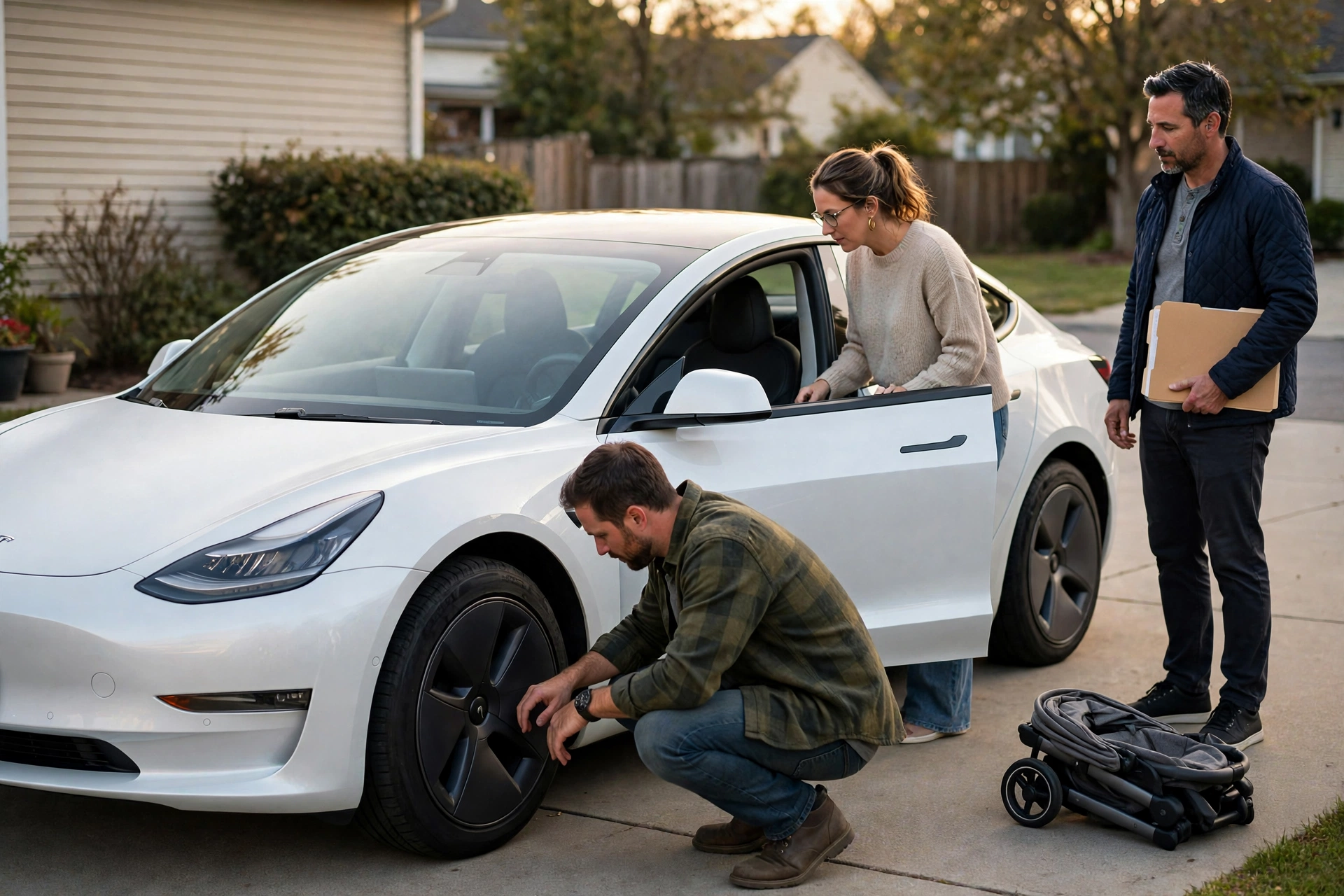
Print this section. Take it to the viewing. A tesla second hand inspection is shorter than a petrol one — no oil, no exhaust, no gearbox — but the items on it matter more.
- Battery health evidence. The in-car battery health test result, or a 100% charge figure you watched happen. A seller who refuses both is telling you something.
- Service history. Ask for the car’s service records and any recall completions. Tesla work shows in the app for the current owner; third-party repairs should come with invoices.
- Accident and title history. Run the VIN through a history service. A salvage or rebuilt title is a hard stop for most families: Tesla has restricted Supercharging on some salvage cars, and insurers price them accordingly.
- Tyres. A set of EV-rated tyres for a Model 3 or Y runs $900–$1,300 fitted (est., mid-2026 tyre retailer pricing). Worn tyres are a legitimate negotiating lever, not a detail.
- Suspension noises. Creaks and clunks over speed bumps on 2019–2022 Model 3 and Y cars usually mean control-arm bushes — a known wear item and a few hundred dollars a side, not a catastrophe, but get it priced into the deal.
- The screen, the charge port, the handles. Cycle everything. Slow screens on pre-2021 cars with the older computer are a known irritation; a charge-port door that sticks will annoy you every single day.
Then the software traps, which catch more buyers than any mechanical fault. Full Self-Driving is the big one. If the first owner bought the FSD package outright, it stays with the car and transfers to you. If they subscribed monthly, the subscription is tied to their account and simply ends — and a surprising number of listings describe a subscribed car as “FSD included”.
Open the car’s Software screen, tap Additional Vehicle Information, and read what it actually says: “Full Self-Driving Capability” is the package; anything less is not. The same screen settles arguments about Premium Interior, acceleration boost and free Supercharging, which on most cars built after 2017 was tied to the first owner and does not follow the car.
Finally, budget the bad day honestly. Out-of-warranty battery replacement is the figure that frightens people, and Recurrent’s analysts have put it plainly: fewer than 1% of Teslas need a pack outside recalls, but a replacement can exceed $13,000 when it happens.
Our breakdown of Tesla battery replacement costs shows how that bill is built and why refurbished packs usually cut it sharply. A car still inside its 8-year battery window is the simple way to keep that risk on Tesla’s desk instead of yours.
The maths: what a tesla second hand buy really saves
Here is the calculation we run on every used EV, done in the open. First, price per mile of range — what each mile of full-charge range costs you. Take the average 2022 Model 3 at $25,339. In Long Range form it started life at 334 EPA miles; at 93% battery health (est., applying Recurrent’s five-year retention figure) it shows about 311 miles today. $25,339 ÷ 311 = $81.47 per mile of range. A new Model 3 Long Range at $44,990 (est., current list before any incentives) with a 363-mile EPA rating: $44,990 ÷ 363 = $123.94 per mile.
The used car delivers its range at roughly a third less per mile. That gap is the whole argument for buying used, in one line.
Now three years of ownership, 12,000 miles a year, both cars charged at home at $0.17 per kWh (est., near the current US residential average). The Model 3 uses about 25 kWh per 100 miles, so 36,000 miles needs 9,000 kWh: $1,530 of electricity for either car.
Depreciation: assume the used car loses 22% of $25,339 over three years (est.) = $5,575; the new car loses 38% of $44,990 (est.) = $17,096. Running repairs: $1,800 allowed for the used car (one set of tyres plus a control-arm job), $1,100 for the new car (tyres only, the rest under warranty). Totals: used $5,575 + $1,530 + $1,800 = $8,905. New $17,096 + $1,530 + $1,100 = $19,726. Difference: $10,821 over three years, almost exactly $300 a month. That is a nursery place, a family holiday, or a very respectable stroller fleet — paid for by letting someone else take the first depreciation hit.
Our verdict scores, model by model
Used Model Y, 2021–2023 — Our score: 8.8/10. Range: 8/10. Reliability: 9/10. Value: 9/10. The hatch takes a folded stroller without the daily Tetris a saloon boot demands, the heat pump is standard, and 2022 cars around $30,070 are the sweet spot of the entire tesla second hand market. If you have children, buy this one.
Used Model 3, 2021–2023 — Our score: 8.6/10. Range: 9/10. Reliability: 9/10. Value: 9/10. Longer-legged and cheaper than the Y, quieter than the early cars, and the Long Range’s efficiency on a school-run duty cycle is superb. It loses half a mark only because the saloon boot opening genuinely does fight bulky prams.
Used Model S and Model X, 2017–2020 — Our score: 6.6/10. Range: 9/10. Reliability: 6/10. Value: 6/10. Lovely mile-eaters, and the free-Supercharging cars have a cult following, but air suspension, door handles and ageing screens turn ownership into a subscription to a parts department. A family budget deserves the predictability of the smaller cars.
Buying through Tesla’s used inventory — Our score: 8.2/10. Range: 8/10. Reliability: 9/10. Value: 7/10. You pay a premium for the inspection, correct software transfer and the extra warranty year. For a first used EV, that premium is money well spent; for your second, you will shop privately and keep it.
Across these scores, a tesla second hand Model Y or Model 3 from 2021–2023 remains the clearest family choice, provided the battery health figure and warranty dates check out.
Frequently asked questions
Does the battery warranty transfer when I buy a tesla second hand?
Yes. The remaining battery and drive unit warranty follows the car to the new owner at no cost, counting from the car’s original delivery date. An 8-year term on a 2022 car therefore runs to 2030, subject to the mileage cap for that version — 100,000, 120,000 or 150,000 miles.
How much range has a five-year-old Tesla actually lost?
Measured fleet data from Recurrent says a Model 3 keeps about 93% of its original range at five years — around 23 miles gone from a 334-mile car. Everyday real-world range is lower than the screen figure in any case, because EPA ratings are optimistic; judge the car by the health percentage, not the headline miles.
Is Full Self-Driving included on a used Tesla?
Only if the first owner bought the package outright — then it stays with the car. A monthly FSD subscription belongs to the seller’s account and ends at sale. Check the car’s Software screen, under Additional Vehicle Information, before paying any premium for it.
Which model year is the sweet spot?
2021 to 2023. You get the heat pump, the quieter cabin, the faster computer, several years of battery warranty still in hand, and prices between roughly $23,000 and $33,000 depending on model and trim. Cars from 2024 onward are excellent but sit close enough to new prices to weaken the case.
Should I worry about a Model 3 with 120,000 miles on it?
Worry about the suspension, the tyres and the price — not the battery, which fleet data puts near 90% health at that mileage. Do note that a Long Range car’s battery warranty cap is 120,000 miles, so cover may be ending exactly as you buy. That is a reason to negotiate hard, not necessarily to walk away.
Buy the battery, not the badge. Get the health figure in writing, do the warranty date maths, and let the depreciation someone else already paid for do the heavy lifting. Do that, and a used Tesla is not a gamble — it is the most rational family car purchase on the market right now.
For families weighing a tesla second hand purchase, patience and the checks above matter more than any single bargain price, and a careful tesla second hand search should always start with battery health and warranty cover.
A tesla second hand buyer who checks battery health, warranty cover and software features first is far more likely to find a tesla second hand car that stays reliable for years.