Last updated: October 25, 2026
There are exactly two answers when you go shopping for a tesla sport utility vehicle in late 2026: the Model Y and the Model X. One of them is the best-selling car on the planet. The other one just got discontinued. Both are shaped like rounded bread loaves, both run on the same Supercharger network, and both post 0–60 times that would have embarrassed a supercar fifteen years ago. The slowest version here needs 6.8 seconds. The fastest needs 2.5. That spread is the whole story, and this guide treats it like one: stopwatch first, calculator second, brochure language nowhere.
So here is the plan. We line up every current version of the tesla sport utility vehicle family, check the EPA range figures against the official listings, time the sprints, price the miles, count the seats, and score each model at the end. Prices are Tesla’s US list prices, checked October 25, 2026, before the $1,640 in destination and order fees Tesla adds to every car. If a number is Tesla’s claim rather than an EPA rating, it gets flagged in the text.
What counts as a tesla sport utility vehicle, and what does not
Definitions first, because Tesla’s lineup invites confusion. The Cybertruck is a pickup truck. It has a bed, it tows like a truck, it is filed as a truck. The Model 3 and Model S are sedans. That leaves two genuine SUVs in the catalogue: the Model Y, a compact-to-midsize crossover built in Texas and California, and the Model X, the big three-row flagship with the Falcon Wing rear doors. Everything in this guide is about those two nameplates and their variants. Nothing else in Tesla’s showroom qualifies, no matter how tall it looks in photos.
Now the twist that reshapes the whole segment. Tesla ended Model X production in 2026 and closed the order book; the X survives as leftover inventory and a strong used market. In July 2026 Tesla launched the Model Y L, a stretched six-seat version of the Y with a longer wheelbase and a genuinely usable third row, built to take over the family-hauler job the X is vacating. So the living tesla sport utility vehicle lineup is really one nameplate in two lengths, plus a farewell flagship you can still find if you move fast. Keep that framing in mind. It changes what “buying new” even means here.
The Model Y lineup: six versions, one body shell
Tesla renamed the Model Y range in October 2025, retiring the old Long Range badge in favour of Standard and Premium tiers, then added a Standard all-wheel-drive version in February 2026 and the long-wheelbase Y L that July. Every version rides on the refreshed “Juniper” body with the full-width light bars, the panoramic glass roof and the flush door handles. Here is the full spread, with EPA range figures as listed on fueleconomy.gov:
| Version | List price | EPA range | 0–60 mph | Seats |
|---|---|---|---|---|
| Model Y Standard RWD | $39,990 | 321 miles | 6.8 s | 5 |
| Model Y Standard AWD | $41,990 | 294 miles | 4.6 s | 5 |
| Model Y Premium RWD | $45,990 | 357 miles | 5.4 s | 5 |
| Model Y Premium AWD | $49,990 | 327 miles | 4.3 s | 5 or 7 |
| Model Y Performance | $57,990 | 306 miles | 3.3 s | 5 |
| Model Y L Premium | $61,990 | 328 miles | 4.4 s | 6 |
| Model X Dual Motor | $99,990 | 352 miles | 3.8 s | 5, 6 or 7 |
| Model X Plaid | $114,990 | 335 miles | 2.5 s | 5, 6 or 7 |
The Standard cars are the value play and they do cut real corners to get there: simpler LED headlights instead of the slim light bar treatment, heated seats without ventilation, no rear touchscreen, and a smaller battery. Wheel choice matters more than buyers expect. The EPA rates the Standard RWD at 321 miles on its standard 18-inch wheels and just 303 miles on the optional 19s. Eighteen miles of range, gone, purely for looks.
The Premium tier restores the equipment, adds the bigger battery, and unlocks the longest range in the whole tesla sport utility vehicle family. The Premium AWD is also the only standard-length Y that can be ordered with the $2,500 seven-seat package. Hold that thought. We will deal with those two extra seats further down, and the verdict is not kind.
Equipment aside, the split that matters is charging and pace. Premium and Performance cars peak at 250 kW on a Supercharger. The Standard pair peak lower, around 175 kW (est., based on Tesla’s published charge curves for the smaller pack). On a road trip that gap shows up as extra minutes plugged in at every stop. Around town, charging at home overnight, you will never notice it.
Tesla sport utility vehicle range: the EPA numbers that matter
Range claims are where marketing departments go to play, so we use the EPA’s own listings throughout. The fueleconomy.gov database rates the Model Y Premium RWD at 357 miles combined, with an efficiency figure of 25 kWh per 100 miles. Tesla’s own page quotes 355 miles for the same car and labels it an estimate. Trust the EPA number; it is the one generated on a test cycle your driving will be compared against.
The Standard RWD posts 321 miles at a superb 24 kWh per 100 miles (138 MPGe), the Premium AWD 327 miles, the Performance 306 miles on its 21-inch wheels, and the stretched Y L 328 miles on 20-inch wheels. The Model X, in final-year form, rates 352 miles in Dual Motor trim and 335 miles as a Plaid.
Now the haircut. EPA figures are laboratory numbers, and sustained 75 mph motorway driving is the harshest auditor there is. Budget for roughly 70–80% of the EPA figure on a fast highway run (est., consistent with independent highway range tests of comparable EVs, which typically land 10–30% under the rating).
That turns the Premium RWD into a realistic 250–285 mile highway car, the Performance into a 215–245 mile car, and the Plaid X into a 235–270 mile car. Cold weather takes another bite. None of this is a scandal; it is physics, and every rival plays by the same rules.
The honest takeaway is that the Premium RWD Y is the range champion of the family by a margin big enough to plan trips around, while the Performance trades a fifth of its range for its party trick. Worth it? The stopwatch section is next. You can probably guess where this writer lands.
The stopwatch section: family haulers with supercar reflexes
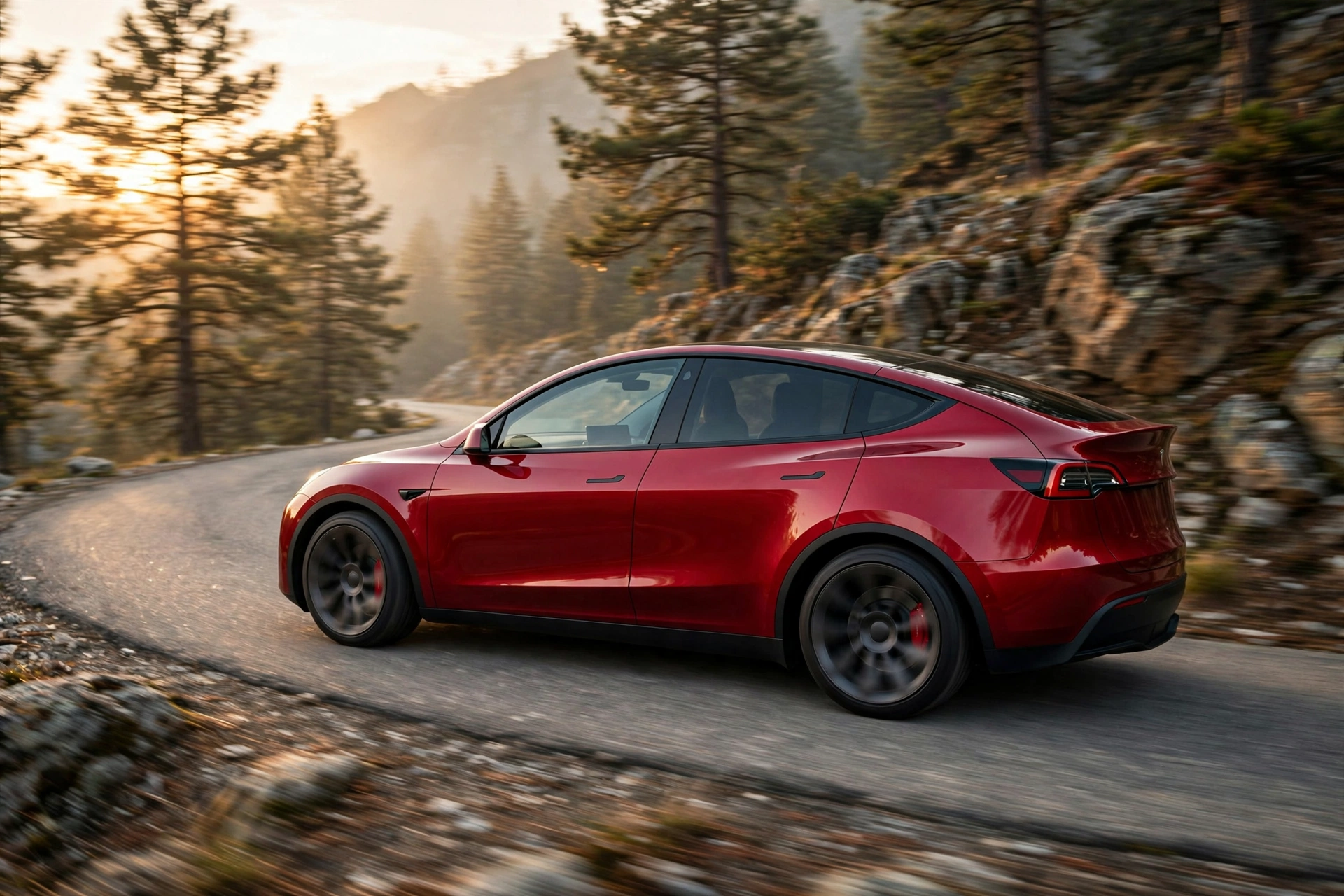
Read these numbers slowly. Model X Plaid: 1,020 horsepower, 0–60 in 2.5 seconds, quarter mile in 9.9 seconds, top speed 163 mph. In a three-row SUV with doors that open like a bird stretching. The standard Model X needs 3.8 seconds and makes 670 horsepower, which would be the headline act anywhere else.
The Model Y Performance hits 60 in 3.3 seconds and runs to 155 mph, riding on adaptive dampers and 21-inch wheels. The Premium AWD Y does 4.3 seconds. Even the humble Standard AWD manages 4.6, quicker than most hot hatches, and only the base Standard RWD (6.8 seconds, 125 mph top speed) performs like a normal car. Our own Model Y speed and range test breakdown digs into how those numbers hold up outside the brochure.
Time for some arithmetic the sales page will never show you. The X Plaid costs $114,990. The Y Performance costs $57,990. Difference: $57,000, paid to cut the 0–60 sprint from 3.3 to 2.5 seconds. Divide $57,000 by 0.8 seconds and the Plaid charges you $71,250 per second of acceleration gained. Per second. That is the most expensive stopwatch in the family by an absurd margin, and it buys you a party trick your passengers will ask you to demonstrate exactly twice.
The Y Performance, meanwhile, gives you 97% of the launch violence for 50% of the money, in a car that is easier to park and cheaper to insure. This is the easiest performance verdict on the site: the Y Performance is the thinking driver’s dragster, and the Plaid is a lottery-win purchase. Buy accordingly.
Charging: the network is the real spec sheet
Every tesla sport utility vehicle charges on the same NACS connector and the same Supercharger network, and that network remains the family’s single biggest advantage over rival SUVs. There are more than 30,000 Supercharger ports across the United States (est., based on Tesla’s published network counts), routed automatically by the car’s own trip planner, billed without apps or membership cards.
Premium and Performance Model Ys and both Model X versions peak at 250 kW. Tesla quotes up to roughly 175 miles added in 15 minutes for the longest-range Y under ideal conditions (est.; a warm battery arriving near empty is required, and winter will not cooperate). The Model X, with its bigger pack, can add close to 200 miles in the same window on Tesla’s figures. The Standard Ys peak lower and add miles more slowly, which is the one compromise that genuinely registers on a long drive.
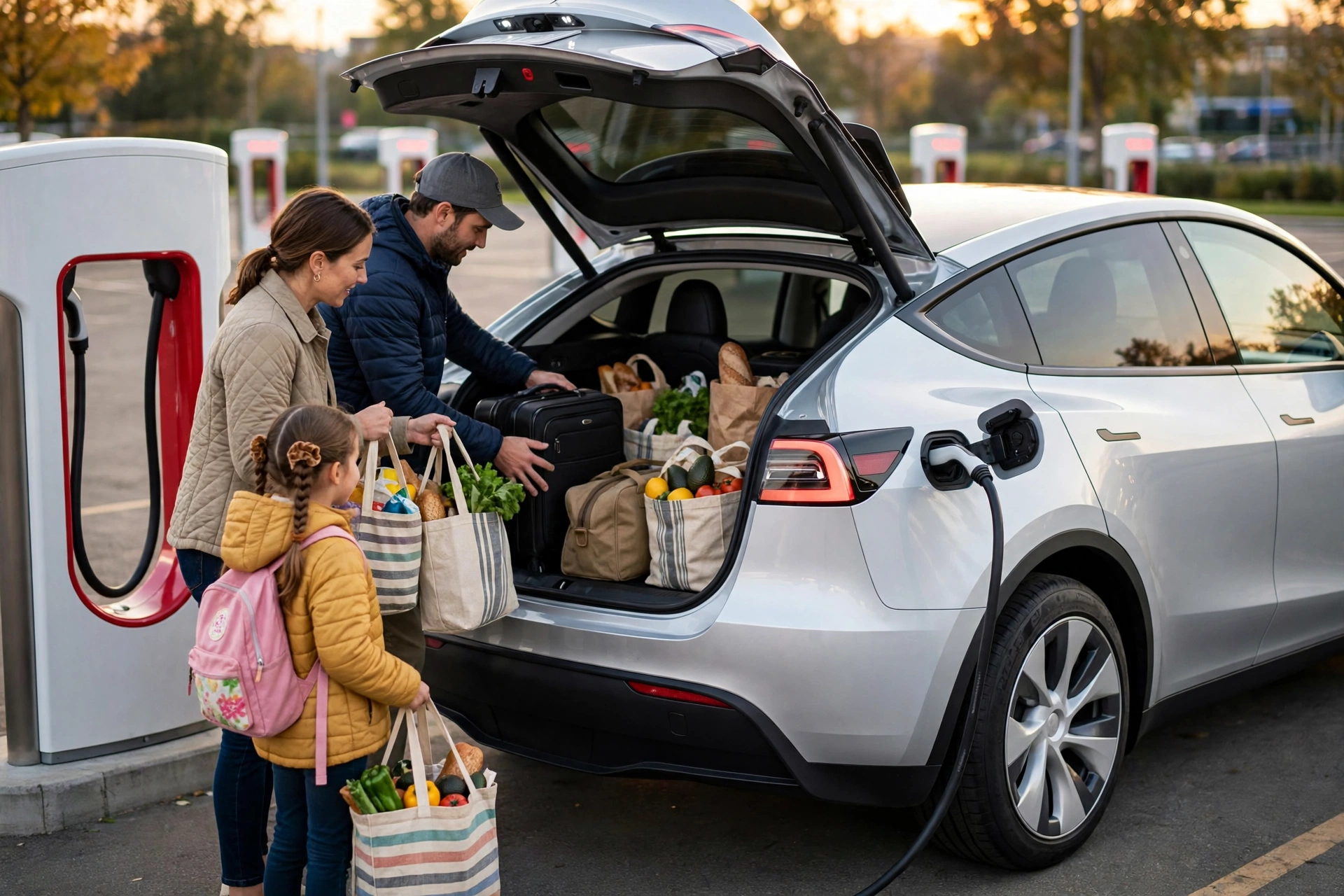
Home charging is simpler. The onboard charger handles 11.5 kW, so a Wall Connector on a 60-amp circuit refills any version overnight, and the EPA’s own running-cost estimates assume most owners will do exactly that. Charge at home and the charging story disappears entirely. Charge on the road and the story is still better than any rival’s, because the chargers actually work when you arrive. Reliability sounds boring in a spec table. At 11 p.m. in February, with 9% battery and a sleeping toddler in row two, reliability is the only spec that matters.
What a tesla sport utility vehicle costs: price per mile of range
Here is the computation we run on every SUV in this segment: list price divided by EPA range, giving the cost of each mile of range you are buying. Run it across the family (prices checked October 25, 2026, before fees) and the hierarchy snaps into focus:
- Model Y Standard RWD: $39,990 ÷ 321 miles = $124.58 per mile of range
- Model Y Premium RWD: $45,990 ÷ 357 miles = $128.82
- Model Y Premium AWD: $49,990 ÷ 327 miles = $152.87
- Model Y L Premium: $61,990 ÷ 328 miles = $188.99
- Model Y Performance: $57,990 ÷ 306 miles = $189.51
- Model X Dual Motor: $99,990 ÷ 352 miles = $284.06
- Model X Plaid: $114,990 ÷ 335 miles = $343.25
The Model X charges more than double the Y’s rate for every mile of range, and the Plaid nearly triples it. Some of that buys size, doors and theatre. Most of it buys speed you cannot legally use.
Running costs tell the friendlier half of the story. Take a Model Y at its EPA efficiency of 25 kWh per 100 miles, drive 12,000 miles a year, and charge at home at $0.17 per kWh: 12,000 × 0.25 = 3,000 kWh, costing $510 a year. A petrol crossover at 26 mpg with fuel at $3.35 a gallon burns 12,000 ÷ 26 = 462 gallons and costs $1,546. The Y saves roughly $1,036 a year, about $5,180 across five years, before you count the oil changes it never needs.
The Model X at an estimated 33 kWh per 100 miles (est.) costs about $673 a year on the same maths, against roughly $2,310 for a petrol luxury SUV at 20 mpg on premium fuel. If you want to run your own mileage and electricity price through the full ownership picture, our EV total cost of ownership calculator does the five-year sums properly.
Two cost warnings, stated plainly. First, the $7,500 federal clean vehicle credit ended on September 30, 2025, so no tesla sport utility vehicle gets it in late 2026; the list prices above are the real prices, plus that $1,640 in fees. Second, Model X pricing is a moving target now that production has ended: final list prices were $99,990 and $114,990, while some leftover units have been advertised notably higher (est., asking prices vary by store and week). A used X, bought after someone else absorbed the depreciation, is the financially literate way into the big car.
Seats, cargo and the Falcon Wing question
Space is where the family split gets real. The standard Model Y seats five, with about 30 cubic feet of cargo room behind the second row (est.) and up to 76 cubic feet with the seats folded, plus a front trunk. The $2,500 seven-seat option on the Premium AWD adds a third row sized for small children and short hops. Adults back there will compose complaint letters.
Our position: skip it entirely. The Y L is the correct answer to the three-row question, with six proper seats in a 2+2+2 layout, second-row captain’s chairs, a wheelbase stretched by 5.9 inches, and up to 89 cubic feet of cargo volume. It costs $61,990, which is real money, and it is still the better buy than contorting a standard Y into a job it was never shaped for.
The Model X plays a different game. Five, six or seven seats, up to roughly 91 cubic feet of cargo space (est.) and a 6.5-cubic-foot front trunk. And those doors. The Falcon Wing rear doors hinge upward with sensors that map the ceiling and the car beside you, opening in garages where a normal door would clip a pillar. They make child-seat loading genuinely easier and school-run exits genuinely theatrical. They are also the most mechanically complicated doors ever fitted to a family car, which matters now that the model is out of production and every repair runs through Tesla service at Tesla prices.
Drama versus durability. For a new-car buyer with a warranty, the doors were a delight. For a used buyer in 2028 staring at an actuator quote, they are a line item. Go in with your eyes open.
Ownership notes: where the bills hide
A tesla sport utility vehicle asks little of you in routine servicing: no oil, no transmission fluid, no exhaust, just tyres, brake fluid checks, cabin filters and washer fluid. The bills that do arrive cluster in predictable places. Performance models on 21-inch wheels eat expensive tyres at a pace that surprises owners who use the launch control they paid for. The X adds Falcon Wing door sensors, air suspension components and a panoramic windscreen that costs serious money to replace. Before buying any used example, read our guide to common Model Y problems and budget accordingly. The powertrain itself is the reliable part of these cars. It is the garnish that gets expensive.
Our verdict scores
Tesla Model Y — Our score: 9.2/10 (Range: 9/10 · Charging: 10/10 · Value: 9/10). The Premium RWD pairs the family’s longest EPA range with its second-lowest price per mile of range. The Performance is the performance bargain of the decade. The Standard cars are honest transport at an honest price. One body shell, three correct answers depending on your priorities, and a charging network nobody else matches. This is the benchmark every rival SUV is measured against, and most of them lose.
Tesla Model X — Our score: 7.4/10 (Range: 8/10 · Charging: 9/10 · Value: 5/10). The stopwatch numbers remain untouchable and 352 miles of range in the Dual Motor is properly useful. The score falls on value and timing: double the Y’s price per mile of range, flagship pricing on leftover stock, and the most complicated doors in the business on a discontinued model. As a new purchase in late 2026 it only makes sense if you specifically want the X and accept the premium as the cost of admission. As a used purchase at the right price, the maths improves fast.
For most buyers, choosing a tesla sport utility vehicle comes down to range, charging and value, and the Model Y Premium RWD leads on all three. A tesla sport utility vehicle also makes sense for drivers who charge at home, because overnight charging removes most road-trip worry. If you need three rows every week, a tesla sport utility vehicle in the stretched Model Y L form is the practical choice. In short, a tesla sport utility vehicle buyer who values range should start with the Premium RWD, while a tesla sport utility vehicle buyer who values speed should look at the Performance. Finally, a tesla sport utility vehicle remains the benchmark in this class, even as the Model X leaves production.
Who should buy which tesla sport utility vehicle
Most families: the Model Y Premium RWD. Longest range, lowest running costs, $128.82 per mile of range, done. Snow-belt drivers who need the driven front axle: Premium AWD, and skip the seven-seat option. Big families who genuinely need three rows every week: the Y L, whose captain’s chairs turn the school run into a first-class cabin exercise. Speed addicts: the Y Performance, full stop; it delivers the family’s second-fastest sprint for half the Plaid’s money.
Buyers who want the big flagship with the doors and the 1,020-horsepower headline: the X Plaid, bought used, bought with a warranty, bought with your eyes open. And anyone cross-shopping the cheapest route in: the Standard RWD at $39,990 and $124.58 per mile of range is the most car per dollar Tesla has ever sold.
You can spec and order the current lineup on Tesla’s official Model Y design page, where the configurator shows live prices for every version listed here. When you compare any tesla sport utility vehicle, check EPA range, charging speed and price per mile of range before you decide.
Frequently asked questions
Which tesla sport utility vehicle has the longest range?
The Model Y Premium RWD, rated at 357 miles by the EPA. The Model X Dual Motor follows at 352 miles, then the Model Y L at 328 miles. If range is your top priority, the Premium RWD is the pick, and it is not close enough to argue about.
Is the Cybertruck a Tesla SUV?
No. The Cybertruck is a pickup truck, with an open cargo bed and truck classification. Tesla’s sport utility vehicles are the Model Y and the Model X only.
Can you still buy a new Model X?
Barely. Production ended in 2026 and the order book is closed, so remaining choices are leftover dealer inventory, which some stores price above the final list prices, and a deep used market. The six-seat Model Y L is Tesla’s intended replacement for X shoppers.
How fast does a Model Y charge?
Premium and Performance versions peak at 250 kW on a Supercharger and can add up to roughly 175 miles in 15 minutes under ideal conditions (est.). The Standard versions peak lower, around 175 kW (est.). At home, the 11.5 kW onboard charger refills any version overnight.
How many seats does the Model Y have?
Five as standard. The Premium AWD offers an optional third row for $2,500, making seven seats sized mainly for children. The stretched Model Y L seats six in a 2+2+2 layout with second-row captain’s chairs.
Does any Tesla SUV still qualify for the $7,500 federal tax credit?
No. The federal clean vehicle credit ended on September 30, 2025, so every tesla sport utility vehicle bought in late 2026 is purchased at full list price, plus destination and order fees. Some states still run their own incentives, so check your state’s programme before signing.