Last updated: October 24, 2026
A tesla model y speed range test answers the question every prospective owner actually asks, even if they phrase it differently. Not “how far does it go,” but “how far does it go at the speed I really drive?” The EPA number on the window sticker is measured on a gentle cycle with plenty of slow running. Your commute is not. Your road trip is not. This guide pulls together the published test results, works out what each speed costs you in miles, and names the trim that survives a fast highway leg with the least drama.
The short version, before the detail earns it: speed is the single biggest lever on Model Y range, bigger than temperature, bigger than wheel size, bigger than whether you chose one motor or two. Hold 65 mph and a Long Range Model Y behaves like the car in the brochure. Hold 85 mph and it behaves like a car with a materially smaller battery. Everything below puts numbers on that sentence.
Tesla Model Y Speed Range Test: What the Published Tests Actually Measured
Start with the independent tests, because Tesla’s own figures deserve a second opinion and these testers provide one. Edmunds runs a long-term 2026 Model Y, and its published figures are refreshingly generous to Tesla: an EPA estimate of 321 miles against an Edmunds tested range of 338 miles on its mixed-route range test. Mixed routes flatter an EV. Stop-and-go running lets regenerative braking earn its keep, and lower average speeds keep aerodynamic drag in check. Treat 338 miles as proof of what the car can do around town and on mixed roads, not as a highway promise. EPA ratings are published on fueleconomy.gov.
The highway-only tests tell a sterner story. A high-speed highway test of the Model Y Standard covered 268 miles before the car could no longer hold highway speed, using 69.2 kWh in the process — about 4.1 miles per kWh. The same car, on Edmunds’ mixed route, managed 337 miles. Same battery, same motors, 69 miles of difference, and the only thing that changed was the driving. That gap is the whole point of this article.
Car and Driver’s classic 75-mph highway test on the earlier-generation Long Range car returned 220 miles. That figure belongs to the pre-refresh car and its older aerodynamics, so do not paste it onto a 2026 Juniper and call it current. It still earns its place here as a warning: a steady 75 mph has always been where EPA optimism goes to die, and the refresh improved the car without repealing physics.
One more published figure worth holding onto: owners and testers consistently report lifetime consumption around 250 Wh per mile in mixed driving, rising past 300 Wh per mile on fast interstate running. A Model Y that sips 250 Wh per mile around town and gulps 305 Wh per mile at a fast cruise is not broken. It is doing exactly what every electric crossover does when the wind becomes the enemy.
What Each Speed Costs You: The Numbers, Worked Out
Published real-world consumption data for the Model Y clusters around a clear curve: roughly 5.0 miles per kWh at 30 mph, 4.5 at 50 mph, 4.1 at 65 mph, 3.6 at 75 mph, and 3.2 at 85 mph. Apply that curve to the Long Range car’s roughly 75 kWh of usable battery (est., based on published test figures) and you get the table below. These derived ranges are our estimates, computed from the published consumption curve — not Tesla claims, and not a single afternoon’s drive.
| Steady speed | Consumption (est.) | Range on ~75 kWh (est.) | What that feels like |
|---|---|---|---|
| 55 mph | ~222 Wh/mi | ~338 miles | Unhurried; you arrive later and calmer. |
| 65 mph | ~244 Wh/mi | ~307 miles | The sweet spot for a long leg. |
| 75 mph | ~278 Wh/mi | ~270 miles | Normal interstate pace; plan stops accordingly. |
| 85 mph | ~313 Wh/mi | ~240 miles | Fast, loud with wind, and thirsty. |
Read that table as a set of choices, not as a scolding. Dropping from 85 mph to 75 mph hands back about 30 miles. Dropping from 75 mph to 65 mph hands back about 37 more. On a 300-mile leg, the 65-mph driver covers it on one charge (est.). The 75-mph driver stops once. The 85-mph driver stops once and arrives with less margin than they expected. Speed does not just cost energy. It costs stops, and stops cost the time you thought speeding would save.
Here is that trade worked out honestly. A 300-mile trip at 65 mph takes about 4 hours 37 minutes of driving and uses roughly 73.2 kWh. The same trip at 75 mph takes 4 hours flat and uses roughly 83.4 kWh. You save 37 minutes and spend about $1.86 more on home electricity at the national average rate. Sounds like a bargain until you count the charging stop the faster trip forces: 10 to 20 minutes at a Supercharger, plus the exit and the re-entry, and suddenly the 37 minutes have mostly evaporated. Drive fast if you enjoy it. Do not drive fast because you believe it saves time on a long electric trip. Often it merely moves the time from the road to the charger.
Why Speed Hurts an EV More Than It Hurts a Gas Car
Aerodynamic drag grows with the square of speed. Double the speed and drag roughly quadruples. A gas car hides this penalty because its engine is so inefficient at low speeds that the extra drag barely registers against all the energy it already wastes as heat. An electric motor wastes almost nothing, so drag shows up in full, unflattering detail on the consumption readout.
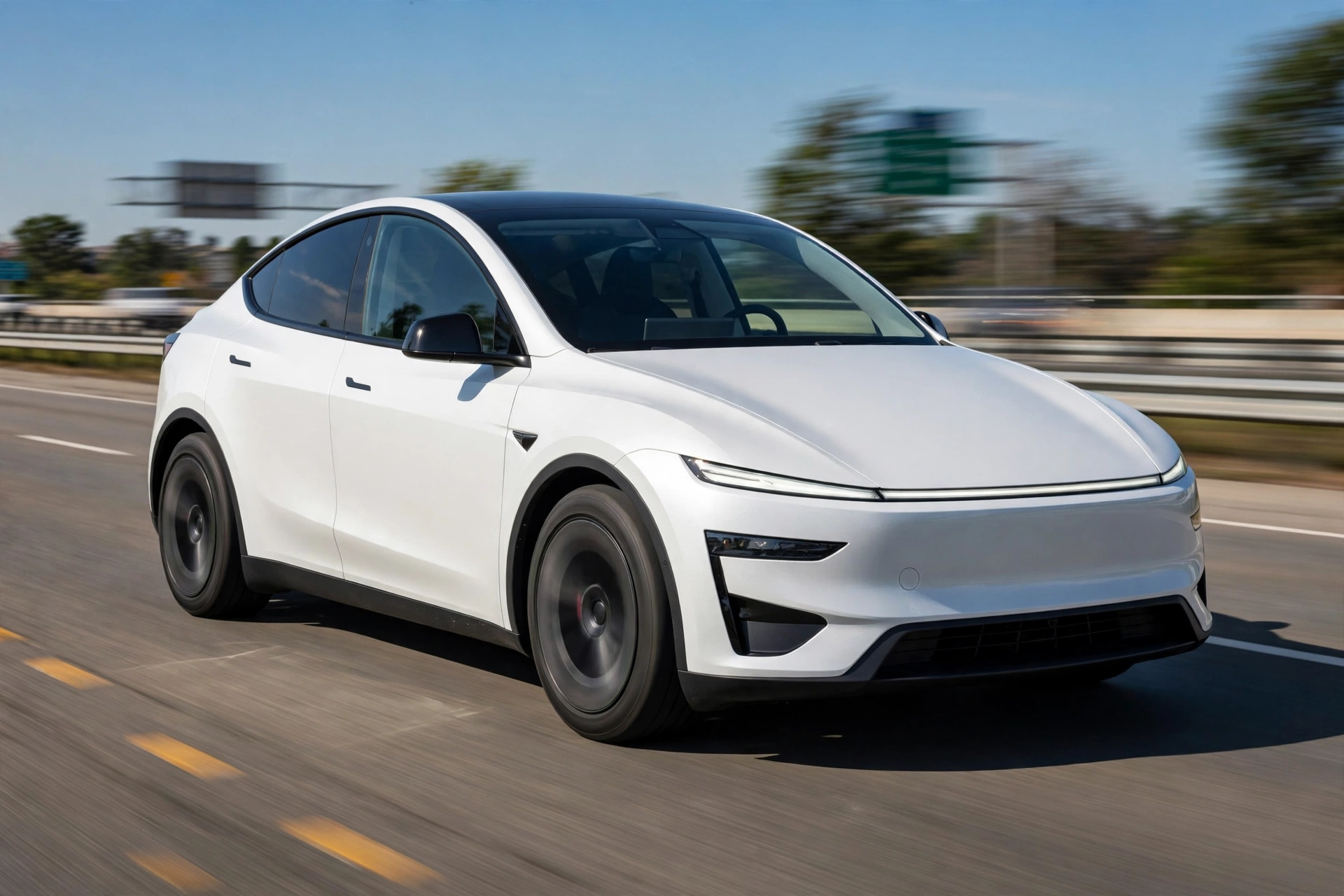
The Model Y fights back better than most crossovers. The 2026 Juniper refresh cut the drag coefficient to 0.22, sharpened the nose, and added a full-width front light bar that is genuinely elegant at night — a thin, clean line of light rather than the fussy jewellery some rivals bolt on. The rear carries its own full-width bar, reflected onto a panel below, which looks far more expensive than it has any right to. None of that changes the square law. It only softens it.
Weight matters less than people think at a steady cruise, and more than people think everywhere else. The Model Y is a heavy car, around 4,400 lbs depending on trim, and every acceleration event pays for that mass. On a flat interstate at a constant speed, mass mostly stops mattering and the air takes over. That is why a steady-speed test is the fairest test there is: it strips away driving style and leaves only physics.
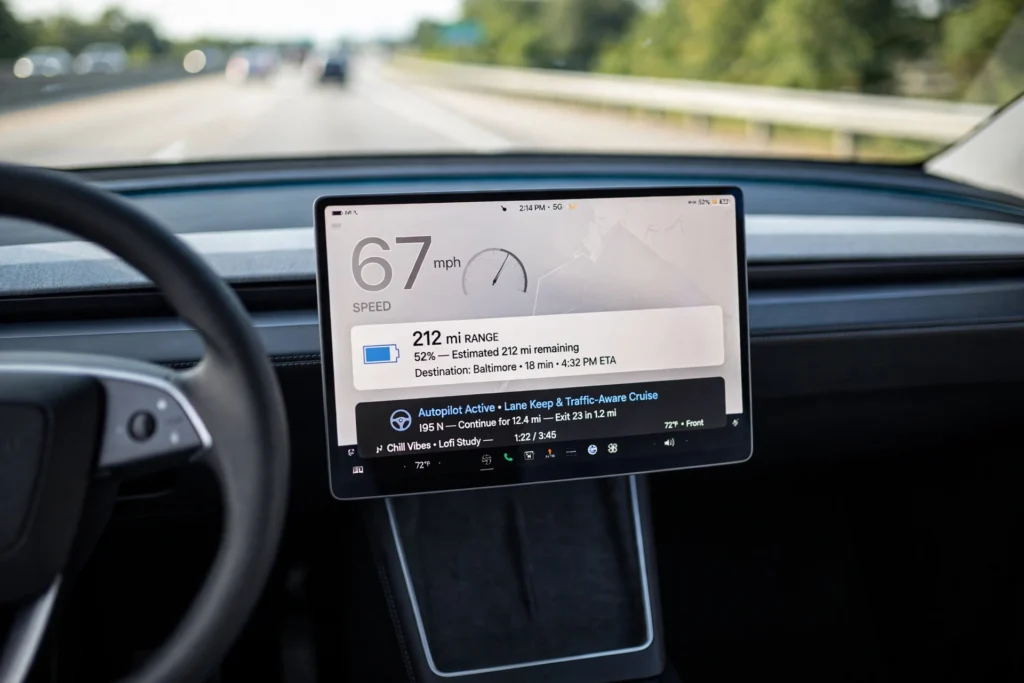
Trim by Trim: Speed Range Test Verdicts
Tesla’s lineup keeps shifting names and prices — Standard, Premium, Long Range, and various combinations thereof — so treat the prices below as reported October 2026 figures and check the configurator before ordering. The range figures are EPA estimates unless marked otherwise. Our scores weigh range at speed, charging, and value, argued from the facts above rather than from the brochure. Current prices are listed on Tesla’s official Model Y page.
Standard RWD — Our score: 8.3/10 (Range 8.0 / Charging 8.0 / Value 9.0)
Reported at $39,990 with 321 miles of EPA range and a 6.8-second run to 60 mph, the Standard car is the quiet bargain of the range. Its highway test result of 268 miles at speed is the strongest real-world evidence in this article for a base trim, and its smaller appetite for cash leaves room for the home charger and the winter tyres. The cabin gives up nothing that matters: the same screens, the same seats, the same calm. My one-sided view is simple — most buyers who think they need Long Range actually need this car and a realistic charging plan.
Long Range RWD — Our score: 9.1/10 (Range 9.4 / Charging 8.8 / Value 9.0)
Reported at $44,990 with 357 miles of EPA range, the Long Range RWD is the range king of the lineup and the only Model Y that makes a 300-mile highway leg boring in the best sense. Its single motor is lighter and thriftier than the dual-motor setup, it still reaches 60 mph in 5.4 seconds, and Tesla says it adds 182 miles in 15 minutes on a Supercharger against 169 miles for the heavier all-wheel-drive car. If your driving is mostly highway, this is the trim. Full stop. The $4,000 saving over all-wheel drive buys a great deal of electricity.
Long Range AWD — Our score: 8.6/10 (Range 8.6 / Charging 9.0 / Value 8.2)
Reported at $48,990 with 327 miles of EPA range and a 4.6-second sprint to 60 mph, the all-wheel-drive car is the safe, sensible, slightly boring choice — and boring is a compliment when snow is falling. The second motor costs you range at speed and $4,000 at purchase, and it pays you back in traction and in that planted, unbothered feeling on a wet on-ramp. Buy it for winters and steep driveways. Do not buy it because a salesperson told you all-wheel drive is “better” in some general, unspecified way.
Performance — Our score: 7.9/10 (Range 7.6 / Charging 9.0 / Value 7.2)
Reported at $57,990 with 306 miles of EPA range and a 3.3-second launch to 60 mph, the Performance is enormous fun and a poor value, and both things are true at once. The 21-inch wheels look superb and cost real miles — expect to give back 15 to 20 miles against the 19-inch setup on a highway leg (est., from wheel-size test reporting). The cabin’s sport seats are properly supportive, a small luxury that matters on a long drive, but the ride is firmer and the range penalty is permanent. Buy it because you love acceleration. Never buy it because you think it will go farther. It will not.
Original Analysis: What a Mile of Range Actually Costs You
This is the computation other guides skip, so here it is worked out in full. Divide each trim’s reported price by its EPA range and you get the price of each rated mile: Standard RWD $124.58 per mile ($39,990 / 321), Long Range RWD $126.03 per mile ($44,990 / 357), Long Range AWD $149.82 per mile ($48,990 / 327), and Performance $189.51 per mile ($57,990 / 306). The cheapest car buys the cheapest miles. The fastest car buys the most expensive ones. Nobody at a dealership will show you this table, which is exactly why it belongs here.
Now the cost of filling up. The U.S. Energy Information Administration put the average residential electricity price at 18.16 cents per kWh in August 2026. A full charge of roughly 75 kWh therefore costs about $13.62 at home. Spread over the Long Range AWD’s 327 EPA miles, that is 4.2 cents per mile. At a steady 75 mph, where consumption rises to roughly 278 Wh per mile, the same electricity costs about 5.0 cents per mile. Speed costs you roughly a fifth more per mile even before you count the extra stop.
Stretch that over five years. Drive the American average of 13,500 miles a year in the all-wheel-drive car at about 274 Wh per mile and you use roughly 3,699 kWh a year, costing about $672 a year at the national average rate. A comparable gas SUV at 28 mpg and $3.08 a gallon burns about 482 gallons a year, costing about $1,485. The saving is about $813 a year, or about $4,066 over five years — before maintenance, before brake savings, before a single off-peak tariff. That is our computed figure, from our own arithmetic, and it assumes home charging. Charge mostly at Superchargers at a typical 40 cents per kWh (est.) and the fill costs about $30, the per-mile cost at 75 mph rises to about 11.1 cents, and the five-year saving shrinks hard. Where you charge matters as much as what you drive. For a fuller five-year picture, see the EV total cost of ownership calculator.
Charging on a Fast Trip: The Stop Is Shorter Than You Fear
The Long Range cars peak at about 250 kW on a Supercharger and take roughly 27 minutes for a 10 to 80 percent charge in published test conditions. The useful number is smaller and better: 15 minutes adds about 182 miles to the rear-drive car and about 169 miles to the all-wheel-drive car, per Tesla’s figures as reported in October 2026. Plan your stops around 15 minutes, not around full charges, and the car stops being a chore on a long day.
The smart road-trip habit is a narrow battery window. Arrive low, leave at 60 or 70 percent, and let the charging curve do its best work at the bottom of the pack. Charging from 80 to 100 percent at a Supercharger is slow, expensive in time, and occasionally the reason a queue forms behind you. The car’s trip planner already knows this. Trust it, then check its maths against the speed table above, because the planner assumes you will drive at the speed limit and most of us do not. For the longer-term cost if the pack itself ever needs replacing, see Tesla battery replacement cost.
One honest caveat about the network advantage: Supercharger access is genuinely the Model Y’s superpower in North America, with tens of thousands of stalls and a plug-and-charge experience that still embarrasses most rivals. That advantage is real, it is worth money, and it does not make a single one of the range numbers in this article any bigger. A great network shortens stops. It does not lengthen range.
The Cabin at Speed: Small Luxuries, Small Annoyances
Speed range tests usually ignore the cabin, which is a mistake, because the cabin is where you spend the hours the range numbers describe. The Juniper refresh is a materially nicer place to sit than the car it replaced. Ventilated front seats are standard on the Long Range cars, and on a summer highway run they are the difference between arriving fresh and arriving damp. The acoustic glass, now on the rear windows as well, takes the edge off tyre roar at 75 mph, though it cannot silence it entirely — wind noise at 85 mph is still wind noise, and no amount of glass repeals it.
The 15.4-inch front screen remains the car’s one great polarising object. It is crisp, fast, and beautiful, and it still forces the driver to look away from the road to adjust the mirrors or the wipers. The 8-inch rear screen is a genuine small luxury for passengers, who can manage their own climate and entertainment without negotiating with the front. Ambient lighting, done in restrained strips rather than a nightclub impression, makes night driving feel considered rather than gimmicky.
Two small annoyances deserve naming because reviewers keep smoothing them over. There is still no Apple CarPlay or Android Auto, so your phone lives in Tesla’s world or not at all. And the single-screen layout means a passenger cannot help with navigation without reaching across the cabin. Neither is a reason to reject the car. Both are reasons to spend twenty minutes with the screen before you buy, rather than discovering them at 70 mph in the rain. For a fuller rundown of ownership issues, see Tesla Model Y problems explained.
Winter, Wheels and Towing: The Other Range Thieves
Cold weather is the second-biggest range thief after speed, and it stacks with speed cruelly. Below freezing, expect real-world range to fall to roughly 60 to 70 percent of the EPA figure on a highway leg, which turns a 270-mile car at 75 mph into a 160- to 190-mile car (est.). Precondition the battery while plugged in, use the heated seats instead of blasting cabin heat, and plan legs of 120 to 170 miles in deep winter. Nobody enjoys that advice. Everybody who ignores it ends up resenting the car.
Wheels are the most avoidable range tax in the lineup. The step from 19-inch to larger wheels costs roughly 15 to 20 miles on a typical highway leg, and the 21-inch Performance setup gives back more still. They look wonderful in photographs. They look less wonderful on a consumption readout at midnight in January. My advice is blunt: choose the smaller wheels, spend the saving on something you will actually notice, and let other people pay for the photograph.
Towing is the extreme case. The Model Y is rated to tow 3,500 lbs with the factory hitch, and a tall trailer can roughly halve highway range (est., from published towing consumption data showing 580 to 620 Wh per mile at 65 mph with a bluff trailer). A 270-mile car becomes a 110- to 130-mile car between chargers. Towable, yes. Effortless, no. Plan trailer trips around charging stops the way you plan them around fuel stations, and never trust the EPA number with a trailer attached.
Who Should Buy Which Model Y, After a Speed Range Test
Buy the Long Range RWD if most of your miles are highway miles. It goes farthest, charges fastest per minute at a Supercharger, and costs $4,000 less than the all-wheel-drive car. Buy the Long Range AWD if winters are serious where you live, or if your driveway defeats two-wheel drive a few times a year. Buy the Standard RWD if your budget is fixed and your daily driving is mostly local, with highway trips that tolerate one extra stop. Buy the Performance only if acceleration makes you smile every single time, because the range penalty will remind you of the price every single week.
Who should not buy a Model Y at all, on speed-range evidence? Anyone whose regular trip is a 300-mile highway leg at 85 mph with no charging stop they are willing to make, and anyone without home or workplace charging who expects Supercharger pricing to feel cheap. For both groups, the car is still good. The fit is wrong. A car that needs a charger you do not have is a car that will annoy you daily, whatever its test scores say. For a broader guide to range, charging, costs and who should buy, see EV cars: range, charging, costs and who should buy.
Frequently Asked Questions
How far does a Tesla Model Y go at 75 mph?
On the Long Range car, expect roughly 270 miles at a steady 75 mph in mild weather (est., computed from the published consumption curve and a roughly 75 kWh usable battery). The older-generation car managed 220 miles in Car and Driver’s 75-mph test, and the newer Juniper car does better thanks to improved aerodynamics, but no Model Y holds its full EPA figure at a steady 75 mph.
Does driving slower really save that much range?
Yes, and the effect is larger than most owners expect. Dropping from 85 mph to 75 mph returns about 30 miles on the Long Range car (est.), and dropping from 75 mph to 65 mph returns about 37 more (est.). The reason is aerodynamic drag, which grows with the square of speed. Ten mph at the top of the speed range costs far more than ten mph at the bottom.
Which Model Y trim has the best real-world range?
The Long Range RWD, with 357 miles of EPA range — the best figure any Model Y has ever carried. Its single motor and lighter weight make it the efficiency leader, and it adds more miles per Supercharger minute than the all-wheel-drive car. The Standard RWD is the value pick, but the Long Range RWD is the range pick.
How much does it cost to charge a Model Y at home?
About $13.62 for a full charge of roughly 75 kWh at the August 2026 national average of 18.16 cents per kWh. That works out to about 4.2 cents per mile at the EPA rating and about 5.0 cents per mile at a steady 75 mph. Your state rate changes everything: Hawaii pays multiples of Nevada’s rate, so check your own utility tariff before trusting any national average.
Is the Model Y a good road-trip car despite the speed penalty?
Yes, with one condition: you plan stops around 15-minute Supercharger visits rather than full charges. The network is dense, the car charges at up to 250 kW, and a 15-minute stop adds roughly 169 to 182 miles depending on trim. The speed penalty costs you stops, not trips. Drivers who accept that trade love the car on the highway. Drivers who refuse it should buy something else.