Last updated: October 25, 2026
The motor gets the credit. It shouldn’t. On a wet Tuesday, grinding up the hill everyone else walks, the thing deciding whether you roll into the office calm or arrive pushing a 62-pound bicycle is the e bike battery lithium ion pack bolted to your frame. The motor only spends what the battery saved. So this guide treats the pack as the main component, because out on the road, in the rain, it is.
Here is the short version. Almost every pack on a modern e-bike is a steel or plastic case stuffed with small cylindrical cells, wired together and supervised by a circuit board. The cells come in two common sizes and a handful of chemistries, and those two choices quietly determine your range, your winter performance, how many years the pack lasts, and what a replacement costs. None of this is printed clearly on the sales page. All of it is knowable before you buy.
Inside the Case: 18650 and 21700 Cells
An e bike battery lithium ion pack is not one big battery. It is dozens of small ones. The two formats that matter are the 18650 (18 mm wide, 65 mm long) and the 21700 (21 mm wide, 70 mm long). A good 18650 holds about 3.5 amp-hours; a good 21700 holds about 4.9 amp-hours and handles higher current with less heat. Bigger cells mean fewer welds, fewer failure points, and usually a slightly lighter pack for the same energy. That is why newer designs keep drifting toward 21700s.
The cells are wired in series to build voltage and in parallel to build capacity. Take a typical commuter pack: 52 cells arranged 13 in series, 4 in parallel (written 13S4P). Do the arithmetic and the marketing number appears. Thirteen cells in series at 3.6 volts nominal each gives 46.8 volts, sold everywhere as a “48V” system. Four cells in parallel at 3.5 amp-hours each gives 14 amp-hours.
Multiply: 46.8 × 14 = 655 watt-hours. The same pack gets advertised as 48 × 14 = 672 Wh, because brands use the rounder voltage. Same box, two numbers, 17 Wh of optimism. Watt-hours are always volts times amp-hours, and now you can check any listing yourself in about five seconds.
Reading an e bike battery lithium ion listing like a skeptic
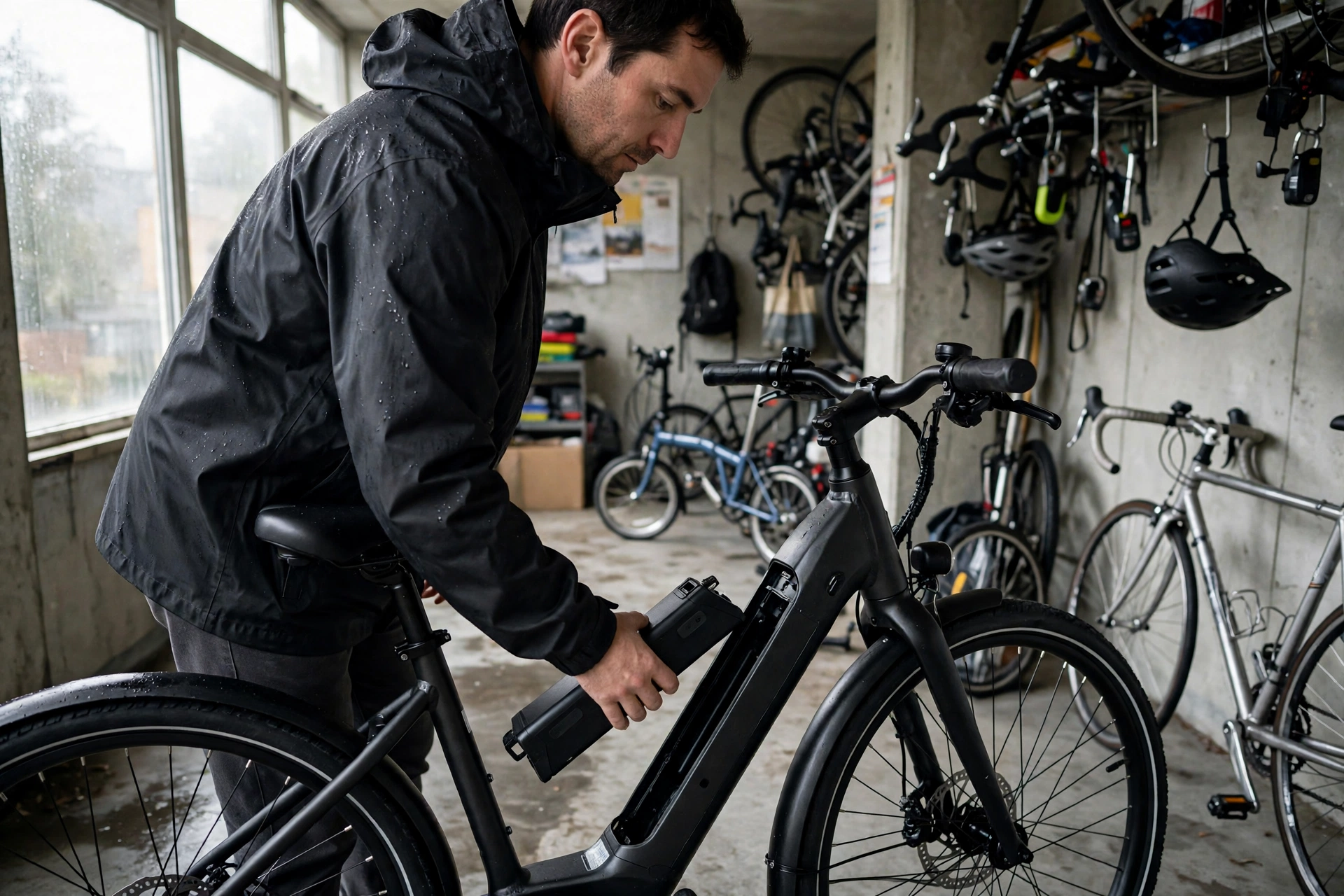
The cell math above is also a lie detector. A listing that promises a slim downtube pack with 1,000 Wh built from 18650 cells is claiming roughly 80 cells at 12.6 Wh each — and 80 cells do not fit in that case, nor weigh what the listing says they weigh. Run the count before you run your card. Honest packs state the cell brand, the configuration, and a watt-hour figure that survives the volts-times-amp-hours check. Listings that hide behind a huge amp-hour number at an unstated voltage are hoping you will not do ten seconds of arithmetic. Do the arithmetic.
E Bike Battery Lithium Ion Chemistries: NMC vs LFP
“Lithium ion” is a family name, not a recipe. The two chemistries you will actually meet on e-bikes are NMC (nickel manganese cobalt) and LFP (lithium iron phosphate, LiFePO4). They behave like different tools because they are.
NMC is the default. At the cell level it stores roughly 200 to 260 Wh per kilogram, against roughly 120 to 160 Wh/kg for cylindrical LFP cells. On a bicycle, kilograms are range. An NMC pack gives you the most miles for the least weight hanging off the frame, which is why nearly every mainstream commuter and mountain e-bike ships with one. The trade is longevity and temperament: quality NMC cells are typically rated around 500 to 800 full cycles before fading to 80% capacity, and their thermal runaway threshold sits lower, roughly 150–200°C, which demands respect and a good protection circuit.
LFP is the stubborn one. It is heavier for the same energy, so it shows up mostly on cargo bikes, utility bikes, and machines where the frame can carry the extra pounds. In exchange it offers a cycle life commonly rated at 2,000 cycles and beyond, and a thermal runaway threshold around 200–300°C, which makes it far more forgiving of abuse. If your bike lives in a shared apartment hallway and charges next to a stroller, that forgiveness is not a footnote. It is the whole argument.
NMC — Our score: 8/10. Energy density: 9/10. Safety: 6/10. Lifespan: 6/10. The right default for most riders, most hills, most commutes.
LFP — Our score: 7/10. Energy density: 5/10. Safety: 9/10. Lifespan: 10/10. Loses on weight, wins on years. For a cargo bike doing school runs until the kids outgrow it, I would take LFP and stop thinking about batteries entirely.
One more opinion, stated plainly: buy cells with a name. Samsung, LG, Panasonic, EVE — a pack built from traceable cells by a maker who publishes them will outlast and out-behave an anonymous pack with a bigger number on the sticker. The cheapest e bike battery lithium ion listings hide no-name or re-wrapped cells, and cell quality is the one thing you cannot inspect from outside the case.
The BMS Inside Every E Bike Battery Lithium Ion Pack
Every decent pack contains a battery management system, a small circuit board that watches each group of cells and can cut power in milliseconds. Its jobs: stop charging when a cell group hits its voltage ceiling, cut discharge before cells drop too low, limit current when you demand more than the pack should give, block a short circuit, balance the cell groups so they age together, and shut things down when temperatures go out of bounds. On cheap packs, temperature sensing is the first corner cut. Ask, or check the spec sheet.
Why should a commuter care about a board they will never see? Because the BMS is the difference between a pack that fades gracefully over five winters and one that dies in March with a blinking charger light. Balancing alone matters: without it, the weakest cell group drags the whole pack down, and your “500-cycle” battery behaves like a 200-cycle one. The cells get the headlines. The BMS does the shift work.
Voltage Platforms: 36V, 48V, and 52V
Most commuter packs sit on one of three platforms. A 36V system (10 cells in series) is the older, lighter standard, fine for flat cities and gentle assist. A 48V system (13 in series) is the current mainstream: more headroom for hill torque at a given current, which means less heat in the wiring and controller on the climb you ride twice a day.
A 52V system (14 in series) starts a charge at 58.8 volts and holds its voltage higher as it drains, so the bike feels less tired near the end of a long ride — riders call the fade on a draining pack “sag,” and sag is what makes the last hill home feel personal.
None of this makes one platform morally superior. It makes them different tools, and it makes compatibility a hard rule: charger, controller, and pack must all agree on voltage. A 52V charger on a 48V pack is not an upgrade path, it is an overcharge with extra steps. Whatever e bike battery lithium ion system you run, its charger is part of the system — which is why the certification in the safety section below covers the two together.
Cycle Life, Degradation, and What a Charge Really Costs
Battery life is quoted in cycles to 80% capacity. A cycle is one full discharge and recharge; two half-discharges count as one. Here is what that means in commuter years. Ride five days a week and charge most nights and you might log 200 full-equivalent cycles a year (est., based on a 20–30 mile daily round trip against a 40–60 mile rated range). An 800-cycle NMC pack reaches its 80% mark in about four years. An LFP pack rated at 2,500 cycles is still working when the bike around it needs its second drivetrain.
Degradation is not a cliff. It is a slope, steepest in the first year, then flattening. Heat is the accelerator: a pack stored fully charged in a hot garage ages faster than one used daily. Cold is different — a pack at freezing may deliver roughly 15–25% less range that day (est., consistent with manufacturer winter-riding guidance), then recover fully when warm. Cold costs you a ride. Heat costs you the battery.
Now the money, because this is where lithium earns its keep. Take a replacement NMC pack at $450 (est., mid-range US pricing for a name-brand 500–700 Wh pack, checked October 25, 2026) and divide by its 800 rated cycles: $450 ÷ 800 = $0.56 of battery wear per full charge. The electricity is nearly a rounding error — 0.655 kWh at $0.17 per kWh is about $0.11. Total: roughly $0.67 per charge, or about 1.9 cents per mile across a 35-mile discharge.
An LFP pack at $520 (est., same basis) divided by 2,500 cycles is $0.21 of wear per charge. Run the same sum yourself with our e-bike charging cost breakdown and the gap between chemistries stops being abstract.
Charging behaviour that extends pack life
Standard chargers deliver 2 amps and refill a 14 Ah pack in roughly six hours once the constant-voltage taper at the end is counted (est.). Fast chargers at 4–5 amps cut that time hard and cost you some cycle life doing it — heat and high charge rates are the two things cells dislike most.
The practical routine: charge after the ride, not right before it; unplug when full rather than leaving the pack simmering at 100% for days; and if the bike will sit for weeks, store it around half charge. Manufacturers differ on the exact storage figure, but a partial charge near 50% is the common guidance, and it beats both full and empty by a wide margin.
One hard rule. Never charge a pack that is below freezing. Charging a frozen lithium pack plates metallic lithium onto the cells and permanently steals capacity, and no charger setting undoes it. Bring the pack indoors, let it sit until it reaches room temperature, then charge. In January, that hour of patience is the cheapest maintenance you will ever do.
Fire Safety and Certification: UL 2849, UL 2271, and the CPSC Numbers
The fire statistics deserve a straight read, neither panic nor shrug. The U.S. Consumer Product Safety Commission reported at least 208 micromobility fire or overheating incidents across 39 states between January 1, 2021 and November 28, 2022, including at least 19 deaths. A later CPSC staff report covering 2017–2024 counted 45 fire-related deaths across micromobility products, 19 of them e-bike deaths in 13 battery fire incidents. In New York City alone, the FDNY responded to 268 lithium-ion battery fires in 2023, with 18 deaths.
Against millions of packs in daily use, the rate is low. Against a fire that starts in your hallway at 3 a.m., the rate is irrelevant. Both things are true, and the second one is why certification exists.
Two standards matter. UL 2849 certifies the whole e-bike electrical system — drive train, battery, and charger tested as a combination. UL 2271 covers the battery pack itself for light electric vehicles. In June 2026 the CPSC proposed a mandatory federal rule built on exactly these standards, which tells you where the floor is heading.
Before buying, read UL Solutions’ own explanation of UL 2849 e-bike certification and check the exact model, because certification is per model, not per brand. The CPSC micromobility safety center adds the behavioural rules, and they are blunt: be present when charging, never charge while sleeping or away, never use a pack that was modified or rebuilt with used cells, and use the charger the maker supplied.
Notice what the incident data keeps pointing at: modified packs, replacement batteries of unknown origin, mismatched chargers. The certified e bike battery lithium ion system, charged awake on a hard surface, is a solved problem. The fires cluster around the exceptions. So do not create exceptions in your own hallway.
E Bike Battery Lithium Ion Replacement Cost and End of Life
When a pack finally fades — and 80% capacity is the industry marker for end of life, not death; a tired pack still rides, just shorter — replacement is the bill riders forget to budget. Name-brand packs typically run $400 to $900 (est., based on US list prices for 500–750 Wh packs from major brands, checked October 25, 2026). Off-brand packs cost less and gamble more, for all the reasons in the safety section above. Before you order anything, run your own numbers with our e-bike battery replacement cost estimator, and weigh a genuine pack against the price of the whole bike: on a $1,400 commuter, a $600 pack is a decision, not a purchase.
Disposal is not optional and it is not the trash. The CPSC is explicit: never throw lithium batteries in household waste or general recycling. Take the pack to a battery recycler or hazardous waste collection centre, tape the terminals first, and if the pack is swollen or damaged, keep it somewhere non-flammable and away from the house until you can move it — many bike shops accept end-of-life packs through industry recycling programs such as Call2Recycle. A dead pack handled properly is scrap. Handled badly, it is the statistic from the previous section.
The Verdict for Commuters
Strip it down. A good e bike battery lithium ion pack is name-brand cells, a real BMS with temperature sensing, and certification you can verify. Chemistry: NMC for the light, long-range everyday bike; LFP if the bike is heavy-duty, lives indoors, or needs to outlast its frame bolts. Habits: charge awake, store near half, never charge frozen, and treat the supplied charger as part of the machine. Do those unglamorous things and the pack stops being the fragile part of the bike. It becomes the part you forget about — which, on a rainy hill at 8 a.m., is the highest praise a component can earn.
In short, choosing the right e bike battery lithium ion pack comes down to verified cells, a strong BMS, and certification you can check before you buy. An e bike battery lithium ion pack that meets those tests will serve a daily commuter well for years, and an e bike battery lithium ion system kept to the habits above is the safest way to enjoy that range.
Riders sorting out classes and motor rules alongside the battery questions will find our complete guide to Class 1 e-bikes a useful companion read.
FAQ
How long does an e bike battery lithium ion pack actually last?
Expect 500 to 800 full cycles from a quality NMC pack before it holds about 80% of its original charge — roughly three to five years of daily commuting. LFP packs are commonly rated at 2,000 cycles or more. Calendar age matters too: even a lightly used pack slowly loses capacity, faster in heat.
Can I charge my pack every night?
Yes, if you ride daily. Daily charging is normal use. What shortens life is leaving the pack at 100% for long stretches, so unplug when it is full and, for storage beyond a week or two, leave it near half charge instead.
Why does my range drop in winter?
Cold slows the chemistry and raises internal resistance, so the pack delivers less usable energy — roughly 15–25% less range at freezing is a realistic planning figure (est.). The capacity returns when the pack warms. Store and charge the pack indoors in winter, and never charge it while it is still frozen.
Is a bigger watt-hour number always better?
No. Watt-hours tell you energy, not quality. A 672 Wh pack built on anonymous cells with a weak BMS will fade sooner and behave worse than a 600 Wh pack from a reputable maker. Check the cell brand and certification before you celebrate the number.
Can I use a different charger or a second-hand pack?
Use the charger matched to your pack’s voltage and connector, ideally the one the maker supplied — certification testing treats charger and battery as one system. A second-hand e bike battery lithium ion pack is a gamble on someone else’s storage habits and drop history; if you buy one anyway, buy it in person, check for case damage and swelling, and walk away from anything with an unknown past and a too-good price.
What should I do with a swollen or damaged pack?
Stop using it and stop charging it. Keep it away from flammable material, do not puncture or open it, and take it to a hazardous waste facility or a participating bike shop recycling program. Never put it in household trash — the CPSC’s guidance on that point is absolute.
For any rider comparing options, the e bike battery lithium ion choice should start with cell brand, BMS protection, and certification, not the biggest watt-hour number on the listing. That e bike battery lithium ion checklist is the simplest way to avoid a disappointing or unsafe purchase.