Last updated: October 25, 2026
Verdict first, because that is why you are here: for most owners, lithium is now the correct way to replace 48v golf cart batteries, flooded lead-acid is the correct buy for a cheap cart you barely use, and AGM is the worst value of the three. The rest of this page is the arithmetic behind that sentence. No brochure language. Just capacities, cycle counts, weights, prices, and what each chemistry actually costs you per year.
A 48-volt pack is not one battery. It is a string of smaller batteries wired in series, positive to negative, so their voltages add up. Three layouts dominate. Six 8-volt batteries make 48 volts. Four 12-volt batteries make 48 volts. Eight 6-volt batteries make 48 volts. Same total voltage, very different capacities, weights, and prices. When a seller quotes you a number for a set, the first question is always: which layout, and how many amp-hours?
Finding out what is under your seat takes thirty seconds. Lift the seat. Count the batteries. Multiply the count by the voltage printed on each case. Six batteries stamped 8V means a 48V system. Four stamped 12V means the same system built a different way. While you are in there, count the filler caps on top. Three caps per battery means 6 volts (three 2-volt cells inside). Four caps means 8 volts. Six caps means 12 volts. That cap count has saved more owners from ordering the wrong set than any manual ever written.
Capacity is measured in amp-hours, and the fine print matters. Ratings are quoted at the 20-hour rate, meaning the battery delivers that many amp-hours when discharged slowly over twenty hours. Pull the power out faster, like a cart climbing a hill does, and you get less. This is the Peukert effect, and it punishes lead-acid far harder than lithium. Take the industry benchmark, Trojan’s T-875: an 8-volt flooded battery rated at 170 amp-hours at the 20-hour rate, 155 at the 10-hour rate, and 145 at the 5-hour rate, according to Trojan Battery’s own product page. Same battery. Three different capacities, depending on how hard you lean on it.
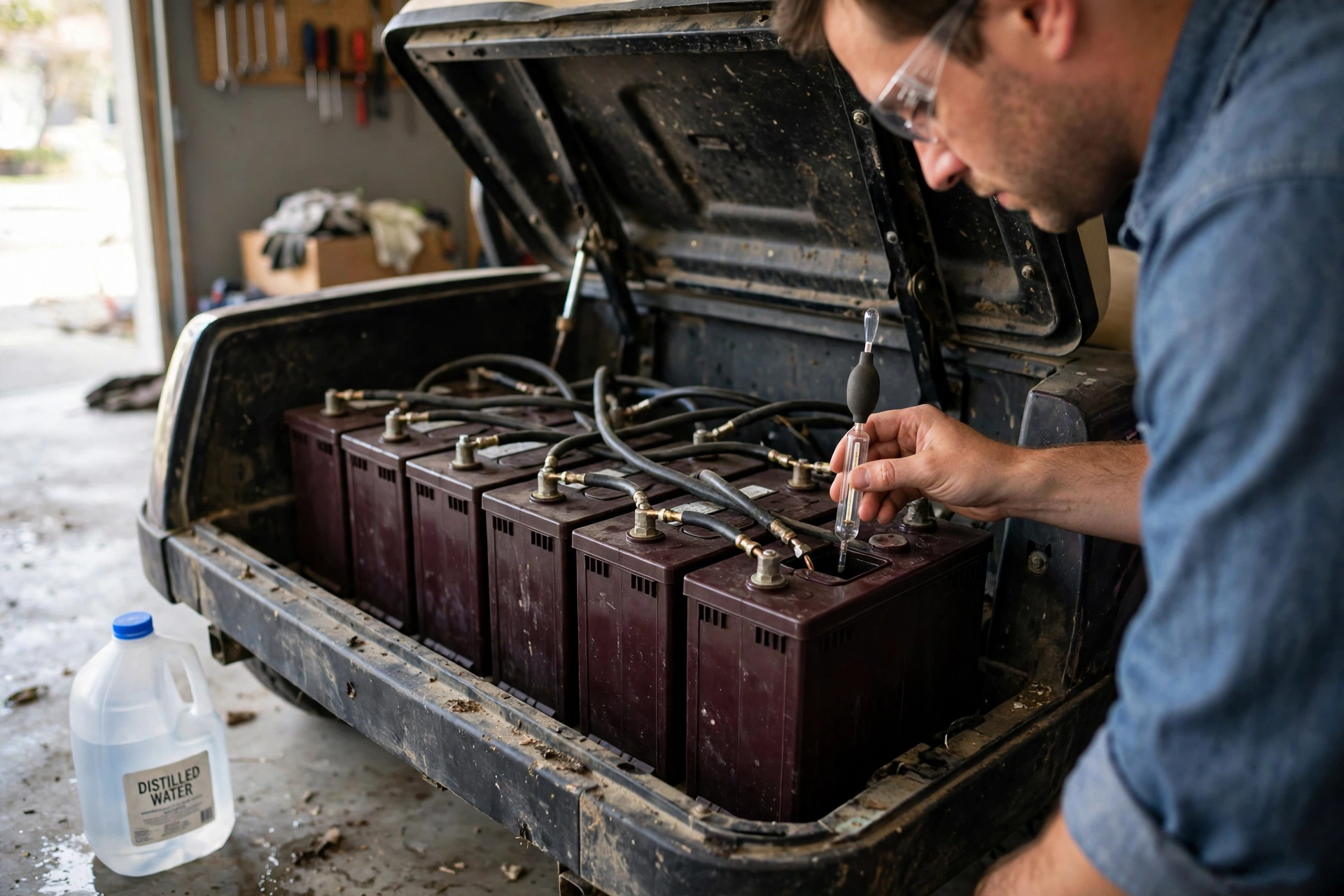
Six T-875s give you a 170 amp-hour pack, 378 pounds of lead and acid (63 pounds per battery), and the setup most 48V carts left the factory with. Everything else in this guide is measured against that baseline. Hold onto three numbers: 170 amp-hours, roughly $1,600 for a genuine set, and a service life of four to seven years if you maintain it. If you do not maintain it, cut that life in half and keep your wallet open.
The three chemistries sold as 48v golf cart batteries
Every set you can buy falls into one of three families. Flooded lead-acid is the original: lead plates sitting in liquid sulfuric acid, with caps you open to add water. AGM is lead-acid with the acid absorbed into fiberglass mats, sealed, so there is nothing to water. Lithium, in this market almost always lithium iron phosphate (LiFePO4), is a different chemistry entirely, sold either as one big drop-in pack or as a set of 12-volt lithium units wired together. The cart does not care which family you choose. Your budget and your habits should.
Flooded lead-acid: cheap, proven, thirsty
Flooded is the default for a reason. A six-pack of genuine Trojan T-875s lists at $1,598.99 at Pete’s Golf Carts (checked October 25, 2026), and budget brands undercut that by several hundred dollars. Trojan rates each T-875 at 1.51 kilowatt-hours of stored energy, and retailer guidance puts the set at roughly 1,200 cycles at 50% depth of discharge with four to seven years of service when watered and charged properly. Nothing else touches it on purchase price. Nothing else demands this much of your attention either.
Here is the part owners learn the expensive way: flooded batteries do not die of old age. Owners kill them by skipping water. Run the plates dry a few times and the set is finished, whatever the date on the case says. Water them on schedule, charge after every use, and a flooded set earns its keep. Ignore them for one summer and you are shopping again by fall.
AGM: sealed, silent, and poor value
AGM sets, Trojan’s Reliant line and T875-AGM among them, sell on one promise: no watering, ever. True. What the sales pitch skips is the invoice. A set of AGM 48v golf cart batteries typically runs $1,800 to $2,300 (est., based on current retailer listings for sealed cart batteries, checked October 25, 2026), several hundred more than flooded, for cycle life that is only modestly better, around 600 to 900 cycles at deep discharge in fleet comparisons. Weight is a wash, roughly 390 to 430 pounds a set. You pay lithium-adjacent money and get lead-acid performance with the maintenance deleted. That trade made sense in 2012. It does not survive contact with today’s lithium prices, and we will show you why in the cost section below.
Lithium (LiFePO4): one pack, a tenth of the fuss
A lithium conversion replaces the whole string with a single 51.2-volt pack (still sold and wired as “48V”). RoyPow’s widely used 105 amp-hour unit stores 5.37 kilowatt-hours, weighs roughly 95 to 105 pounds depending on the version, and carries a five-year warranty with a ten-year design life. RoyPow rates its 105Ah pack at 36 to 50 miles per charge on moderate terrain in RoyPow’s own lithium golf cart battery guide. Cycle life is the headline: 3,500 to 4,000-plus cycles for name-brand packs, three times what flooded delivers, with 80 to 100% of the capacity usable instead of half.
The catch is the charger, and it is non-negotiable. Lithium needs a charger with a lithium profile: correct voltage ceiling, no equalization stage, no temperature-compensation tricks from the lead-acid era. An old flooded charger with an equalize mode can push voltage where the pack’s battery management system does not want it, and the BMS will shut the pack down to protect itself. Most conversion kits bundle the right charger for exactly this reason. Budget for it or buy the kit. That charger is the one genuine complication in lithium 48v golf cart batteries, and it is a one-time complication.
Usable energy: what 48v golf cart batteries actually deliver
Now the computation nobody prints on the box. Amp-hours times volts gives watt-hours stored. What matters is how much of that you may actually use without shortening the pack’s life.
Flooded, 6 × 8V at 170Ah: 170 × 48 = 8,160 watt-hours on paper. Flooded lead-acid should not be discharged past 50% if you want it to live, so usable energy is 8,160 × 0.50 = 4,080 watt-hours, about 4.1 kWh. A typical two-passenger cart on mixed paved paths uses around 160 watt-hours per mile (est., based on common cart consumption at 15–20 mph with two occupants). 4,080 ÷ 160 = 25.5 miles of theoretical range. Then Peukert and voltage sag take their cut under real loads, and owners see 18 to 22 miles. That matches reality: two rounds of golf, or a long neighborhood loop, and no more.
AGM, 4 × 12V at 150Ah: 150 × 48 = 7,200 watt-hours. AGM tolerates about 60% discharge, so 7,200 × 0.60 = 4,320 watt-hours usable, roughly 27 theoretical miles, again landing near 20 in the real world. Sealed convenience, same ceiling.
Lithium, 51.2V at 105Ah: 105 × 51.2 = 5,376 watt-hours. LiFePO4 gives up 90% of that happily: 5,376 × 0.90 = 4,838 watt-hours usable, about 30 miles at the same 160 Wh/mile, and lithium holds its voltage nearly flat until the pack is almost empty, so the cart pulls the same on mile 25 as on mile 2. RoyPow’s higher 36-to-50-mile figure assumes gentler speeds and terrain. Our number assumes you drive it like you mean it. Either way, the smaller lithium pack delivers more usable energy than the bigger lead-acid pack. Read that sentence again before you price a replacement set.
The only cost comparison that matters: dollars per year
Sticker prices lie by omission. Divide by the years of service and the ranking flips.
Flooded: $1,599 for the Trojan set ÷ 5 years (the middle of Trojan’s four-to-seven-year guidance, assuming you water them) = $320 per year. Over a decade you buy two sets: $3,198, plus distilled water, plus your Saturday mornings.
AGM: $2,000 for a typical set (est., mid-range of current listings) ÷ 4 years = $500 per year. The most expensive way to own a cart, hiding inside the “maintenance-free” label.
Lithium: a complete conversion kit with pack, lithium charger, and state-of-charge gauge runs about $2,100 (est., based on current RoyPow-class kit pricing, checked October 25, 2026). $2,100 ÷ 10 years = $210 per year. One purchase per decade. The same trap catches car buyers, by the way; our EV total cost of ownership guide exists because purchase price and ownership cost are different animals.
One honest exception. If your cart is a $900 campground beater used nine weekends a year, buy the cheapest flooded set you can find and accept the shorter life. Calendar age kills a pack before cycle count does at that usage, and lithium’s decade of life is wasted on a cart that sits. The math above is for carts that actually work for a living.
Charging 48v golf cart batteries without shortening their lives
More 48v golf cart batteries are killed by charging habits than by mileage. Charge times separate the chemistries as sharply as price does. Flooded needs 8 to 12 hours for a full charge and wants it after every outing, because sitting discharged grows sulfate crystals on the plates. AGM is a bit quicker, 6 to 10 hours, with the same sit-full rule. Lithium charges in 2 to 5 hours on a proper 20-amp-plus lithium charger and does not care about partial charges at all. Top it up for forty minutes between rounds. It will not punish you.
Two charger rules, both absolute. First, the charger profile must match the chemistry: flooded chargers run absorption and sometimes equalization voltages that lithium packs reject, and lithium chargers will undercharge a flooded set. Second, never leave any of these packs on a dumb trickle device all winter. Flooded batteries self-discharge at 5 to 15% per month per Trojan’s data sheet, so a stored cart needs a maintainer or a monthly top-up charge, not a constant cook. A cart charger draws about as much from the wall as the EVs in our guide to charging an electric car with a regular outlet, which is to say, an ordinary circuit handles it fine.
The flooded maintenance routine, all ten minutes of it
Since flooded is still the cheapest entry, here is the whole ritual. It applies to flooded 48v golf cart batteries only; if you run AGM or lithium, skip this section and enjoy your free time. Check water levels every two to four weeks in the season, monthly in storage. Fill with distilled water only, after charging, to the split ring, never above it.
Tap water’s minerals plate the cells and shorten life; this is chemistry, not superstition. Wipe terminal corrosion with a baking-soda solution, keep cables torqued, and run an equalization charge when your charger offers one and the manual calls for it. A $12 hydrometer tells you the truth about each cell’s specific gravity, and one weak cell means the set is on its way out. That is the entire job. Ten minutes, twice a month. The owners who call flooded batteries unreliable are the ones who skipped it.
Converting to lithium: what the swap actually involves
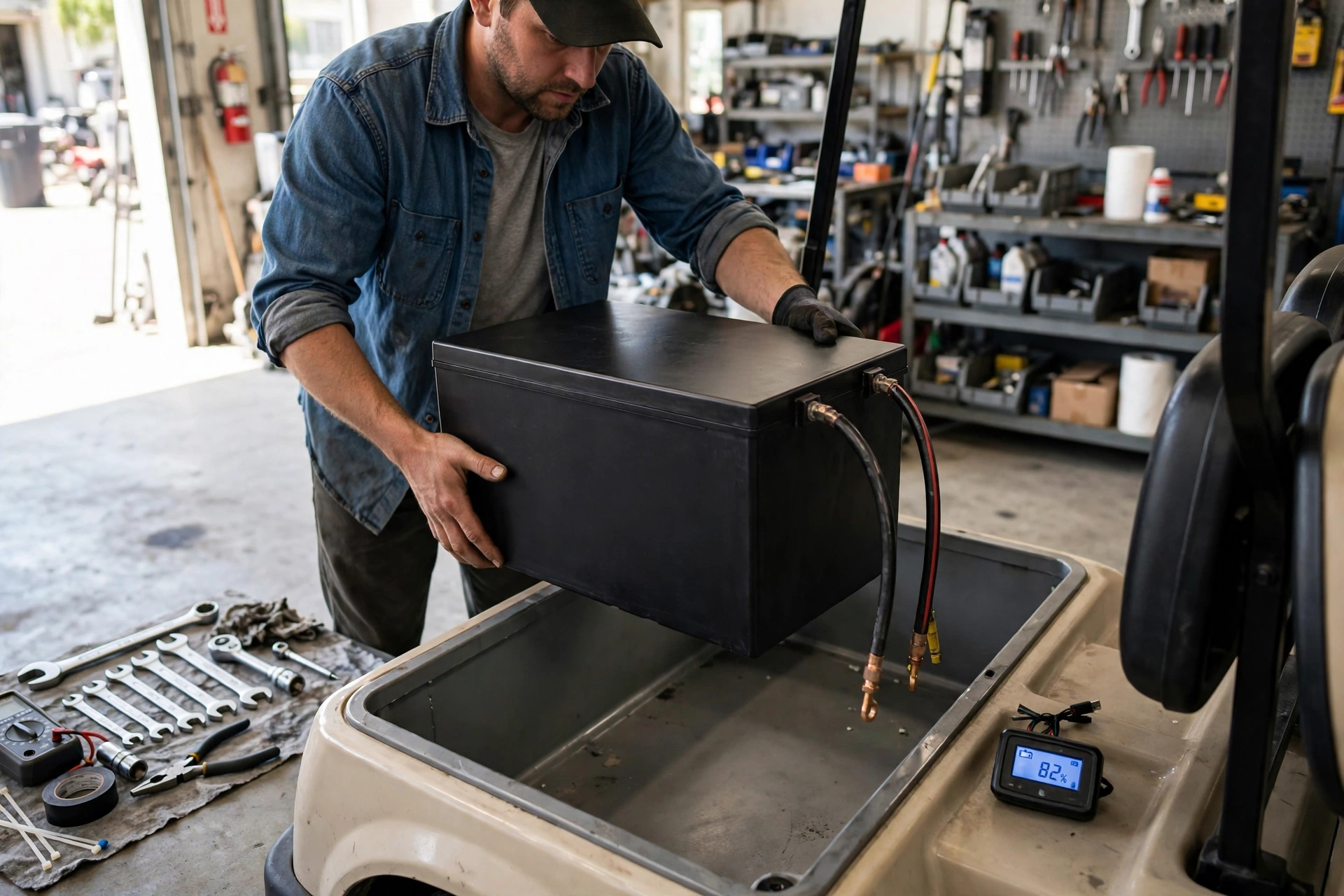
Ripping out 378 pounds of lead and dropping in a 100-pound pack takes most owners one afternoon. The steps are simple. Remove the old set and cables. Clean the tray. Set the lithium pack in, connect the main positive and negative, and mount the new charger and gauge.
Two details trip people up. First, your old dash battery meter reads voltage, and lithium’s flat discharge curve makes a voltage gauge lie until the pack is nearly empty; the kit’s shunt-based gauge exists for this reason. Second, accessories like lights and horns often run off a 48-to-12-volt reducer or a tap across two batteries on lead-acid setups. A single lithium pack has nothing to tap, so fit the reducer the kit specifies.
Then there is the weight, and it changes the cart. Dropping roughly 275 pounds makes the cart accelerate harder, climb better, and stop shorter, and it is kinder to tires, suspension, and wet grass. Some owners add ballast back for traction on steep, loose ground. Most just enjoy it. Before any of this, run your existing set through the kind of cost check our EV battery replacement cost estimator was built for: if the cart itself is sound, the conversion is nearly always worth more than the cart’s resale bump suggests, because you are buying a decade of not thinking about batteries.
Our scores for 48v golf cart batteries, chemistry by chemistry
Flooded lead-acid — Our score: 6.5/10. Range: 6/10. Lifespan: 5/10. Value: 8/10. The budget champion and the benchmark everything else is judged against, held back by the watering ritual and a hard 50% discharge ceiling.
AGM — Our score: 5.8/10. Range: 6/10. Lifespan: 6/10. Value: 4/10. Sealed convenience at a price the performance never justifies. If your cart lives somewhere you genuinely cannot open the seat monthly, AGM is a reluctant answer. Otherwise it is the worst seat at the table.
Lithium (LiFePO4) — Our score: 8.9/10. Range: 8/10. Lifespan: 10/10. Value: 8/10. More usable energy from a smaller pack, a third of the weight, triple the cycles, and the lowest cost per year of the three. For any cart used more than twice a week, the debate is over.
48v golf cart batteries: questions people actually ask
How long do 48v golf cart batteries last?
Flooded sets last four to seven years with proper watering and charging; neglected sets die in two to three. AGM runs four to five years. A name-brand lithium pack is designed for ten years and 3,500-plus cycles. Usage pattern matters more than chemistry marketing: daily discharge cycles a pack out faster than calendar time does.
Can I mix old and new batteries in one pack?
No. A series string performs at the level of its weakest battery, and a new battery wired to tired ones gets dragged down and overworked. Replace the full set at once. Every manufacturer, Trojan included, says the same thing, and for once the upsell is honest.
How far will a 48V cart go on one charge?
Plan on 18 to 22 real-world miles from a healthy flooded or AGM set, and around 30 from a 105Ah lithium pack driven at the same pace, more at gentle speeds. Hills, soft ground, lift kits, and big tires all subtract. Our range math in the usable-energy section above shows exactly where those numbers come from.
Do I need a new charger for a lithium conversion?
Yes. Lithium requires a charger with a lithium profile and no equalization stage. Most quality kits include one. Running a lead-acid charger on a lithium pack risks BMS shutdowns at best and a shortened pack life at worst.
What is the cheapest way to replace a dead 48V set?
A budget flooded set from a warehouse brand, typically $900 to $1,200 (est., current listings checked October 25, 2026), installed yourself. It is the right answer for a cart worth little or used rarely. For a keeper cart, the cheapest decade is lithium, whatever the invoice says on day one.
Can I leave my cart plugged in all the time?
Only on a smart charger or maintainer designed for your chemistry, and even then, check it monthly. Flooded packs gas while charging and need ventilation and water checks. Lithium packs prefer storage around half to full charge with the charger disconnected once full. Set a reminder; do not set a fire risk.
The short version
Buy lithium if the cart earns its parking spot weekly. Buy flooded if the cart is cheap, seasonal, or new to you and unproven. Skip AGM unless access for watering is physically impossible. Whatever you choose, count the caps before you order, match the charger to the chemistry, and do the dollars-per-year division before you do anything else. Choose your 48v golf cart batteries by the year, not by the invoice. The pack under your seat is the cart. Treat the decision that way.
For most shoppers, 48v golf cart batteries are a decade-long decision, not a one-season purchase. Choosing 48v golf cart batteries on usable energy and cost per year, rather than sticker price alone, is how you avoid buying twice. In short, the best 48v golf cart batteries for a hard-working cart are the ones that keep their voltage, range and warranty intact for years.