Last updated: October 25, 2026
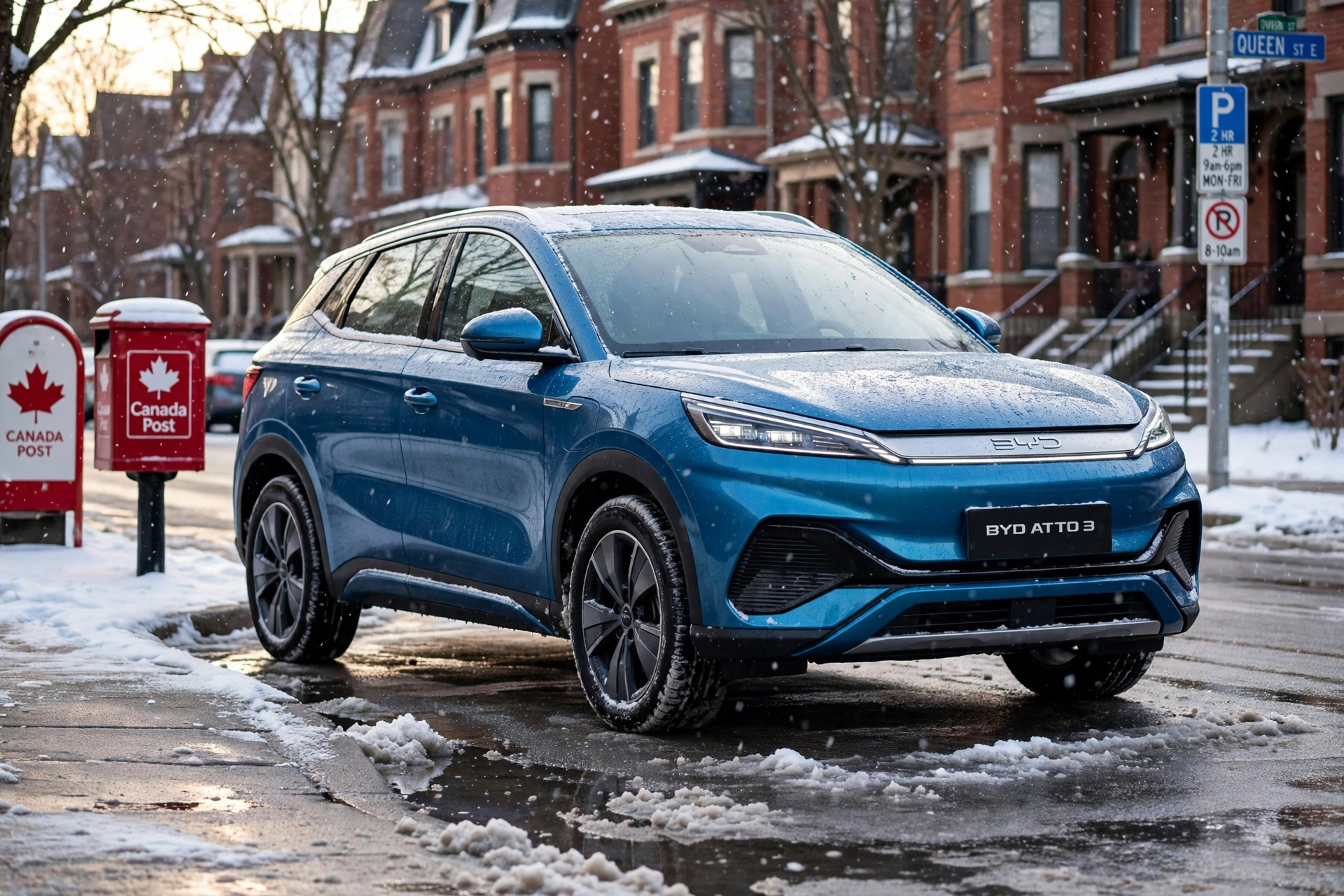
Short answer first, because most pages on this topic will not give you one. You cannot buy a BYD passenger car in Canada today. There is no BYD Canada dealership, no order book, no reservation list and no car to test-drive — not in Toronto, not in Vancouver, not anywhere in the country. Anyone telling you otherwise in late October 2026 is ahead of the facts. That was the whole story for years. It is no longer the whole story, because the policy wall that kept BYD out came down on March 1, 2026, and what replaced it changes the calculation completely.
Here is what actually changed. Ottawa repealed the 100 per cent surtax on Chinese-built electric vehicles and substituted an import quota: 49,000 cars a year may enter at the ordinary 6.1 per cent tariff. BYD has registered its passenger-car factories with Transport Canada. Dealer groups say storefronts are being negotiated. None of that puts a Seal in your driveway this winter. All of it means the byd canada question has shifted from “never” to “when, and at what price”.
A warning before the details, because this subject attracts nonsense. The loudest headline of 2026 — a supposedly confirmed launch, 20 dealerships and a C$25,000 Seagull — traced back to an impersonator account posing as a BYD executive. A national news outlet retracted its story and apologised. So this guide separates what is verified from what is merely repeated, following the same sourcing discipline we set out in how we research our guides. Where a figure is our estimate rather than an official number, it is marked (est.).
BYD is also not the stranger to this country that the car headlines suggest. The company has sold electric transit buses here for years, opened an assembly plant in Newmarket, Ontario in 2019 and supplied the Toronto Transit Commission. Its battery systems sit in grid-scale storage projects across North America. The missing piece was never the company’s presence. It was permission to sell you a car — and that permission is exactly what 2026 rearranged.
Thing 1: There Is Still No BYD Canada Order Book
Start with the only source that can actually sell you a car: BYD itself. The company’s Canadian website, checked on October 25, 2026, does not permit purchases, leases, financing applications, reservations, pre-orders or deposits. Read that list again. Every route by which a manufacturer normally takes money for a car is explicitly switched off.
BYD has been equally plain when asked directly. After the impersonator story spread, the company confirmed to Global News that it has not announced, approved or finalised any plan to introduce passenger vehicles to the Canadian market, open dealerships, or launch specific models. That is an unusually complete denial. Companies planning a launch usually hide behind “no comment”; BYD chose to close the rumour down.
One genuine fact sits underneath the speculation, and it deserves precise wording. BYD Auto Co., Ltd. is listed in Transport Canada’s Appendix G registry — the pre-clearance list of foreign manufacturers whose plants are recognised for importing vehicles into Canada — for passenger cars, covering its Shenzhen and Xi’an factories. Those are the plants that build the Atto 3, Dolphin, Seal and Seagull. Registration is a necessary step before a single car can be imported commercially. It is not a launch. As of the most recent registry checks reported this autumn, no other Chinese passenger-car brand has completed even this step.
Our position is blunt: do not hand a deposit to anyone — a website, a broker, a “reservation” service — claiming to secure you a Canadian BYD today. There is nothing to reserve. Money sent against a car with no importer of record, no price and no delivery window is not a deposit. It is a donation.
Thing 2: The 100 Per Cent Tariff Is Gone, and a Quota Stands in Its Place
The old regime was simple and absolute. From October 1, 2024, every Chinese-built electric vehicle imported into Canada carried a surtax of 100 per cent of its value, stacked on top of the standard 6.1 per cent most-favoured-nation tariff. A tariff set that high is not a tax; it is a fence. Ottawa’s own regulatory analysis concedes the point with a remarkable figure: across its entire life, the surtax assessed roughly C$2 million in net revenue, because almost nothing came in to be taxed.
The replacement, effective March 1, 2026 under Order in Council P.C. 2026-144, works differently. The Canada Border Services Agency’s Customs Notice 24-32 records the repeal in dry official language, and Global Affairs Canada’s Notice to Importers No. 1162 supplies the machinery: up to 49,000 Chinese-origin electric vehicles a year may enter at the 6.1 per cent MFN rate, each shipment covered by a specific import permit. The quota is split into two periods of 24,500 and grows by 6.5 per cent a year, which puts the second-year ceiling at about 52,185 cars (est., from the published growth rate).
Two features of this system matter more than the headline number. First, when a period’s allocation is exhausted, further covered imports are prohibited — not taxed harder, prohibited. Second, the 49,000 is shared. China-built cars from established Western brands compete for the same permits, and by mid-October 2026 some 15,931 Chinese-built electric vehicles of all brands — 32.5 per cent of the annual allowance — had already entered under the current quota year, according to federal import data. Not one of those permits belongs to byd canada by right. BYD will have to compete for its allocation like everyone else.
BYD Canada Prices: The Tariff Math, Done in the Open
Because no Canadian sticker prices exist, every “BYD price in Canada” figure online is an estimate wearing a costume. Here is ours, with the arithmetic exposed so you can argue with it. Take the Seal sedan and a hypothetical Canadian MSRP of C$44,990 (est.) — a figure circulating in Canadian trade coverage of the quota.
Under the old rules, the border charges on that car would have been: 100 per cent surtax × C$44,990 = C$44,990, plus 6.1 per cent MFN duty × C$44,990 = C$2,744, for a total of C$47,734 in border charges (est.) — more than the car itself. Under the rules in force since March 1, 2026, the same car carries the 6.1 per cent duty only: C$44,990 × 0.061 = C$2,744 (est.). The difference between the two regimes, on one sedan, is C$44,990. An entire car’s worth of tax, removed. Run the same exercise on an assumed Atto 3 sticker of C$39,990 (est.) and the duty today is C$39,990 × 0.061 = C$2,439 (est.), against a C$39,990 surtax alone under the old order.
A European cross-check keeps everyone honest. The Atto 3 lists in Germany at €38,990, but that price includes 19 per cent German VAT. Strip it out — €38,990 ÷ 1.19 = €32,765 (est.) — and convert at an assumed €1 = C$1.55 (est.) and you land near C$50,786 (est.) before freight, certification and margin. Yet BYD prices market by market: the same Atto 3 wears strikingly different stickers in Shenzhen, Sydney and Stuttgart. A converted European price is a ceiling argument, not a forecast.
Our judgment: in year one, scarcity sets the price, not BYD’s cost advantage. A 49,000-car national quota shared across every China-built EV will not produce discount warfare. Expect launch pricing within sight of Hyundai and Kia stickers. The C$25,000 Seagull was a fabrication, and any pricing promise built on it should be treated as one.
The Cars Behind the BYD Canada Search Traffic
Four models generate nearly all of the interest, and all four are European-market cars today — which means every range figure below is a WLTP figure, the European test cycle, and is labelled as such. Canadians cross-shopping them should read the conversion note at the end of this section before falling in love with a number.
BYD Atto 3 — the default answer
The Atto 3 is a compact electric SUV, 4,455 mm long, front-wheel drive, and the highest-volume export BYD builds. European specification: a 60.48 kWh Blade battery in lithium iron phosphate chemistry, a 150 kW (201 hp) motor, 0–100 km/h in 7.3 seconds, DC charging up to 88 kW, and a WLTP range of 420 km. German list prices run from €38,990. The cabin’s rotating 15.6-inch touchscreen and five-star Euro NCAP rating are the details owners mention most; the modest 88 kW charging peak is the one they complain about, and rightly — most rivals charge faster.
BYD Dolphin — the sensible hatchback
The Dolphin is a 4.29-metre hatchback pitched at the MG4. It starts at €29,990 in Germany with a 44.9 kWh battery and a 95 hp motor, which is adequate and no more. The version worth wanting is the Comfort: a 60.4 kWh battery, 204 hp and up to 427 km of WLTP range. As family transport for a two-car household, this is the BYD that makes the strongest case on paper.
BYD Seal — the Model 3 rival
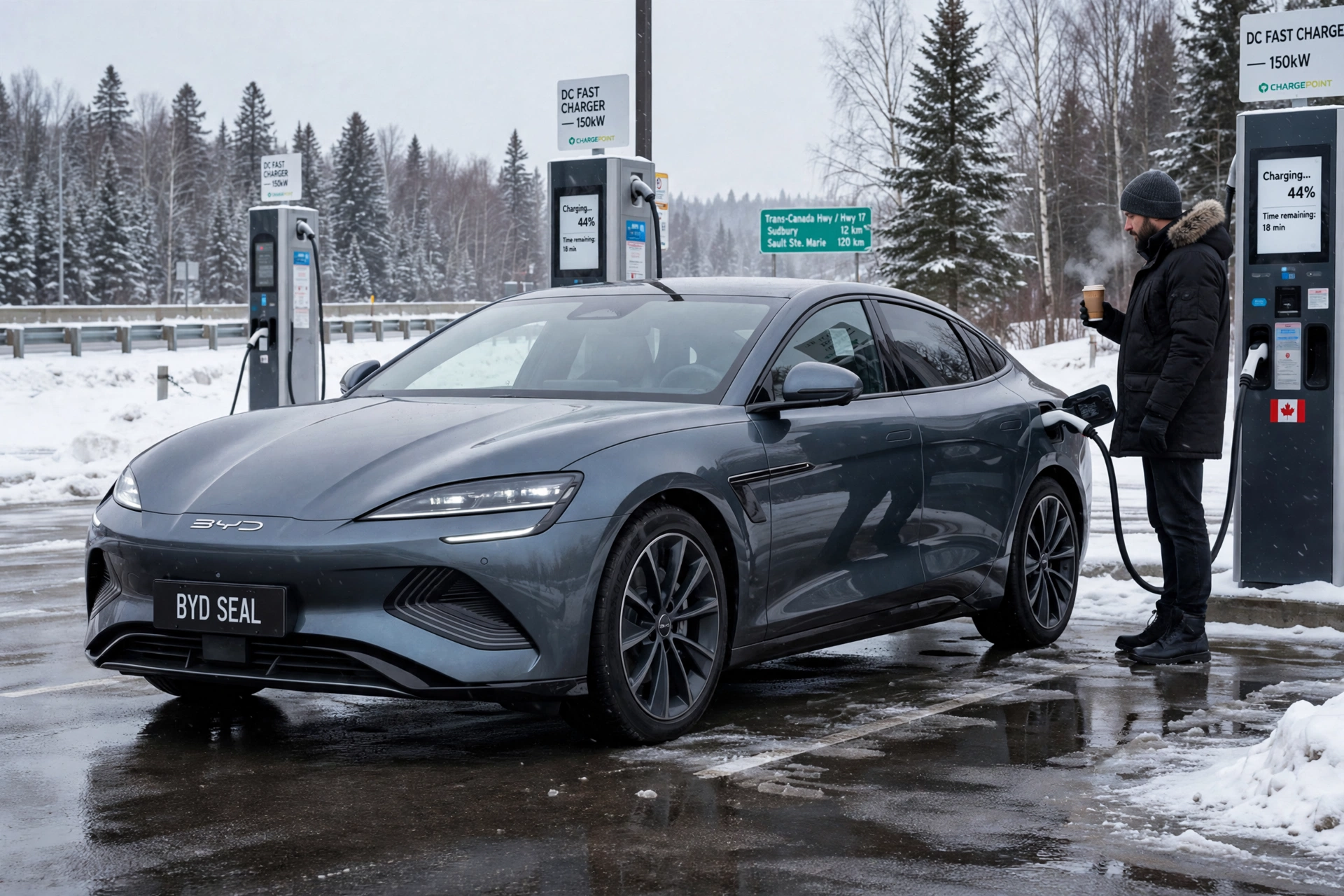
The Seal is a low, 4.8-metre sports sedan, and the specification is serious: 61.4 kWh and 460 km WLTP in the base car, 82.5 kWh and 570 km WLTP in the rear-drive Design, 150 kW DC charging with a claimed 30–80 per cent charge in 26 minutes, and a 390 kW dual-motor flagship that reaches 100 km/h in 3.8 seconds. German prices start at €47,990. This is the car that would test Tesla’s Canadian pricing discipline, which is precisely why its absence stings.
The Seagull problem
BYD’s smallest car — sold in Europe as the Dolphin Surf — is the one wrapped in the fabricated C$25,000 claim. Ottawa has reportedly reserved a rising share of the quota for vehicles priced at C$35,000 or less, which suits the Seagull exactly. Plausible? Yes. Announced? No. Treat every Seagull delivery date you read as fiction until BYD publishes one.
WLTP is not EPA — convert before you compare
Europe’s WLTP cycle returns flattering numbers; North America’s EPA cycle does not. A serviceable rule of thumb is EPA ≈ WLTP × 0.8 (est.). Applied here: the Atto 3’s 420 km becomes roughly 336 km (est.), and the Seal’s 570 km becomes roughly 456 km (est.). Still respectable figures. Just not brochure figures. One further Canadian caveat: every car above uses an LFP battery, and LFP chemistry charges slowly in deep cold unless the pack is preconditioned. At −20 °C in Winnipeg, that is not a footnote. It is the ownership experience.
Thing 5: You Cannot Import One Yourself — the 15-Year Wall
Every few months someone proposes the clever route: buy a BYD in Europe or Mexico, ship it home, beat the system. Transport Canada’s rules close this door completely. A vehicle may be imported and registered in Canada only if it was built to Canadian safety standards (CMVSS) or, through the Registrar of Imported Vehicles programme, to United States standards (FMVSS). A car manufactured for the European, Chinese or Mexican market meets neither, and vehicles from those markets become admissible only when they are 15 years old or older.
The quota does not rescue the idea. Import permits under Notice 1162 administer commercial importation by recognised manufacturers; they are not a personal loophole, and a permit would not make a non-compliant car registrable in any province. Then come the practical nails. A European BYD charges through a CCS2 inlet, which does not fit North American CCS1 or NACS connectors. No Canadian dealer network exists to honour a warranty, supply parts or read the car’s diagnostics. Insurers and future buyers will price that orphan status without mercy. This path is not expensive. It is closed.
Thing 6: The BYD Already in Canada Builds Buses, Not Hatchbacks
The company’s Canadian history is real, commercial and slightly bruising. BYD opened a 45,000-square-foot electric bus assembly plant in Newmarket, Ontario in 2019 and supplied the Toronto Transit Commission; BYD’s own announcement of its first Canadian bus entering service dates from that era of optimism. Industry accounts since then describe a short, troubled run — one widely cited count puts Newmarket’s output at just 10 buses before the line went quiet, amid quality complaints and Ottawa–Beijing friction.
Beyond buses, BYD’s Appendix G listings cover trucks, and its battery arm supplies stationary storage internationally. Useful context, all of it, but keep the categories separate in your mind: a decade of selling buses to transit agencies built BYD no showrooms, no service bays for private cars and no parts pipeline for a Dolphin with a cracked bumper in February. A passenger-car launch starts from zero, whatever the bus division did.
Thing 7: If You Need an Electric Car This Year, Buy What Is Actually on a Lot
Life does not always wait for trade policy. If your current car died this morning, the correct decision is to buy from the EVs Canadians can purchase today: the Chevrolet Equinox EV, Hyundai Kona Electric and Ioniq 5, Kia EV6, Tesla Model 3 and Volkswagen ID.4 cover most budgets and use cases, with several starting under C$50,000 (est.). Our guide to EV cars — range, charging costs and who should buy one works through that field, and the total cost of ownership calculator will run your own mileage and electricity rate rather than a national average.
Rebates deserve one cold sentence. Quebec’s Roulez vert programme still lists up to $2,000 toward qualifying models priced under $65,000 and registered by December 31, 2026, per the programme’s published terms (checked October 25, 2026) — and a car that is not on sale appears on no rebate list anywhere. If your lease instead runs into 2027, waiting costs you nothing but patience, and the BYD file may look very different by then. Timing, here, is the whole decision.
Our Verdict: Scores for the Three BYD Canada Paths
Three realistic strategies for byd canada shoppers, scored on availability, value and risk. Risk is scored out of 10, where a higher number means a riskier path.
Path 1 — Wait for the official launch. Our score: 7/10. Availability: 3/10 · Value: 8/10 · Risk: 4/10. The regulatory door is open, the factories are registered and dealer talks are reported, so the wait is probably measured in seasons rather than decades. What keeps this from an 8 is BYD’s own silence: until the company announces dates and prices, you are planning around a rumour with good paperwork.
Path 2 — Import one yourself. Our score: 1/10. Availability: 2/10 · Value: 2/10 · Risk: 10/10. The 15-year admissibility rule, the CCS2 charging inlet and the absence of any warranty or parts support make this the worst option on the page. Do not do it.
Path 3 — Buy an established EV now. Our score: 8/10. Availability: 10/10 · Value: 7/10 · Risk: 2/10. You give up BYD’s hypothetical price advantage and gain a car, a warranty and a service network this winter. For most households, that trade wins today — and the TCO gap is narrower than the headlines imply once the quota-era BYD premium is priced in (est.).
BYD Canada FAQ
Can I buy a car from BYD Canada right now?
No. As of October 25, 2026, no BYD dealership operates in Canada, and the company’s Canadian website accepts no purchases, reservations or deposits. BYD has confirmed it has not announced or finalised a passenger-car launch here.
When will BYD start selling cars in Canada?
Nobody honest knows. BYD has published no date. The verifiable groundwork — Transport Canada registration, an open import quota, dealer-network talks reported around the Greater Toronto Area — points to a launch being prepared rather than imagined, but any specific month you see online is speculation (est.).
Is the 100 per cent tariff on Chinese EVs still in force?
No. It was repealed effective March 1, 2026. Chinese-built EVs now enter under an annual quota of 49,000 vehicles at the standard 6.1 per cent tariff, with shipment-specific import permits. Once a quota period fills, imports stop until the next period opens.
What would a BYD Atto 3 cost in Canada?
There is no official price. Our worked estimate in this guide converts the German car to roughly C$50,786 before freight and taxes (est.), while a quota-era Canadian sticker could sit lower because BYD prices each market separately. Treat any single confident figure — high or low — as a guess.
Can I import a BYD from Europe or Mexico myself?
No. Vehicles built for those markets do not meet Canadian or United States safety standards, and Transport Canada admits such vehicles only once they are 15 years old. A European car would also arrive with a CCS2 charging inlet that does not fit North American fast chargers.
Would a Canadian BYD qualify for government rebates?
Only if the specific model were listed by a programme, and an unlaunched car is listed nowhere. Quebec’s Roulez vert, for example, pays up to $2,000 on listed models under $65,000 registered by December 31, 2026. A future BYD priced under that ceiling could qualify once on sale — a reason to watch the launch list, not a reason to wait by itself.