Last updated: October 25, 2026
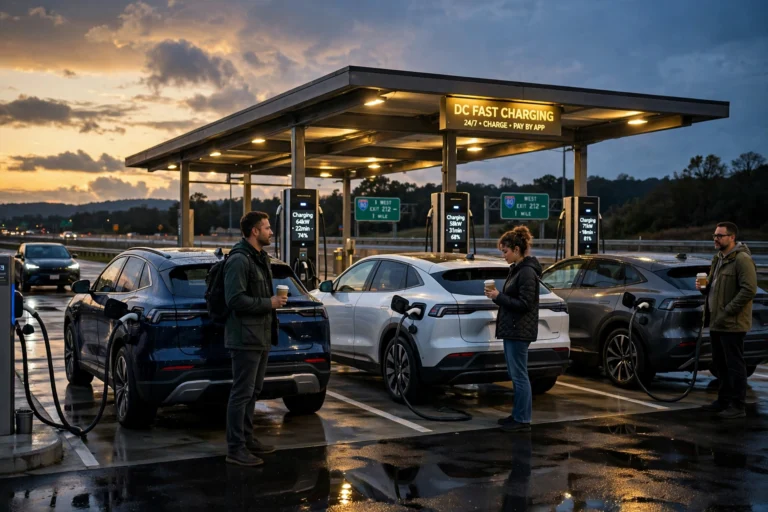
Picture the scene, because if you rent, you have lived it. It is 9:40 on a Tuesday night, your battery sits at 11 percent, and the fast charger behind the grocery store — the one the app swore was available — blinks red and refuses your card. ev charging problems are not an edge case in this country. For drivers without a driveway, they are the tax you pay for somebody else’s broken hardware, and I am tired of watching renters absorb that tax quietly.
Here is the scale of it. J.D. Power’s 2025 U.S. Electric Vehicle Experience Public Charging Study, built on responses from 7,428 EV owners in the first half of 2025, found that 14 percent of public charging visits ended with no charge at all. One in seven. The driver arrived, plugged in or tried to, and left with the same battery percentage they came with. That is an improvement on roughly one in five visits the year before. Fourteen percent is still a failing grade in any other industry. Imagine one in seven gas pumps in America simply declining to work.
I write about charging from the renter’s side of the fence. No garage. No panel I am allowed to touch. A landlord who treats a charger request like a request to remodel the kitchen. So this guide is organised the way your problems actually arrive: the public charger that fails you, the home setup that fights you, the session that slows to a crawl, and the adapter drawer.
Every fix below is something you can do yourself, or something you can demand — from a landlord, an employer, a network, an electrician. Where a figure comes from a study, I name the study. And where the honest answer is “that one is not yours to fix,” I say so, because knowing whose problem it is saves you money.
The public ev charging problems that strand renters and commuters
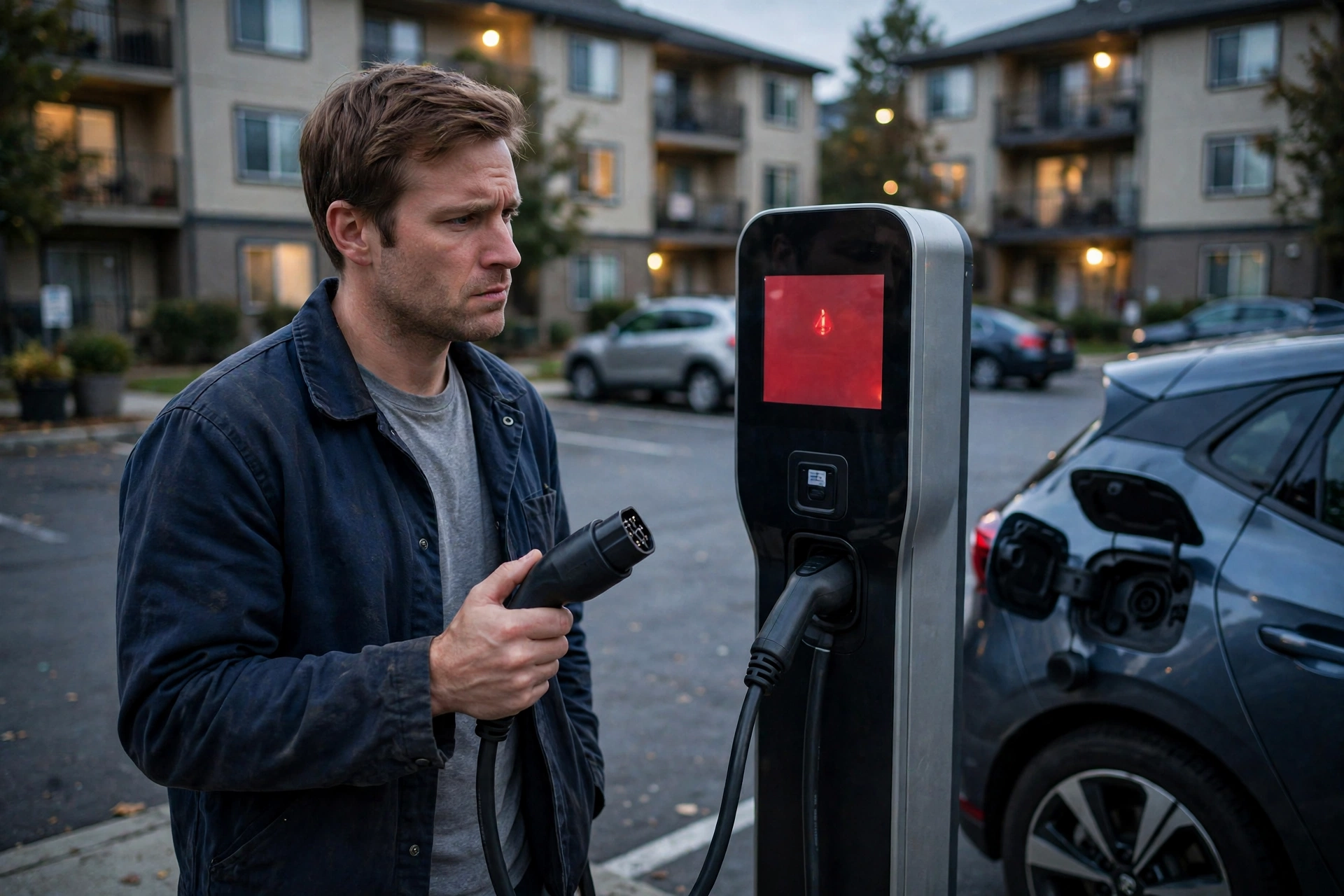
Of that 14 percent of failed visits in the J.D. Power study, 60 percent failed for the simplest reason imaginable: the charger was out of service or not working properly. Not driver error. Not the car. The box itself. The rest split between payment failures and connectors that would not latch or communicate.
The same study recorded a 21 percent failed-visit rate in the Pacific region, with Seattle at 25 percent and Los Angeles at 24 percent — one in four visits, in two of the most EV-dense cities in the country. The East South Central region managed 7 percent. Same cars, same drivers, wildly different odds. If you rent in Los Angeles and your friend owns a house with a charger in Tennessee, you are not living in the same EV country.
There is a standard these networks should be held to, and it already exists. Chargers built with federal NEVI money must average at least 97 percent uptime per port, take contactless card payment with no membership required, and show the per-kWh price before the session starts. My position is simple: that floor should apply to every public charger in America, not just the federally funded ones. A charger that cannot stay alive is not infrastructure. It is street furniture with a screen.
Broken connectors and beaten-up hardware
The connector takes the worst of public life. It gets dropped on concrete, run over, yanked sideways by drivers in a hurry, and left hanging in rain and road salt. Cracked housings, bent pins, worn latches, frayed cable jackets — J.D. Power’s “out of service” bucket is full of exactly this. Before you blame the network’s software, look at the plug in your hand. If the latch is damaged, the car and charger cannot complete their safety handshake, and the session dies before it starts.
Your moves: inspect the connector before you plug in, seat it firmly until it clicks, and support a heavy DC cable rather than letting it hang off the port. If a connector is visibly damaged, do not force it — a bad connection under high current is a heat problem waiting to happen. Report it in the network’s app with the station ID. Reports feel pointless. They are also the data that uptime enforcement runs on, so file them.
Payment and app failures
Sometimes the charger is healthy and the money side is broken. Card readers die. App logins expire at the worst moment. A network demands an account, a deposit hold, and a blood sample before it will sell you electrons you need to get home. J.D. Power’s researchers flagged payment friction as a growing drag on satisfaction even as pure reliability improved.
Defend yourself in advance. Keep two network accounts active, not five — two that cover the corridors you actually drive. Keep a contactless bank card as your payment of last resort; NEVI-funded sites must accept one, and most newer cabinets do. If an app refuses to start a session, try the card reader before you give up and drive to the next site, and screenshot the error with the charger ID visible. That screenshot is your evidence for a refund when the session fee posts anyway.
Sessions that stop early or never start
The session that dies at 34 percent is its own special misery. Causes, in rough order of how often they show up: the charger overheats and thermally derates or shuts down on a hot afternoon; the payment authorisation expires mid-session on networks that re-check your card; the cable is slightly too short, the latch sits under strain, and vibration breaks the connection; or the car itself ends the session because a charge limit or departure schedule you set months ago is still active. Check your own settings before you curse the network. A charge limit of 80 percent set for daily driving will quietly end a road-trip session at 80 percent.
A weak 12-volt accessory battery causes a surprising share of “the charger is broken” calls, too. The car needs its 12-volt system alive to run the computers that manage charging. If sessions fail to start across several different chargers, suspect the car — and get the 12-volt battery tested before you blame a fourth network.
Home ev charging problems: breakers, outlets and the GFCI fight
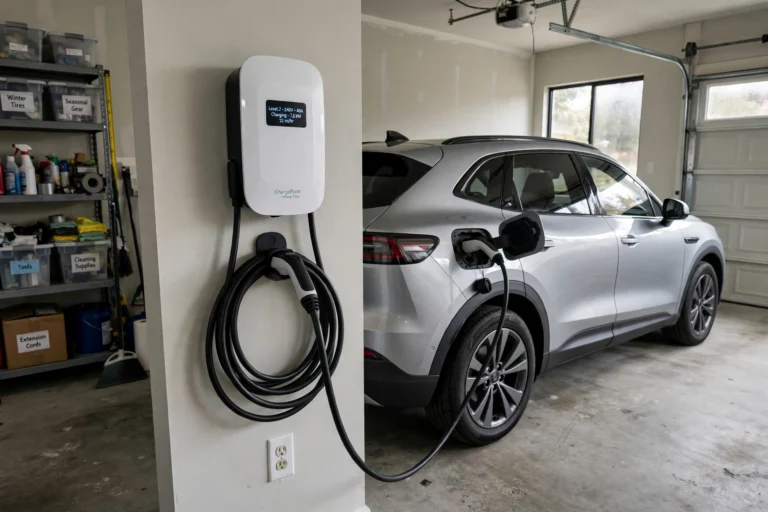
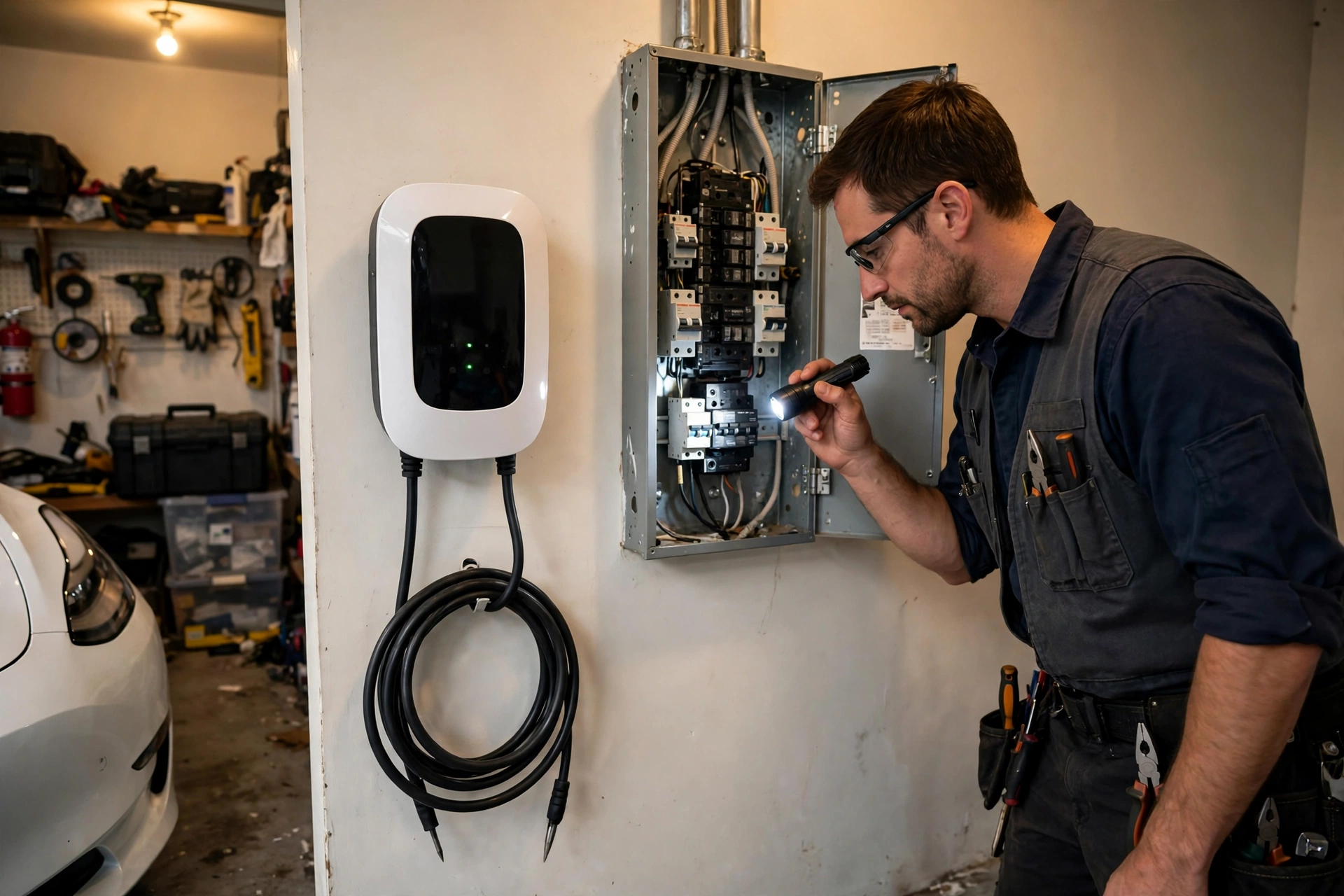
If you do have a home setup — a house, a townhouse, a landlord who said yes — the failure modes change completely. Public problems are strangers’ problems. Home ev charging problems are electrical problems, which means they follow rules, repeat predictably, and mostly have permanent fixes. Anything past the reset button and the settings menu belongs to an electrician.
The breaker that trips mid-session
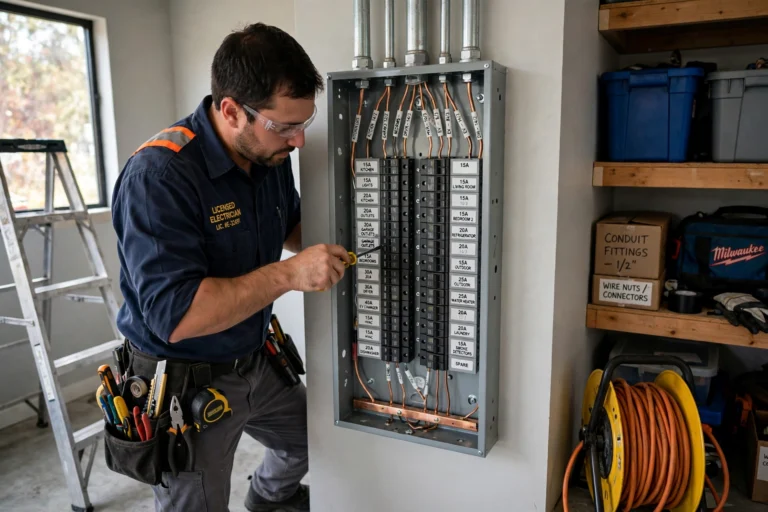
An EV charger is a continuous load, and electrical code treats it that way: the circuit must be sized at 125 percent of the charger’s draw. A 40-amp charger belongs on a 50-amp circuit. A 48-amp charger needs 60 amps. Installs that cheat this rule — or older panels already near their limit — trip breakers, usually an hour into a session when everything is properly warm. Heat is the second culprit. Loose terminal connections inside the panel or the charger build resistance, resistance builds heat, and heat trips breakers or worse. A breaker that trips and will not reset until it cools down is telling you something specific: something in that circuit is getting hot.
Scorch marks, discoloured plastic, a hot plug face, a burning smell near the outlet or panel — stop charging, leave the breaker off, and call an electrician. That is not a troubleshooting step; that is the end of troubleshooting. A marginal connection that a kettle never exposes becomes a fire risk at 40 amps all night.
GFCI nuisance trips
The most maddening home fault is the GFCI breaker that trips with no real fault present. A GFCI breaker trips on about 5 milliamps of leakage. Your charger also has ground-fault protection built in, and it runs self-tests; its internal filters leak tiny amounts of current as a normal part of operating. Stack the charger’s small, harmless leakage on top of a sensitive 5-milliamp breaker and the pair trip each other at random — sometimes mid-session, sometimes while the car sits idle. Two safety systems, each working as designed, fighting to a draw.
The fix ladder, in order: have an electrician confirm there is no genuine ground fault (that check is not optional); try lowering the charger’s amperage in its settings, which sometimes calms the electrical noise; and know that the durable fix is often a hardwired installation, which in many code situations lets the charger’s own listed protection do the job without a plug-in GFCI breaker upstream. Manufacturers publish their own reset and error-code steps — ChargePoint’s Home troubleshooting page — and the manual’s blink codes beat guesswork every time. Whatever you do, do not defeat or bypass GFCI protection to stop the trips. The annoyance is real. The protection is the point.
The outlet itself
Plug-in chargers lean on a NEMA 14-50 outlet, and the cheap builder-grade outlets sold for ranges were never designed for a plug to be inserted and removed weekly, or to carry near-maximum current for eight hours nightly. Worn contacts grip loosely, loose grips make heat, and heat melts outlet housings. If you use a plug-in charger, the outlet should be an industrial-grade unit, installed by an electrician, and the plug should stay in it. Treat unplugging as an occasional event, not a weekly one. Renters: if your landlord’s handyman installed the outlet, asking an electrician to inspect it once is money well spent. Our guide to charging from a regular outlet covers what plain 120-volt charging can and cannot do while you wait for something better, and our charger sizing calculator will tell you honestly whether your panel can feed the charger you are dreaming about.
Slow charging that is not actually broken
A large share of what drivers report as ev charging problems is physics wearing a disguise. Lithium batteries charge fastest in the middle of their range. Nearly every EV tapers hard past 80 percent, because the battery management system is protecting the pack. A session that rockets to 80 and then crawls is a healthy session. This is why experienced drivers fast-charge from 10 to 80 percent and leave — the last 20 percent can take as long as the first 70.
Cold does the same thing from the other end. A cold-soaked battery accepts charge slowly until it warms; the chemistry is sluggish, and the car protects the cells meanwhile. If your car offers battery preconditioning on the way to a fast charger, use it; arriving with a warm pack can be the difference between a 25-minute stop and a 50-minute one. Our explainer on winter range loss covers the cold-weather half of this story. A charger rated at 350 kW bolted to a car that peaks at 150 kW also is not broken — the car sets the ceiling, and the number on the cabinet is marketing.
Shared power fools people, too. Many DC sites split their capacity between stalls, so the identical charger delivers half speed when a second car plugs in beside you. Workplace and apartment Level 2 posts do the same under load management: eight cars sharing a circuit sized for four. Slow is not always failed.
Adapters and the NACS–CCS split
North America is mid-transition between two DC fast-charging plugs: CCS, the incumbent, and NACS — now standardised as SAE J3400 — which most automakers are adopting. During the transition, adapters are the bridge, and bridges wobble. Every extra connection is another place for ev charging problems to start, and an adapter adds two of them. The Joint Office of Energy and Transportation’s charging connector overview lays out who uses what — read it before you buy anything.
The rules that keep you safe are short. Use only the adapter your automaker supplies or approves for DC fast charging — not a no-name marketplace special, however good the reviews look. A DC adapter carries hundreds of amps through a connection you cannot inspect mid-session; a cheap one is a fire risk with a shipping label. AC adapters (for Level 2 destination chargers) are a different, lower-stakes category, but the same brand-name logic applies. Keep the adapter’s contacts clean and dry, and if a session refuses to start on an adapter, retry once with a firm, straight insertion — adapters add a second latch and a second handshake to a process that already has enough of both. Unsure what fits your car? Run it through our charger compatibility checker before you spend a dollar.
What ev charging problems really cost a driver with no driveway
Now the part nobody at the networks wants to price out. Take a renter driving 12,000 miles a year in a car that uses 30 kWh per 100 miles — a fair mid-size EV figure. That is 0.30 kWh per mile, so 12,000 × 0.30 = 3,600 kWh a year. Run the two lives:
Life one — reliable home or workplace charging. EIA data puts the average U.S. residential rate near $0.17 per kWh. 3,600 kWh × $0.17 = $612 a year.
Life two — pushed onto public chargers by a broken home setup or a landlord’s no. AAA’s tracking put the average public charging price at $0.37 per kWh in October 2025, and Paren’s Q3 2025 data puts DC fast charging alone at about $0.49 per kWh. At the public average: 3,600 × $0.37 = $1,332 a year. At fast-charging prices: 3,600 × $0.49 = $1,764 a year.
The penalty for unreliable charging is $1,332 − $612 = $720 a year, and up to $1,152 if your fallback is all fast charging. That is a month’s groceries, extracted quietly, 40 cents at a time. (Prices checked October 25, 2026.)
Then add the failure tax in time. Say you charge publicly twice a week — about 100 sessions a year. At the J.D. Power failure rate of 14 percent, roughly 14 of those sessions fail outright. Give each failure a modest 25 minutes for the drive to the next site, the second handshake, the second payment dance: 14 × 25 = 350 minutes, nearly six hours a year standing in parking lots because a cabinet could not do the one job it exists for. Reliability is not a convenience feature. For renters, it is the whole economics of owning the car.
Our verdict: score the options, not the promises
Enough diagnosis. Here is where each charging route actually lands, scored for the driver who cannot simply move house. Sub-scores are Reliability, Fixability (can a failure actually get fixed, and by whom), and Cost.
Home Level 2 charging — Our score: 8.7/10
Reliability: 9/10 · Fixability: 8/10 · Cost: 9/10
The gold standard, full stop. Nearly every fault is diagnosable, an electrician can fix almost all of them permanently, and the per-kWh price is the lowest in the game. It loses points only because renters must beg permission to join the club — which is a housing-policy failure, not a technology failure.
Workplace Level 2 charging — Our score: 7.4/10
Reliability: 8/10 · Fixability: 5/10 · Cost: 9/10
The renter’s best realistic weapon, and employers should treat it as the cheap, high-retention benefit it is. The catch is fixability: when a workplace post dies, it enters a facilities ticket queue and can sit dead for a quarter. Report it in writing, with the date. Paper trails get chargers fixed.
Public DC fast charging networks — Our score: 5.1/10
Reliability: 5/10 · Fixability: 2/10 · Cost: 4/10
Essential on road trips, infuriating as a daily plan. A 14 percent national failure rate — 25 percent in Seattle — is not a network; it is a lottery. You cannot fix a dead cabinet yourself, you cannot reach a human who can, and in states that still allow per-minute billing, the slowest-charging (usually cheapest) cars pay the most per mile. Per-kWh pricing should be mandatory everywhere, and I will die on that hill.
The pattern underneath all three scores: the closer the charger is to being yours, the fewer ev charging problems you personally eat. Policy should be pushing reliability and access toward the drivers furthest from that — renters, apartment dwellers, shift workers charging at midnight. Right now it does the opposite.
ev charging problems: questions drivers ask us
What are the most common ev charging problems if I rent and have no driveway?
In order: a public charger that is out of service when you arrive (60 percent of all failed visits in J.D. Power’s 2025 study), payment and app failures, sessions that stop early, and fast charging that runs slower than the number on the cabinet because your battery is cold or past 80 percent. Build your defence around the first two: two network accounts, a contactless card, and a backup site identified before you leave home. Our guide to finding charging stations covers the backup-site habit in detail.
Why does my home charger keep tripping the breaker?
The usual three: the circuit is undersized for a continuous load (a 40-amp charger needs a 50-amp circuit), a GFCI breaker and the charger’s own ground-fault protection are nuisance-tripping each other, or a loose connection is heating up under load. Reset it once. If it trips again in the same session — or trips instantly, or anything looks scorched or smells hot — stop and hire an electrician. Repeated trips are information, not bad luck.
Why did my fast charge slow to a crawl at 80 percent?
Because your car told it to. Batteries charge fastest in the middle of their range, and the management system tapers power sharply past about 80 percent to protect the pack. On a road trip, unplug at 80 and drive to the next charger — you will usually arrive sooner than if you had sat there absorbing the last 20 percent at a trickle.
Is a cold battery really a charging problem?
Functionally, yes, even though nothing is broken. A cold-soaked pack accepts charge slowly until it warms. Precondition the battery on the way to the charger if your car offers it, and expect winter fast-charging stops to run longer than summer ones at the same station.
Are plug adapters safe for fast charging?
The automaker-supplied or automaker-approved ones, used as directed, yes. No-name DC adapters are the one purchase in this entire guide I will tell you to avoid outright. Buy the one your car’s manufacturer stands behind; the adapter is a high-current connection you cannot monitor mid-session.
A public charger is dead. Is reporting it actually worth my time?
Yes, and it takes ninety seconds. Report through the network’s app with the station ID. Uptime enforcement, warranty dispatches and NEVI reporting all run on logged failures, and a charger nobody reports is a charger nobody fixes. Then screenshot any session fee that posts for a charge you never received and dispute it — networks refund documented failures far more often than drivers expect.