Last updated: October 25, 2026
Let me save you some scrolling. The qiolor tiger plus electric bike is a 90-pound café racer costume wrapped around a genuinely big battery and a strong hub motor, and it splits opinion harder than almost anything I cover. Riders who want a moped that happens to have pedals tend to love it. Trail riders should keep walking, and I will explain exactly why below, with the access rules spelled out.
My name is Ivan, I spend my weekends on singletrack, and I judge every motorised two-wheeler by three things: what the motor actually does, what the suspension actually is, and where you are legally allowed to point it. This bike passes one of those tests cleanly, scrapes through another, and fails the third in a way that matters.
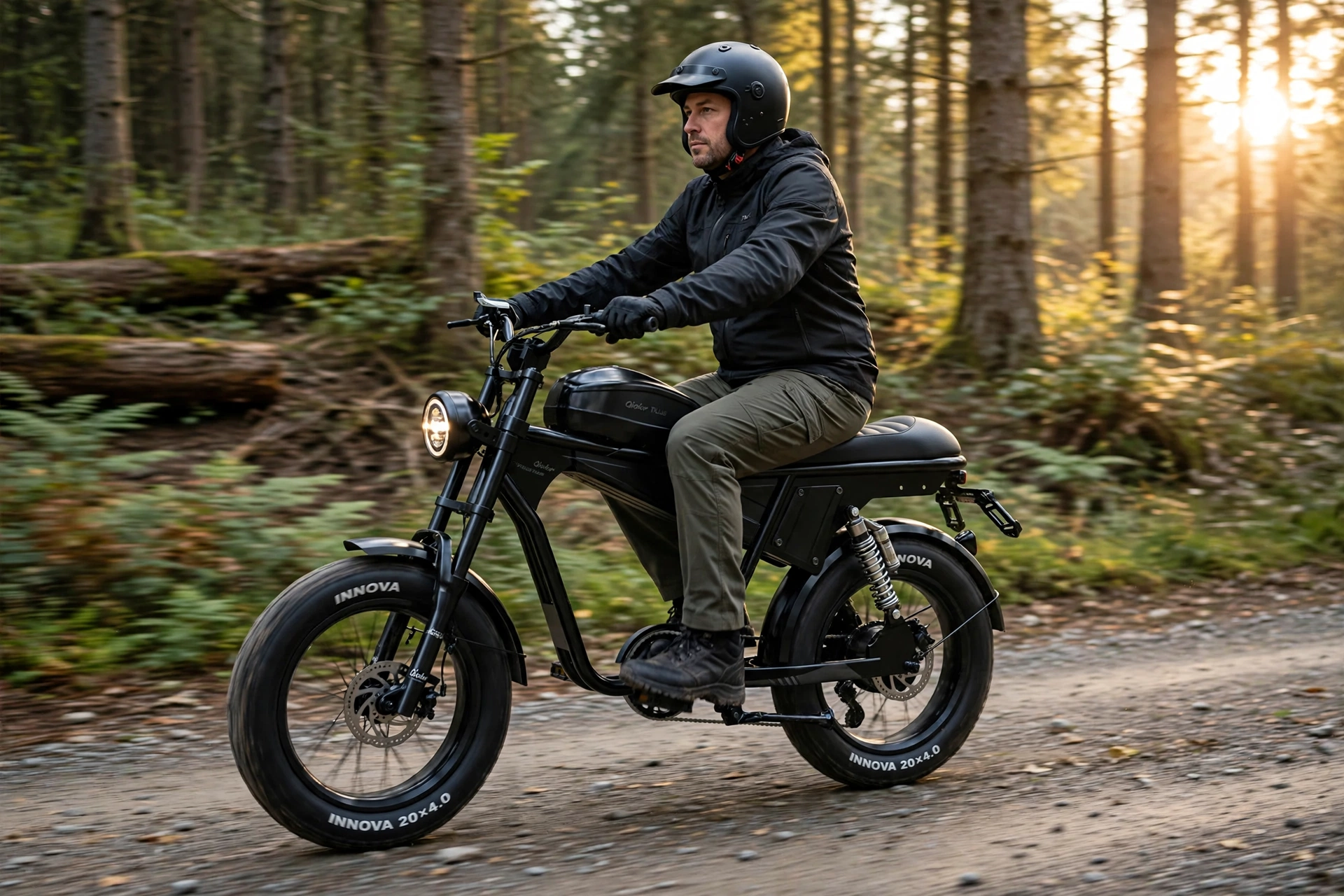
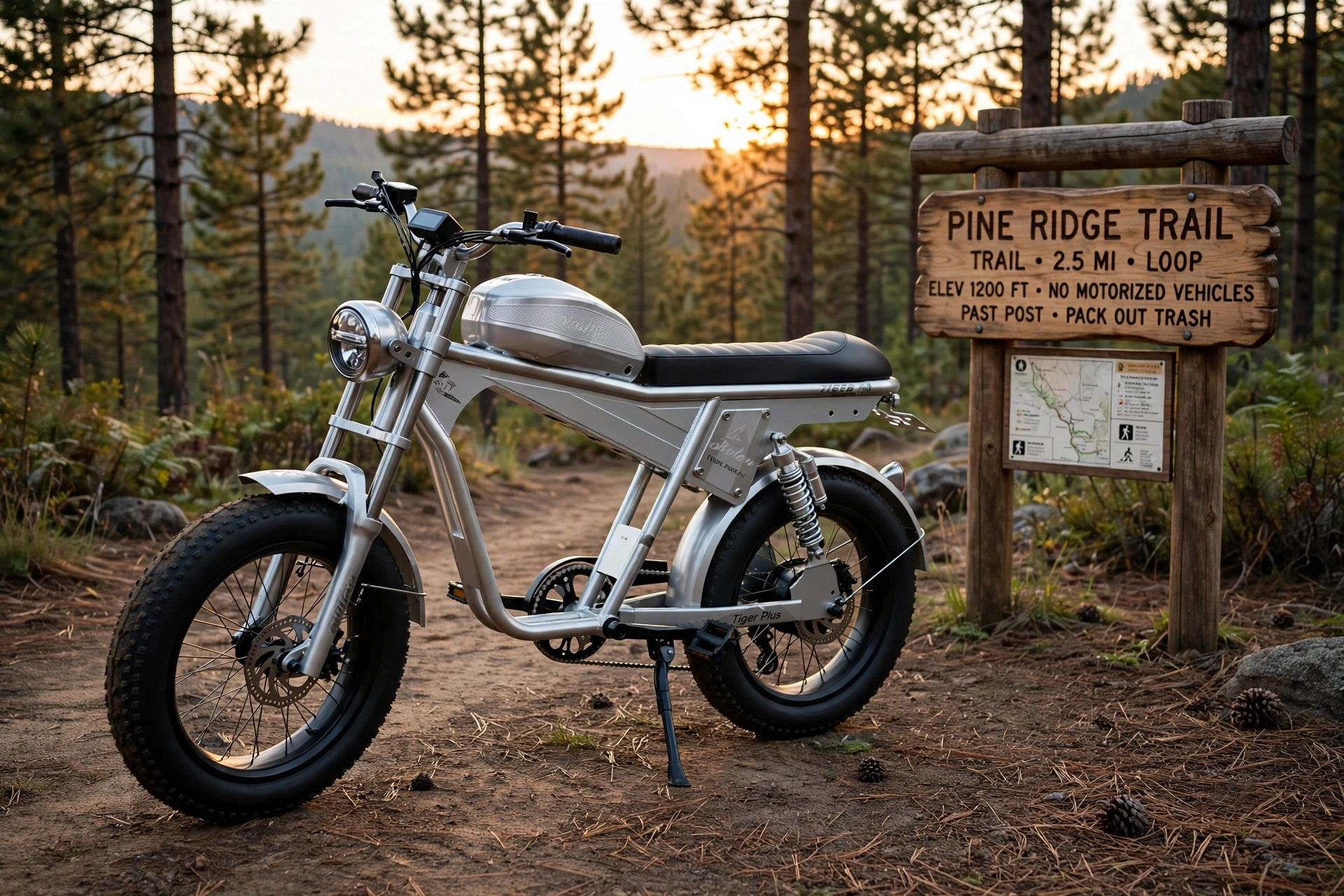
First, the machine itself. Qiolor builds the Tiger Plus as its flagship retro model: a long, low 6061 aluminium frame, an extended memory-foam bench seat with room for two, foldable rear passenger pegs, and chunky 20-inch by 4.0-inch INNOVA fat tyres. It ships in black or silver, with a round metal headlight, colour display, NFC card unlock, and customisable side panels you can sticker up like a 1970s tank.
The motor is a 750W rear hub unit peaking at 1,100W with 85 Nm of torque. You pick your battery at checkout: 48V 15Ah (720Wh) or the headline 48V 35Ah (1,680Wh). Qiolor claims up to 60 miles from the small pack and 130 miles from the big one, and lists a 26 mph top speed. Full spec sheet, geometry and the current configurator live on Qiolor’s official Tiger Plus product page, which is where I pulled every maker figure in this guide.
Now the honesty problem, because there is one. Independent testing found this bike running to 30 mph — four mph past Qiolor’s own stated maximum and well past every legal e-bike class ceiling in the United States. BikeRide’s test summary flags the same thing I would: strong, barely contained throttle power, plus spec sheets from Qiolor that contradict each other depending on which page you read. Weight is listed at 90 lbs on the current spec table, yet other Qiolor pages have quoted different figures for the same bike. When a manufacturer’s own numbers wander, I trust the stopwatch and the scale, not the brochure.
So who is this guide for? If you are cross-shopping moped-style machines and want real range, real charge times and real ownership costs — in dollars, computed, not vibes — read on. If you are hunting for a trail bike, close this tab and go look at proper mid-drive hardtails. I mean that kindly. This thing weighs as much as two of them.
One more framing note before the spec sheet. The qiolor tiger plus electric bike ships as a Class 2 e-bike, throttle and pedal assist, speed limited to 20 mph out of the box, with the limit adjustable in the settings. That single sentence decides where you may ride it, and I will hold the bike to it throughout this review. Manufacturers love to sell the unlocked number and whisper the legal one. I do the opposite here.
Qiolor Tiger Plus Electric Bike Specs: Motor, Suspension and the Hardware That Matters
Start with the motor, because on this bike the motor is the personality. The 750W geared rear hub motor peaks at 1,100W and delivers 85 Nm of torque, which is serious shove for a hub drive. Five pedal-assist levels, a half-twist throttle on the right bar, and three ride modes (Eco, Normal, Sport) manage the output. Here is the detail testers keep coming back to: the throttle is not limited by your chosen assist level. Twist it in Eco and you still get full power. On a quiet street that is merely sloppy programming. Anywhere near pedestrians, it is a genuine hazard, and it tells you the software team prioritised the thrill demo over control.
The motor, honestly assessed
There is no torque sensor. Pedalling is a suggestion the controller mostly ignores, and the fixed bench seat puts you too low to get real leverage through the cranks anyway. So judge this as what it is: a throttle machine with pedals fitted for legal camouflage. Hill climbing is strong — 85 Nm through a 20-inch wheel multiplies torque nicely, and the 7-speed Shimano-style drivetrain (est.) at least stops you ghost-pedalling at speed. Heat management gets a mention in Qiolor’s own material, with a high-temperature-resistant motor ring, which matters because hub motors cooking themselves on long climbs is the classic failure mode in this segment. Credit where due: the spec is not lazy. The delivery is just crude.
Suspension: the one area Qiolor spent real money
Full suspension, and not the decorative kind. Up front sits a dual-crown fork — the motorcycle-style twin-leg setup — with preload and compression adjustment dials. At the back, two coil-over air shocks (est. on exact valving; Qiolor lists air shock absorbers) soak up the rear.
On a 90-pound bike running 4-inch tyres at low pressure, this produces a genuinely plush ride over broken pavement, gravel and washboard dirt roads. I believe the testers who called the ride smooth. Physics agrees with them: mass plus travel plus fat rubber equals calm. What it does not equal is trail agility. Ninety pounds does not flick between switchbacks, does not hop a log, and absolutely does not shoulder up a hike-a-bike section. The suspension here is comfort equipment. Treat it that way and it is the best hardware on the bike.
Brakes, tyres and the small print
Four-piston hydraulic disc brakes, front and rear. Good. A bike this heavy, capable of 30 mph in tested trim, needs exactly that and nothing less. The INNOVA 20 x 4.0 fat tyres are street-biased despite the “off road” marketing, which is fine — streets are where this bike belongs.
Dimensions run 71.2 inches long, and the frame is rated for a 400 lb total load, rider plus passenger plus cargo. Recommended rider height is 5’3″ to 6’6″, though shorter riders should know the bench seat does not adjust like a normal saddle; your fit is basically fixed the day you buy it. Assembly is quoted around 30 minutes. The IP5 water-resistance rating means creek crossings and mud are survivable, pressure washers are not.
Real Range: What the Qiolor Tiger Plus Electric Bike Actually Does on a Charge
Qiolor’s range claims come with an asterisk the size of a hub motor: the 60-mile and 130-mile figures were measured on pedal assist level 1, the gentlest setting, almost certainly with a light rider on flat ground. Nobody rides a 90-pound bench-seat moped at PAS 1. Nobody. Independent reviewers running the 35Ah pack at PAS 4 near top speed clocked roughly 45 to 55 miles, and the test coverage collected by BikeRide’s Tiger Plus review page also records the 30 mph tested top speed that Qiolor’s brochure forgets to mention. Use those tested numbers as your planning ceiling, not the headline.
My working estimates, built from the tested figures above: the 35Ah qiolor tiger plus electric bike should return 45–55 miles of mixed riding with honest pedalling (est.), 30–40 miles of throttle-heavy cruising (est.), and something approaching 100 miles only if you ride it like a bicycle at PAS 1, which defeats the entire point of the machine.
The 15Ah pack scales down to roughly 20–28 mixed miles (est.). Still respectable next to most moped-style rivals, because 1,680Wh is a huge reservoir by e-bike standards — most competitors carry half that. The range story here is genuinely good. It is just 130 miles of good on paper and about 50 miles of good in the world, and I would rather you planned around the truth.
Which battery should you buy? The 35Ah. Not close. The small pack turns this into a short-hop toy that still weighs 90 lbs and still charges like a truck, while the big pack is the one configuration where the bike’s whole concept — ride far, ride long, skip the car — actually works. Buying the 15Ah version to save money is buying the costume without the capability.
Charging: Pennies to Fill, Hours to Wait
Here is the arithmetic Qiolor’s marketing avoids. The 35Ah battery stores 48 volts × 35 amp-hours = 1,680 watt-hours, or 1.68 kWh. It charges through a 3A charger (est. per third-party teardowns; Qiolor quotes time, not amps), and 35Ah ÷ 3A tells you why the official charge time is 10 to 12 hours: the maths lands right on 11.7 hours before taper.
The 15Ah pack on its smaller charger takes about 5 hours. There is no fast-charge option, no dual-charger trick, nothing. You plug in at night, you ride tomorrow. On the qiolor tiger plus electric bike, charging is a nightly ritual, not a pit stop. That is the rhythm of ownership, and if your usage needs a midday turnaround, this bike fails you no matter how much you like the styling.
The running cost, though? Absurdly cheap. At a US average residential rate of $0.17 per kWh (est.), one full charge of the big pack costs 1.68 × $0.17 = $0.286 — call it 29 cents. Spread over a realistic 50 miles (est.), that is about $0.57 per 100 miles in electricity. Even if you only ever matched the claim on a perfect day, it would be $0.22 per 100 miles. For a deeper breakdown of how rates change the picture, our guide to how much it costs to charge an electric bike walks through the same maths for smaller packs. Charging cost is simply never the reason to reject this bike. Charging time might be.
The battery itself is removable — all 9.35 lbs of cell pack per Qiolor’s table (est.; that figure looks light for 1,680Wh, another spec-sheet wobble) — so apartment dwellers can charge indoors. One safety note I refuse to skip: BikeRide records that the Tiger Plus is not UL-certified. Plenty of budget bikes share that gap, but on a 1.68 kWh pack charged overnight in a hallway, it deserves a clear head and a smoke alarm, not a shrug.
Ownership Costs: Price per Mile, Warranty and the Bill Nobody Mentions
Price first, with the date attached: Qiolor’s own store listed the Tiger Plus at $2,499 (checked October 25, 2026), free shipping, 30-day returns. Qiolor’s blog pages have quoted $2,199 for the same model, so treat any price you see as a moving target and screenshot your checkout page. Now the computation I run on every bike in this class — price per mile of range:
- Against the claimed range: $2,499 ÷ 130 miles = $19.22 per claimed mile.
- Against a realistic 50-mile range (est.): $2,499 ÷ 50 = $49.98 per real-world mile.
Both numbers are honest; they just answer different questions. The first tells you the hardware is cheap for its battery size. The second tells you the brochure doubles the value you will actually extract.
Budget beyond the sticker, too. A 1,680Wh replacement pack for a qiolor tiger plus electric bike will not be a $300 purchase when it eventually fades (est. $700–$900 based on comparable large-format packs), and our e-bike battery replacement cost estimator will show you what pack size does to that bill. Warranty is listed at 5 years on the current product page, which is generous for this segment — though Qiolor’s older material said 2 years, so get the current terms in writing before you pay.
Trail Access: Where the Qiolor Tiger Plus Electric Bike Belongs, and Where It Does Not
This is my section. The one I actually care about. Out of the box, the Tiger Plus is a Class 2 e-bike: pedal assist plus throttle, capped at 20 mph. In that trim it is welcome on most roads, bike lanes where Class 2 is permitted, and the growing number of paths that accept Class 1 and 2 machines. Our complete Class 1 e-bike guide explains the class system land managers actually enforce, and it is worth ten minutes of your life before you spend $2,499.
Unlock it, though — and the settings menu invites exactly that — and a 26-to-30 mph throttle bike is no longer any class of e-bike at all under US definitions. It is an unregistered motor vehicle wearing a bicycle costume.
On singletrack, the verdict is simpler still: no. Most natural-surface trail systems that allow e-bikes allow Class 1 pedal-assist only, no throttle, and a 90-pound, bench-seated, dual-crown machine reads as a motorcycle to every ranger and every hiker you meet. You will get the whole category banned from places I ride. I have watched it happen elsewhere and I have no patience left for it.
So where does it belong? Gravel roads, forest service roads where motorised traffic is legal, beach-town streets, farm tracks on private land, and the daily commute on tarmac. Ridden there, in Class 2 trim, it is a legitimate car replacement with a grin attached. Ridden on hiking trails at 30 mph, it is a problem with a headlight. Choose correctly.
Who Should Buy It, and Who Should Walk Away
Buy the qiolor tiger plus electric bike if: your commute or errands run 10–40 miles on pavement or gravel, you want to carry a passenger on a proper bench seat with real foot pegs, you can charge overnight every night, and the café racer shape makes you happy every time you look at it. Joy is a valid spec. This bike delivers it in a segment full of identical grey boxes.
Walk away if: you ride trails, you live up stairs, you need a bike that fits on a bus rack or in a hatchback, or you expect manufacturer documentation you can cross-check without finding three different numbers.
Also walk away if you are a smaller rider hoping the seat adjusts — it does not, and at 90 lbs you will not be muscling this thing around a garage to compensate. There are lighter, better-documented machines for your money, and our research method page explains how we research the figures behind verdicts like this one, if you want to audit my working.
Verdict
The qiolor tiger plus electric bike is a flawed machine I nonetheless understand. The battery is huge, the brakes are right, the suspension is real, and the electricity costs pennies. But the charging is glacial, the documentation contradicts itself, the throttle behaviour is careless, and the unlocked speed has no business near a trailhead. Buy it as a road-going moped with pedals and it makes sense. Buy it as anything else and it does not.
Our score: 6/10 — Range: 7/10 · Charging: 4/10 · Value: 5/10
Range earns its mark on the tested 45–55 miles, not the claimed 130. Charging loses heavily because 10–12 hours is 10–12 hours. Value sits in the middle: $19.22 per claimed mile is cheap hardware, $49.98 per real mile is not.
For anyone still deciding on the qiolor tiger plus electric bike, the honest summary is simple: plan for tested range, overnight charging, and road use, and the qiolor tiger plus electric bike makes sense on those terms.
Choosing the qiolor tiger plus electric bike comes down to that same trade-off: the qiolor tiger plus electric bike offers big-battery range and a comfortable bench seat, while the qiolor tiger plus electric bike also demands overnight charging and road-only riding.
Frequently Asked Questions
Is the qiolor tiger plus electric bike legal to ride on bike paths?
In its factory Class 2 trim — throttle and pedal assist capped at 20 mph — yes, on paths that permit Class 2 e-bikes, which is most paved path networks but not all. The moment you raise the speed limit in the settings, it stops meeting any US e-bike class definition, and path legality goes with it. Local rules vary by city and land manager, so check before you ride, not after the ticket.
How far does the Tiger Plus really go on one charge?
Plan on 45–55 miles from the 35Ah battery in mixed riding (est., based on independent tests at higher assist levels), or roughly 20–28 miles from the 15Ah pack (est.). Qiolor’s 60 and 130-mile claims were measured at pedal assist level 1, the gentlest setting, and your mileage at real speeds will land far below them.
How long does the battery take to charge?
About 5 hours for the qiolor tiger plus electric bike’s 48V 15Ah battery and 10–12 hours for the 48V 35Ah battery, per Qiolor. The pack is removable, so you can charge it indoors away from the bike. A full charge of the big battery costs roughly 29 cents in electricity at $0.17 per kWh (est.).
Can the Tiger Plus carry two people?
Yes. It has an extended bench seat, foldable rear passenger footrests, and a 400 lb maximum load rating covering rider, passenger and cargo combined. Keep in mind the passenger gets no suspension of their own beyond the rear shocks and those fat tyres — because the bike is full-suspension, they actually fare better here than on most rival mopeds.
Is the Tiger Plus a good trail bike?
No, and I will not soften that. It weighs 90 lbs, has a throttle, a fixed bench seat that ruins pedalling leverage, and tested speed beyond e-bike class limits. Most trail systems that accept e-bikes accept Class 1 pedal-assist machines only. Ride it on gravel and forest roads where motorised use is legal and it is in its element.
Does the Tiger Plus have UL certification?
Independent test coverage records that it does not carry UL certification for its electrical system. That is common in this price segment but worth knowing before you charge a 1.68 kWh battery indoors. Charge it attended where you can, on a hard surface, away from exits.