Last updated: October 25, 2026
Buying an e bike 2nd hand is the fastest way to get a real motor under you for half the money, and the fastest way to donate $550 to a battery company if you shop with your heart instead of a multimeter. The frame doesn’t wear out on a schedule. The battery does. So this guide treats every used listing the way a mechanic would: as a battery with a bicycle attached, priced by people who hope you won’t test either one.
Start with the listing language, because it lies in a specific dialect. “Barely ridden.” “Battery like new.” “Goes 45 miles easy.” A seller’s range claim is the single most invented number in the entire used market — manufacturers already inflate range figures with 140 lb test riders on flat ground at low assist, and private sellers then inflate the inflation. A two-year-old pack that honestly did 28 miles when new does not do 28 miles now, no matter what the ad says in capital letters.
Here are the seven things that actually decide whether a used e-bike is a bargain or a parts donor: what the market really charges, how to test the battery yourself, the math that exposes a fake deal, motor and drivetrain wear, the serial-number check that keeps you from buying stolen property, the class-sticker check that keeps you legal, and which buying channel deserves your money.
One opinion up front, because you’ll save time: a cheap used e-bike with a tired battery is not a cheap e-bike. It’s a full-price e-bike paid in two installments, and the second installment arrives within a year. The seven checks below take about forty minutes in a stranger’s driveway. Skip them and you’ll spend those forty minutes on the phone with a parts department instead.
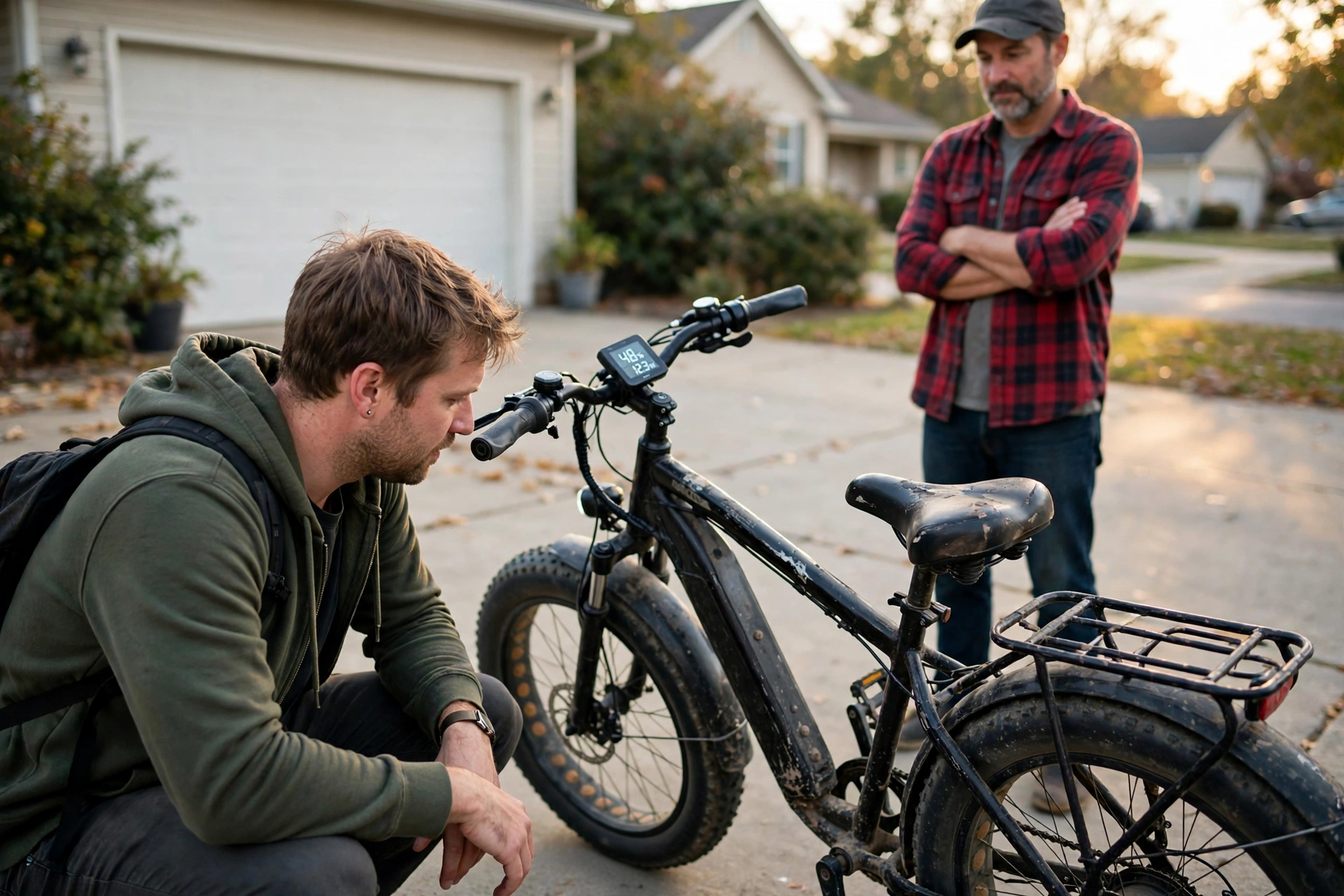
E Bike 2nd Hand Prices: What Sellers Ask vs. What Bikes Are Worth
Prices checked October 25, 2026. The Commonplace e-bike price index, built from live asking prices in October 2026, puts the median used Aventon at $900 (typical range $700–$1,300), the median Rad Power at $625 ($500–$1,000) and the median Lectric at $500 ($300–$700). Those are asking prices, not sold prices — bikes that sit for three weeks at $1,300 sell at $950 or don’t sell at all. Treat every ask as the opening bid in a negotiation the seller started early.
Depreciation is steep and front-loaded. Resale trackers at wetried.it, comparing the two biggest direct-to-rider brands, observed a two-year-old Aventon Aventure holding roughly 60–70% of its retail price, with Rad Power bikes holding roughly 50–60% after two years. Run that on a $1,999 Aventure.2: at 65% it changes hands around $1,299, which means the first owner burned about $700 in 24 months — roughly $350 a year (est., from the observed resale band) for the privilege of the warranty and the new-bike smell.
That first owner’s loss is your opportunity, with one condition. The discount exists because the next buyer carries the battery risk. A used bike priced at 60% of new with a healthy pack is a genuinely good deal. The same bike at 60% with a pack at the end of its life is priced about $500 too high, and section three shows the arithmetic. Brand matters here too: supported brands with dealers, parts catalogs and published torque figures hold value. A no-name bike with a proprietary pack shape is worth close to its scrap value the day the battery dies, because nobody sells the replacement.
Thing 1: The Battery Is the Bike
Everything else on an e bike 2nd hand purchase is a $30–$150 problem. The battery is a $300–$800 problem. Repair specialists who see these bikes daily put replacement packs at $300 to $800 or more depending on brand and capacity, and refurbisher Upway warns a fresh pack can run to 50% of the entire bike’s price. On a $625 median-ask Rad, a $550 factory pack is 88% of what you just paid for the whole machine. Read that again before your next “steal of a deal” road trip.
Battery life is counted in cycles, not birthdays. One cycle is a full discharge and recharge. Most quality packs are rated for 500 to 1,000 cycles before capacity falls off a cliff; Bosch, to use a published benchmark, guarantees its packs hold at least 60% capacity after 500 cycles. Calendar age still matters — a pack stored flat at 0% in a hot garage for two summers ages fast without turning a wheel — but cycles are the honest odometer.
Sellers rarely know their cycle count, and many displays don’t show it. Estimate it yourself: cycles ≈ total miles ÷ real miles per charge. A bike showing 6,417 miles that honestly returns 32 miles per charge (est., typical for a fat-tire bike at mid assist) has eaten about 200 cycles. That’s a pack with years left. A delivery rider’s bike with 11,000 miles at 25 miles per charge is past 440 cycles and living on borrowed time. Bosch-powered bikes are the exception to the guessing: a dealer can plug in and print a diagnostic report with the pack’s measured capacity. Ask for one. A seller who refuses a $0 diagnostic on a $1,400 bike is telling you the result.
Thing 2: Test the Pack Before You Trust the Display
The bar display lies politely. It shows percentage of whatever capacity remains, so a shrunken pack still reads a cheerful 100%. The only trustworthy tests measure the pack against its original spec. Do all three; they take twenty minutes.
The voltage check. Bring a $15 multimeter. A fully charged 48V pack (13 cells in series) reads 54.6V at rest. A 36V pack reads 42V. If the seller hands you a “fully charged” 48V battery reading 51.8V, the charger, a cell group or the truth is broken. Voltage sag under load is the deeper tell: ride a hill at full assist and watch the display’s voltage or bars. A healthy pack sags a little and recovers. A tired pack falls off a cliff under load — bars vanishing on the climb, then creeping back on the flat. That bounce-back is capacity loss performing for you.
The range check. Every e bike 2nd hand inspection needs this one: ask for the bike fully charged, then ride a known loop at the assist level you’d actually use. Testing guides use a hard line: if the bike delivers under 70% of its original rated range, the pack has significant degradation and the price must fall by the cost of a pack. A bike rated at 45 miles that wheezes to 26 is at 58%. It is not “still pretty good.” It is a bike plus a $550 errand.
The eyeball check. Swelling, a case that no longer sits flush, cracked mounts, corroded contacts, a charger that isn’t the original, a battery that gets hot in your palm on a short ride — any one of these ends the negotiation. Never buy a pack with impact damage or water-ingress marks. Lithium cells remember abuse chemically, and they collect the debt later, sometimes at 2 a.m. in your garage.
Thing 3: Run the Numbers — E Bike 2nd Hand Math That Saves You $550
Here is the computation sellers hope you skip, worked on real figures. Take a used Rad Power bike at the Commonplace median ask of $625. Two versions of that bike exist, and they look identical in photos.
Version A — dead pack walking. The battery tests under 70% and needs replacing inside a year. Rad’s own replacement batteries sold for about $550 (the price in the CPSC warning coverage). $625 + $550 = $1,175. Add the consumables every used bike needs: a chain at $28 (est.), brake pads at $35 (est.) and one fat tire at $69 (est.) = $132. True cost: $1,307. The same model sold new at $1,699 in Rad’s later price cuts (checked October 25, 2026), so your “steal” saved $392 — 23% — in exchange for zero warranty, a three-year-old motor and a frame with someone else’s crash history.
Version B — tested pack at 85% capacity. Same $625 ask, same $132 in consumables, no battery purchase: $757 all-in. Saving against new: $942, or 55%. That is the deal you drove across town for.
The entire difference between a smart buy and a donation is one $550 line item, and it’s the line item the seller least wants measured. Price any suspect pack before you haggle: our e-bike battery replacement cost estimator gives you the number to subtract from the ask, in writing, while you stand in the driveway. If the seller won’t budge by at least the pack’s cost on a bike that fails the 70% test, walk. There is always another listing. There is not always another $550.
Thing 4: Motors Last. Drivetrains Don’t.
On an e bike 2nd hand buy, motors are the reliable part. A sealed hub motor or a Bosch/Shimano mid-drive usually outlives the frame’s paint, and used-market testing guides put a replacement motor at $200–$500 plus labor — annoying, not fatal. On the test ride, run every assist level, use the throttle if fitted, and listen. Grinding, clicking that syncs with your pedalling, or a geared hub that whines like a dentist’s drill means worn internals. Power that surges or cuts out on bumps is usually a dying connector or controller, and intermittent electrical faults are the ones that eat shop hours.
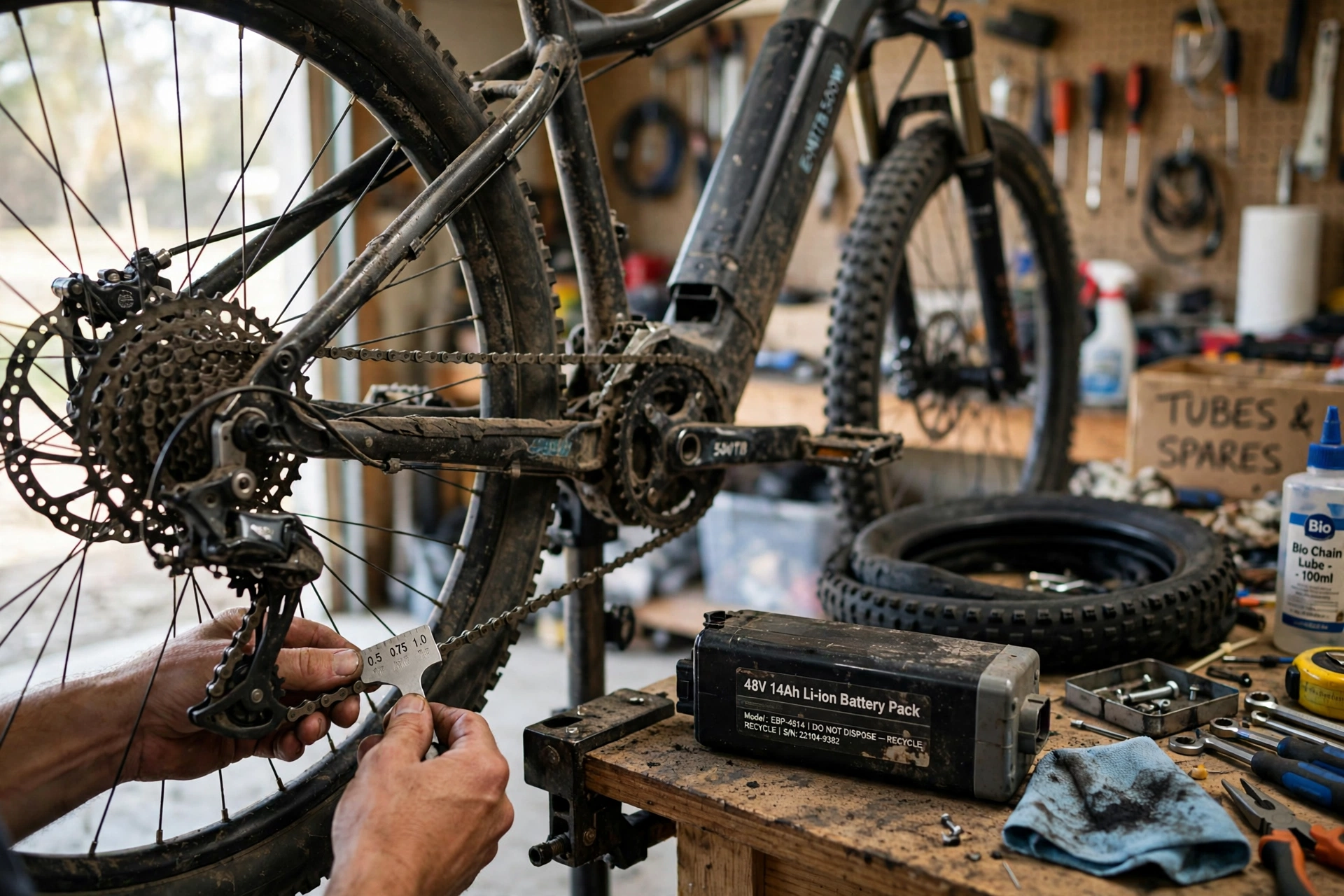
The drivetrain is where used bikes quietly bill you. Mid-drives put motor torque through the chain — a 250W Bosch Performance Line CX makes 85 Nm, and torque that healthy eats chains and cassettes at two to three times the rate of a pedal bike (est., shop consensus). Carry a $12 chain checker. A chain stretched past 0.75% on a mid-drive usually means the cassette went with it, and a chain-plus-cassette job runs $90–$220 (est.) before labor. Hub-motor bikes spare the chain but cook brake pads instead: a 73 lb fat-tire bike descending on resin pads is a wear machine. Squeeze the levers, check pad thickness, spin both wheels and watch the rotors for wobble.
Torque is also your honesty filter. A listing shouting “1,000W MONSTER TORQUE” for a bike with a 48V 14Ah pack and a no-name hub is selling adjectives. The numbers that matter are printed on the motor shell and in the manual: rated watts, peak watts, and torque in Nm. If the seller can’t produce them, price the bike like they’re bad.
Thing 5: Check the Serial Number Before You Check the Tires
An e bike 2nd hand deal on a stolen bike is not a bargain at any price, because it isn’t yours — it’s evidence with pedals, and it goes back to its owner the first time a shop or an officer runs the number. The check costs four minutes and nothing else. The serial number sits under the bottom bracket on most bikes, or on the head tube just below the handlebars on many e-bikes. Photograph it, then search it on Bike Index, the nonprofit registry holding more than 1.7 million catalogued bikes, and on Project 529’s Garage for good measure. A hit means walk away and let the registry contact the owner.
Paper tells the same story from the other side. A legitimate owner usually has something: the original receipt, an order confirmation email, the manual with the serial sticker, the charger with the brand’s name on it. A seller with no documents, no charger and a price $300 under every comparable listing is not a generous person having a bad week. Three more tells: the serial area freshly ground or painted over, a battery lock drilled out, and a seller who insists on cash in a parking lot after dark and can’t tell you where the bike was bought. Any one of them ends the meeting.
When the bike checks out, protect your own purchase the same way: register it in your name, photograph the serial, and keep the seller’s name and the sale date in a note on your phone. If the bike is ever stolen, that record is the difference between a recovery story and a shrug.
Thing 6: Class Stickers, Torque Claims and Other Legal Fiction
Legal classes are precise, and the used market treats them as suggestions. In most US states: Class 1 is pedal-assist only up to 20 mph. Class 2 adds a throttle, still capped at 20 mph. Class 3 is pedal-assist to 28 mph, must have a speedometer, and is banned from many shared-use paths and some trail systems outright. Our Class 1 e-bike guide lays out the class system in full. The sticker on the seat tube states the class and motor wattage as sold — check it against reality. A “Class 2” bike that does 33 mph on throttle alone after a previous owner deleted the limiter is, legally, an unregistered motor vehicle in most states, and it will be treated that way after a crash, right when your insurer starts asking questions.
Battery recalls are the other legal fiction — the fiction that a recalled pack is fine because it still charges. It isn’t. In November 2025 the US Consumer Product Safety Commission warned owners to stop using Rad Power batteries marked RP-1304 and HL-RP-S1304 after 31 fire reports and roughly $734,500 in property damage; the affected packs shipped with the RadWagon 4, RadCity 4, RadRover 5, RadCity Step-Thru 3, RadRover Step-Thru 1, RadRunner 1 and 2, RadRunner Plus and RadExpand 5. The CPSC warning, covered by Bicycle Retailer, names the battery model printed on the pack’s own label — flip any used Rad battery over and read it before money moves. Those exact models flood e bike 2nd hand listings precisely because informed owners are unloading them.
While the pack is in your hands, look for certification marks. UL 2849 certifies the whole electrical system — battery, charger, controller working together — while UL 2271 covers the battery alone. New York City already requires UL 2849 for e-bike sales, and other cities are copying the rule. An uncertified pack in a used bike isn’t automatically a fire, but it removes your last independent witness that anyone ever tested the thing.
Thing 7: Where You Buy an E Bike 2nd Hand Changes the Risk
Same bike, three channels, three completely different risk profiles. Scores are ours, from the checks above.
Certified refurbisher. Outfits like Upway test every pack and replace any battery measuring under 80% of original capacity, then add a one-year warranty. You pay closer to the top of the used band and get paperwork instead of promises. Our score: 8.4/10 — Value: 7/10 · Risk: 3/10 (lower is safer) · Battery certainty: 10/10.
Local bike shop, used or trade-in. A mechanic has usually at least ridden it, consumables are often fresh, and there’s a counter to walk back to. Prices run 10–20% above private asks (est., market observation). Our score: 7.6/10 — Value: 7/10 · Risk: 4/10 · Battery certainty: 7/10.
Private sale — Marketplace, Craigslist, a colleague’s cousin. This is where the $625 medians live and where every test in this guide is on you. The ceiling is the best deal in the market; the floor is a stolen frame with a recalled battery. Our score: 5.8/10 — Value: 9/10 · Risk: 8/10 · Battery certainty: 2/10.
My take, no hedging: first-time buyers should pay the refurbisher premium once and learn the market on a bike that works. The private-sale discount only pays if you run the full checklist — voltage, range loop, chain gauge, serial search — without skipping steps because the seller seems nice. Nice is not a diagnostic category.
Red Flags: Walk Away, No Matter How Cheap
- Battery case swollen, cracked, repainted, or hot after a ten-minute ride.
- Charger is a generic brick with no brand label, or the seller “lost” the original.
- Display percentage drops two bars on one short hill, then climbs back on the flat.
- Serial number ground off, stickered over, or the seller won’t let you photograph it.
- No receipt, no manual, no story that survives two follow-up questions.
- Price sits $300+ under every comparable listing and the ad demands a fast cash sale.
- The pack is a model under an active safety warning, like the Rad RP-1304 named above.
- “It just needs a $40 part” — a seller who won’t spend $40 to sell a $900 bike knows the part isn’t $40.
E Bike 2nd Hand Questions, Answered Straight
Is buying an e bike 2nd hand worth it?
Yes, when the battery tests at 80% capacity or better and the serial check comes back clean. The first owner absorbs roughly $350 a year in early depreciation, and you keep it. Buy a bike with a dying pack and the saving evaporates into a $550 battery invoice — the math in Thing 3 shows both outcomes on the same $625 bike.
How many miles is too many on a used e-bike?
Miles alone don’t kill these bikes; cycles do. Convert: miles ÷ real range per charge. Under 200 cycles is a young pack. Past 400, price in a replacement. A garage-kept commuter at 7,000 gentle miles can be a better buy than a 2,500-mile bike that lived outside, charged to 100% and stored full in a hot shed.
Can I test battery health without special tools?
Mostly. A $15 multimeter confirms a full-charge voltage (54.6V on a 48V system), and a measured range loop against the bike’s original rated range gives you the percentage that matters — under 70% means walk or renegotiate hard. For Bosch and Shimano systems, any dealer of that brand can run a printed diagnostic, which beats every driveway trick.
What does a replacement e-bike battery actually cost?
Between $300 and $800+ depending on brand and capacity, with factory packs from the big direct brands around $550. The pack is the largest single cost in used ownership — which is why the cheapest upgrade to a used bike is the test ride you take before buying it. Running costs afterwards are trivial: a full charge costs pennies, as our breakdown of how much it costs to charge an electric bike shows.
Are used e-bikes covered by any warranty?
Almost never from a private seller — assume none, and treat any “still under warranty” claim as fiction until the seller shows the original dated receipt, because most manufacturer warranties name the first owner only. Certified refurbishers are the exception: one year of coverage is standard in that channel, and it’s the main thing their premium buys.
Buy the battery, test everything, run the serial, read the class sticker. Do those four things and an e bike 2nd hand purchase is the smartest money in e-bikes. Skip them, and you’re not the buyer in the deal. You’re the exit strategy.
An e bike 2nd hand purchase rewards patience: an e bike 2nd hand buyer who tests the battery, checks the serial, and reads the class sticker avoids the costly mistakes this guide warns about. Before any e bike 2nd hand deal closes, confirm the pack health, the seller’s story, and the true all-in cost, because an e bike 2nd hand bargain is only a bargain when every check passes.