Last updated: October 25, 2026
Nobody falls in love with a brick. Yet the electric bike charger that came in your bike’s box quietly decides three things you care about every single week: how long you wait, how long your battery lives, and whether your hallway smells like warm electronics at 11 p.m. It is the least glamorous part of e-bike ownership. It is also the part city riders get wrong most often, usually by buying a $19 lookalike after the original goes missing.
Picture the classic apartment shuffle. Your bike lives downstairs, the battery comes up with you (because a battery left outside tends to wander off), and the one charger you own is somewhere else. At your office. At your partner’s place. Still plugged in behind a couch two neighborhoods away. So you open a marketplace tab, type in your voltage, sort by price, and hover over a brick that costs less than lunch.
Stop. That click is the whole ballgame.
Seven things separate an electric bike charger that serves you for years from one that cooks a $500 battery — or worse. Voltage matching. Amps, with honest charge-time math. Plugs that lie to your face. Certification you can actually verify. Weight, because some of us carry this thing daily. Real running costs, which turn out to be pocket change. And the handful of smart features that earn their money. We will do the arithmetic out loud, because charger math is simple and almost nobody shows it.
1. Your electric bike charger must match the battery voltage — exactly
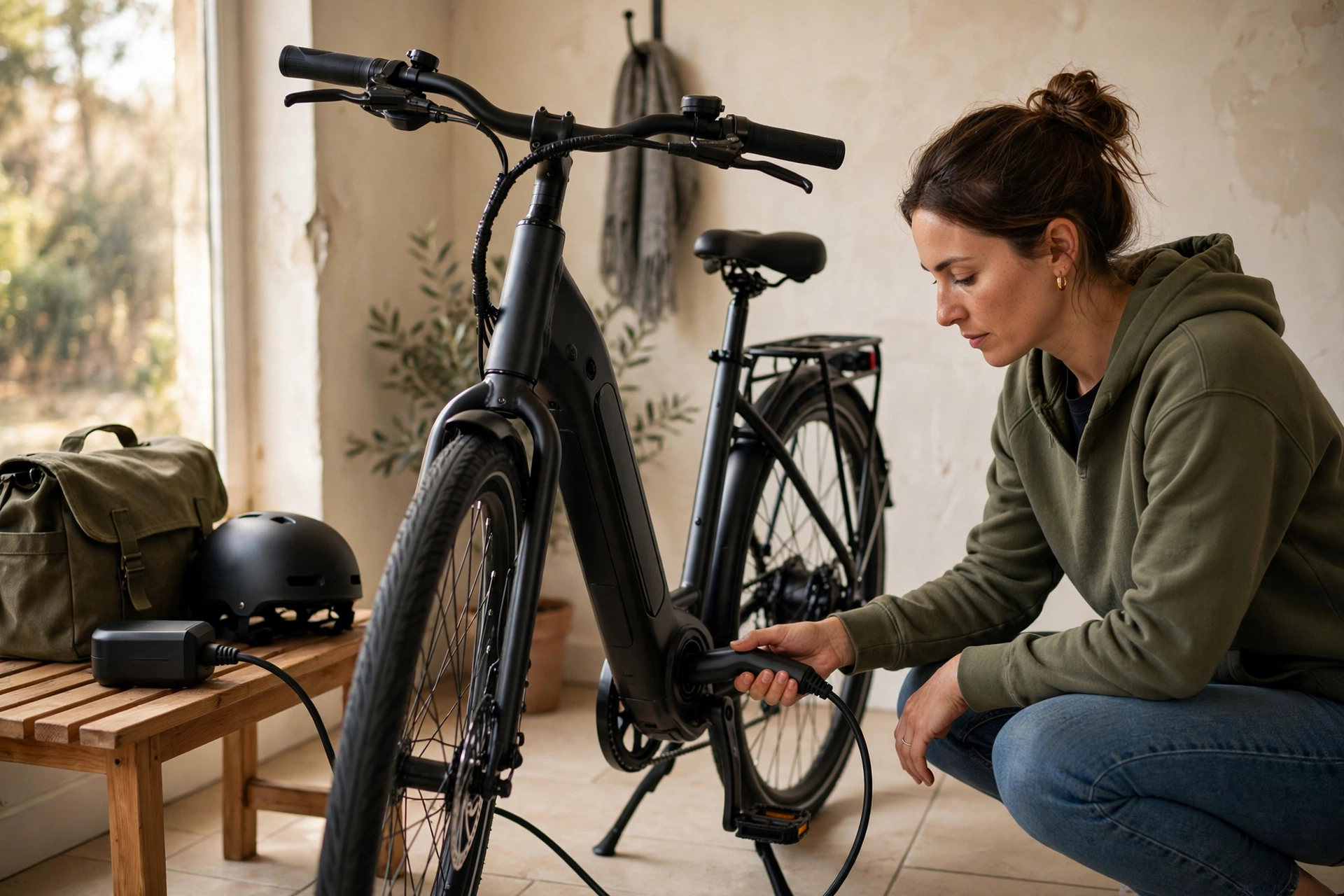
Here is the trap that catches smart people. Your battery says 48V. The correct charger for it does not say 48V anywhere big. It says 54.6V output, in small print, on the brick’s label. That is not a typo. Battery voltages are nominal — a polite average — while chargers are rated by the maximum voltage they push at full charge. The pairs go like this: a 36V battery needs a charger that outputs 42.0V, a 48V battery needs 54.6V, and a 52V battery needs 58.8V. Each lithium cell inside tops out at 4.2V, and the charger has to land on that number, pack-wide, every time.
Get the pairing wrong in one direction and your electric bike charger simply never fills the pack. A 42.0V charger on a 48V battery stalls out at a partial charge, the gauge lies to you, and your range quietly shrinks. Get it wrong in the other direction and things stop being funny. A 58.8V charger meant for a 52V pack will shove 48V cells past their 4.2V ceiling. Overcharged cells swell. Swollen cells vent. Venting cells are how charging fires start. There is no “close enough” setting on this dial, and no, the battery management system is not a license to experiment — it is a last line of defense, not a voltage converter.
So the rule is boring and absolute: match the charger’s OUTPUT number to your battery’s required charge voltage, printed on the battery label or in the manual. An electric bike charger is matched by its output figure, not by the logo on the box and not by the plug shape. Write your number down. Tape it inside a kitchen cabinet if you have to. Future you, standing in a shop with a dead battery, will be grateful.
2. Amps set the clock: 2A slow and gentle, 4–5A fast and warmer
Voltage is the lock. Amperage is the faucet. Most e-bikes ship with a 2A charger, and 2A is a deliberate choice: it is gentle, cool, and kind to cells. Fast chargers push 4A or 5A and cut your wait roughly in half. What does that mean on a real pack? Let’s run the numbers on the most common city setup going, a 48V 14Ah battery.
First, the pack’s size: 48 × 14 = 672Wh. The matching charger outputs 54.6V, so at 2A it delivers 54.6 × 2 = 109.2W. Charge time on paper is just capacity divided by flow: 14Ah ÷ 2A = 7 hours. Real life adds a taper, because lithium charging slows down over the final fifth as current fades, so expect about 6 to 7 hours wall-clock (est., based on typical charge curves). Swap in a 4A charger and the flow doubles to roughly 218W: 14 ÷ 4 = 3.5 hours on paper, about 3.5 to 4 hours in practice (est.). Same battery. Half the evening back.
Tempting, right? Here is the counterweight. Speed makes heat, and heat is the tax lithium cells pay in lifespan. An electric bike charger running at 4–5A every single day will age a pack faster than the lazy 2A brick will — not dramatically, not overnight, but measurably over a couple of seasons. Your pack also has a ceiling: most battery labels list a maximum charge current, often 3A to 5A, and exceeding it can trip the management system or cook cells quietly. Never buy amps your battery hasn’t agreed to.
My take, and I’ll plant a flag here: most commuters don’t need a fast charger. They need a second charger where the bike actually sleeps. Published battery-testing summaries point the same direction — they report that routinely stopping around 80–90% instead of brim-full can stretch a pack from roughly 500 cycles toward 1,000 (est., results vary by cell and temperature). Slow overnight charging plus an occasional partial top-up beats daily fast-charging on every axis except impatience. Save the 4A brick for the days you’re touring, double-shifting, or running errands on a deadline.
3. The plug can fit and still be wrong
Connectors are where good intentions go to spark. The e-bike world never standardized on one plug, so your electric bike charger might end in a chunky 3-pin XLR (common on hub-motor commuters), a slim DC barrel, an RCA-style plug on some folders, or a fully proprietary connector on Bosch, Shimano and other big drive systems. The barrel plugs are the sneaky ones: a 5.5mm barrel with a 2.1mm center pin and one with a 2.5mm pin look identical on a product photo, yet one fits snug and the other wobbles, arcs, and runs hot.
Worse, fit says nothing about polarity. Two chargers can share a shell and a plug while wiring the center pin opposite ways, and reversed polarity is a fine way to kill a charge port. Brand systems make this simpler by being stubborn — a Bosch charger physically refuses to mate with anything else — and honestly? Good. Proprietary plugs are annoying right up until they stop you from making an expensive mistake at midnight.
Before any replacement ships to your door, check three things against your old unit: pin count or barrel dimensions, the output voltage from Thing 1, and the polarity diagram printed on the label. If a listing calls itself “universal,” read that as marketing, not a specification. And a small city habit worth stealing: put a strip of tape on each charger you own and write the bike’s name on it. Chargers migrate. Tape doesn’t forget.
4. Electric bike charger safety is a certification, not a vibe
Now the serious section, and it deserves its own heading because this is where cheap gets dangerous. The standard that matters is UL 2849. It doesn’t test a charger on a bench in isolation — it certifies the whole electrical system, battery, charger, motor and controller together, the way they actually interact in your hallway. UL Solutions’ own overview of UL 2849 e-bike certification spells out that system-level scope. A related mark, UL 2271, covers the battery pack alone: good, worth having, but it says nothing about the brick you plug into it.
Lawmakers have started drawing the same line. New York City’s Local Law 39 requires certified e-bike systems and chargers for legal sale, and California’s SB 1271 does the same statewide. Meanwhile the CPSC’s micromobility safety center keeps repeating three habits: be present while charging, use the charger supplied or approved by the manufacturer, and unplug when the charge is done. Federal incident investigators keep finding the same pattern in charging fires — aftermarket packs and mismatched chargers, over and over.
Why are the $15–$30 no-name bricks (est., typical marketplace pricing) so risky? Because the parts you can’t see are the parts that got cut. A proper electric bike charger has an accurate overcharge cutoff, thermal protection, and an output voltage that stays where the label claims. A bargain brick may drift high, skip the cutoff, and keep pushing current into a full pack until the cells object — loudly, and with flame.
Here’s my blunt rule, no hedging: if a charger carries no verifiable certification from a recognized lab, it does not enter my building. Not “probably fine.” Not “just this once.” A quality charger, by the way, should feel warm in your palm during a charge — never too hot to hold comfortably. Hot is a warning, not a personality trait.
5. Weight, size, and the two-charger trick
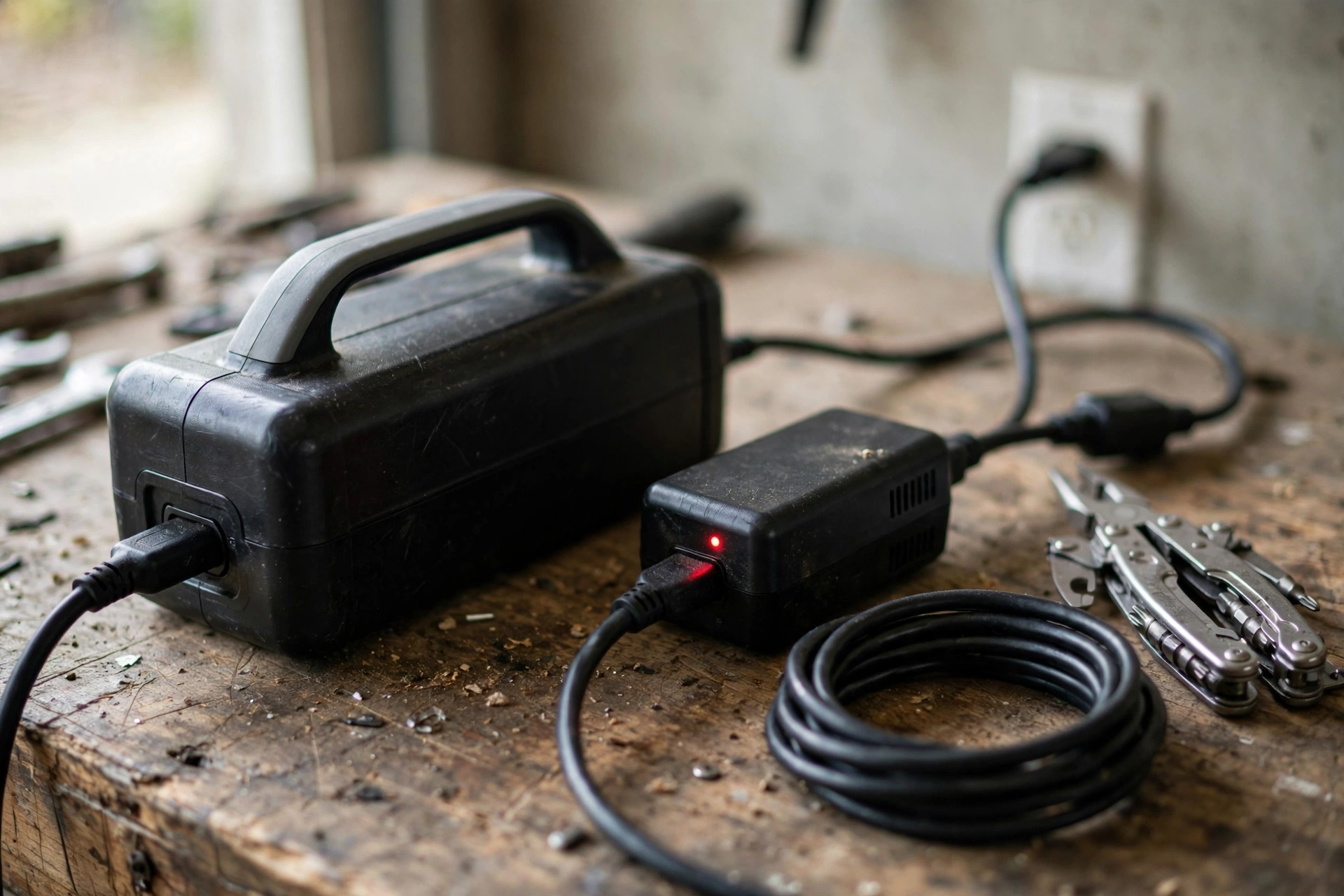
Time for my favorite obsession: what this thing weighs, because a charger you carry is a charger you resent. Stock 2A bricks typically run about 1.5 to 2.2 pounds with their cables (est., based on common included units), which is fine in a pannier and miserable in a tote next to a laptop and a water bottle. Slim travel chargers get under a pound (est.), and fanless designs skip the cooling fan entirely — lighter, silent, and one less part to fail. If you charge at a desk, fanless matters more than you’d think. A faint fan whine at 9 a.m. is nobody’s favorite coworker.
Now the theft-proofing angle, the part nobody writes about. A charger dangling in a shared bike room, plugged in for six hours, is a charger advertising itself. The fix is beautifully simple: if your battery is removable, the battery comes with you and charges at your desk, indoors, where both it and the brick stay boring and unstealable. That one habit does more for your security than a second lock.
And here is the two-charger trick in full: keep the original charger at home, parked by the door. Buy one certified second charger and leave it at work. No daily brick in the bag, no forgotten charger on the wrong side of town, no sketchy loaner from a coworker’s drawer. It costs less than one replacement battery by a factor of about seven (est.). Riders who fold their bikes for trains and small hallways benefit twice — a compact travel unit lives in the bag full-time, and the home setup never gets disturbed.
6. What an electric bike charger costs to buy — and the pennies it costs to run
Prices first, checked October 25, 2026. A genuine replacement charger from a major bike brand typically runs $49 to $99 (est., from brand store listings). Certified third-party 2A chargers sit around $35 to $60 (est.). A 4A smart charger with a charge-limit switch lands between $89 and $159 (est.), and premium programmable units climb toward $300 and beyond (est.). The uncertified marketplace brick at $15 to $30 is the outlier, and by now you know why it’s cheap.
Running costs are where it gets fun, because they’re nearly nothing. Take that same 672Wh pack. Chargers waste a little energy as heat, so at roughly 85% efficiency (est.), filling it pulls 672 ÷ 0.85 ≈ 790Wh from the wall — call it 0.79 kWh. At an average US residential rate of about $0.17 per kWh (est.), one full charge costs 0.79 × 0.17 = $0.134. Thirteen cents. Ride five days a week and charge 250 times a year, and your annual electricity bill for the bike is about $33.55. Even a fast charger only nudges the figure to roughly 14–15 cents a charge through slightly worse efficiency (est.).
We ran the riding side of this math in our guide to how much it costs to charge an electric bike, and the conclusion holds up: the electricity is a rounding error. Put differently, an $89 certified smart charger costs about as much as 664 full charges of electricity (89 ÷ 0.134). Nobody ever saved money buying the dangerous brick. They just moved the spending from the charger column to the battery column — or the insurance column.
7. Three features worth paying for — and two that aren’t
Worth it, first: a charge-limit switch. Chargers that let you stop at 80% or 90% for daily riding and reserve 100% for big days automate the lifespan trick from Thing 2, no willpower required. Second: honest auto-shutoff with a clear indicator, so “done” actually means done. Third: a fanless aluminum case if the charger lives at your desk or in your bag — silence and durability in one slab.
Not worth it: headline amperage as a flex. A 6A charger aimed at a small pack can exceed the battery’s rated maximum charge current, which is the one spec in this whole guide you must never outvote. Also not worth it: miracle claims. “Smart AI chip,” “battery revival mode,” “5x battery life” — if the listing shouts features but can’t show a certification mark, the features are fiction.
One more consideration, and it’s the budget line hiding under everything: gentle charging habits are the cheapest insurance your battery will ever get. Packs cost hundreds to replace, so before yours fades, run your numbers through our e-bike battery replacement cost estimator and see what an extra season of life is worth in dollars. Then look at the $49 charger again. The math argues with you, and the math wins.
Our verdict: the electric bike charger setups we’d actually buy
The stock charger that came with your bike — Our score: 8.6/10. Safety: 9.5/10 · Speed: 5.5/10 · Value: 9/10. It was matched to your pack at the factory and, on a certified bike, tested as part of the system. Slow is its only real sin, and slow is a schedule problem, not a safety one.
A certified 4A smart charger with a charge-limit switch, bought as the second unit — Our score: 8.4/10. Safety: 8.5/10 · Speed: 9/10 · Value: 7.5/10. This is the upgrade we’d actually spend on. It halves your wait on deadline days and baby-sits the pack on all the others. Just confirm your battery’s maximum charge current clears 4A first.
The uncertified $19 marketplace brick — Our score: 1.5/10. Safety: 1/10 · Speed: 6/10 · Value: 2/10. It is cheap exactly once. Everything after that first charge is borrowed luck, and luck is a terrible charging strategy.
Electric bike charger questions, answered fast
Can I charge my bike with any electric bike charger that has the right plug?
No. The plug is only the handshake. The charger’s output voltage has to match your battery’s required charge voltage — 54.6V for a 48V pack — and its amperage has to stay at or under the maximum charge current printed on your battery label. A plug that fits with the wrong numbers behind it is the most common way riders damage packs.
Why does my charger say 54.6V when my battery is 48V?
Because 48V is the nominal, average voltage of the pack, while 54.6V is where it finishes. Each of the 13 cell groups inside charges up to 4.2V, and 13 × 4.2 = 54.6. The charger is labeled by the destination, the battery by the journey. Both are telling the truth.
How long does a 48V 14Ah battery take to charge?
On a standard 2A charger, about 6 to 7 hours from empty (est.). On a 4A charger, about 3.5 to 4 hours (est.). Smaller packs scale down proportionally — a 10Ah pack on 2A lands near 5 hours. Partial charges are faster still, since the slow taper only kicks in near full.
Is it okay to leave the charger plugged in overnight?
The official guidance says be present while charging and unplug when it’s done, and I follow it: my bike charges in the evening, in the entryway, and gets unplugged before bed. A certified charger with auto-shutoff lowers the risk considerably, but “lower” and “zero” are different words, and unplugging costs you four seconds.
My charger died. Should I buy the exact same model?
It’s the safest default, yes. If you switch brands, match the output voltage exactly, keep amperage the same or lower (unless your battery’s label allows more), match the connector precisely, and insist on certification. If you’re still shopping for the bike itself, our Class 1 e-bike complete guide covers which systems come with certified charging gear in the box.
Keep your brick boring. Boring voltage that matches, boring amps that behave, a boring little certification mark doing its quiet job. The best electric bike charger is the one you stop thinking about entirely — plugged in by the door, light glowing, battery happy, ready when you are.