Last updated: October 25, 2026
Most truck reviews start outside, staring at the bodywork. Wrong place. You live with a truck from the driver’s seat, usually for longer than you planned, often with a trailer behind you and a crew that wants feeding. The cybertruck inside story is stranger than the stainless wedge outside suggests: one enormous screen, a squared-off steering wheel, no stalks, almost no buttons, and a back seat with more room than the roofline has any right to allow. I judge cabins the way I judge tow rigs — by what happens at hour six, not by the photos on launch day.
So here is the verdict up front, because burying it helps nobody. Space: excellent. Seats: good, with one caveat for tall rear passengers. Storage: smarter than it looks. Controls: Tesla took the rulebook, set fire to it, and handed you a touchscreen instead. Part of that trade is worth it. Part of it will annoy you every working day you own the truck. The cybertruck inside tour below runs the tape-measure numbers against the Ford F-150 Lightning, weighs the work-truck practicality, and separates the trims that get the full cabin from the ones that quietly lose half of it.
Cybertruck Inside: One Screen, One Squircle and Zero Stalks
Climb in and the dashboard is a single flat slab running the full width of the cab, its top surfaced in a soft, suede-like material that exists for one good reason: the windshield is so long and so raked that a glossy dash would bounce reflections straight into your eyes. There is no instrument cluster. There is no head-up display. There are not even visible air vents — the airflow hides in a slit across the dash and gets aimed from the screen. Ahead of you sits the squared steering wheel everyone calls the squircle, flat at the top and bottom, round at the sides, with the Cybertruck’s outline stamped into the airbag cover.
Tesla’s official Cybertruck page pitches this cabin as a clean, lounge-like space, and on first impressions that is exactly what it is: calm, uncluttered, almost empty.
The screen filling that emptiness is an 18.5-inch touchscreen, the largest display Tesla has ever fitted to anything, and it runs the entire truck. Gear selection, mirrors, wipers, headlights, the glovebox, the tonneau cover — all of it lives in that glass. A second screen of 9.4 inches sits at the back of the centre console for rear passengers, though only on the Premium All-Wheel Drive and Cyberbeast trims. Premium cabins also get a 15-speaker audio system with two dedicated subwoofers, which reviewers consistently rate among the best standard systems in any pickup, and a hospital-grade HEPA filter under the Bioweapon Defense Mode badge. Keep the trim split in mind. It becomes the whole story later on.
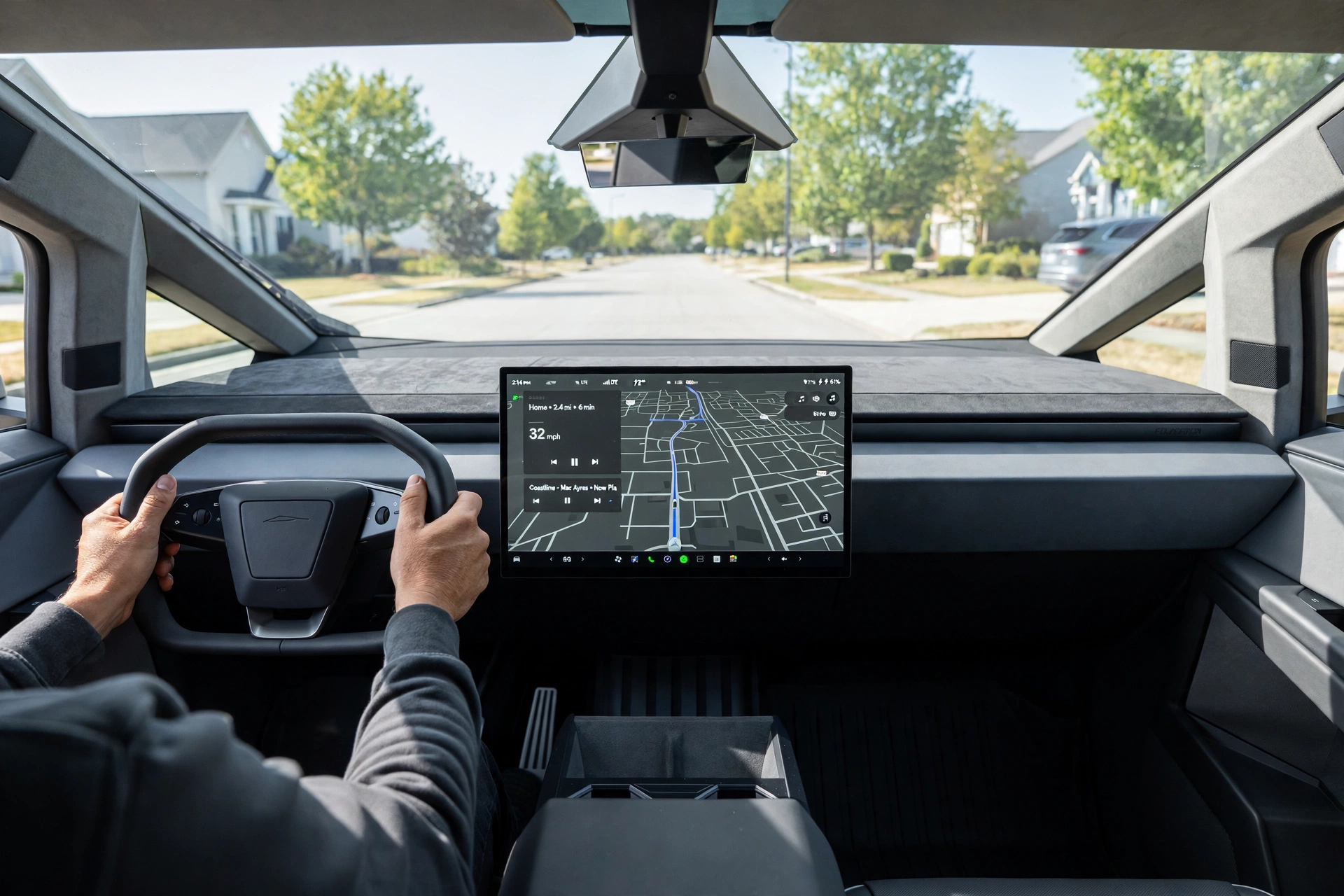
Now the controls, because this is where a work truck earns or loses my respect. There are no stalks at all. Indicators live on buttons on the left spoke of the wheel. The high beam, the wipers, the voice control — buttons and screen menus. Trouble is, the wheel turns with your hands, so your indicator button is rarely where your thumb left it. Add thick work gloves, a wet roundabout and a trailer swinging behind you, and the setup goes from quirky to genuinely irritating. Indicator buttons on a rotating wheel are a bad idea on any vehicle. On a truck built to tow 11,000 pounds, they are a worse one.
The saving grace is real, though: steer-by-wire. There is no mechanical column, so the ratio can tighten right up at parking speeds, and the squircle needs barely a turn and a half lock to lock (est.). Backing a trailer into a tight yard becomes a one-handed, low-effort job. That is the single best low-speed towing aid fitted to any pickup cabin, and it nearly redeems the buttons. Nearly.
Two smaller details deserve credit. If the screen ever freezes, a set of backup gear-selector buttons hides in the overhead console by the mirror, so the truck can still be moved. And because the rear window is little more than a letterbox — useless with the tonneau closed or a load stacked high — the rear-view mirror feed is a camera display, clear and wide. Truck drivers have trusted mirrors for a century, and I still want a real one. The camera feed, though, is honestly better than the slit of glass it replaces.
The Tape Measure: Cybertruck Inside Space vs the F-150 Lightning
Feelings are cheap. Measurements are not. The cybertruck inside dimensions Tesla publishes are 41.1 inches of front legroom and 40.9 inches in the rear, figures Autoblog’s interior breakdown lists alongside 41.7 inches of front headroom and 39.1 inches of rear headroom. Ford’s SuperCrew F-150 Lightning, per The Car Connection’s specification tables, offers 43.9 inches of front legroom and 43.6 inches in the back. Now run the totals. Cybertruck combined legroom: 41.1 + 40.9 = 82.0 inches. Lightning combined legroom: 43.9 + 43.6 = 87.5 inches.
The Ford wins the leg-stretch contest by 5.5 inches overall — and 2.7 of those inches sit in the rear seat, precisely where a grown adult notices the difference on a two-hour run to a site three counties away.
Headroom flips the result at the front and confirms it at the back. Up front the Cybertruck’s 41.7 inches beats the Lightning’s 40.8 by 0.9 of an inch, helped by the tall glasshouse. In the rear, the sloping roof collects its tax: 39.1 inches against the Ford’s 40.4, a 1.3-inch deficit that Carwow’s testers felt directly — anyone much over six feet tall starts to run short of air back there.
Screen glass is the one contest Tesla wins by a landslide. Assume a 16:9 panel (est.): an 18.5-inch diagonal works out to roughly 16.1 × 9.1 inches, or about 146 square inches of display. Add the 9.4-inch rear screen at roughly 38 square inches and a Premium cabin carries around 184 square inches of touchscreen — 1.28 square feet of it. Chevrolet takes the middle road with a smaller screen and physical switchgear, as our Chevy Silverado EV walkthrough shows, and plenty of working drivers will prefer it that way.
Front Seats, Console and Storage That Earns Its Keep
The front seats themselves are supportive without squeezing, trimmed in synthetic leather on Premium trims and grey textile on the base Dual-Motor truck. Premium seats are heated and ventilated; the base truck keeps heated, ventilated fronts too, which is a generous touch at the lower price. You sit high, the floor is dead flat, and there is an open shelf low in the dash big enough for a backpack or a compact suitcase — Carwow’s testers used it exactly that way. The centre console is a floating block with a sliding cover styled after the bed’s tonneau: two angled wireless phone chargers sit ahead of two properly large cupholders, and the lidded bin under the armrest swallows the usual mess of straps, tape measures and paperwork.
Storage keeps scoring points the longer you live with it. The glovebox is a slide-out drawer on the passenger side, reasonably roomy, and it opens from the touchscreen or by voice command. Yes, that means three taps to reach your insurance papers. Yes, you can lock it with a PIN from the same screen, which is more security than most gloveboxes ever offered.
Door bins are large and neatly segmented, sized for bottles and gloves rather than styled into uselessness. Premium trims also add two 120-volt outlets in the cabin per Tesla’s trim comparisons — enough to run a laptop and a battery charger for your cordless tools on the way to a job. Nothing here is flashy. All of it works, and in a truck cabin, boring-and-works beats clever-and-fragile every time.
The Rear Bench: Cybertruck Inside Room Where the Crew Actually Sits
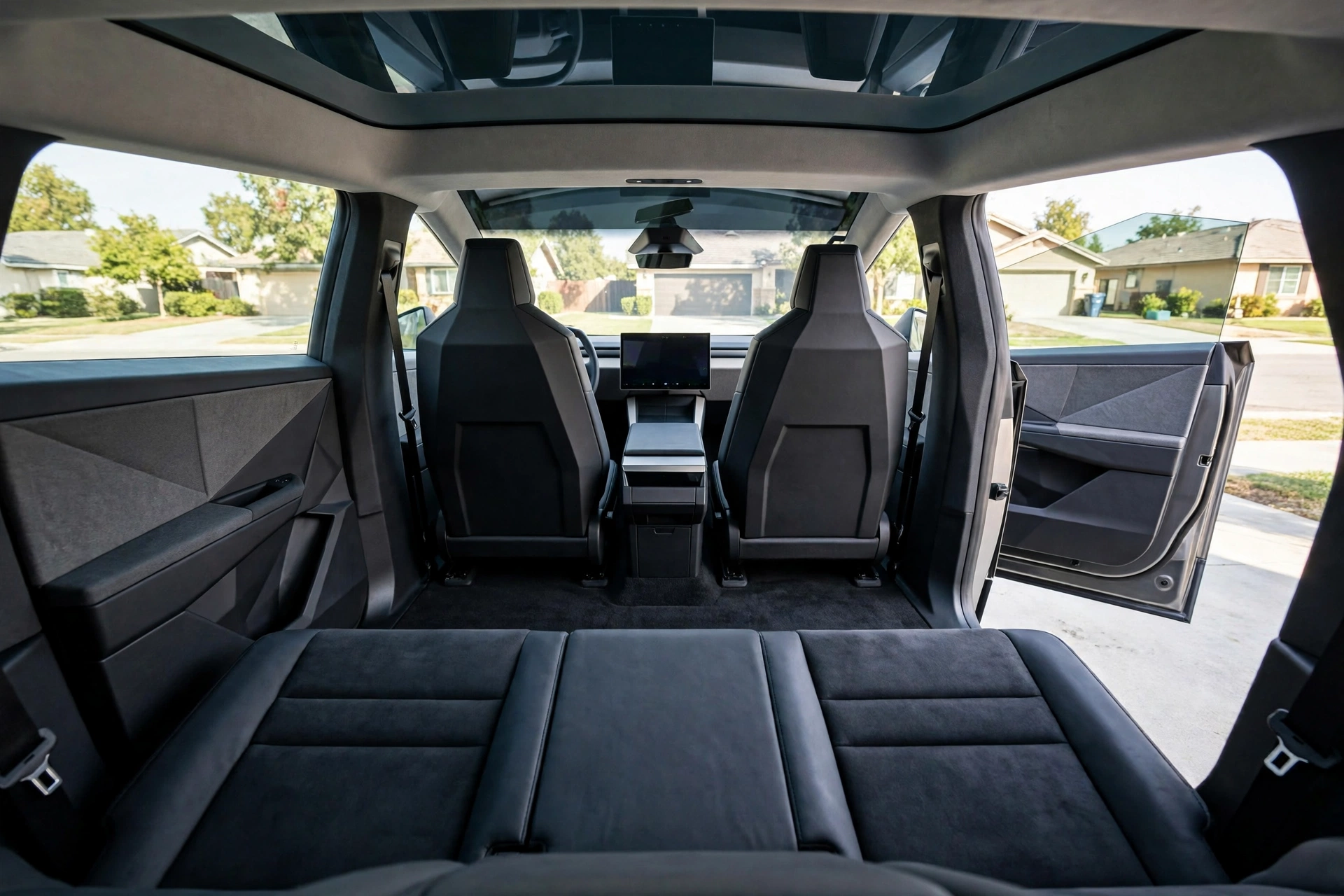
Three adults fit across the rear bench, and the cybertruck inside rear quarters are more generous than the silhouette promises. Knee room is excellent thanks to that 40.9 inches of legroom, the floor is completely flat, and there is space under the front seats for work boots. The rear doors open to nearly 90 degrees, which sounds like a spec-sheet footnote until you are loading a child seat, a dog, or a tired apprentice carrying a toolbox. Three ISOFIX anchor points run across the bench — Carwow counted all three — so family duty is properly covered too.
The honest limitation stays headroom: six-footers fit, taller passengers will feel the glass roof closing in, and over rough ground a rear passenger’s head and that glass panel can meet. The seatback is upright in the pickup tradition, fine for an hour, noticeable after three.
Flexibility is where the bench earns real praise. The seat cushions flip up vertically, Honda-style, turning the rear footwell into a tall, flat load bay for the things you refuse to leave in an open bed: a chop saw, a suitcase standing upright, a dog crate. A fold-down centre armrest appears when the middle seat is empty, and on Premium trims the 9.4-inch rear screen handles climate settings, video and games, and can even slide the unoccupied front passenger seat forward. Premium rear seats are heated as well.
For crew work the maths is simple — two adults ride in genuine comfort all day, three ride acceptably, and with the cushions flipped the cab doubles as a lockable tool store. That last trick is worth more than a sunroof ever will be.
Materials and Light: Hose-Down Practical or Showroom Fragile?
Two decor schemes exist. Tactical Grey is standard everywhere; the White option lightens the lower half of the dashboard and the upper door cards, while the seats stay dark whatever you choose. Here is a firm opinion, free of charge: white trim in a working truck is a showroom fantasy. One muddy February, one spilt coffee, one dog with wet paws, and that pale dash ledge carries the evidence for the life of the vehicle. Take the grey. The Premium synthetic leather wipes clean with a damp cloth — mud, dust and coffee all come off without a fight — while the base trim’s grey textile soaks up grime the way any cloth does, a point worth weighing if your truck earns its living outdoors.
Above you, a single fixed glass panel runs the length of the cabin. It cannot open and has no shade, but it is heavily tinted, floods the interior with light, and makes the rear bench feel far less cave-like than the tiny rear windows suggest. Premium cabins add a full-width ambient lighting strip that sweeps across the dash and into the doors, its colour set from the main screen; it sounds like a gimmick and turns out to be genuinely pleasant on a night drive home.
The HEPA filtration on Premium trims is the least visible and most underrated feature here — an hour behind a diesel tipper on a dusty haul road will teach you its value. Reviewers also note the cabin stays impressively quiet at highway speed for something shaped like a garden shed, with the glass and seals doing serious work. The roof’s one real cost shows up in summer: parked in full sun, that much glass turns the cabin into a greenhouse faster than a steel roof would (est.), and the climate system works hard for the first minutes of a drive. Tesla’s cabin-overheat protection exists for exactly this reason, and owners in hot states treat a windscreen shade as essential kit rather than an accessory.
In winter the same panel is a genuine pleasure — the whole cab feels twice its size.
Trim Walk: The $20,000 Question Between Base and Premium Cabins
This is where buyers get caught, so read the fine print before the test drive. With prices checked October 25, 2026, the range starts with the newer Dual-Motor All-Wheel Drive at $59,990, steps to the Premium All-Wheel Drive at $79,990, and tops out with the Cyberbeast at $99,990 — and Tesla revises these numbers often enough that you should confirm them on the order page before quoting me. The $20,000 step from base to Premium (79,990 − 59,990) is mostly a cabin step. It buys the premium synthetic-leather interior instead of grey textile, the 9.4-inch rear screen, the full 15-speaker system instead of a reduced speaker count (est.), heated rear seats, the premium console, ambient lighting and HEPA filtration.
The cybertruck inside equipment list changes more between those two trims than the powertrain does. One footnote for used buyers: the earlier Long Range Rear-Wheel Drive truck, launched at $69,990 and discontinued in September 2025, went further still — cloth seats, seven speakers, no rear screen, no HEPA filter. Cheap used examples will be exactly those trucks.
The Cyberbeast, for its part, brings the same Premium cabin as the $79,990 truck. Your extra money buys a third motor and savage acceleration, not better furniture, so nobody should stretch to it for interior reasons. Full Self-Driving remains an $8,000 option across the range, and whether it is worth it belongs in a different argument. If a conventional cabin with physical knobs and switches is non-negotiable for you, the opposite philosophy is on sale elsewhere — the trucks in our GMC electric truck guide keep their buttons and lose nothing for it. Neither approach is wrong. They are answers to different questions about who the truck is for.
Our Verdict on the Cybertruck Cabin
Strip away the launch-day noise and the cybertruck inside package is a spacious, tough, genuinely practical cabin wrapped around one stubborn decision: putting every control in a screen. The space numbers hold up against the Ford, the flip-up bench is a proper work feature, and steer-by-wire makes trailer shuffling easier than in any rival.
The indicator buttons and the glovebox-by-menu remain daily irritations that no software update can fully fix. Run your own ownership sums with our EV total cost of ownership calculator before signing anything, and if you carry adults in the back every day, sit them in one first — that rear headroom figure is the one number in this cabin that can genuinely break the deal.
When you judge the cybertruck inside package on daily use, the cybertruck inside space, the cybertruck inside storage and the cybertruck inside rear room all score well, while the cybertruck inside controls remain the weak point. That is the honest cybertruck inside verdict: a practical cabin let down by its buttons, not by its room.
Our score: 6.5/10
- Work Use: 6/10 — Wipe-clean surfaces, flat floor, flip-up bench and cabin outlets earn it; glove-hostile controls and menu-diving cost it.
- Family Use: 8/10 — Three ISOFIX points, 90-degree doors, rear screen and huge legroom; only tall-teen headroom holds it back.
- Controls: 5/10 — Steer-by-wire is superb for towing manoeuvres, but stalk-free buttons on a moving wheel are a step backwards, full stop.
Frequently Asked Questions
Is the cybertruck inside big enough for five adults?
Yes, with one asterisk. Legroom is generous in both rows — 41.1 inches front, 40.9 inches rear — and three adults fit across the rear bench. The asterisk is rear headroom at 39.1 inches: passengers up to about six feet are comfortable, while taller riders will feel the sloping glass roof closing in, especially over rough roads.
Does the Cybertruck have a glovebox?
It does, but not the kind you pull open. The glovebox is a slide-out drawer on the passenger side, opened from the central touchscreen or with a voice command, and it can be protected with a PIN set on the same screen. It is reasonably spacious. It is also three taps away when you are wearing gloves, which tells you everything about Tesla’s priorities.
Which Cybertruck trims get the rear touchscreen?
The 9.4-inch rear screen comes on the Premium All-Wheel Drive and the Cyberbeast. The base Dual-Motor All-Wheel Drive does without it, and so did the discontinued Long Range Rear-Wheel Drive. If rear passengers matter to you — kids on trips, crew on long hauls — that single feature may justify the Premium step on its own.
How many speakers does the Cybertruck have?
Premium All-Wheel Drive and Cyberbeast cabins get a 15-speaker system with two dedicated subwoofers, widely praised by reviewers as one of the best standard setups in a pickup. The base Dual-Motor truck runs a reduced speaker count (est.), and the discontinued rear-wheel-drive version had seven speakers. The difference is obvious within one song.
Can you power tools from the Cybertruck cabin?
Premium trims provide two 120-volt outlets inside the cabin, plus further outlets in the bed, per Tesla’s trim comparisons — enough for laptops, chargers and small tools at a site with no power. The current base Dual-Motor truck trims back the outlet package, so check the exact specification of the truck you are ordering rather than assuming the headline figures apply.
Is the squircle steering wheel hard to use when towing?
The wheel itself is the easy part. Steer-by-wire sharpens the ratio at low speeds, so tight manoeuvres with a trailer need far less arm work than a conventional column, and the flat top keeps the screen in clear view. The hard part is the stalk-free layout: indicator and wiper controls sit on wheel buttons that move as you steer, which takes real adjustment and never becomes fully natural with gloves on.