Last updated: October 25, 2026
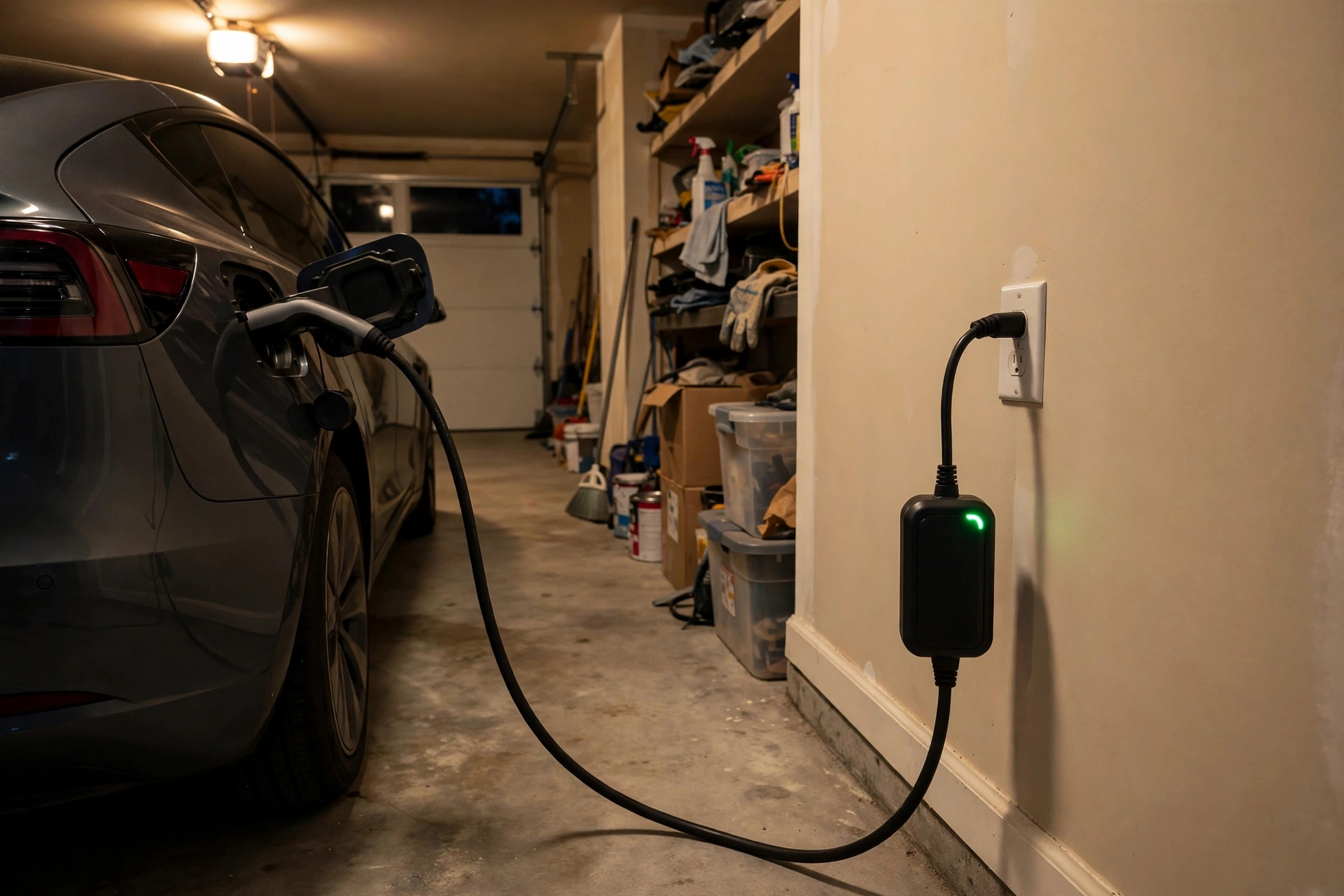
The cheapest home charging setup in the world is the one already hanging on your garage wall. A level 1 ev charger is not a wall box, not an installation project, and not really a product category at all. It is a portable cord that plugs into an ordinary 120-volt outlet, the same outlet that runs a lamp or a phone charger, and feeds your car a slow, steady trickle of power. For the right driver, it is genuinely all you need. For the wrong driver, it is a daily frustration that ends — expensively and inevitably — in a Level 2 installation anyway.
One clarification before anything else, because the terminology causes real confusion at dealerships. The charger is inside your car. The box built into the vehicle, called the onboard charger, converts AC power from the wall into DC power the battery can store. The cord you hold is EVSE — electric vehicle supply equipment. It is a smart, safety-checked extension of the outlet: it confirms the connection is sound, tells the car how much current it may draw, and cuts power instantly if it detects a ground fault. That is why the brick on the cord matters, and why a plain hardware-store cable is never a substitute.
The numbers are fixed by physics and by the electrical code, not by brands. A standard North American outlet on a 15-amp circuit may only be loaded to 80 percent of its rating for a continuous draw, and EV charging is the textbook definition of a continuous draw. That gives you 12 amps: 120 volts × 12 amps = 1.44 kilowatts.
On a 20-amp circuit, the same rule allows 16 amps, or 1.92 kilowatts. The U.S. Department of Energy’s Alternative Fuels Data Center puts the result at roughly 3 to 5 miles of range added per hour of charging, and you can read its full guidance in the DOE’s Charging Electric Vehicles at Home overview. No cord, however expensive, beats those figures by more than a rounding error.
So the honest question is not which cord to buy. The question is whether 3 to 5 miles an hour covers the driving you actually do. The U.S. Environmental Protection Agency notes that many drivers with commutes under 40 miles a day find Level 1 charging sufficient to meet their daily needs overnight, and federal travel surveys put the average American driver’s day at roughly 37 miles (est., based on Federal Highway Administration travel data). If your real day looks like the average day, this humble cord keeps up. If it doesn’t, no buying decision inside this category will save you — and knowing that before you spend anything is the entire point of this guide.
What a Level 1 EV Charger Adds Overnight, In Real Numbers
Let’s run the arithmetic on a car millions of people own. Take a Tesla Model 3 at its EPA rating of about 25 kWh per 100 miles — 4.0 miles of range for every kilowatt-hour stored. Plug in at 7 p.m., unplug at 5 a.m. That is 10 hours at 1.44 kW, which is 14.4 kWh pulled from the wall. Charging is not lossless; figure roughly 15 percent lost to conversion and the car’s own systems while it charges (est., consistent with published efficiency measurements for 120-volt charging). Around 12.2 kWh reaches the battery. Multiply: 12.2 × 4.0 = roughly 49 miles of range by breakfast.
On the 20-amp circuit, the same night looks better. 10 hours × 1.92 kW = 19.2 kWh from the wall, about 16.3 kWh stored after the same losses, which is close to 65 miles in that same Model 3. That difference is the single most useful upgrade available to a level 1 ev charger setup, and it costs nothing if your garage already has a 20-amp receptacle — many do. Check the breaker box before you check any product listings.
Now the other end of the scale, because battery size changes everything. Ford’s own figures are blunt about it: the F-150 Lightning with the extended-range battery needs about 95 hours to charge fully on Level 1, and Ford rates its Mobile Power Cord at 12 amps on a 120-volt outlet, adding roughly 3 miles per hour to a Mustang Mach-E. You can see the context on Ford’s official home-charging page. A 131 kWh truck battery on a 1.44 kW trickle is not a charging plan; it is a science experiment. Owners of big-battery trucks and SUVs should read the rest of this guide as an explanation of why their included cord lives in the frunk for emergencies.
Who This Setup Genuinely Covers — And Who It Quietly Fails
The drivers Level 1 serves well share one trait: their cars sit parked, near an outlet, for long stretches. Retirees, remote workers, second-car households, and anyone whose round trip stays under about 40 miles can run this way for years. The habit that makes it work is simple discipline. You plug in every single night, not only when the battery looks low, because the system’s whole margin is built on never falling behind.
Plug-in hybrids are the strongest case of all. A PHEV battery of 8 to 18 kWh refills from empty in roughly 6 to 13 hours on the standard 12-amp setting, which means even the slowest cord in this guide takes a Prius Prime or a RAV4 Prime from flat to full between dinner and dawn. For a PHEV owner, paying for a Level 2 installation to save three hours the car spends asleep anyway is money spent on nothing.
Renters deserve a straight answer too. If your lease forbids electrical work — most do — a level 1 ev charger is often the only home charging legally available to you, and it is far better than relying on public chargers alone. What you need from your landlord is written permission to use an exterior or garage outlet, a weatherproof in-use cover on that outlet, and a cable route that nobody trips over at night. Ask. Plenty of landlords say yes to a 12-amp draw that costs about twenty cents an hour in electricity.
Where it fails is variance. A 35-mile daily average with a weekly 110-mile Saturday is not a 35-mile pattern; it is a pattern with a hole in it that takes two full nights to refill. Two EV households sharing one outlet fail the same way. Shift workers with short turnarounds fail. Anyone whose job can produce a sudden 150-mile day fails. The cord does not care about your intentions; it replaces about 49 miles a night, and it keeps its own ledger.
Level 1 EV Charger Safety Rules You Should Not Bend
Twelve amps sounds trivial until you remember the load runs for ten hours straight, every night, for years. Residential outlets were not designed with that duty cycle as the default assumption, so the safety rules for a level 1 ev charger are specific and, frankly, not negotiable.
Give it a dedicated circuit. Article 625 of the National Electrical Code treats EV charging as a continuous load and expects the branch circuit to serve the EVSE, not the EVSE plus a freezer, a space heater, and a garage fridge. Shared loads are the number-one cause of the nuisance breaker trips that fill owner forums. If the breaker trips twice in a week, the circuit is telling you something. Listen to it.
Inspect the outlet like it matters, because it does. The receptacle should grip the plug prongs firmly; a plug that droops or slides out easily is a worn outlet, and worn contacts plus ten hours of current equals heat. Scorch marks, discoloration, warmth on the faceplate, or a buzzing sound all mean stop and replace the receptacle — a commercial-grade replacement costs roughly $15 to $60 (est., parts only, checked October 25, 2026) and an electrician’s visit to fit it is cheap insurance. Older homes deserve extra suspicion here, particularly any outlet fed by wiring you cannot identify.
No extension cords. No power strips. No exceptions. Every major automaker’s manual says the same thing: plug the EVSE directly into the wall. Extension cords are not rated for this continuous load, their connections sit unprotected on the floor, and they defeat the temperature sensing built into many EVSE plugs. If the cord will not reach, move the car or have an electrician move the outlet. This is the rule people break most and regret most.
Use the protection that is already built in. The brick on the cord includes ground-fault protection (a CCID device), and garage and outdoor outlets should have GFCI protection under current code. Buy only cords listed by a recognized testing laboratory — look for UL or ETL marks. An unlisted no-name cordset from a discount marketplace, running at its thermal limit all night, is the one purchase in this entire category that can genuinely hurt you.
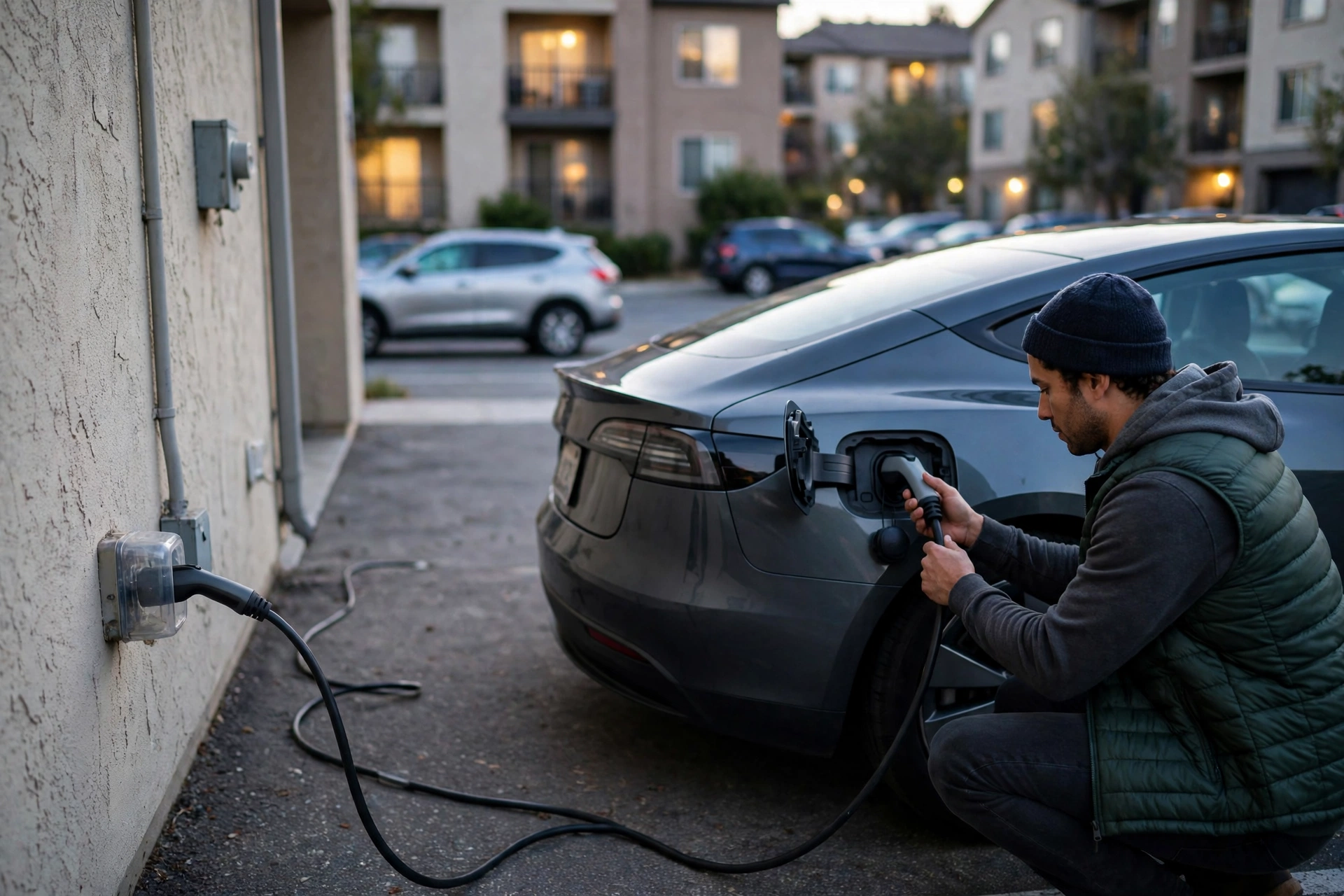
J1772, NACS, and the Plug on the End of the Cord
Two connector standards share the North American fleet, and your cord has to match your car’s inlet — or carry an adapter. The SAE J1772 plug has been the standard inlet on nearly every non-Tesla EV sold in North America for a decade. Tesla used its own connector, which the industry has since adopted and standardized as SAE J3400, universally called NACS. From 2025 onward, Ford, GM, Rivian, and most other brands have been shipping vehicles with native NACS inlets, so the fleet is mid-transition and will be for years.
Practically: a Tesla owner buying a spare cord needs a NACS cordset or a J1772 cordset plus the adapter Tesla includes with the car. A Mach-E or Bolt owner whose next car will have a NACS inlet should know that quality adapters run about $85 to $200 (est., checked October 25, 2026) and work in both directions for AC charging. Adapters are safe when they are listed and rated for the current; they are not the place to save twenty dollars.
One more buying point, stated plainly: do not pay a premium for a smart Level 1 cord. An app, a usage graph, and Wi-Fi scheduling add nothing when the circuit itself is the bottleneck, and your car already has charge scheduling built in. Spend $0 by using the cord in the trunk, or $150 to $300 (est., checked October 25, 2026) on a listed spare from a known brand — Tesla’s Mobile Connector sits around $250 in that range — and put whatever you saved toward the things in the safety section above.
Cold Weather: Where the Trickle Nearly Stops
Here is the limitation that surprises northern owners every January. A cold battery must be warmed before it will accept a charge at full rate, and the energy for that warming comes from the same 1.44 kW the outlet is supplying. In one widely cited test of a Tesla Model Y charging at 12 amps in a 37 °F garage, roughly 1 kW of the available 1.4 kW was going to battery heating — about two-thirds of everything the wall provided. The car was, in effect, running a small space heater with a minor sideline in charging.
Drop the temperature further and the arithmetic turns bleak. At sustained temperatures below about 0 °F, a level 1 ev charger may add range so slowly that the session is mostly defensive — holding the pack warm and preventing overnight losses rather than recovering miles. Drivers in genuinely cold climates who park outdoors should treat Level 1 as a fair-weather solution and read our analysis of how much range EVs lose in winter before deciding it will carry them through February. Garaging the car, even in an unheated garage, recovers a meaningful share of the loss; so does timing the charge to finish just before departure, when the pack is already warm from the session.
Level 1 EV Charger vs. Level 2: The Cost Math Nobody Shows You
The cord costs almost nothing. A Level 2 installation, charger included, typically runs $900 to $1,800 (est., based on 2026 national installer averages, checked October 25, 2026). The obvious question is whether the expensive option ever pays for itself, so let’s do the payback honestly, in both directions.
Scenario one: you drive 35 miles a day, 340 days a year — 11,900 miles. At 4.0 miles per kWh, your battery takes in 11,900 ÷ 4.0 = 2,975 kWh a year. On Level 1 at roughly 85 percent wall-to-battery efficiency (est.), you buy 2,975 ÷ 0.85 = 3,500 kWh. On Level 2 at roughly 92 percent (est.), you buy 2,975 ÷ 0.92 = 3,234 kWh.
The difference is 266 kWh a year; at a typical U.S. residential rate of $0.17 per kWh (est.), Level 2 saves you about $45 a year in losses. A $1,200 installation divided by $45 is a 26-year payback. On efficiency alone, Level 2 never pays. Anyone who tells you otherwise is selling installations.
Scenario two flips the answer. Suppose you drive 55 miles a day. Level 1 replaces about 49 of them, so you drift behind roughly 40 miles a week, and you cover that with one public DC fast-charging stop: about 10 kWh a week won’t do it — call it 25 kWh a week once the deficit and the detour are counted.
Public fast charging at roughly $0.48 per kWh (est.) versus $0.17 at home is a $0.31 penalty on 25 kWh, times 50 weeks: about $388 a year. Now the $1,200 installation pays back in just over three years, and it also returns your Sunday evenings. The variable that decides everything is not the charger. It is whether the trickle covers your miles.
Run your own numbers before you call anyone. Our EV charger sizing calculator will tell you what circuit size your actual driving pattern calls for, and method matters more than opinion here — the way we break down charging from a regular outlet follows the same nightly-miles test used throughout this guide.
Our Verdict and Scores
Our score: 7/10 for a level 1 ev charger as a home setup — with the sharpest split between sub-scores of anything we rate. Speed: 3/10, because 1.44 kW is 1.44 kW. Convenience: 9/10, because the installation is a wrist movement. Value: 10/10, because the correct price for this equipment is the $0 you already paid when the cord came with the car.
Scored by driver, the picture sharpens. Plug-in hybrid owners: 9/10 — this is your charger, full stop. Drivers under 40 miles a day with a garage: 8/10. Renters with a cooperative landlord: 8/10, and a lifeline compared with public charging alone. Two-EV households: 4/10, workable only with genuine scheduling discipline. Anyone commuting more than 50 miles a day, or driving a large-battery truck: 3/10, and our advice is to stop comparison-shopping cords and get Level 2 quotes this week. A premium Level 1 purchase is the worst buy in home charging — all of the slowness, none of the free.
Judged on that nightly-miles test, a level 1 ev charger is an honest, low-cost starting point for many drivers, and a level 1 ev charger remains easy to live with as long as it keeps pace with your routine.
Frequently Asked Questions
Do I need an electrician to install a level 1 ev charger?
No installation exists to hire out — you plug the cord into a standard grounded 120-volt outlet. An electrician is still worth one visit if your outlet is old, loose, or on a circuit shared with heavy loads, because a receptacle swap and a circuit check are inexpensive and the load runs all night. If you later upgrade, that same visit tells you what a Level 2 circuit would require.
How long does a full charge take on Level 1?
For a typical 60 kWh battery, roughly 40 to 50 hours from empty — about two days. Smaller cars and plug-in hybrids finish far sooner, often in 5 to 13 hours. Large trucks sit at the extreme: Ford quotes about 95 hours for a full charge of the extended-range F-150 Lightning on its Mobile Power Cord.
Can I use an extension cord if the outlet is too far away?
No. Automaker manuals prohibit it, cords are not rated for a continuous 12-amp load over many hours, and the connection points introduce heat and fault risks the EVSE cannot monitor. Reposition the car, or have an outlet installed where the car actually parks.
Will charging this slowly damage my battery?
No — the opposite. Low-power AC charging is gentle: it generates little heat and stresses the cells minimally, and battery researchers consistently rank it among the kindest ways to charge. Follow your manufacturer’s guidance on daily charge limits (many suggest 80 to 90 percent for nickel-based packs, with periodic full charges for LFP packs), and the slow cord is a non-issue for longevity.
Is Level 1 enough for a plug-in hybrid?
Yes, and it is the use case where the answer is not even close. PHEV batteries are small enough — generally 8 to 18 kWh — that the standard cord refills them completely overnight, every night, including a full recharge after a day that emptied the pack. Most PHEV owners who install Level 2 do so for a future full EV, not for the car in the driveway.
What happens if my breaker keeps tripping?
The circuit is overloaded or the outlet is failing, and the breaker is doing its job. Unplug, move nothing else onto that circuit, and check whether a fridge, freezer, or heater shares it. Repeated trips after that mean an electrician, not a bigger breaker — never upsize a breaker without upsizing the wiring it protects.
As a closing check, a level 1 ev charger is worth keeping if it covers your daily miles without extra stops, a level 1 ev charger that falls behind week after week is the clear signal to price a Level 2 installation, and a level 1 ev charger should be judged again whenever your commute, parking, or driving pattern changes, so keep a level 1 ev charger only while it still fits your routine.