Last updated: October 27, 2026
Right. Gloves off. The cycle electric motor is the most mis-sold component on any electric bike. Brands print a peak watt figure measured over a few seconds, torque numbers your legs never feel through the gearing, and “1,000 W” stickers on hub motors that cook their own planetary gears by August. So this guide runs like a referee, not a brochure. Every motor layout and every named system gets scored as we go, out of ten, on torque delivery, efficiency and value. The scoring method is the one set out on our research page, and every specification below comes from the manufacturer’s own published data, checked October 27, 2026.
Think a score is wrong? The numbers are all on the table. Argue with those.
Every cycle electric motor you will ever meet belongs to one of two families. A hub motor lives inside the front or rear wheel and pushes the wheel directly. A mid-drive sits at the bottom bracket and pushes the chain, which means it borrows the bike’s own gears. That single architectural choice decides hill manners, weight distribution, tyre changes and half of everything else in this guide. Round one is the families. Round two is the famous names. Keep score.
Geared hub motors hide a small electric motor and a set of planetary gears — usually nylon or steel — inside a fat hub shell. The gears let a physically small motor spin fast and still produce usable torque, and a clutch lets the wheel freewheel when the power is off, so the bike pedals like a bike.
Typical outputs run 250–750 W, weights sit around 3–4.5 kg (est., based on published kit weights), and this is the layout under most budget and commuter e-bikes. Weaknesses: those little gears are a wear item, the motor cannot use your gearing, and heat has nowhere to go. Scored as a commuter motor: Our score: 6.9/10 — Torque delivery 6/10 · Efficiency 7/10 · Value 8/10. It wins on price and simplicity. Nothing else.
Direct-drive hub motors delete the gears entirely: the axle is the motor shaft, the magnets line the shell, and the whole wheel is the motor. Silent, almost nothing to wear out, and capable of regenerative braking. The bill arrives in weight — commonly 5–9 kg (est.) for the big ones — and in behaviour. With one fixed “gear,” a direct-drive is lazy off the line and fades badly on long climbs, where low speed means low efficiency and high heat. As a hill motor it loses, clearly: Our score: 6.4/10 — Torque delivery 5/10 · Efficiency 6/10 · Value 7/10. Fine on flat ground at steady speed. That is a narrower talent than the sales pages suggest.
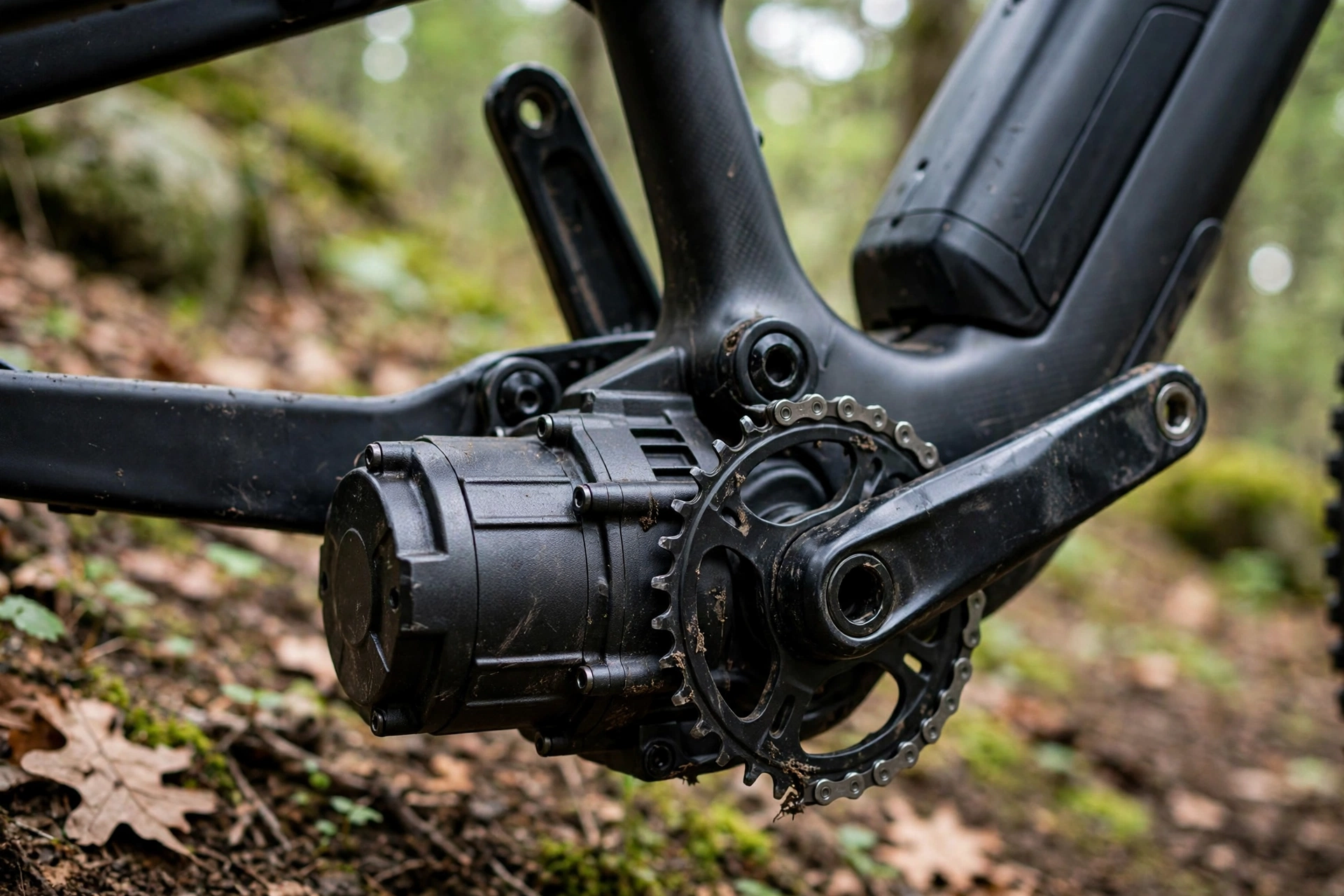
The mid-drive cycle electric motor: gears are a cheat code
A mid-drive feeds its power through your chain and cassette, so dropping to the big rear cog multiplies the motor’s torque exactly as it multiplies your legs. That is why an 85 Nm mid-drive walks up climbs that strangle a nominally stronger hub motor: it is not stronger, it is better geared. The weight also sits low and central, inside the frame triangle, so the bike still steers like a bicycle instead of a wheelbarrow. Wheel removal stays normal, tyre changes stay easy, and the motor works in its efficient high-rpm band almost everywhere.
The honest costs: your chain, cassette and chainring wear faster under doubled torque, a mid-drive bike costs more, and if the motor dies the bike is a heavy acoustic bicycle with a very expensive paperweight at its centre. None of that overturns the verdict. On any route with a gradient worth naming, the mid-drive layout wins the round 10–8, and for trail riding there is no serious argument left. Every flagship system in the head-to-head below is a mid-drive. That is not a coincidence.
Watts and newton-metres: what a cycle electric motor’s numbers actually decide
Two numbers run this sport, and marketing departments abuse both. Torque, in newton-metres, is twisting force at the crank. It decides how hard the bike shoves off the line and whether it keeps moving on a 20% ramp. Power, in watts, is torque multiplied by how fast the crank spins. It decides speed. Here is the part the stickers hide: nearly every legal system here carries a 250 W rated continuous output, because that is the regulatory class, while its short-burst peak is 500–1,000 W. The peak is a sprint. The rating is the marathon.
Bosch’s support percentages make the same point in friendlier language: 340% support means your 100 W of leg power calls up 340 W of motor, for 440 W in total.
Now the maths every cycle electric motor has to survive. Take a 200 lb rider-and-bike combination — 90.7 kg — on a 10% grade at 10 mph. Gravity alone demands 90.7 × 9.81 × 0.44 m/s of climbing speed ≈ 396 W. Rolling resistance adds roughly 24 W, air about 12 W (est.), and drivetrain losses around 5%. Total at the cranks: roughly 455 W. If your legs contribute a strong, sustainable 150 W, the motor must hold about 305 W continuously for the entire climb. Any full-power mid-drive below clears that bar on paper. Whether it clears it at minute twenty, hot and bothered, is the thermal question coming later — and it separates the champions from the sticker bikes.
The referee’s favourite stat is torque per kilogram of motor, because it exposes packaging talent. The arithmetic, using each maker’s published torque and weight:
| System | Torque | Weight | Nm per kg |
|---|---|---|---|
| DJI Avinox M1 | 105 Nm | 2.52 kg | 105 ÷ 2.52 = 41.7 |
| Bosch CX, 120 Nm upgrade | 120 Nm | 2.8 kg | 120 ÷ 2.8 = 42.9 |
| Specialized 3.1 | 101 Nm | ~2.9 kg (est.) | 101 ÷ 2.9 = 34.8 (est.) |
| Shimano EP801 | 85 Nm | 2.7 kg | 85 ÷ 2.7 = 31.5 |
| TQ HPR60 | 60 Nm | 1.9 kg | 60 ÷ 1.9 = 31.6 |
| Yamaha PW-X3 | 85 Nm | 2.75 kg | 85 ÷ 2.75 = 30.9 |
| Bafang M620 Ultra | 160 Nm | 5.3 kg | 160 ÷ 5.3 = 30.2 |
Read that table twice. The biggest torque number in the sport, Bafang’s 160 Nm, produces a mid-pack score once its 5.3 kg of cast metal enters the ring. And Bosch, the supposed conservative, tops the chart the moment its own free software upgrade is switched on. Hold both thoughts for the head-to-head.
The big systems, head-to-head
Six cycle electric motor systems matter in 2026: five factory mid-drives fighting over premium bikes, and one Chinese heavyweight fighting the rulebook. Scores first, excuses after.
DJI Avinox M1. The drone company’s drive unit rewrote the class: 105 Nm and 850 W of peak power from 2.52 kg, with a Boost mode that serves 120 Nm and 1,000 W for 30 seconds at a time. Polymer gears keep it eerily quiet, the 800 Wh battery is light for its size, and the tuning app is genuinely good. The catch is availability — it ships on Amflow bikes and a slowly growing list of partners, and the dealer network behind it is young. Our score: 9.2/10 — Torque delivery 10/10 · Efficiency 9/10 · Value 7/10. On pure numbers, this is the current champion.
Bosch Performance Line CX (Gen 5). As shipped, the CX makes 85 Nm, 600 W peak and 340% support from a 2.8 kg magnesium case. Then Bosch did something no referee expected: it gave the power away. A free performance upgrade lifts the CX to 100 Nm and 750 W, and Bosch’s own performance upgrade page documents the 2026 step to as much as 120 Nm with support up to 600% at low speed — though the bike brand may cap the ceiling at the factory, so check your specific model. Add the deepest dealer network in the business and this is the ownership pick. Our score: 9.0/10 — Torque delivery 9/10 · Efficiency 9/10 · Value 8/10.
Specialized 3.1 (built with Brose). The standard unit makes 101 Nm and 666 W peak; the S-Works tune makes 111 Nm and 720 W, on identical hardware — you are buying firmware, so score the value line accordingly. Specialized dropped the old belt drive for full-metal gears and encapsulated windings, aimed squarely at the heat and reliability complaints of the previous generation, and pairs it with a big 840 Wh battery. Superb delivery at every cadence. It only comes inside a Levo, at Levo money. Our score: 8.8/10 — Torque delivery 9/10 · Efficiency 8/10 · Value 6/10.
Yamaha PW-X3. Yamaha invented this category in 1993 and the PW-X3 is its quiet masterpiece: 85 Nm, 2.75 kg, the narrowest Q-factor in the class at 128 mm, and torque available the instant your foot touches the pedal, before the crank has even turned. Independent testers consistently describe Yamaha units as the reliability benchmark of the industry, and nothing in the spec sheet contradicts them. No headline-grabbing peak figure, no drama. Our score: 8.4/10 — Torque delivery 8/10 · Efficiency 8/10 · Value 8/10.
Shimano EP801. Shimano’s flagship matches the old guard at 85 Nm and 600 W peak, weighs 2.7 kg in magnesium, and counters with the best tuning ecosystem: E-Tube lets you reshape the assistance character in real detail, and brands may fit third-party batteries — Canyon’s 900 Wh pack being the famous example. Shimano’s own EP801 and EP6 comparison table shows the value play clearly: the EP6 keeps the same 85 Nm with 500 W peak and a 3.0 kg aluminium case, and costs far less on finished bikes. The EP801 itself feels a generation behind on raw shove now. Our score: 8.2/10 — Torque delivery 7/10 · Efficiency 9/10 · Value 8/10.
Bafang M620 Ultra. One thousand watts, 160 Nm, a torque sensor, and enough grunt to tow a trailer up a ski slope. Also 5.3 kg, chains treated as consumables, and a legal problem: at 1,000 W with throttle drive it fits none of the three US e-bike classes, whatever the listing claims — our Class 1 e-bike guide lays out exactly where those class lines sit. Judged purely as machinery it is a brute bargain. Judged as a bicycle motor, it is competing in the wrong sport. Our score: 7.6/10 — Torque delivery 10/10 · Efficiency 6/10 · Value 9/10.
Torque sensor or cadence sensor: the cycle electric motor’s split personality
The sensor is the motor’s referee, and it decides ride feel more than any watt figure. A torque sensor measures how hard you are pushing — Bosch samples pedal input over 1,000 times per second — and matches it proportionally. Push harder, get more. It feels like stronger legs, it sips the battery because the motor only works when you do, and on technical climbs it meters out traction instead of wheelspin. A cadence sensor is a switch wearing a sensor’s clothes: it notices the cranks turning and delivers a preset slab of power, arriving late and leaving later. You will feel the surge at junctions and the ghost-push when you meant to roll gently.
My call, and it is not close: once you have ridden a good torque-sensing system, a cadence-sensor bike feels broken, and there is no going back. Cadence sensing survives for one legitimate reason — it costs almost nothing — and on a flat, cheap, throttle-assisted runabout that reason is good enough. Everywhere else, pay for the torque sensor. The scorecard agrees with itself here: every system above 8/10 in this guide measures your effort. Every budget hub that scored under 7 guesses at it.
Heat: where the peak numbers go to die
Heat is the tax collector inside every cycle electric motor. Electrical losses become warmth; warmth raises resistance; the controller protects the windings by cutting output. That is derating, and it is why your mate’s bike felt heroic at the trailhead and ordinary at the summit. DJI is admirably honest about it — Boost mode’s 120 Nm and 1,000 W are specified for 30 seconds.
Independent dyno testing, including emtb-test’s measured comparison of the updated Bosch against the Avinox, shows sustained outputs clustering far below the brochure peaks, with the two motors nearly inseparable at real climbing inputs. Hub motors suffer worst: a sealed shell, minimal airflow, and on geared units a small motor working hard at low wheel speed, exactly where efficiency collapses.
So here is the rule I score by, and you should shop by: judge a motor on its twenty-minute number, not its thirty-second number. Ask what it holds on a long climb, in summer, with a heavy rider. The brands will not print that figure. The test sites measure it. Read them before you read the stickers.
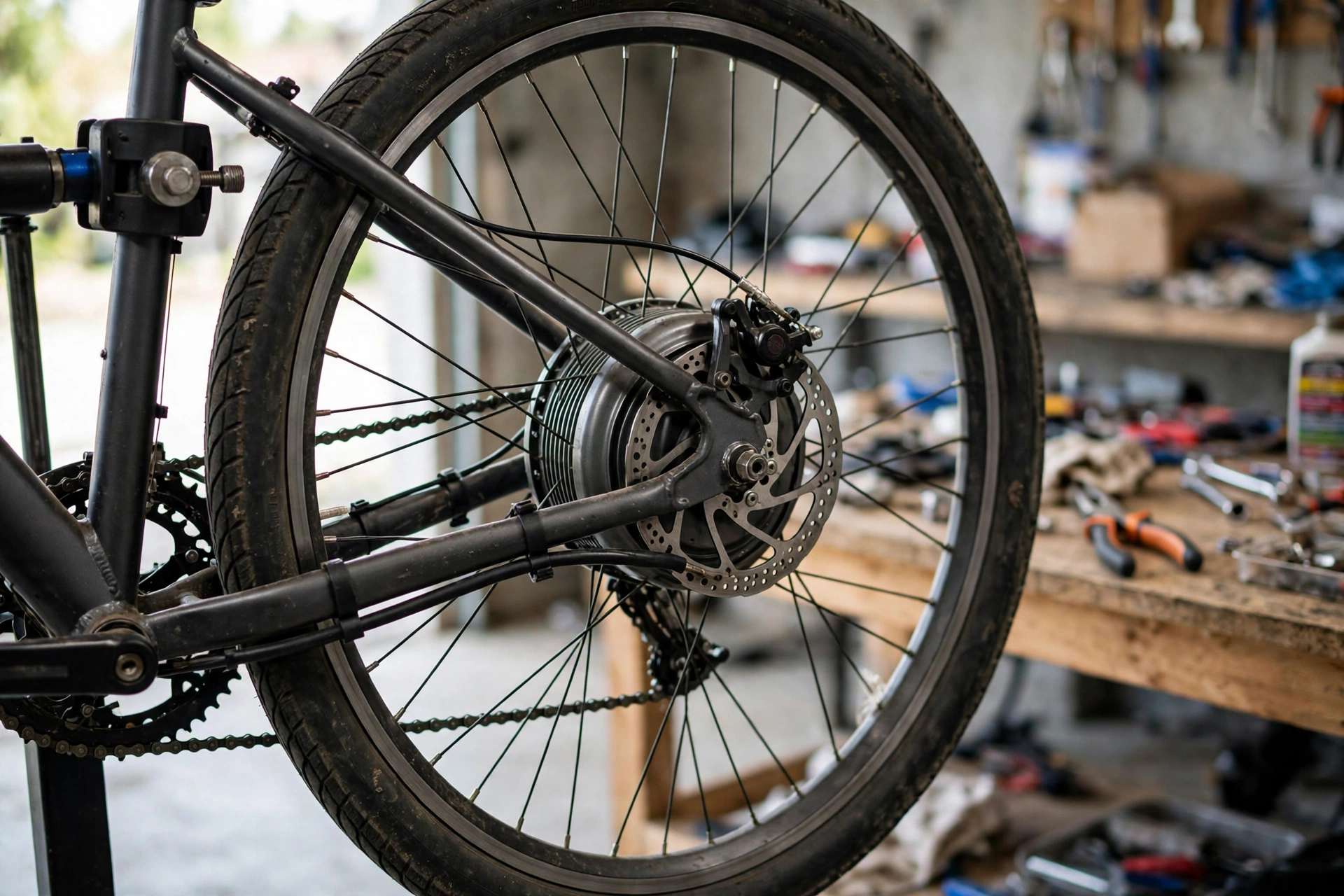
Retrofit kits: a cycle electric motor for the bike already in your shed
The honest case for a conversion kit: you own a good frame, you like its fit, and a factory mid-drive bike costs three times the kit. The Bafang BBS series is the default answer — the 750 W BBS02B kit sells from about $315 and BBSHD kits around $550–$750 (est., based on US marketplace listings checked October 27, 2026, battery always extra).
Both are cadence-sensed with a throttle, which tells you exactly where they sit in the sensor round above. The Tongsheng TSDZ series is the connoisseur’s pick at similar money (est.), because it torque-senses and feels like a factory system. Bafang’s M620 is not a bolt-on kit in any normal sense; it needs a frame built around its dedicated mount.
Now the penalties, because kits collect them. Your old brakes become the weakest component on a bike that is suddenly 8–10 kg heavier and twice as powerful. Rim brakes and a 1,000 W kit are a disqualification, full stop. Hub kits need torque arms on the dropouts.
Battery quality varies from certified to bonfire, so buy a pack with named cells and a matched charger — and check the pairing properly with a tool like our EV charger compatibility checker before anything gets plugged into anything. Finally, the legal score: a 750 W kit with a throttle generally lands outside Class 1 and 2 definitions in strict states, and land managers judge the bike in front of them, not your invoice. Build honestly, ride it where it belongs.
The referee’s final card
Category winners, no appeals. Best numbers: DJI Avinox — 41.7 Nm per kilogram with manners. Best ownership bet: Bosch CX — the free upgrades, the dealer network, the resale value. Best feel: Yamaha PW-X3, the connoisseur’s motor. Best value factory system: Shimano EP6 bikes, same 85 Nm, less money. Best DIY route: a torque-sensing Tongsheng kit on a sound frame with disc brakes. And if your definition of performance starts with outright speed rather than climbing force, that is a different contest entirely — our fastest e-bike guide scores it. Whatever you choose, choose the motor first and the frame colour last. The motor is the bike. Everything else is luggage.
Cycle electric motor questions, answered straight
What is the strongest cycle electric motor I can buy on a legal e-bike?
By torque per kilogram, the DJI Avinox at 105 Nm (120 Nm in short Boost bursts), with the Bosch CX at up to 120 Nm after its 2026 performance upgrade — subject to the bike brand’s factory cap. Bafang’s 160 Nm M620 out-torques both, and also out-classes the law: at 1,000 W it is not a Class 1, 2 or 3 system.
Is more torque always better?
No. Past roughly 85–100 Nm, returns shrink fast for most riders: front wheels lift, rear tyres break traction, and chains and cassettes wear at motorcycle rates. Torque you cannot deploy is a maintenance bill wearing a medal.
Hub or mid-drive for a hilly commute?
Mid-drive, and it is not a debate I am willing to stage. The gearing multiplies torque on the climb and the motor stays in its efficient band. A geared hub copes with gentle city grades. Sustained 10% work is mid-drive territory.
Why does my motor feel weaker near the top of long climbs?
Thermal derating. The controller is protecting the windings and magnets by trimming output as temperatures climb. It is normal, it affects every brand, and it is exactly why sustained figures matter more than peak figures.
Can I fit a mid-drive kit to any bike?
Most Bafang BBS kits suit standard 68–73 mm threaded bottom-bracket shells. Carbon frames, press-fit shells and integrated downtube designs are generally out. Check shell width and chainline before ordering, and budget for stronger brakes in the same order.
Do these motors wear out?
The brushless core has no brushes to consume; bearings, seals and gear sets are the wear items. Nylon planetary gears inside geared hubs are a service part. Sealed factory mid-drives from Bosch, Shimano and Yamaha routinely outlast the bike’s first two owners — one more reason the second-hand market prices them calmly.