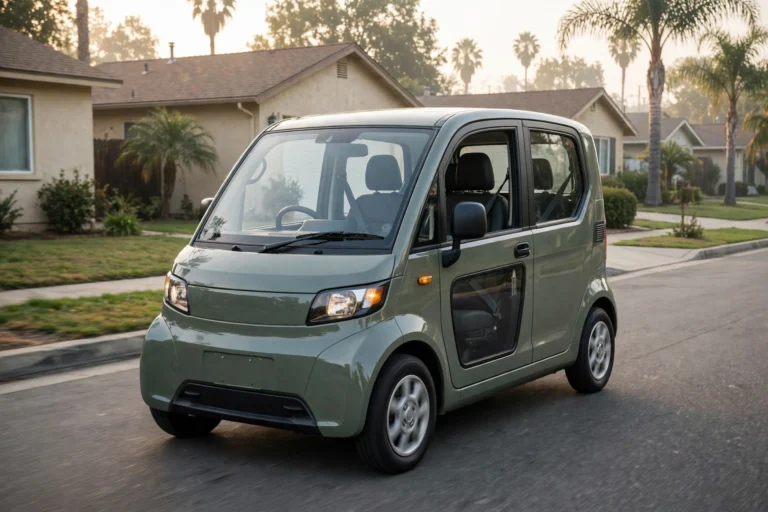
Last updated: October 27, 2026
Verdict first, because that is the order that matters. If you want a golf cart street legal from the day it arrives, buy a factory-built low-speed vehicle with a real 17-digit VIN. Buy the Bintelli Beyond 4 if value leads your list. Buy the GEM e4 if range and dealer cover lead it. Do not buy a standard cart, bolt on a lights kit, and call it done. The kit adds lamps and mirrors. It does not add a title, a federal certification label, or resale value.
Below: the short legal version, the kit trap, scores for the models worth your money, the seven checks that decide this purchase, and the three-year cost maths. Prices were checked on October 27, 2026, against manufacturer pages and dealer listings, following our research method.
One term needs killing off before anything else. “Street legal” is not a trim level. It is not an accessory pack. It is a federal vehicle class. A low-speed vehicle, LSV for short, is built to Federal Motor Vehicle Safety Standard 500, carries a VIN like any car, and gets titled, plated and insured like any car. A golf cart is none of those things. It is sports equipment with a steering wheel. A golf cart street legal claim that cannot point to a VIN is marketing, not law. Sellers blur that line on purpose, because a $400 light kit sounds cheaper than a $13,000 vehicle.
Keep the line sharp and the rest of this decision gets easy.
Second verdict, just as blunt. If your ordinary route needs a road posted above 35 mph, close this page and buy a used car instead. Every vehicle below is capped at 25 mph by federal rule. That cap is not a suggestion, a setting, or a dealer unlock away from 40. It is the class. An LSV earns its keep on short hops inside a neighbourhood, a beach town, a campus or a retirement community where the limit is 35 or less. Ask it to mix with 45 mph traffic and you have bought the wrong tool, however nice the seats are.
The shortlist, then. Four factory models cover nearly every honest use case. The Bintelli Beyond 4 starts at $12,995 and loads in the kit rivals charge extra for. The ICON i40X lists at $12,295 for 2026 with lithium standard. The Club Car Onward 4 Forward LSV starts at $14,999 with the strongest name in carts behind it. The GEM e4 starts at $17,490 and runs away from the field on range and dealer depth. Club Car’s CRU also exists, at roughly $25,000, and gets its own short verdict below. Scores come after the legal section, because in this class legality comes first.
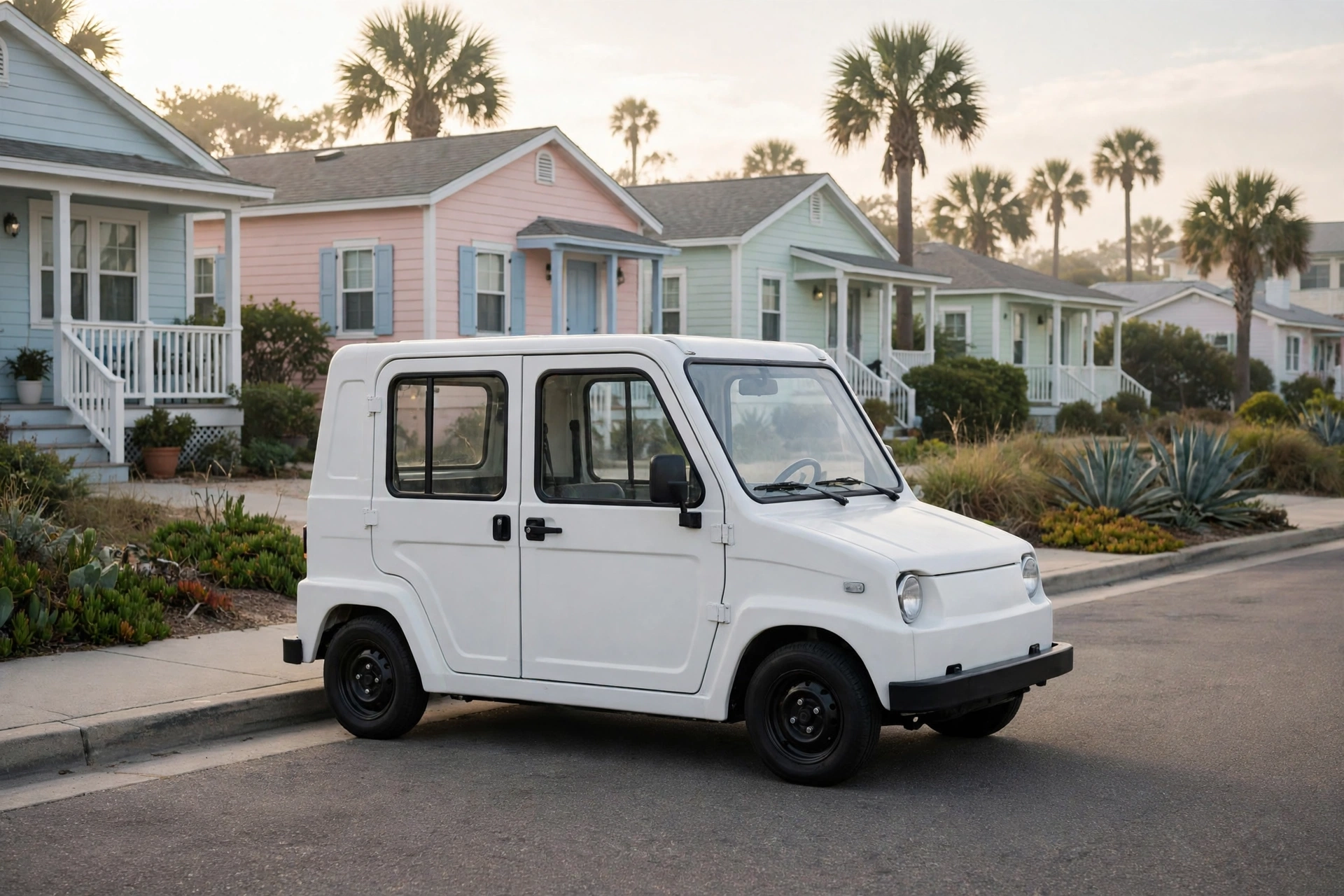
Golf cart street legal, defined in one short section
Federal law draws the box. Under FMVSS 500, an LSV is a four-wheeled vehicle that runs more than 20 mph and no more than 25 mph on a flat paved surface, with a gross vehicle weight rating under 3,000 lb. The required equipment is fixed: headlamps, tail and stop lamps, turn signals, reflex reflectors, mirrors, a parking brake, a safety-glass windshield, seat belts at every seat, a backup camera, and a VIN that conforms to federal rules. NHTSA sets the standard and manufacturers self-certify against it. No airbags. No crash-test regime. That is the deal this class makes, and 25 mph is the price of it.
The states take it from there. Titling, registration, plates, insurance and the driver’s licence are state business, and most states allow LSVs on roads posted at 35 mph or less. A few states still have no LSV statute on the books, and cities and HOAs can restrict further. So the federal label gets a vehicle built; your state and your street decide whether it can work. The NHTSA interpretation letters on low-speed vehicles spell out where the federal line sits if you want the primary source. Check your state before you spend a dollar. Not after.
A factory LSV is not a cart with a kit on it
Here is the gap sellers hope you never price. A basic street legal kit for a normal cart runs $300 to $800 and covers lights, mirrors, belts and a horn. A full professional conversion, with the speed work, DOT windshield and paperwork some states demand, lands between $1,500 and $4,000 in parts and labour, and $2,000 to $4,500 by the time the cart is titled, plated and insured. Plenty of owners have done it. Some states title conversions cleanly. Many do not.
The hard problem is the VIN. Only a manufacturer holding an NHTSA-assigned maker code, or a state DMV in narrow rebuilt-vehicle cases, can issue one. A plain cart carries a serial number, and a serial number is not a VIN. No VIN means no title in most states. No title means no plate. No plate means your “street legal” cart is a lawn ornament with indicators. Factory machines skip the entire fight: the VIN, the manufacturer’s certificate of origin and the certification label arrive with the vehicle.
If a seller offers you a converted cart, accept one thing only: a title already issued, in the seller’s name. Anything less is a story, and stories do not transfer at the DMV.
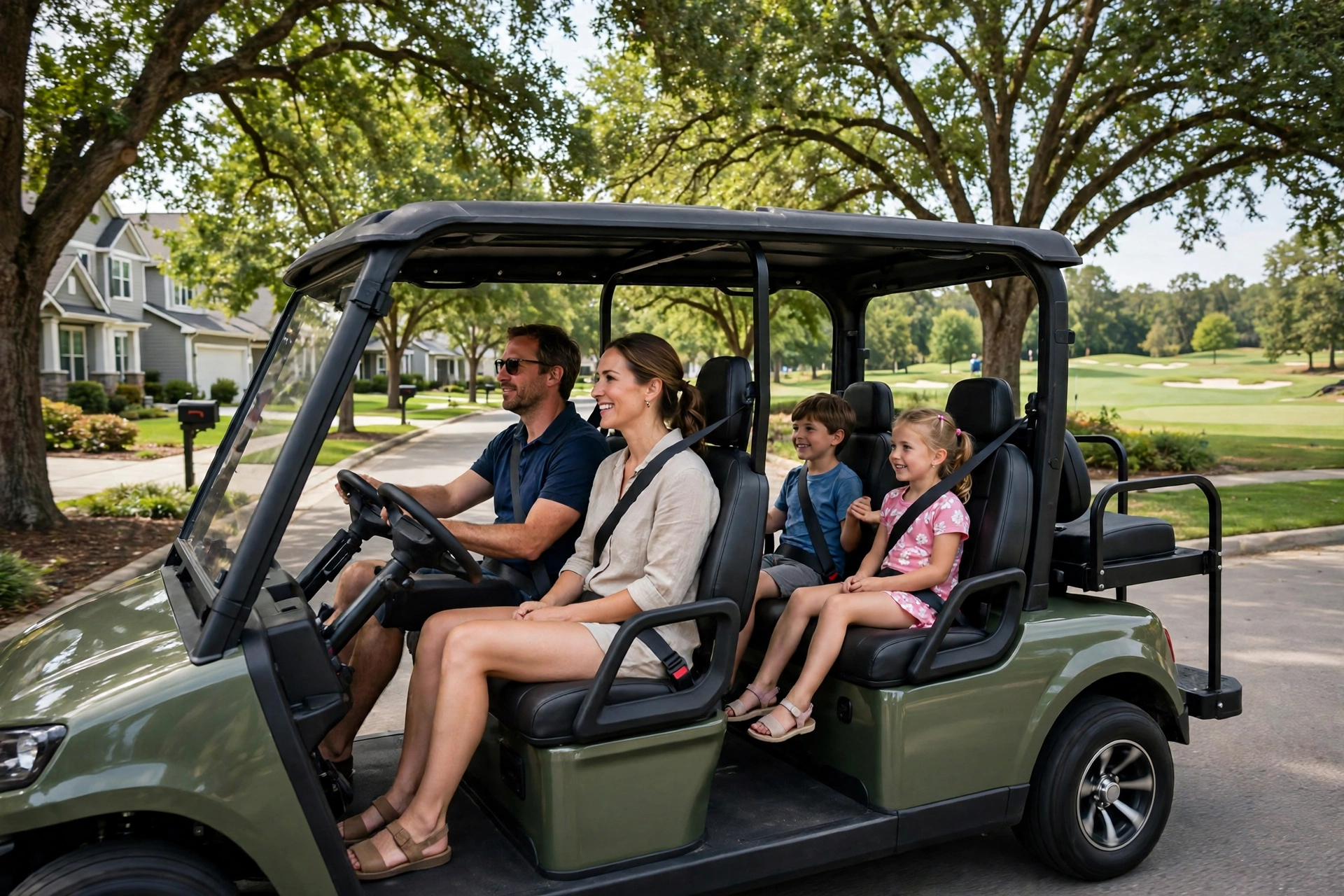
The models worth buying, scored
Four factory machines that make golf cart street legal ownership painless, scored the same way: safety kit, battery and range, value. Every one tops out at 25 mph, because every legal one must. Range, battery and price are where they separate.
GEM e4 — the range and network pick
Polaris has built GEMs for over two decades, and it shows in the details: an occupant protection structure that meets a roof-crush specification, hard doors if you want them, and a dealer network no rival here matches. The e4 starts at $17,490 and seats four. GEM’s battery menu is the honest core of the offer. Standard maintenance-free AGM returns roughly 28 to 35 miles (est., scaled from GEM’s published battery figures). The 7.2 kWh lithium pack, a $5,990 option, reaches 40 to 57 miles. The 14.4 kWh pack, an $11,980 option, stretches to a claimed 106 miles. Lithium carries a 7-year, 30,000-mile warranty, against 2 years and 8,000 miles for AGM.
Read GEM’s own model and battery pages and the pattern is plain: the base price buys the chassis, and the battery is where the real money goes. Verdict: the e4 is the default answer for buyers who will use the thing daily and keep it a decade.
Our score: 8.6/10 — Safety kit: 9/10 · Battery & range: 9/10 · Value: 7/10.
Bintelli Beyond 4 — the value pick, and the overall winner
Bintelli’s pitch is a short one: everything standard. The 2026 Beyond 4 lists at $12,995, with dealers advertising $11,999 at check time, and it arrives with a 51.2V 105Ah lithium battery, a 5 kW motor, four-wheel hydraulic disc brakes, power steering, a DOT windshield with wiper, three-point belts, a touchscreen with backup camera and a Bluetooth soundbar. Range is 30 to 35 miles per charge, which covers the real job these vehicles do. The aluminium frame matters at the coast, where steel frames rot. The warranty runs four years, and Bintelli sells through more than 250 dealers, so service is a drive, not a freight shipment.
The six-seat Beyond lists at $14,990, the cheapest honest way to move six people at 25 mph. Verdict: for most buyers, this is the one. The GEM is better. It is not $4,500 better for neighbourhood work.
Our score: 8.8/10 — Safety kit: 9/10 · Battery & range: 7/10 · Value: 10/10.
ICON i40X — strong kit, thin range
ICON’s 2026 i40X lists at $12,295 and undercuts Bintelli on the sticker while matching much of the specification: a 51V 105Ah Eco lithium pack, a 5 kW AC motor, four-wheel disc brakes, independent front suspension, a 10.1-inch touchscreen with CarPlay, and a full LSV package with an MSO and VIN. Dealer-quoted range is 25 to 30 miles (est.), the weakest here, and the dealer network is smaller and younger than Bintelli’s. The lithium pack carries an 8-year battery warranty, which is a serious number. Verdict: a sharp buy where a good ICON dealer sits within trailering distance. A gamble where one does not.
Our score: 7.9/10 — Safety kit: 9/10 · Battery & range: 6/10 · Value: 8/10.
Club Car Onward 4 Forward LSV — the safe name, at a price
Club Car’s street legal entry starts at $14,999, with four forward-facing seats, an overhead entertainment system running Apple CarPlay and Android Auto, and the deepest service network in the cart world. Battery choice drives the deal: lead-acid keeps the sticker down and range near 30 miles (est.), while the lithium option costs more and goes further. Nothing here embarrasses itself. Nothing here justifies the premium over the Bintelli either, beyond the badge and the dealer map.
Then there is the CRU, Club Car’s enclosed “living room on wheels,” at roughly $25,000 before its lithium upgrade adds about $2,500 more. It is charming. It is also used-car money for a vehicle that cannot legally pass 25 mph. Verdict: buy the Onward if your local Club Car dealer is excellent and close. Skip the CRU unless the money genuinely does not matter.
Our score: 7.6/10 — Safety kit: 8/10 · Battery & range: 7/10 · Value: 6/10. (CRU, for the record: Our score: 6.1/10 — Safety kit: 9/10 · Battery & range: 7/10 · Value: 3/10.)
Seven checks before you buy any golf cart street legal
Run these in order. Fail one, walk.
1. VIN and certification paperwork. A 17-digit VIN on the frame, a manufacturer’s certificate of origin in the paperwork, and an FMVSS 500 certification label on the vehicle. No VIN, no deal. On a used machine or a conversion, demand the issued title, in the seller’s name, before money moves.
2. Battery chemistry and replacement cost. Lithium or nothing, for a new purchase in 2026. A lead-acid set costs roughly $1,200 to $1,800 (est.) and lasts three to five years. A large lithium pack costs real money — GEM’s 14.4 kWh option at $11,980 shows the scale — while a typical 105Ah cart lithium pack runs $2,000 to $3,000 (est.). Warranty years tell you what the maker believes. Believe the maker.
3. The 25 mph reality. Every trip, every road, forever. Map your actual routes before buying: posted limits of 35 mph or less, and your state’s rule on crossing a faster road at an intersection. If one daily trip breaks the rule, the vehicle fails the job and no accessory fixes it. Golf cart street legal ownership is a route decision before it is a vehicle decision.
4. Your state’s title, plate and insurance rules. Registration, plates, liability insurance at roughly $300 to $800 a year (est.), and a valid driver’s licence. A few states still lack an LSV statute entirely. HOAs and city ordinances add their own layers. One phone call to the DMV beats one court date.
5. A dealer within reach. These are simple machines, and simple machines still break: controllers, chargers, contactors, tyres. A competent dealer 20 minutes away is a feature worth $1,000. A dealer three states away is a liability with a logo. Fleet and campus buyers should also read our guide to electric vans for business, because an LSV is the wrong tool for half the jobs fleets hand it.
6. Seating you will actually use. Forward-facing seats with three-point belts beat a flip-down rear bench for road work, every time. Count your real passengers on a real Saturday, then check the cost per seat in the next section before you fall for a two-seater.
7. Resale. Factory LSVs from known brands hold money. A 2026 market scan of used listings put median ICON asking prices at $8,875 against $12,295 new, and GEM carries the strongest name of all. Converted carts sell as carts, at cart money, with the conversion earning back pennies. Battery age is the resale killer: a lithium pack with warranty left is worth cash, while a tired lead-acid set is a discount the buyer will take straight out of your price.
What a golf cart street legal costs over three years
Start with the simplest maths in this class: price per seat. GEM e2: $15,240 ÷ 2 seats = $7,620 per seat. GEM e4: $17,490 ÷ 4 = $4,373. GEM e6: $21,240 ÷ 6 = $3,540. ICON i40X: $12,295 ÷ 4 = $3,074. Club Car Onward LSV: $14,999 ÷ 4 = $3,750. Bintelli Beyond 6: $14,990 ÷ 6 = $2,498 per seat, the cheapest legal seat in this article. Seats are the product. Buy them at the lowest honest price.
Now the full three-year sum, factory route first. A Beyond 4 at $12,995 + $900 freight and setup (est.) + $200 title and registration (est.) + insurance at $450 a year (est.) × 3 years = $1,350. Total: $15,445. The lithium battery sits inside Bintelli’s four-year warranty for the whole period, and nothing else on the vehicle should cost more than tyres and brake pads.
Conversion route. A decent used cart at the 2026 median asking price of $5,999 + $2,750 in conversion parts and labour (est., mid-range) + $250 in title, inspection and admin (est.) + the same $1,350 of insurance + one replacement lead-acid battery set at $1,500 (est.), because used carts eat batteries. Total: $11,849. Cheaper by $3,596, and worth it only if your state titles conversions without a fight — a question to settle before purchase, not after.
Already own a solid cart? The same maths drops to $5,850 across three years, and conversion wins outright. Our EV total cost of ownership calculator runs the same exercise for full-size cars if you are cross-shopping the two.
The honest summary: a conversion saves money and spends certainty. A factory machine spends money and saves certainty. Pick the currency you are short of.
Golf cart street legal: quick answers
What does golf cart street legal actually mean? It means the vehicle is a federally defined low-speed vehicle: built to FMVSS 500, capped at 25 mph, carrying a VIN, and titled, plated and insured under your state’s rules. It does not mean a normal cart with a light kit fitted. If the seller cannot show you a title or a manufacturer’s certificate of origin, the vehicle is not street legal, whatever the advert says.
Can I convert my existing cart instead of buying new? Sometimes. The kit is the cheap part, at $300 to $800. The full conversion, paperwork and first insurance bill run $2,000 to $4,500 all-in on a cart in good shape. The deciding factor is your state: some title converted carts routinely, while others make it painful or impossible because the cart has no VIN. Ask your DMV first. Then price the work.
How fast can I drive one, and on which roads? 25 mph, full stop. The vehicle may not exceed it and stay in the class. Most states allow LSVs on roads posted at 35 mph or less, and many allow crossing a faster road at an intersection. Highways are out. So is derestricting the controller: a 30 mph machine is no longer an LSV, it is an unregistered car held to no crash standards at all.
Do I need a licence, plates and insurance? In most states, yes to all three. The driver needs a valid driver’s licence, the vehicle needs registration and a plate, and liability insurance typically runs $300 to $800 a year (est.). Rules vary by state, and a few states still have no LSV law on the books, so confirm locally before buying.
Lead-acid or lithium: which battery should I pay for? Lithium. On GEM’s own figures it lasts 3,500 cycles against roughly 600 for AGM, weighs about half as much, and holds its range as it ages. Lead-acid wins on the sticker only, then hands the saving back at replacement time. A cheap LSV on lead-acid is a subscription, not a purchase.
Why not just buy a small used car? A fair question with a narrow answer. If your trips stay inside 35 mph limits, an LSV is cheaper to buy, cheaper to insure, cheaper to run and easier to park than any car, and it charges from a wall socket. The moment one regular trip needs a 45 mph road, the car wins and it is not close. Buyers on that side of the line should read our breakdown of electric cars, their range, charging and costs instead.
Final word. The best golf cart street legal buy in October 2026 is the Bintelli Beyond 4 for most people, the GEM e4 for heavy daily use, and a conversion only for owners who already hold a good cart in a conversion-friendly state. Everything else in this class is a compromise wearing a brochure. Buy the VIN. Buy the lithium. Buy the dealer near your house. Then go and enjoy 25 mph, which turns out to be plenty.
If you are still weighing a golf cart street legal purchase, keep the checklist short: confirm the VIN, confirm the 25 mph limit fits your routes, and confirm a golf cart street legal model from a dealer near you. That simple check keeps a golf cart street legal buy legal, practical and easy to resell.
A golf cart street legal choice should also fit your garage, your charger and your budget. Check those three things before you sign, and a golf cart street legal purchase stays a practical one for years.