Last updated: October 27, 2026
An electric car that refuses to charge looks like one problem. It is usually five different problems wearing the same coat, and their prices are nowhere near each other. A weak 12-volt battery can cost under $300 fitted. A dead onboard charger can cost ten times that. So car charging system repair starts with one rule I will not bend on: pay for diagnosis, never for guesses. Any shop that quotes you a charger replacement before scanning the car and testing the cheap parts first is selling you their most profitable guess. Walk away.
This guide walks the ladder in the order a good workshop should climb it: free checks at home, the 12-volt battery, the charge port and cable, the wallbox, and only then the expensive electronics inside the car. Every price below was checked on October 27, 2026 against published repair data and shop guides, and figures that are still estimates are marked (est.) with the basis stated. Keep a notebook. Write down what the car does, when it does it, and which charger you were using. That one page of notes can save you a $220 diagnostic argument later.
Start at $0: the car charging system repair triage checklist
Before the car goes anywhere, work this list in order for car charging system repair. Each step costs nothing, takes minutes, and eliminates one suspect. Skipping steps is how owners end up buying a new wallbox for a car problem, or a new onboard charger for a wallbox problem.
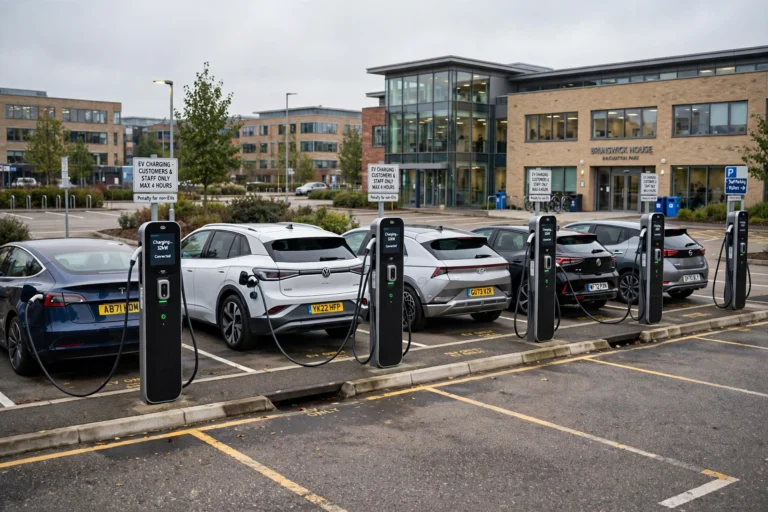
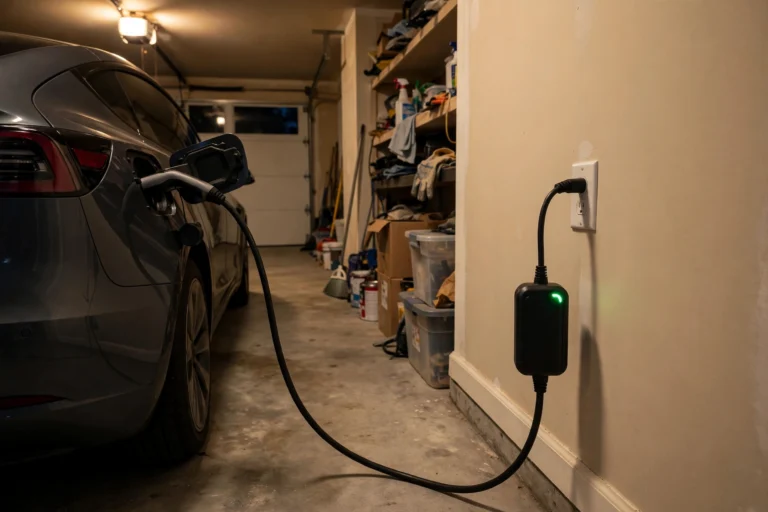
- Swap the charger, not the car. If home charging fails, try a public AC charger or a neighbour’s wallbox. If the car charges there, your home equipment is the suspect, not the car. Our guide to charging an electric car from a regular outlet covers the slowest, simplest fallback test: the portable cordset on a plain socket.
- Swap the location again. Still failing? Find a DC fast charger using our page on how to find EV charging stations. A car that fast-charges on DC yet refuses AC is pointing a finger at its onboard charger, because DC charging bypasses it. A car that refuses both has a different, shorter list of suspects.
- Inspect the inlet with a torch. Look for bent pins, green corrosion, trapped grit, a cracked latch. Manufacturer guidance says the same thing: Tesla’s own support pages for troubleshooting a Wall Connector start with checking for obstructions, moisture and debris in the inlet and connector before anyone books service.
- Check the boring settings. Charge limits, scheduled-charging timers, a tripped breaker, a wallbox that lost its Wi-Fi schedule. Read the fault message word for word and photograph it.
- Restart and update. A full power-down and restart, plus any pending software update, clears a surprising share of charging refusals. Software faults leave no broken parts behind, which is exactly why they get mis-sold as broken parts.
Write the result of each step next to it. “Fails on home wallbox, works on public AC, works on DC” is a diagnosis in one sentence, and it tells a workshop precisely where to start looking.
The 12-volt battery: the small part behind a big scare
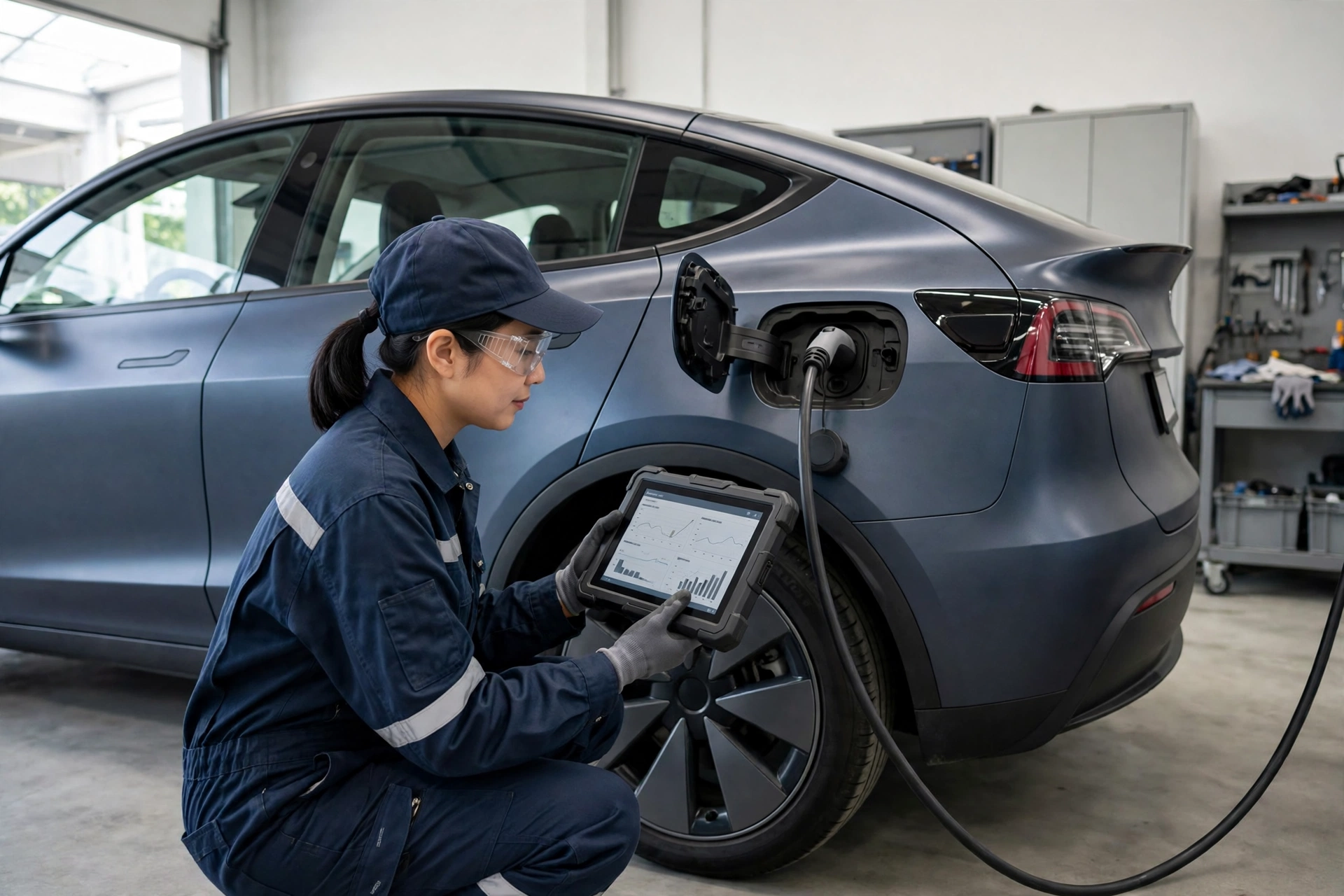
Ask an honest workshop what starts a car charging system repair job most often and the answer is rarely the charger itself. Every EV carries a conventional 12-volt battery, and it runs the computers that authorise charging. When it fades, the car can refuse to start a charge, drop a charge mid-session, light up a Christmas tree of warnings, or brick itself entirely — while the big traction battery sits there perfectly healthy. Charging faults that appear alongside slow waking, flickering screens or a car that needed a jump pack are 12-volt faults until proven otherwise.
The money: a replacement 12-volt battery itself typically costs under $300, with fitting on many models taking under an hour. Published warranty-claim data reported by Carscoops in 2026 put the average auxiliary-battery repair claim at about $716 (converted from UK warranty data), because labour, towing and follow-on faults pad the bill.
The ugly version of this story is the integrated charging unit: on some Hyundai and Kia models, a failing 12-volt battery stresses the ICCU that manages charging and 12-volt power, and that assembly runs into the thousands — Endurance Warranty cites totals around $3,000 once diagnostics, labour and programming are added, and Hyundai recalled cars over ICCU failures in late 2024.
A $250 battery ignored for a year is the most expensive cheap part in the whole charging system.
My checklist for the 12-volt, in order for car charging system repair:
- Test it under load, not just with a voltmeter at rest. A battery can show 12.4 volts on the driveway and collapse the moment the car wakes up.
- Check its age. Most EV 12-volt batteries are done at 3–5 years. If yours is in that window and charging faults have started, replacement is maintenance, not a gamble.
- Clean and torque the terminals. A loose clamp imitates a dying battery beautifully.
- After replacement, some models need the new battery registered in software. Ask before you pay, not after the warnings return.
Charge port, inlet and cable: the wear items nobody inspects
In car charging system repair, the charge port is the equivalent of a worn brake pad: a consumable interface that degrades a little with every use. It is a wear item, same family as tyres and wiper blades, yet almost nobody looks at it until it fails. It gets plugged and unplugged thousands of times, rained on, frozen, and occasionally reversed into. Common findings: worn or heat-discoloured pins, a latch that no longer locks (many cars will not charge with an unlatched connector), water ingress past a perished seal, and damaged wiring just behind the inlet.
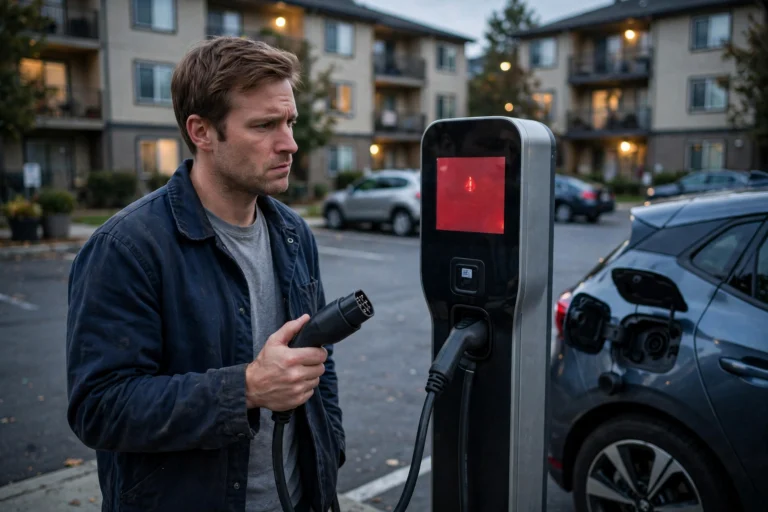
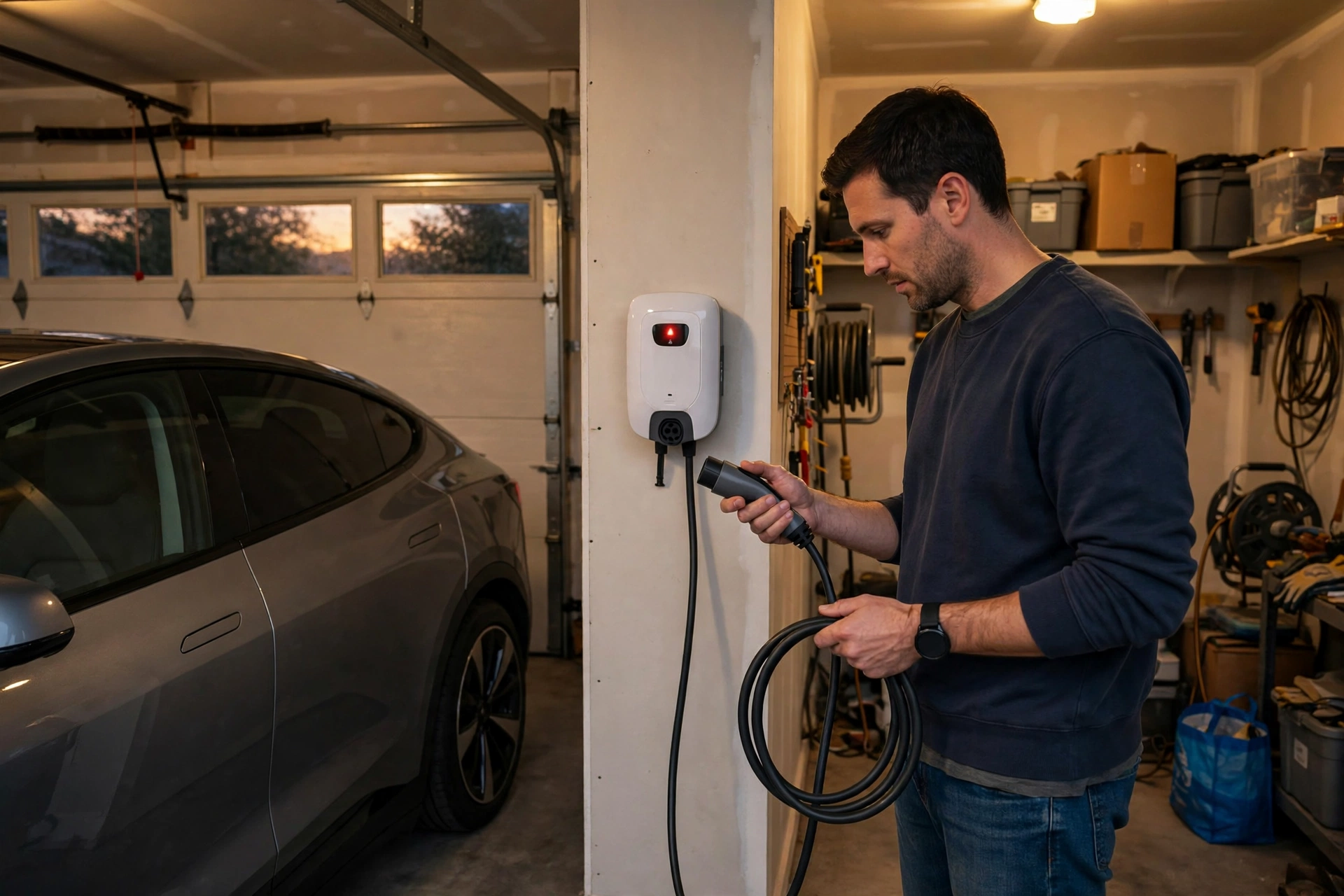
Cable and EVSE faults sit in the same bucket. A home wallbox with a flashing red fault light, a portable cordset that overheats at the plug, a cable with a kinked or crushed section — each one stops charging exactly like a car fault does. Before condemning a wallbox, run the EV charger compatibility checker to confirm the replacement you are eyeing actually matches your car’s connector and charging rate. The US Department of Energy’s Alternative Fuels Data Center has a solid plain-English primer on charging electric vehicles at home, covering what the equipment should do when it is healthy.
Car charging system repair prices: a charge port inlet replacement at a dealer commonly lands between $800 and $1,500 including labour (reported range across Tesla and other brands, checked October 27, 2026). Outliers exist and they are rude — one 2023 Chevrolet Bolt EUV owner was quoted about $2,648 by a dealer for a full charging receptacle replacement, plus $219.90 just for the diagnosis, on a car under 50,000 miles. That quote is why the torch-and-photograph step matters: owners who looked closely at that port spotted a stray piece of metal on a contact that a parts cannon would never have found.
A replacement home wallbox, for comparison, runs $300–$800 for the unit (est., based on current US retail listings) plus an electrician’s visit if it is hardwired.
Car charging system repair costs: the ladder, added up
Here is the car charging system repair maths I run before approving anything. Same fault — “car will not charge on AC at home” — four different endings. Labour is costed at $150/hour (est., mid-range US independent-shop rate; dealer rates often run higher), and diagnosis is a flat $150 (est., typical range $100–$250; that Bolt owner was charged $219.90).
| Finding | Parts | Labour | Extras | Total with $150 diagnosis |
|---|---|---|---|---|
| 12-volt battery | $210 | 0.5 hr = $75 | $0 | $150 + $210 + $75 = $435 |
| Charge port inlet | $620 | 2 hr = $300 | $0 | $150 + $620 + $300 = $1,070 |
| Home wallbox (EVSE) | $550 | Electrician 1 hr = $150 | $0 | $150 + $550 + $150 = $850 |
| Onboard charger | $1,850 | 4 hr = $600 | Coolant + software $120 | $150 + $1,850 + $600 + $120 = $2,720 |
Read the car charging system repair ladder the way a workshop should. The most common ending is the cheapest one. The most expensive ending — the onboard charger — is real money: published guides put onboard charger replacement between $1,200 and $3,000 fitted depending on the model, and 2026 warranty-claim data reported by Carscoops averaged $2,890 per onboard charger repair, with the single largest claim hitting about $14,000 on a premium model.
Now run the wrong-guess maths. Replace the wallbox first, on a hunch: $850 spent, car still not charging, because the actual fault was the 12-volt battery at $435 all-in. Total damage $1,285 for a problem that cost $435. Diagnosis is not the expensive line on the invoice. Guessing is.
When the onboard charger is genuinely the fault
This is the deep end of car charging system repair. The onboard charger converts AC from your wall into DC for the battery. Its failure signature is specific: the car charges happily on DC fast chargers (which feed DC straight to the battery and skip the onboard charger entirely) yet refuses, interrupts or crawls on every AC source. Reduced AC charging speed is the early warning — a car that used to pull 7.4 kW at home now sipping 3 kW is derating, often from heat damage inside the unit. Failure typically shows between 70,000 and 110,000 miles in published wear data.
Two traps to avoid. First, warranty: do not assume the 8-year battery warranty covers the onboard charger. On many models it sits under the shorter powertrain or electrical warranty instead — Renault’s Megane E-Tech, for instance, covers the onboard charger under a 5-year electric powertrain warranty rather than the 8-year battery warranty. Check your paperwork before assuming a $2,700 bill is yours.
Second, “repair” versus “replace”: most workshops swap the whole unit, because board-level repair of sealed power electronics is specialist work. A refurbished unit can cut the parts cost sharply, so ask for that quote too — then ask what warranty the refurbished part carries. A cheap unit with 90 days of cover is not automatically a bargain.
Dealer or independent shop for car charging system repair?
In car charging system repair, dealer strengths are real: factory scan tools, model-specific bulletins, software flashing, and warranty handling in one visit. Dealer weaknesses are also real: higher labour rates and a culture of replacing assemblies rather than investigating them — that $2,648 Bolt receptacle quote came from a dealership. Independent EV-certified shops usually charge less per hour and will test a 12-volt battery before writing a four-figure estimate, and ASE now runs dedicated EV technician certification, so the skill gap is closing fast.
Whoever you choose, run this car charging system repair checklist before you hand over the keys:
- Ask for the diagnostic fee in writing, and whether it is credited against the repair if you proceed.
- Ask what they will test first. The right answer starts with the 12-volt battery, the inlet, and a known-good charger.
- Ask for the old parts back. It keeps everyone honest and costs nothing.
- Ask whether a software update or bulletin already covers your fault. Recalls and service campaigns have quietly paid for a lot of charging repairs, ICCU failures included.
- Get the estimate itemised: parts, labour hours, fluids, programming. One lump sum is a hiding place.
If the car is under any warranty at all, the dealer goes first — an independent repair on a covered fault can complicate a claim. Out of warranty, get the independent to diagnose and quote, then compare. Our explainer on how the EV battery system is put together helps make sense of what the quote is actually describing.
The line you do not cross: high-voltage safety
Everything inside the orange cabling is high-voltage, and it can kill. The onboard charger, the charge port inlet’s inner connections, the ICCU and the DC-DC converter are not DIY parts, full stop.
Do not open them, do not probe them with a multimeter from a home toolkit, and do not let a general handyman do it either. The safe DIY list is genuinely short: swapping chargers to isolate a fault, inspecting the inlet visually with a torch, cleaning dirt from around (not inside) the connector with a dry cloth, checking breakers and settings, fitting a 12-volt battery on models whose manual allows owner replacement, and reading fault codes with a basic scanner.
In car charging system repair, everything past that list belongs to a technician with high-voltage training, insulated tools and the car’s service disconnect procedure. This is not caution theatre. A tyre you can inspect with a tread gauge; a 400-volt charger you inspect by paying someone qualified.
Intervals: the checks that stop the big bills arriving
Wear items fail on schedules, so inspect them on schedules. This is the car charging system repair rhythm I give every EV owner who asks, and it costs almost nothing beyond attention:
- Every 6 months: torch inspection of the charge port. Pins straight and bright, seal intact, latch clicking shut with a positive feel. Two minutes, $0.
- Every 6 months: wallbox once-over. Cable flexed along its length for kinks or crush damage, plug pins checked for heat discolouration, fault-light behaviour confirmed against the manual.
- Annually, from year three: a load test on the 12-volt battery. Most parts stores will do it free; a workshop charges little. Replace at the first weak result, not after the first failed charge.
- At every tyre rotation: tell the technician the car charges on AC and DC and ask them to note any stored charging fault codes while the car is already plugged into a scanner. Marginal cost, real information.
- After any charging fault, however brief: write it in the notebook with the date, the charger used and the message shown. Intermittent faults become diagnosable when there is a pattern on paper; without one, they become repeat diagnostic fees.
None of this prevents an onboard charger dying at 95,000 miles. It does mean the $435 faults get caught while they are still $435 faults, and that is the entire game with car charging system repair: small parts, checked on time, beat big parts replaced on suspicion.
Our verdict on car charging system repair
Most charging failures are cheap faults wearing expensive disguises, and the owners who pay the least are the ones who diagnose in order: free swaps first, 12-volt second, port and cable third, electronics last. Budget $150 for honest diagnosis before you budget anything for parts, photograph every fault message, and treat any four-figure quote that arrives without a test sequence as a quote for a different shop.
Our score: 7/10 for the current repair landscape. Diagnosis ease: 8/10 — the swap tests genuinely narrow most faults in an afternoon. Cost fairness: 6/10 — dealer assembly-swapping inflates too many bills. DIY safety: 4/10 — the checks are safe, the actual components are not, and the gap between those two is where people get hurt or fleeced.
FAQ
How much does car charging system repair usually cost?
It depends entirely on which rung of the ladder your fault sits on. Worked through above with prices checked October 27, 2026: about $435 all-in for a 12-volt battery, roughly $850 for a replacement home wallbox, around $1,070 for a charge port inlet, and about $2,720 for an onboard charger, each including a $150 diagnostic fee. Warranty-claim averages for onboard chargers run higher still, near $2,890.
Why does my EV charge on a fast charger but not at home?
That pattern points hard at the onboard charger or your home equipment, because DC fast charging bypasses the onboard charger completely. Test the car on a different AC charger: if it charges there, your wallbox or its circuit is the fault. If it refuses every AC source, the onboard charger moves to the top of the list.
Can a bad 12-volt battery really stop an EV charging?
Yes, and it does so regularly. The 12-volt battery powers the computers that manage and authorise charging. A weak one produces refusal to charge, charges that stop mid-session, and warning lights that look like traction-battery trouble. Testing it under load takes minutes and should happen before any major part is quoted.
Is the onboard charger covered by the battery warranty?
Often not. Many manufacturers place the onboard charger under the powertrain or electrical warranty, which is shorter than the 8-year traction-battery warranty. Check your warranty booklet for the charging system’s category before paying for car charging system repair — a covered charger turns a $2,700 problem into a paperwork exercise.
What charging repairs can I safely do myself?
The isolation tests, visual inlet inspection, settings and breaker checks, software updates, and — where the manual allows — the 12-volt battery. That boundary is the whole shape of safe car charging system repair for owners: everything you can test with your eyes and a spare charger is yours; everything carrying high voltage belongs to a workshop. Anything involving orange high-voltage cabling, the inlet’s internal wiring, or the charger unit itself is technician-only work.
Should I use a dealer or an independent shop?
Dealer first while any warranty or recall might apply. Out of warranty, an EV-certified independent usually diagnoses cheaper and replaces less. Either way, demand the test sequence and an itemised car charging system repair estimate. For how this site checks the figures quoted here, see how we research our guides.
If you take one lesson from this guide, let it be this: good car charging system repair starts with diagnosis, not parts. Work through the cheap checks first, keep notes on every fault, and get an itemised quote before approving work. That disciplined approach to car charging system repair is what keeps a small fault small — and it is why careful car charging system repair so often costs far less than a guessed replacement.
For car charging system repair, that order — diagnosis first, parts second — is the habit that saves money.
That is the practical value of planned car charging system repair: fewer surprises, clearer quotes, and no paid guesswork.
For lasting results, keep that simple car charging system repair routine in mind: check the cheap parts first, note every fault, and only approve work backed by a clear diagnosis.
Next time a charge fails, work the ladder in order and keep car charging system repair cheap, calm and evidence-led.
If the car still will not charge after the cheap checks, take your notes to the workshop and let car charging system repair follow the evidence, not the most expensive guess.
That discipline is what keeps car charging system repair affordable: diagnosis first, parts second, and every fault code written down.