Last updated: October 27, 2026
The ninebot gokart pro is the electric kart Segway-Ninebot launched in September 2020, and in October 2026 it is purely a used-market product. Segway no longer lists it as a current model — the Gokart Pro 2 replaced it — so every original Pro you see for sale is four to six years old, with a battery the same age. That changes what a sensible guide has to do. This one checks the original specification against what owners actually got, works through the safety design as it was built, and then prices the used buy honestly against a new Pro 2.
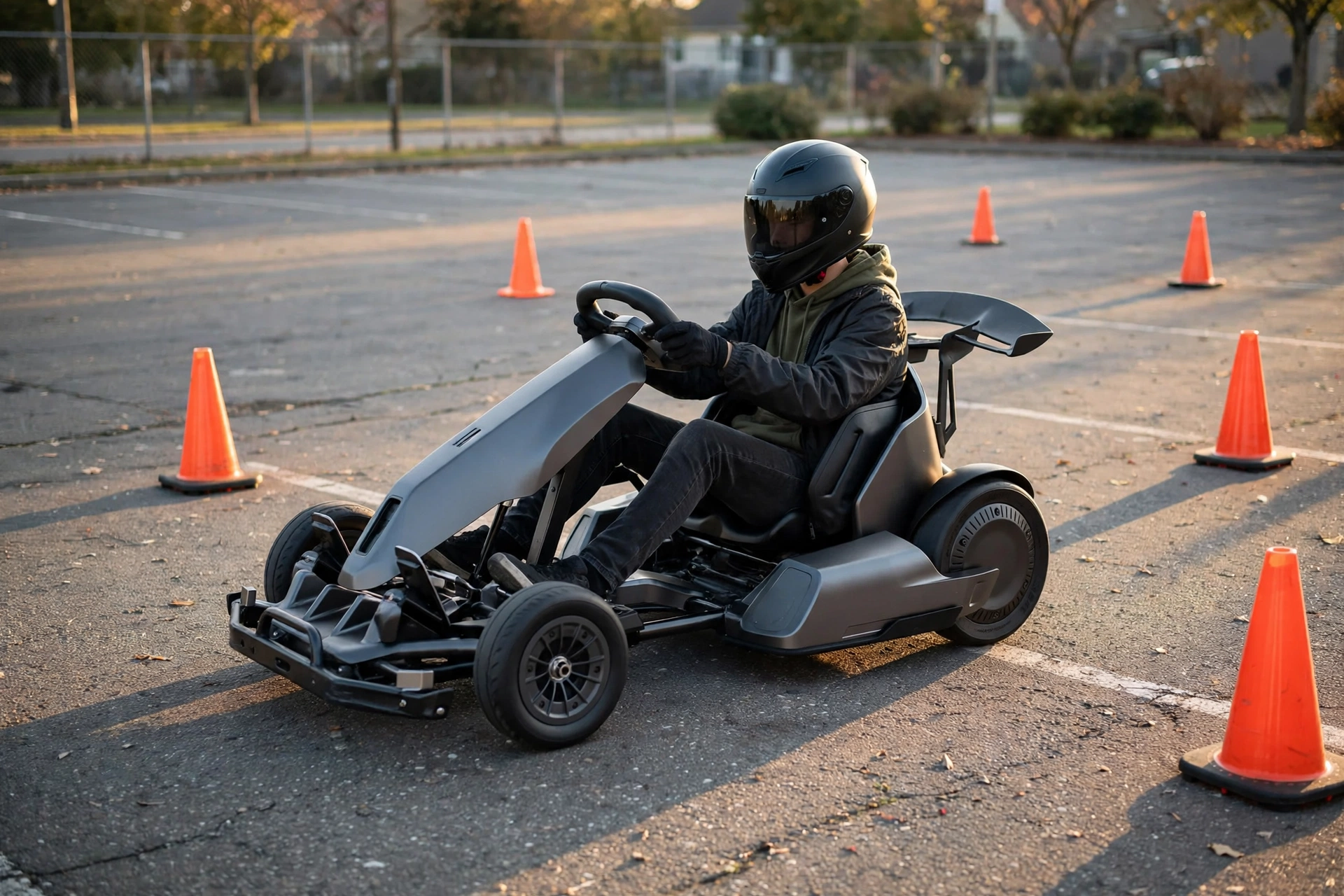
Start with what the machine is, because listings describe it badly. The ninebot gokart pro was sold as a complete kart, not a kit. In the box was a steel kart frame — seat, pedals, steering wheel, front bumper — and a detachable self-balancing power unit that bolts to the back of the frame and provides both rear wheels, both motors and the battery. Remove that unit, fit its steering column, and it is a standalone self-balancing transporter you can ride standing up. The kart is the accessory; the power unit is the vehicle.
One correction matters before any money changes hands. Segway’s own specification sheets list the bundled unit as the Ninebot S MAX, an uprated relative of the standard Ninebot S with the larger 432 Wh battery this kart needs. The standard S carries a much smaller pack of about 236 Wh (est.) and was never the Pro’s power source. The bring-your-own-scooter arrangement belongs to the older Ninebot Gokart Kit from 2018, which did pair with an owner’s Ninebot S or miniPRO. If a seller tells you a Pro runs on a standard S, the unit has been swapped, and that is a reason to walk away, not a detail.
The two-in-one layout is genuinely clever, and it explains the kart’s used following. One purchase covered a weekend kart and a short-trip transporter, the frame folds down for car transport, and the whole thing runs quietly enough for a private lot or a rural driveway. Our research method page sets out how we check figures like these; the short version is that every specification below comes from Segway’s own published material first, and from independent reviews of the period second.
Ninebot Gokart Pro specs, as Segway sold them
Here is the specification that matters, using Segway’s US figures for the ninebot gokart pro rather than the higher numbers on some international listings:
| Top speed | 23 mph (Race mode) |
| Claimed range | 15.5 miles |
| Battery | 432 Wh, inside the S MAX unit |
| Motors | Two rear hub motors, 4,800 W peak combined, 96 Nm |
| Speed modes | Safety 5 mph · Beginner 11 mph · Sport 17 mph · Race 23 mph |
| Rider limits | Age 14+, height 4’3″–6’3″, max payload 220 lbs |
| Kart weight | About 113 lbs |
| Brakes | Electronic brake plus a mechanical handbrake |
| Charge time | About 4 hours |
| Water resistance | IPX4 |
Read the speed modes as the most useful line in that table. The app-set modes are a real parental control, not a gimmick: a younger teen in Safety mode is limited to walking-plus pace, and the kart cannot exceed it until an adult changes the setting.
Acceleration was the headline in 2020 — Segway claimed 1.02 G off the line, comparable to a 150cc petrol kart — and period reviews agreed the launch is startlingly strong for the first few metres.
Top speed, though, is 23 mph, and it is worth being precise about that: international listings quote up to 40 km/h for the same machine, while Segway’s US specification is 37 km/h, which is 23 mph. Segway’s official launch release introduced the kart at a $1,499 early-bird price against a $1,999 retail tag, with the drift system as the headline. Keep that original pricing in mind when valuing a used example: a five-year-old kart advertised near its 2020 retail price is mispriced, whatever its condition. Prices and specifications in this guide were checked on October 27, 2026.
Range, honestly: 15.5 miles is a gentle-mode number
Segway’s 15.5-mile claim for the ninebot gokart pro is achievable arithmetic, but not at the pace anyone buys a kart for. The battery holds 432 Wh. Divide 432 by the claimed 15.5 miles and the claim assumes 27.9 Wh per mile — gentle driving, modest speeds, few full-throttle launches. Driven at Race pace, with repeated hard acceleration and drifting, consumption rises to roughly 40 Wh per mile (est.), and 432 divided by 40 gives 10.8 miles. Plan on 9–12 real miles per charge at kart pace, which is about 30–45 minutes of driving. That is the honest figure, and it is enough for a session — provided you knew it before you bought.
This pattern is not unique to the kart. Segway’s range claims across its range assume favourable conditions, a point we make with the test data in our Segway Ninebot Max G30P guide, where the tested figure also lands well short of the brochure number. The kart simply shows the gap at its widest, because a kart is driven at full throttle almost all of the time. The 15.5-mile figure should never have been printed without the mode attached to it.
Ninebot Gokart Pro safety and design limits
Steering first, because it is widely misunderstood. In kart form, the ninebot gokart pro steers with an ordinary mechanical steering wheel connected to the front wheels. You do not steer it by leaning. Lean steering belongs to the S MAX only when it is detached and ridden standing up, and it plays no part in how the kart corners.
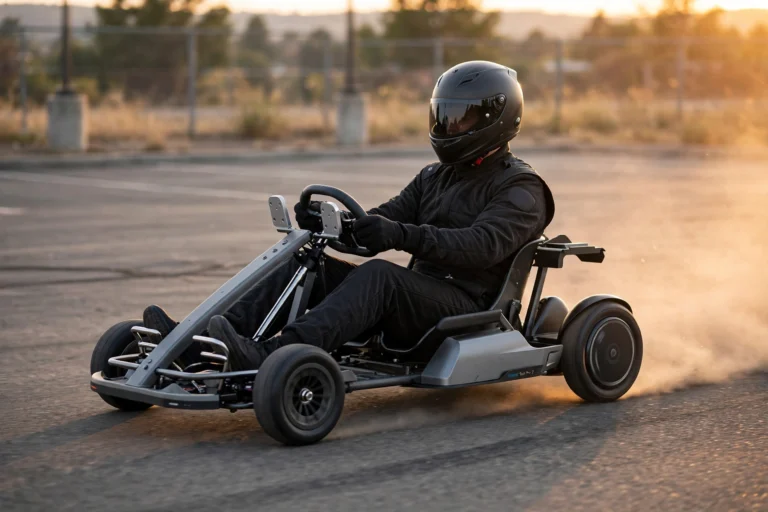
What the S MAX does contribute in kart form is drive: its two hub motors are controlled independently, and Segway’s Drifting Assistant System varies power between the rear wheels to help the kart rotate. The low-grip TPE rear tyres are fitted deliberately so the rear steps out in a controlled slide; the grippier front tyres hold the line. It is a well-judged system, and it is also a system that teaches drifting — which is exactly why the next points matter.
The limits are structural. There is no seat belt and no roll cage. The driver sits inches above the ground in an open steel frame protected by TPE bumper material at the front and sides, which absorbs car-park-speed contact and nothing more. At 23 mph, a fixed-object impact is a serious event, and the correct equipment is a full-face helmet, closed shoes and gloves, every time, on every surface.
The small green front light is a styling marker, not a headlamp — period reviewers noted it is far too dim to ride by, so treat the kart as a daylight machine. The age limit of 14 and the 220 lb payload are Segway’s, and they should be treated as hard limits, not guidance. Independent reviewers of the period made the same point about surfaces: MotorizedRides’ Gokart Pro review stressed that the kart works on flat, paved ground only — kerbs, gravel and grass defeat the low frame and the small front wheels quickly.
Legality is simple and frequently ignored. The ninebot gokart pro is not a road vehicle: it has no lights, signals, mirrors or registration path, and it is not legal on public roads, pavements or bike lanes in US cities. It is a private-land machine — your driveway, a closed lot with permission, a kart facility that allows it. Riders who want an electric two-wheeler that can legally use city streets need a different product entirely, such as the models covered in our Segway Xyber guide, and even those carry class restrictions. A kart on a public road risks a ticket and, far worse, puts a driver at bumper height in traffic. Do not do it.
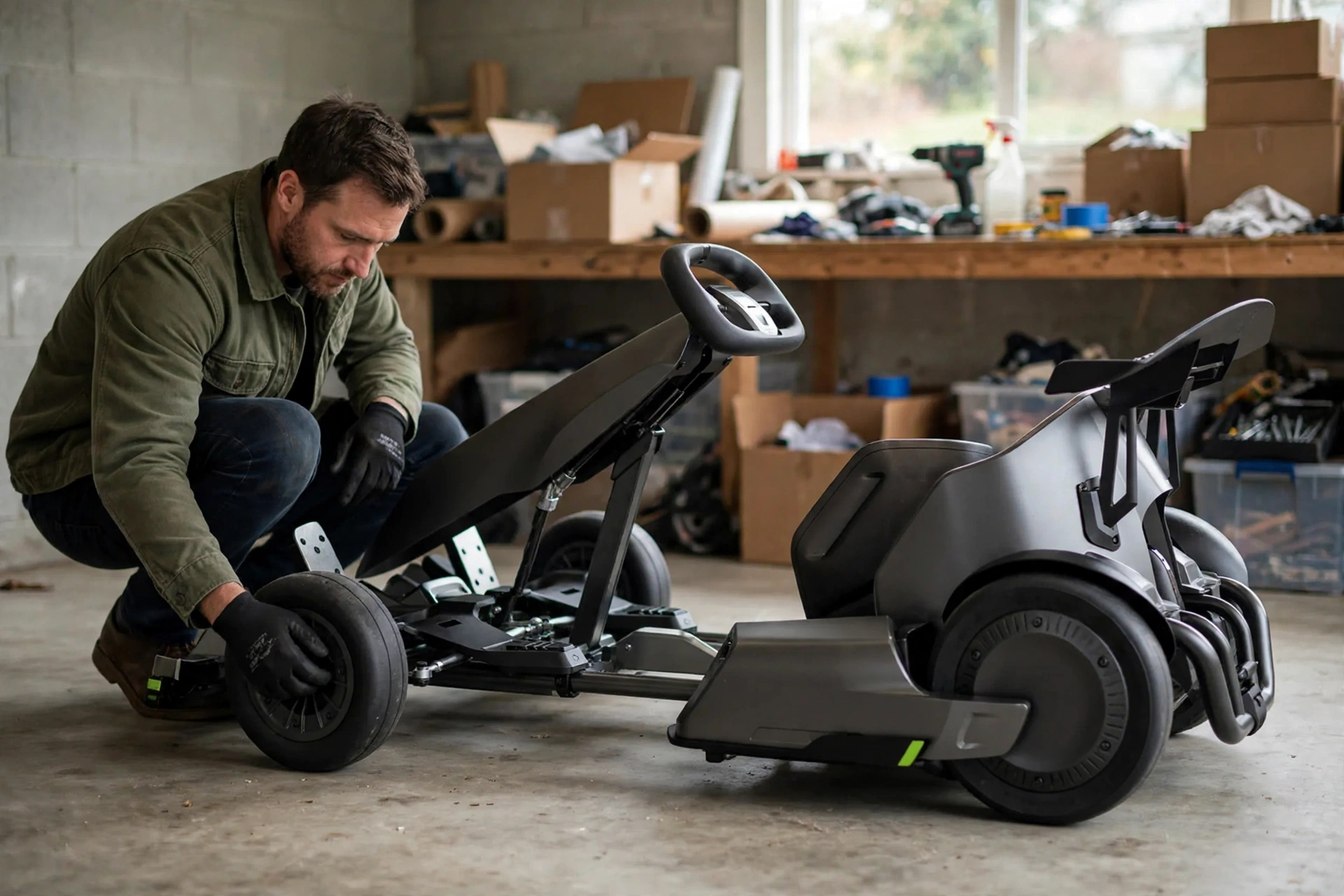
Discontinued: the ninebot gokart pro as a used buy in 2026
Segway’s current kart is the Gokart Pro 2, listed at Best Buy at $2,499.99 and seen at $2,300 in Segway’s October 2026 sale coverage, prices checked October 27, 2026. The original ninebot gokart pro is gone from Segway’s own store. What remains is the second-hand market and a thin layer of refurbished stock: refurb retailers have listed complete used and refurbished Pros at $1,079.95 to $1,399.95 (out of stock when checked), and complete karts on resale marketplaces generally cluster around $700–$1,200 (est.), depending on year and condition.
Anything far below that band usually turns out to be a frame without the S MAX unit, a unit with a tired battery, or a listing for the older, cheaper 2018 Kit wearing the Pro’s name. Check which product is actually in the photographs.
Inspection is where a used Pro is won or lost. Work through this list in person:
- Battery and app: connect the Segway app, read the recorded mileage and battery health, and confirm the pack charges to 100%. A kart that will not pair, or a seller who will not let you pair, is a no.
- Charger: the original charger must be present and correct for the S MAX pack. A missing charger is not a small gap — our EV charger compatibility checker explains why matching voltage and connector matters, and a wrong third-party charger on an ageing lithium pack is a fire risk, not a saving.
- Rear tyres: the TPE drift tyres wear by design. Smooth, squared-off rears mean heavy drift use and a replacement bill soon.
- Steering and frame: check for play in the steering, bent frame rails and cracked welds near the front bumper, which is where these karts meet posts.
- Package contents: some units were sold without the Bluetooth speaker or the knee bar for the detached scooter mode. Confirm what is included before you agree a price.
- Both modes: test the S MAX detached as well as fitted. A unit that misbehaves standing up will misbehave in the kart.
Ownership adds one more safety duty that new buyers rarely plan for. A four-to-six-year-old lithium pack should be charged attended, on the original charger, away from exits and anything flammable, and never left charging overnight in a hallway. Store the unit part-charged if it will sit for a season, and inspect the pack casing for cracks or swelling before every charge. A swollen or damaged pack ends the negotiation on the spot: walk away, because safe disposal is the owner’s problem the moment money changes hands, and no discount prices that risk correctly.
The battery-age maths, done openly
Every original Pro battery is now at least four years old, and lithium packs lose capacity with age and use whether they are ridden or stored. Take a typical 2021 kart and assume a 15% capacity loss (est., a fair mid-point for a pack of this age with mixed storage history). The maths: 432 Wh × 0.85 = 367 Wh remaining. Gentle-mode range falls in proportion: 15.5 × 0.85 = 13.2 miles. At Race pace, using the 10.8-mile figure from the range section above, 10.8 × 0.85 = 9.2 miles. That is still a usable kart session — but it is not the machine the 2020 reviews tested, and the asking price should reflect it.
Now the comparison that settles most purchases. Take a tidy used Pro at $900 (est.). If you drive it 40 hours in your first year — a busy year for a private-land toy — the hardware costs $900 ÷ 40 = $22.50 per hour of driving, and the electricity is a rounding error: a full 0.432 kWh charge at $0.17 per kWh costs about 7 cents.
A new Gokart Pro 2 at $2,499.99 over the same 40 hours costs $2,499.99 ÷ 40 = $62.50 per hour. Reverse the use pattern and the answer reverses: at only 10 hours a year, the used Pro costs $90 per hour, at which point renting track time in a maintained petrol kart is the rational choice. The used Pro is good value for households that will genuinely use it, and poor value as a novelty. That, in one paragraph, is the whole buying decision.
Original Pro or Pro 2?
The Pro 2 is faster — 26.7 mph against 23 mph — and adds a manual mode with paddle shifters, an auto-centring steering wheel that doubles as a games controller, a proper white LED headlight and a fresh battery under a current warranty.
It also costs roughly two to three times a good used Pro. Our position is firm: for a first kart, or for teen riders who will spend their time in Sport mode rather than Race, a verified used ninebot gokart pro at $700–$1,200 (est.) is the sensible purchase, and the speed you give up is speed a new driver should not have yet.
The Pro 2 earns its price only for committed drivers who will use Race and Manual modes weekly, and who value the warranty. Buying a used Pro cheaply and then paying to fix a worn pack, tyres and steering wipes out the saving — the inspection list above is not optional homework, it is the discount.
One group should buy neither. If your only driving space is a public street, a shared car park or a busy shared driveway, no private-land kart fits your life, and a used Pro will spend its life in the garage while its battery ages toward worthlessness. Try a rental kart facility first, confirm you have a legal place to drive, and only then shop. The cheapest kart is the one you can actually use every month.
Our verdict on the ninebot gokart pro in 2026
Our score: 6/10 — Safety & design: 6/10 · Used-buy confidence: 5/10 · Value vs Pro 2: 7/10
The design score reflects a genuinely well-engineered drift system and effective app-based speed limiting, held back by the absence of a belt or cage and a decorative front light on a 23 mph machine. Used-buy confidence is the weak score: every example is out of warranty, battery condition varies kart by kart, and the market is muddied by Kit listings wearing the Pro name. Value is where the original kart still wins — at a fair price, checked properly, nothing else electric delivers this much engineered fun per dollar.
Frequently asked questions
Is the ninebot gokart pro still sold new?
No. Segway replaced it with the Gokart Pro 2, and the original Pro no longer appears in Segway’s own store. Remaining stock is used or refurbished through third-party sellers, at the prices described above (checked October 27, 2026).
What powers the kart — do I need my own Ninebot S?
No. The Pro was sold complete with its S MAX power unit included. The bring-your-own-scooter arrangement was the earlier 2018 Gokart Kit. A Pro advertised without its power unit is an incomplete product, whatever the listing calls it.
How far does it really go on a charge?
Segway claimed 15.5 miles in gentle use. At kart pace, plan on 9–12 miles from a healthy pack, and around 9 miles (est.) from a typical four-to-five-year-old pack with about 15% capacity loss. That is roughly half an hour of hard driving, which suits session use well.
Can it be driven on the road or pavement?
No. It has no road equipment and no registration route, and it is not legal on public roads, pavements or bike lanes. Private land and closed facilities only, with the landowner’s permission.
What age and size of rider does it fit?
Segway’s limits are age 14 and over, heights from 4’3″ to 6’3″, and a maximum payload of 220 lbs. The frame adjusts for leg length within that range. Younger or smaller riders belong in the app’s lower speed modes in any case — and under 14, in our view, they do not belong in it at all.
Should I buy a used Pro or save for the Pro 2?
Buy the used Pro if it passes the inspection list, pairs with the app at full charge, and costs within the $700–$1,200 (est.) band. Choose the Pro 2 if you want the extra speed, the manual mode and a warranty, and expect to use them weekly. Guidance on how we weigh prices like these is in the internal links above; for the wider electric range, our electric mini bike guide covers the next step up in size and speed.
For a final check, a used ninebot gokart pro is worth buying only after the inspection above, and a ninebot gokart pro that pairs, charges fully and steers cleanly is the one to choose. If that ninebot gokart pro fails any of those checks, walk away and keep looking.