Last updated: October 27, 2026
Three cars walk into this comparison. A 1,234-horsepower Lucid that costs a quarter of a million dollars. A Mercedes-AMG that has already left the US price lists. And the BMW i7 M70, a 650-horsepower electric limousine that weighs as much as a Chevrolet Tahoe. You want a winner? Here is the verdict first, because that is how a referee works: the BMW is the best luxury car of the three and the worst electric car of the three. Both halves of that sentence matter. Read on and I will show you the scorecards, round by round, with every figure checked against BMW’s own releases and the EPA’s numbers at fueleconomy.gov.
The quick card, before the detail. The M70 gives you 650 hp, a 3.5-second 0–60 mph run, an EPA range of 285 miles on its best wheel choice, and the finest rear seat in the business. It also gives you 42 kWh per 100 miles on those same wheels, which is consumption from the segment’s bottom drawer. Lucid’s Sapphire is faster, goes 142 miles farther on a charge, and sips electricity. The BMW counters with build quality, a dealer network, and a back seat that turns into a cinema. Pick your fighter. Then check my scoring, because I am keeping receipts.
Round one, the hardware. Two motors, one per axle: a 255 hp unit up front and a 483 hp unit at the rear, both current-excited synchronous machines that use no rare-earth magnets. Combined output is 650 hp and 748 lb-ft of torque, rising to 811 lb-ft for short bursts when you pull the M Sport Boost paddle or engage Launch Control. Top speed is 155 mph. These are BMW’s own published figures for the US car, and you can spec your own on BMW USA’s configurator if you want to watch the options total climb in real time.
Round one, continued: the money. The 2026 M70 starts at $168,500, and BMW’s $1,175 destination charge takes that to $169,675 before a single option (prices checked October 27, 2026). Tick the boxes a flagship deserves and you land where one US test car landed: $192,075. Hold that number. It becomes important later, when we count what each mile of range costs you across this trio, and when we ask why anyone would skip the i7 xDrive60 sitting $44,300 below it in the same showroom.
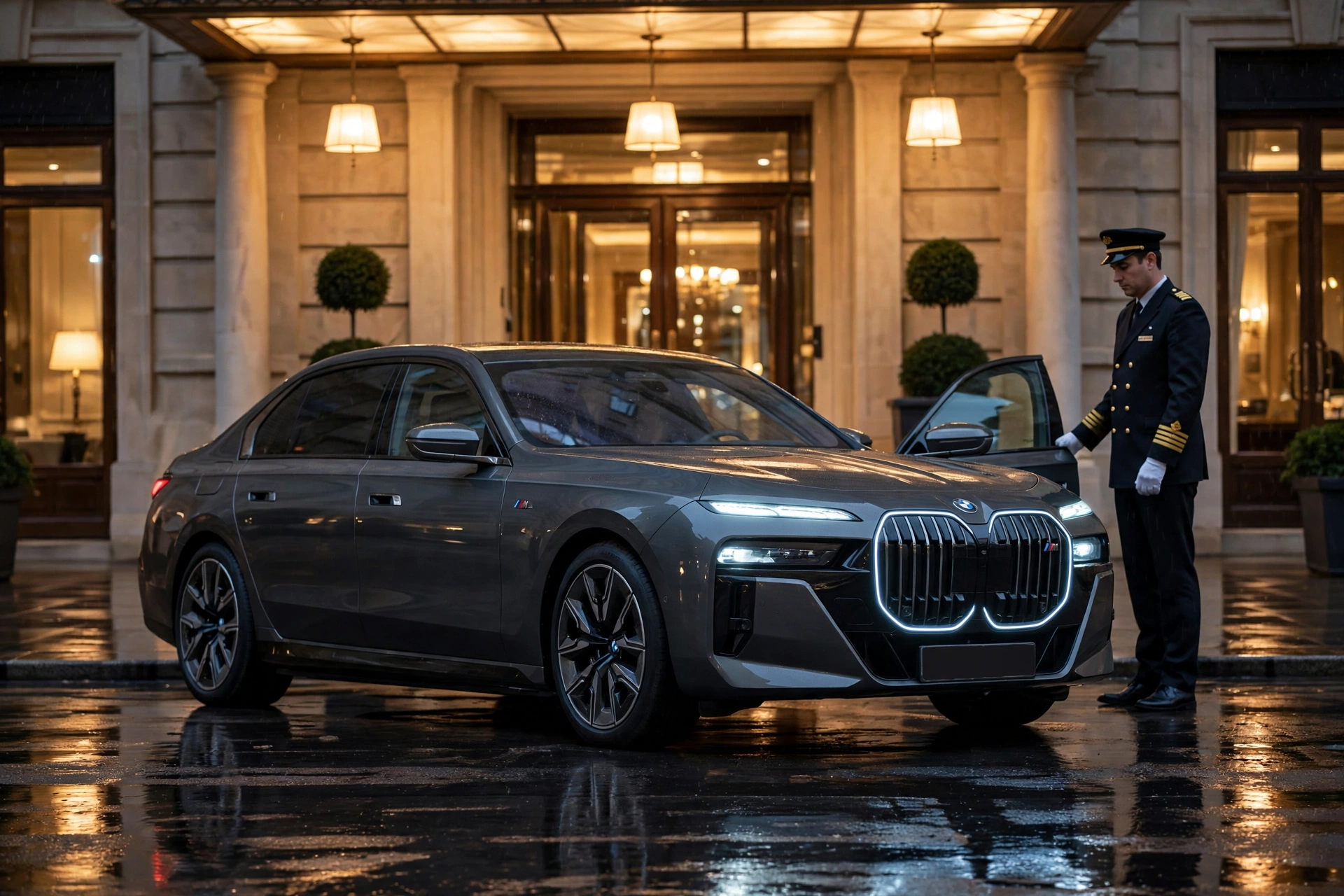
BMW i7 M70 specs, read off the official card
Let me lay the full card out, because this is where the M70’s personality splits in two. The battery is a 105.7 kWh pack with 101.7 kWh usable, running at roughly 376 volts. Peak DC charging is 195 kW, with a 10–80% charge quoted at 34 minutes; home charging runs at 11 kW AC. Nothing there is embarrassing. Nothing there leads the class either. The Sapphire charges at up to 300 kW. The AMG EQS peaked at 200 kW. The BMW sits at the back of its own fight on charging speed, and the referee notes it.
Now the number BMW would rather you skipped. Curb weight: 5,929 pounds, per BMW’s own US specification sheet. Gross vehicle weight rating is 7,150 pounds, which is full-size pickup territory. A generously optioned test car in one US review tipped past 6,200 pounds (est., as tested with options). Three tons. In a sedan. Every dynamic and efficiency figure that follows is downstream of that single decision, and I will keep returning to it, because it explains this entire car.
The weight penalty: what 5,929 pounds does to the BMW i7 M70
Here is the efficiency card, straight from the EPA. On the 21-inch wheels, the M70 is rated at 79 MPGe combined and 42 kWh per 100 miles. On the 20-inch wheels, it gets worse: 75 MPGe and 45 kWh per 100 miles. Yes, you read that correctly — the bigger wheels rate better, because the 21-inch design is the aerodynamic one. Wheel choice alone swings this car’s appetite by 3 kWh per 100 miles, and I challenge you to find another flagship where the showroom wheel decision matters this much.
It also explains why this car’s agility surprises people. Rear-axle steering, M-specific adaptive air suspension and serious brakes make 5,929 pounds change direction with real polish — testers keep using the word “royalty” about the ride. Credit where due. But physics collects its tax somewhere else: in tyres and brake pads asked to manage three tons, and in the electricity bill above. Lightweight rivals pay less of every one of those taxes.
Compare the table. The Lucid Air Sapphire, with nearly double the power, is EPA-rated at 32 kWh per 100 miles. The AMG EQS managed 41. So the BMW burns 31% more electricity per mile than the Lucid while producing 584 fewer horsepower. That is not a rounding error; that is an engineering philosophy losing an argument. Mass is the main culprit, helped along by a tall, upright body that pushes air aside like a wardrobe. My call, no hedging: on efficiency, the Sapphire does not beat the BMW. It laps it. Twice.
Range and charging: the BMW i7 M70 against the EPA and the testers
EPA range for the 2026 model year is 285 miles on the 21-inch wheels and 267 miles on the 20s — check the current figures yourself on the M70’s fueleconomy.gov listing. Note the direction of travel: the 2024 car was rated at 291 miles, so the current rating has actually slipped 6 miles. A small cut, sure. But in a segment where rivals add range every year, standing still is losing, and shaving miles is worse.
Tested figures tell a kinder story, and the standing rule here is that tested numbers sit beside the estimates. Edmunds ran its standardised EV range test on a 2024 M70 with the 21-inch wheels and recorded 312 miles against that car’s 291-mile EPA rating, with measured consumption of 36.9 kWh per 100 miles — comfortably better than the EPA’s consumption figure. Fair play to BMW: the car outruns its sticker in gentle testing. Just remember that Edmunds’ loop is not a 75 mph interstate run in February, and a 42 kWh/100 mi EPA consumption figure is what your winter road trips will look like.
Home charging is the calmer story. The 11 kW onboard charger refills the 101.7 kWh usable pack in about nine and a half hours (101.7 ÷ 11 ≈ 9.2 hours, plus the usual tapering at the top), so a car plugged in at 10 pm is full before breakfast even after a deep discharge. For a chauffeur-driven or executive car that sleeps in the same garage every night, that is the only charging statistic that truly matters — and it is the one round where this car’s numbers are nobody’s problem.
Head-to-head: BMW i7 M70 vs Lucid Air Sapphire
Time for the main event. The Sapphire costs $250,500 including destination. For that $80,825 premium over the BMW, Lucid gives you 1,234 hp, 1,430 lb-ft, 0–60 mph in 1.89 seconds, a 205 mph top speed, EPA range of 427 miles, and a 118 kWh battery charging at up to 300 kW. It also weighs roughly 5,340 pounds (est.) — about 590 pounds less than the BMW, with nearly twice the output. On the performance and efficiency cards, this is not close, and I will not pretend otherwise. Sapphire takes both rounds by a wide margin.
Where does the BMW score back? Everywhere the stopwatch stops mattering. The i7’s cabin is quieter, its materials richer, its rear seat a genuine lounge with a 31.3-inch theatre screen (covered below). BMW has a national dealer network; Lucid has a handful of service centres and a mobile van. If your life runs on rear-seat comfort and a service department in your city, the M70 wins your rounds. If your life runs on speed and range, it never stood a chance.
Lucid Air Sapphire — Our score: 8.8/10 — Performance: 10/10 · Efficiency: 9/10 · Value: 5/10. The performance champion of this trio, priced like it knows it.
Head-to-head: BMW i7 M70 vs the Mercedes-AMG EQS
The Mercedes is the ghost at this table. When it was last on US price lists, as a 2024 model, the AMG EQS cost $147,550 with 649 hp (751 hp with the Dynamic Plus boost), a 3.4-second (est.) 0–60 mph time, 108.4 kWh usable, 200 kW peak charging, and an EPA rating of 305 miles at 41 kWh per 100 miles. It has since left the US lists, which tells you where Mercedes thinks this segment is going. Our own Mercedes electric car guide tracks what the brand sells now instead.
Against the BMW, the old AMG still lands punches: more EPA range (305 vs 285 miles), slightly better efficiency, a lower sticker when new. The BMW counters with the better rear seat, the better ride, and the fact that you can still buy one new with a full warranty. As a used proposition, though, the AMG is the smart money in this entire comparison — flagship pace and range for used-car money. That is not a compliment to BMW’s pricing department.
Mercedes-AMG EQS (2024) — Our score: 7.9/10 — Performance: 8/10 · Efficiency: 7/10 · Value: 8/10 (as a used buy; it was a 6 new).
The maths round: price per mile and the annual charging bill
Now the computation nobody at a launch event will show you. Take the price including destination and divide by the EPA range. That is what you pay for every mile of range on the sticker:
BMW i7 M70: $169,675 ÷ 285 miles = $595 per mile of EPA range. Lucid Air Sapphire: $250,500 ÷ 427 miles = $587 per mile. Mercedes-AMG EQS: $147,550 ÷ 305 miles = $484 per mile. Read that again. The $250,500 Lucid is better value per mile of range than the BMW, because it carries 142 extra miles. The dead Mercedes beats them both. The M70 wins this round against nobody.
Second sum, the efficiency tax, run at 15,000 miles a year on home electricity at $0.17 per kWh (est., a typical US residential rate). The M70 on 21-inch wheels uses 42 kWh per 100 miles, so 15,000 × 0.42 = 6,300 kWh, costing $1,071 a year. On the 20-inch wheels it is 6,750 kWh and $1,148. The Sapphire at 32 kWh per 100 miles uses 4,800 kWh and costs $816. That is 1,500 kWh and $255 a year the BMW burns for the crime of being heavy, every year you own it.
Filling the M70’s 101.7 kWh usable pack at home costs about $17.30 — cheap per fill, and our electric car cost-per-mile breakdown shows where that fits against petrol rivals. Cheap per fill is not the same as efficient, and this car proves it nightly.
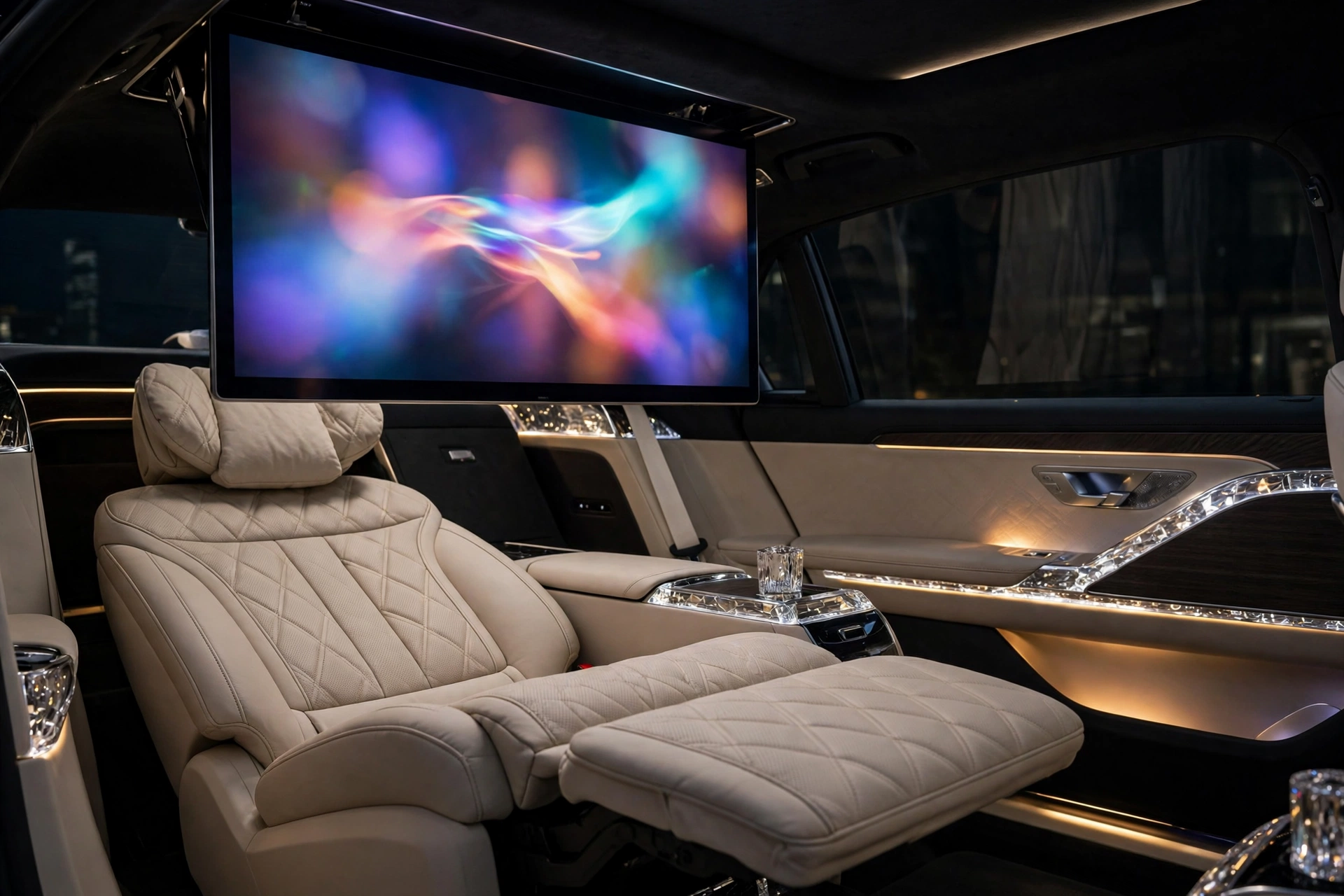
Inside the BMW i7 M70: the rear seat is the main event
Enough penalties. Here is the round the BMW wins outright. The optional 31.3-inch BMW Theatre Screen folds down from the headliner, an 8K cinema screen for the rear cabin, paired with the Executive Lounge rear seat that reclines and extends a footrest. Add the optional 39-speaker Bowers & Wilkins Diamond system (an 18-speaker Bowers setup is standard), automatic doors, and upholstery that shames cars costing $80,000 more. The driver is not forgotten — Highway Assistant hands-free driving and eye-activated lane changes are genuinely slick — but be honest about this car: the front seat is the office. The back seat is the product.
Two warnings from the referee’s chair. First, the theatre screen is an option, not standard kit, so a lightly specced M70 is a much less magical place. Second, all this indulgence rides in a body with split headlights and a grille outline that lights up like a casino sign. You either love the look or you buy the dark paint. There is no third option, and the sales figures for subtle taste suggest most buyers pick the dark paint.
What changed for 2026 — and the facelift problem
For the 2026 model year, changes are small: BMW Digital Key is now standard, the gesture-based Natural Interaction feature has been discontinued, and the EPA range slipped from 291 to 285 miles on the 21-inch wheels. That is the whole list. Now the awkward part. In October 2026, BMW revealed a facelifted 7 Series and i7 for the 2027 model year in Europe, with the M70’s output rising to about 671 hp, a larger battery on lesser trims, and DC charging reported at up to 250 kW. US specifications and timing are unconfirmed (est.), so I am not scoring a car you cannot buy.
But the referee’s advice writes itself: unless the deal on a 2026 car is aggressive, waiting costs you nothing and the incoming car fixes this one’s two weakest rounds — charging speed and output. BMW knows where the M70 loses. The facelift is the confession.
One ownership note before the bell. The warranty card reads 4 years/50,000 miles basic, 8 years/100,000 miles on the battery, and three years of complimentary scheduled maintenance — standard BMW flagship cover, matched against Lucid’s similar terms and a far bigger dealer map to honour them. Score that under support, where the BMW quietly wins.
The verdict
BMW i7 M70 — Our score: 7.6/10 — Performance: 8/10 · Efficiency: 5/10 · Value: 6/10.
The reasoning, one last time. As a luxury object, this is the best car here: the quietest cabin, the finest rear seat, the strongest dealer support. As an electric car, it is out-ranged, out-charged and out-efficiencied by a Lucid that also happens to be nearly twice as powerful. And inside its own house, the i7 xDrive60 offers the same cabin and more range (up to 314 miles in recent ratings) for roughly $44,300 less, which makes the M70’s premium a payment for a badge and a boost paddle.
Run the ownership numbers yourself with our EV total cost of ownership calculator before you sign. If you still want the M70 after that, you want it for the right reason: not because it wins the electric argument, but because nobody else builds a back seat like this. Buyers who want the same trick in a smaller, cheaper package should also read our BMW i5 buyer’s guide — and how we test and score every car is set out on our research page.
Frequently asked questions
How much does the BMW i7 M70 cost?
The 2026 car starts at $168,500, or $169,675 with BMW’s $1,175 destination charge (prices checked October 27, 2026). Options climb fast: a fully loaded US test car stickered at $192,075. The theatre screen, lounge seating and the big Bowers & Wilkins system are all paid extras.
What range will I actually see?
The EPA says 285 miles on the 21-inch wheels and 267 on the 20s. Edmunds’ standardised test of a 2024 car beat its rating with 312 miles at gentle pace. Plan on 285 or less at motorway speeds, and less again in winter — the 42 kWh per 100 miles consumption figure is the honest planning number.
How fast does it charge?
Peak DC rate is 195 kW, with a quoted 10–80% time of 34 minutes. That is mid-pack for the class: the AMG EQS peaked at 200 kW and the Lucid Sapphire at 300 kW. At home it charges at 11 kW AC, so a full usable pack takes roughly nine to ten hours overnight.
Is the theatre screen worth it?
If anyone will regularly ride in the back, yes — it is the feature that justifies the entire car. If the rear seat will mostly carry a child seat and shopping, skip it and keep the money. It is optional, so check the window sticker of any car you view; do not assume it is fitted.
M70 or xDrive60?
The xDrive60. It keeps the cabin, the ride and the screen options, adds range, and saves you roughly $44,300. The M70’s extra 114 hp shows up in a straight line and nowhere else in daily use. Buy the M70 only if the top of the range is the point — that is a legitimate reason, and it is the only one that survives the maths.
Should I wait for the facelift?
Probably. BMW has shown a 2027 i7 with about 671 hp and reported 250 kW charging for other markets; US details are unconfirmed (est.). If the current car’s charging speed and efficiency bother you — and the scorecard above says they should — the wait is the low-risk move.
In short, the BMW i7 M70 is best judged as a luxury flagship first and an efficiency champion second. If you value the rear-seat theatre, quiet cabin and dealer support, the BMW i7 M70 makes a strong case; if maximum range and charging speed matter most, the BMW i7 M70 is harder to recommend over its rivals. The BMW i7 M70 is, in short, a luxury-first flagship.