Last updated: October 27, 2026
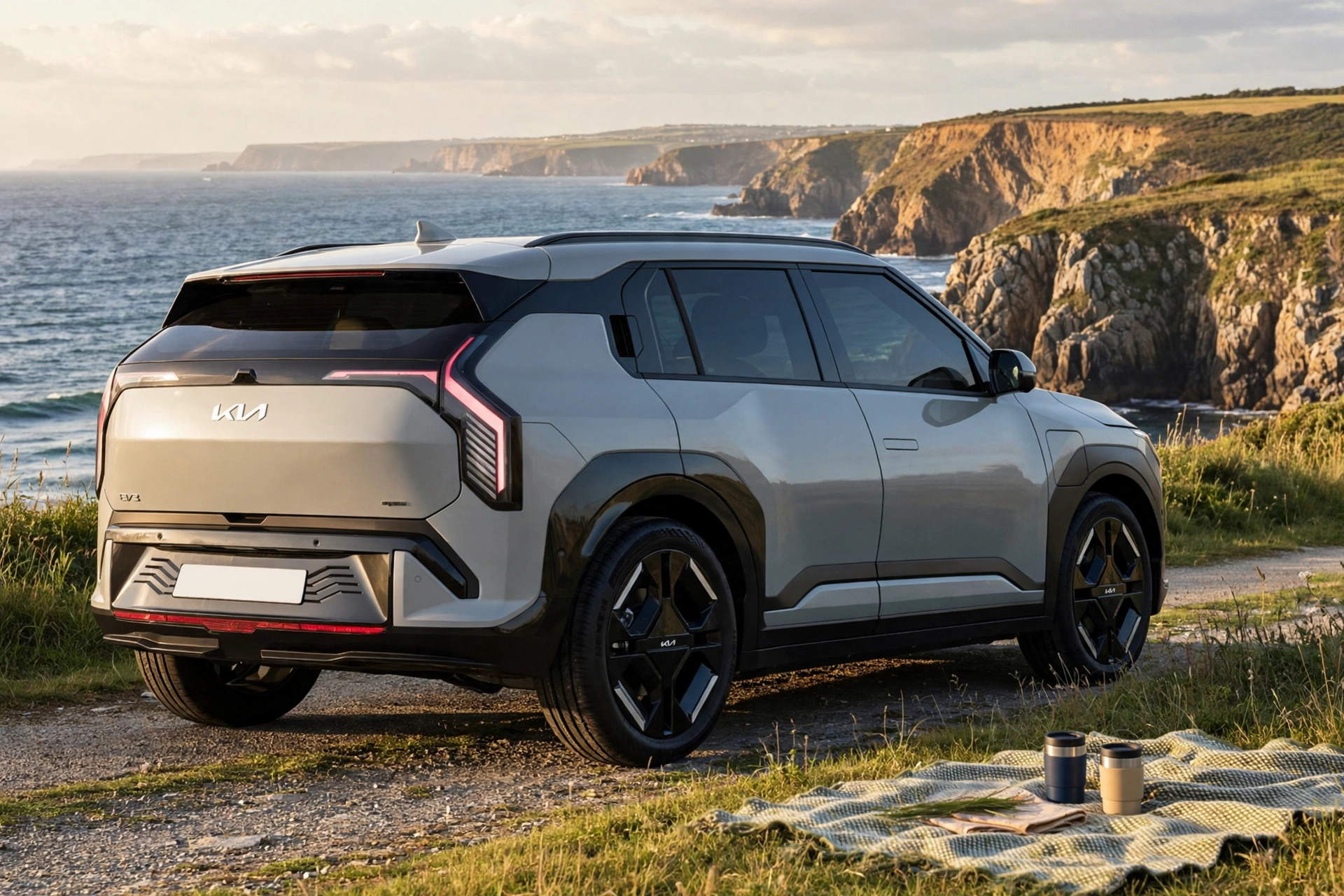
The wait is over. The Kia EV3 is on sale in the United States right now — in showrooms, with a sticker price under $30,000 and a maximum EPA-estimated range of 321 miles. That sentence was not true three months ago. It is the single biggest change in America’s cheap-EV market this autumn, so let’s get the facts straight while the launch dust is still in the air.
Quick timeline, because this launch moved fast. The 2027 EV3 made its North American debut at the New York auto show in April. Production for our market started on August 4 at Kia’s plant in Pesquería, Mexico — the first battery-electric Kia ever assembled there, backed by a $649 million plant investment. Kia confirmed US pricing on August 12, US sales began in mid-August, and on October 1 the company announced the car had officially arrived in US showrooms.
The first scoreboard is in, and it is modest. Kia sold 514 of them in September, the first full month, with roughly 1,300 units in dealer stock at launch. That is a toe in the water, not a flood. Stock is still thin outside the big EV states, and the higher trims are scarcer than the base car (est., based on launch allocation reporting).
What changed this month: Canada got its pricing — from CA$36,995, the lowest-priced EV in that market — with cars reaching Canadian dealers in late October. European order books added the GT flagship. And US inventory has kept building week by week since the August start, which matters for the buying-timing advice further down this page.
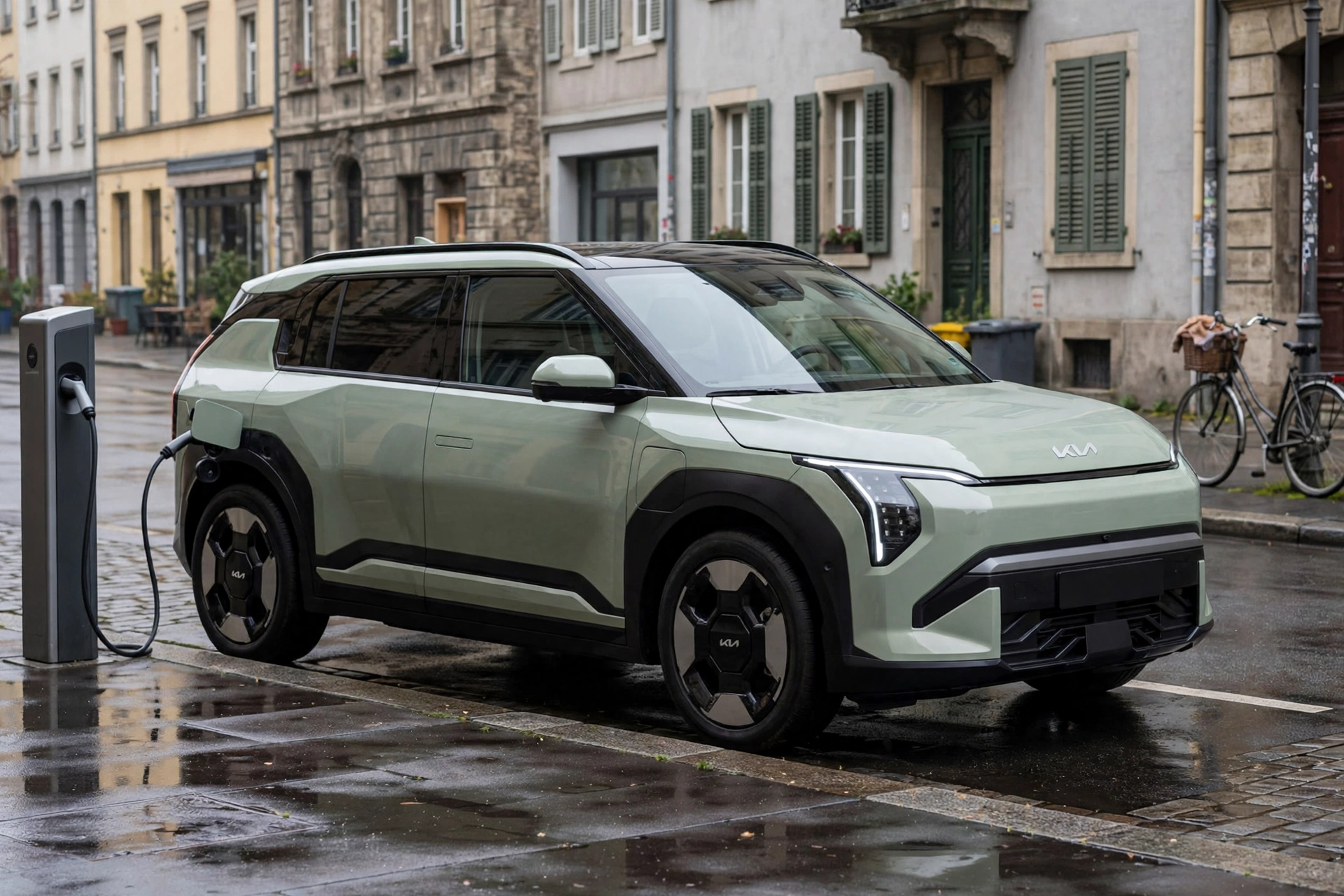
One piece of timing context before the specs. This car lands in a market with no federal tax credit — that ended for every EV on September 30, 2025. So the $29,890 headline is the real starting price, full stop. No asterisk, no credit maths at the dealer. What you see is what everyone pays.
EV3 specs: two batteries, one clear winner
Two battery sizes, both on Kia’s 400-volt E-GMP platform. The Light trim gets a 58.3 kWh pack and an EPA-estimated 221 miles. Every other trim — Wind, Land, GT-Line, GT — carries an 81.4 kWh pack: 321 miles in front-wheel drive, 280 miles with all-wheel drive.
Power is honest for the class. Front-wheel-drive cars make 201 hp. All-wheel drive adds a rear motor for 261 hp. The GT turns that up to 288 hp and a 0–60 mph run of about 5.4 seconds (est., Kia figure). Nobody cross-shopping a $30,000 crossover needs more than the base motor. It is not slow.
Charging is competitive, not class-leading. The big battery peaks at 128 kW on a DC fast charger (Kia’s published figure for the long-range car) and runs 10–80% in about 31 minutes; the small battery takes about 29 minutes. The EV6 charges far faster on its 800-volt system. This one charges fast enough — a coffee stop, not a lunch stop — and that distinction matters at this price.
The detail US buyers will feel on day one: a native NACS port. Superchargers work without an adapter, and Plug & Charge is built in. Before you assume your current car or home setup plays nicely with every network, run the plug and network checks in our EV charger compatibility checker — it takes two minutes and prevents the classic first-road-trip surprise.
Standard V2L is the spec-sheet surprise. Every US trim can power external devices from the battery — tools, lights, a campsite. Vehicle-to-home backup is available through a Wallbox bidirectional setup. A $30,000 car that can keep your fridge alive in an outage is a new thing in this market, and it deserves more attention than it is getting.
Inside, you get the same wide triple-screen layout as Kia’s bigger EVs — a 12.3-inch cluster, a 5-inch climate panel and a 12.3-inch touchscreen, nearly 30 inches of glass in total — plus wireless Apple CarPlay and Android Auto. The car itself is 169.3 inches long, roughly Bolt-sized and about 4.5 inches shorter than the Niro EV it effectively replaces in Kia’s US line-up (est., from published lengths).
Home charging is the standard story, told well. The onboard AC charger takes 11 kW, so the big battery fills from empty in roughly seven and a half hours (81.4 ÷ 11 = 7.4, before the usual losses) — plug in at dinner, leave full at breakfast. The small battery needs about five and a half hours. On a typical weeknight top-up, you will never think about it.
Two years on sale overseas: the track record is already written
Here is the part of this launch that is genuinely unusual. America is not the test market. The EV3 went on sale in Korea in 2024 and reached Europe and the UK later that year, so the US car arrives with two years of owner history, reliability data and independent testing already attached to it.
The record is strong. The car won the 2025 World Car of the Year title outright — not a category prize, the whole thing — and in its first full year it was the third most popular EV in the UK. German comparison testing this year rated it the strongest EV in its test field, praising exactly the things that matter in a family crossover: seats, ride comfort, an easy-going powertrain.
European real-world testing has also taken the mystery out of the range question. Independent UK testers running the long-range car at motorway speeds report around 280–300 miles in mixed use, with 300–320 achievable in gentler driving (figures as reported by UK test publications, checked October 27, 2026). Against the 321-mile EPA estimate, that is a claim that survives contact with the real world. Plenty of rivals’ headline numbers do not.
It also means the early-build questions are already answered. European owners have lived through two winters, two software generations and the first recall-and-update cycle. US buyers in October 2026 are buying a debugged car — a rare luxury at a launch price, and a genuine reason to choose it over a brand-new rival design with no history at all.
EV3 prices: the $29,890 headline and the $1,495 footnote
US prices, checked October 27, 2026, from Kia’s published figures as carried on Kia’s official EV3 page. MSRP first, then the number that actually matters — every trim adds a $1,495 destination charge.
Light FWD: $29,890, or $31,385 delivered, for 221 miles. Wind FWD: $34,990 ($36,485 delivered) for the full 321 miles. Land FWD: $38,490 ($39,985 delivered), same battery, more kit. All-wheel drive is a $3,200 option on Wind and standard further up: Wind AWD $38,690, Land AWD $41,690, GT-Line AWD $43,490 and the GT AWD at $45,890 — $47,385 delivered.
Our position, plainly: the Wind FWD is the buy. It is the cheapest way into the 81.4 kWh battery and the 321-mile rating, and the jump from the Light is $5,100 for 100 extra miles of range. The Light’s 221 miles is the one spec in this line-up that will feel old in five years. Range ages; screens don’t.
Second position, just as plain: skip the GT. At $47,385 delivered you are within touching distance of an EV6, which charges nearly twice as fast and drives a class above. The GT exists to give the range a halo. Let someone else pay for it.
Prices elsewhere, for the global picture. Canada: from CA$36,995. The UK: from £31,555 on the road for the Air Standard Range, including the £1,500 government Electric Car Grant. Germany: from €36,190 including VAT. Straight currency conversions of those numbers (est.) land in the mid-$30,000s — so the US Light, unusually, is among the cheapest ways into this car anywhere.
The EV3’s WLTP number vs its EPA number: the conversion maths
European reviews will quote you 375 miles for the long-range car. American listings say 321. Both are official. Neither is a lie. They are different tests, and the gap between them is predictable enough to do on paper.
The long-range car’s European WLTP rating is 608 km. Convert: 608 ÷ 1.609 = 378 miles. The US EPA estimate for the same battery in front-wheel drive is 321 miles. So 321 ÷ 378 = 0.849. The EPA figure lands at almost exactly 85% of the WLTP figure.
The small battery confirms the pattern. WLTP: 438 km = 272 miles. EPA: 221 miles. 221 ÷ 272 = 0.81. So the working rule for this car — and a decent rule for European EVs generally — is: take the WLTP number, multiply by 0.85, and you are within a few miles of the EPA answer. 378 × 0.85 = 321.3. There it is.
Why the gap? The EPA cycle runs faster, with harder acceleration and more climate-control load, then applies its own adjustment factors. WLTP is gentler. If a European headline number ever looks too good, it is. Use 0.85 and shop on the corrected figure.
What to cross-shop against the EV3 in the US now
The cheap-EV shelf looks very different from a year ago. Two of the obvious rivals are gone. Kia’s own Niro EV has been discontinued in the US — this car is its replacement in everything but name. The Hyundai Kona Electric is paused for the 2026 model year, with only leftover 2025 stock around. The Volvo EX30 still lists at $40,345, and Volvo has confirmed US sales end after the 2026 model year. Time is not on that car’s side either.
That leaves three live rivals, and the honest way to compare them is price per mile of EPA range. MSRPs checked October 27, 2026, before destination, since every maker plays the same destination game:
Nissan Leaf: $29,990 ÷ 303 miles = $98.98 per mile of range. Kia EV3 Wind FWD: $34,990 ÷ 321 = $109.00 per mile. Chevrolet Bolt: $28,995 ÷ 262 = $110.67 per mile. EV3 Light: $29,890 ÷ 221 = $135.25 per mile.
Read that table carefully. The Leaf wins the per-mile maths outright — it is the range bargain of the segment. But the Wind beats the Bolt on the same measure, offers all-wheel drive the other two cannot sell you at any price, and adds standard V2L. The Light, meanwhile, is the worst per-mile value of the four despite the lowest sticker on this page. The cheapest EV3 is not the smart EV3.
Running costs stay friendly whichever you pick. Filling the 81.4 kWh pack from empty at the US residential average of about $0.17 per kWh (est.) costs 81.4 × $0.17 = $13.84, which works out at roughly 4.3 cents a mile at the EPA rating. Our electric car cost per mile guide breaks down how that compares with the petrol crossovers most buyers are trading in.
One more option deserves a line: stepping up a size. The Chevrolet Equinox EV starts at $36,795 including destination and offers up to 319 miles in its cheapest front-drive form — squarely in Wind FWD territory on money, bigger inside, slower to charge. If your life fits in a 169-inch car, the Kia is the sharper tool. If you regularly fill a bigger boot, the Chevy earns its place on the test-drive list. Neither answer is wrong; buying the wrong size is the only mistake here.
Should you buy one this month, or wait?
Timing, since that is the question of the moment. Stock is building but still thin: 514 sales in the first full month against a segment where the old Bolt routinely moved several thousand. If your local dealer has a Wind FWD at MSRP today, that is a fair deal — take it. If the only cars near you carry launch markups or forced add-ons, wait. Supply rises every week, Mexico production is running, and markups on a $35,000 Kia have a short life expectancy.
The one group who should not wait: Kona Electric and Niro EV owners whose cars are coming off lease this winter. Your replacement options inside the Hyundai-Kia family just narrowed to this, and it is better than both of the cars it replaces — more range, faster charging, a proper NACS port. The step up is real.
For a wider look at how the whole affordable end of the market now stacks up, our guide to EV cars: range, charging, costs and who should buy walks the full line-up. And if you want to know how the figures on this page were checked — manufacturer pages, EPA data and dated price reporting — our how we research page shows the working. The launch timeline and US/Canada pricing reporting from Electrek’s EV3 pricing coverage is the cleanest single record of how this launch unfolded.
Our verdict on the EV3
Our score: 8.4/10. Specs for the class: 9/10. US availability: 6/10. Value where sold: 9/10.
The specs score is earned: 321 miles, two batteries, an all-wheel-drive option, standard V2L and a NACS port, in a 169-inch box. Nothing else on the US market at $35,000 matches that sheet.
Availability is the weak leg, honestly scored. The car exists, you can buy one, and Kia deserves credit for shipping it while rivals cancelled theirs. But 514 first-month sales and thin regional stock mean many buyers still cannot test-drive the trim they want. That fixes itself with time. It has not fixed itself yet.
Value is a 9 because the Wind FWD at $109.00 per mile of range beats the beloved Bolt on the maths that matters — while the Leaf keeps everyone honest at $98.98. This is what a functioning cheap-EV market looks like. It has been a while.
Frequently asked questions
Is the Kia EV3 on sale in the US now?
Yes. US sales started in mid-August 2026 as a 2027 model, and Kia confirmed showroom arrival on October 1, 2026. It is built for North America in Pesquería, Mexico. Stock is still building, so the trim you want may need a short wait or a wider dealer search.
How much does the EV3 cost in the US?
From $29,890 for the Light FWD to $45,890 for the GT AWD, plus a $1,495 destination charge on every trim — so $31,385 to $47,385 delivered. Prices checked October 27, 2026. The Wind FWD at $34,990 is the value pick: it unlocks the big battery and the full 321-mile range.
Why is the European range 375 miles but the US range 321 miles?
Different test cycles. Europe’s WLTP figure for the long-range car is 608 km (378 miles); the EPA test is harder and lands at 321 miles — 85% of the WLTP number. Multiply any WLTP headline by roughly 0.85 before comparing it with an American sticker.
Does it qualify for a federal tax credit?
No — and neither does anything else. The federal clean vehicle credit ended for all new EV purchases after September 30, 2025. Some states still run their own incentives; Colorado, for example, offers a state credit on the cheaper trims. Check your state before you negotiate.
EV3 or Chevy Bolt: which should I buy?
On price per mile of range, the Bolt costs $110.67 and the EV3 Wind FWD $109.00 — a near tie. The Bolt is the cheaper car outright and simpler. The Kia answers with all-wheel drive as an option, standard V2L, a newer platform and a longer options list. Budget-first buyers: Bolt. Buyers keeping the car a decade: the Wind.
Can the EV3 power my house?
Partly. Vehicle-to-Load is standard on every US trim, so the battery can run tools, lights and appliances through its outlet — enough for essentials in an outage. Full vehicle-to-home backup is available through a compatible Wallbox bidirectional charger, at extra cost.