Last updated: October 27, 2026
Standing on a scooter is fine for twenty minutes. It is much less fine for a forty-minute ride to the pharmacy, a slow crawl through a farmers market, or any trip on a day when your knees are complaining. That is the gap an electric scooter with seat for adults is meant to fill: same small, cheap-to-run idea as a regular scooter, with somewhere proper to sit, a lower body position, and a calmer way of travelling. This guide is about fit and comfort first. Speed comes last, on purpose.
A seat changes more than comfort. Sitting lowers your centre of gravity, which makes the scooter feel steadier at low speed and far less tiring over distance. It also changes how you stop, how you wait at lights, and how you get on and off. One thing it does not change: a two-wheeled seated scooter still balances like a bicycle. You steer it, it leans, and you are part of keeping it upright. A seat is a comfort and confidence aid, not a mobility device, and we will be plain about that throughout.
Seated scooters fall into three families, and this guide treats them separately because they suit different bodies. First, ordinary standing scooters that accept a removable seat — the cheapest route in, and the most flexible. Second, scooters designed from the start around a seat, usually with a basket and a relaxed, bicycle-like riding position. Third, the wide, cushioned long-distance machines, built for riders who want to cover real miles sitting down. Prices for every model below were checked on October 27, 2026, and anything we could not confirm from a manufacturer page or an instrumented test is marked (est.) with its basis.
One short legal note before the details. In many US states, a seated scooter with no pedals that is faster or more powerful than the local e-bike-style limits is treated as a moped, with registration, a licence and a helmet to match. Gentle models in the 15–20 mph range usually sit inside scooter rules; the fast machine in our third band does not, and we say so where it appears. Our research method page explains how we check claims like these.
Who an electric scooter with seat for adults genuinely helps
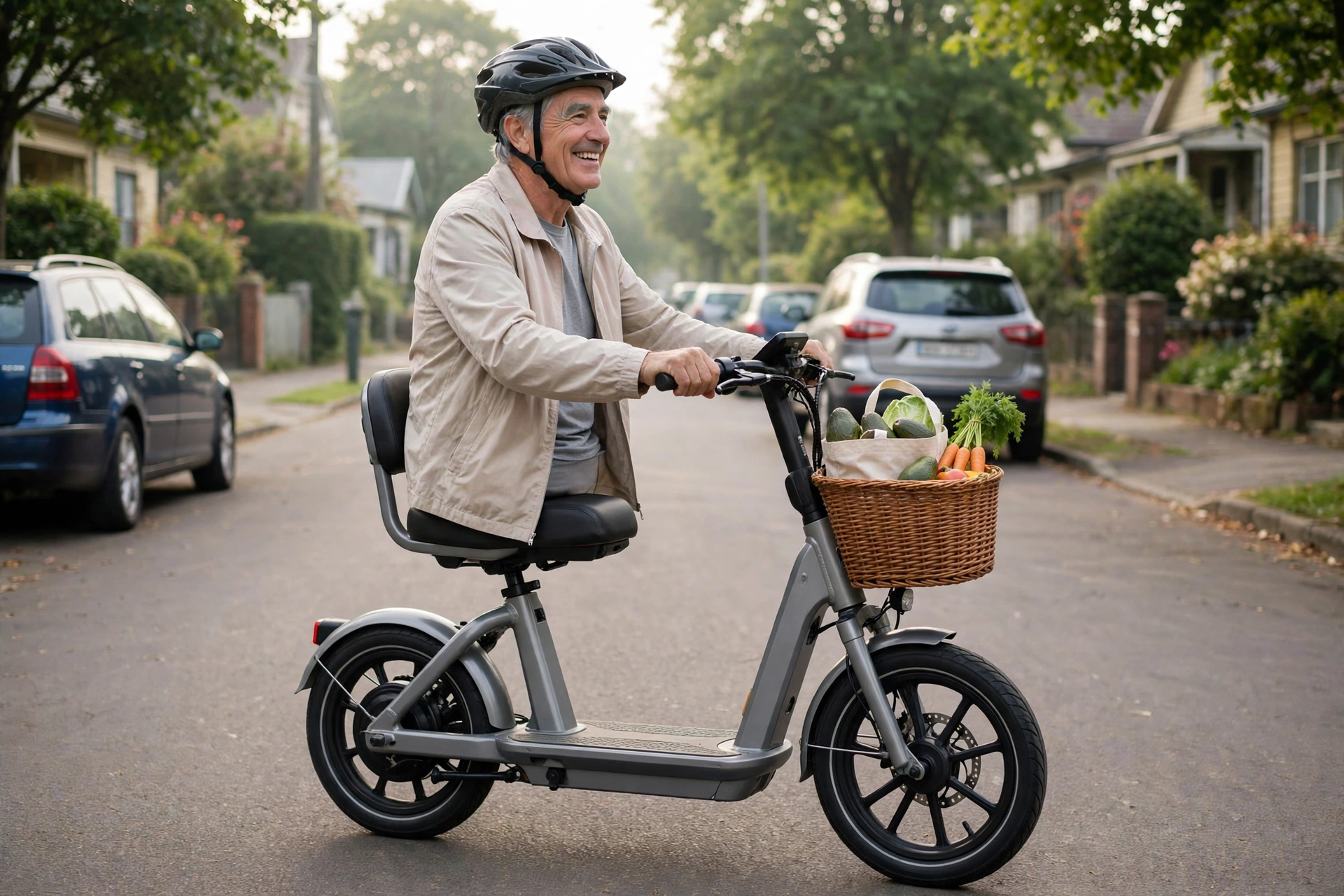
Start with balance confidence. Plenty of adults can balance perfectly well but do not enjoy doing it standing on a narrow deck, in traffic, on a machine that answers every shift of weight. Sitting down puts your feet closer to the ground and your weight lower, and most riders describe the difference the same way: the wobble in their shoulders goes away. For a nervous rider, that calm is the whole product.
Then there are knees and hips. Standing scooters ask your legs to be the suspension for the entire ride, knees bent, absorbing every crack in the pavement. A seat hands that job to a padded cushion and, on better models, proper springs. Riders with arthritic knees, a replaced hip, or legs that tire quickly often find a trip that was impossible standing becomes ordinary sitting. The same applies at traffic lights: seated, you put both feet down and wait. Standing, you hop off, wait beside the scooter, and climb back on — three small efforts that add up across a dozen junctions.
Distance is the third dividing line. Under a mile, almost any scooter works. Past about two miles, standing becomes a chore and posture suffers; a seat turns a three- or four-mile errand into something you might look forward to. If your trips are short hops from a car park, save your money. If they are the weekly shop, the school run, or a ride to see a friend across town, the seat is not an accessory. It is the point.
The fitting checklist for an electric scooter with seat for adults
Seat height, and your inseam. This decides whether you feel secure at a stop. The rule: if the seat height is at or a little below your inside-leg measurement, you can rest both feet flat while seated. The EMOVE RoadRunner V3 has a fixed seat 28.5 inches off the ground. A rider with a 30-inch inseam sits on it happily. A rider with a 27-inch inseam is roughly an inch and a half short (28.5 − 27 = 1.5) — toes, not feet, at every stop. Bicycle-style seat posts, like the EcoSmart Metro’s, adjust over several inches and forgive far more. Measure your inseam before you shop, not after.
Deck width and getting on. A wide deck lets you place your feet side by side and gives you room to step on without threading your leg over anything. The EcoSmart Metro’s bamboo deck is the widest in this guide and the easiest to mount at a standstill. Scooters with foot pegs instead of a deck — the RoadRunner again — suit riders who are comfortable swinging a leg over, and are a poor match for stiff hips. If mounting is your worry, the low, open deck wins.
Tyres and suspension are your real cushion. A padded seat alone cannot fix a harsh ride. Big air-filled tyres do most of the work: the Metro’s 16-inch bicycle-size tyres roll over cracked pavement far more kindly than the 10-inch tyres on smaller scooters. Suspension adds the second layer — the MAX G2 has springs at both ends, and the RoadRunner adds hydraulic forks plus rear shocks. Solid tyres transmit every pebble straight to your spine. For comfort, treat them as a deal-breaker.
Handlebar reach and weight. Sit tall, ideally: bars that force a hunched lean undo the seat’s good work in ten minutes. And weigh the whole package honestly. If the scooter must go into a car boot, the number that matters is the lift, not the ride: the MAX G2 is 53.5 lb, the EcoSmart Metro 65 lb, the RoadRunner 77.8 lb on the tester’s scales. Anything over about 55 lb is a two-person lift for most of us, whatever the advert implies.
Stability, honestly: what a seat can and cannot do
Here is the part the sales pages skip. An electric scooter with seat for adults still has two wheels in a line. At walking pace and below, it needs your balance, seated or not. What the seat genuinely delivers is a lower centre of gravity, feet that reach the ground sooner, and far less fatigue — and fatigue matters, because tired riders make sloppy stops. What it cannot deliver is the planted, cannot-fall feeling of a chair. If you need a machine that holds itself up at a standstill, that is a mobility scooter, a different product sold through different channels, and no seated scooter here is a substitute for one.
Three-wheeled seated scooters sit between the two. The TopMate ES32 is the common example: 250 W, a 270 Wh battery, a 15 mph top speed, a claimed 15.5 to 18.6 miles of range, and a folding frame of just 34.6 lb, at $699 from the brand’s own store (checked October 27, 2026). It will not fall over at a stop, and its reverse gear is genuinely handy.
The trade-offs are just as real: it corners by steering rather than leaning, so it can feel tippy on cambered ground, and even TopMate’s own listing tells riders to slow right down for turns because the larger tyres raise the centre of gravity. It has a single front drum brake, small 10-inch wheels, and it still asks for basic balance. Three wheels help most at a standstill and least in a turn — the opposite of what many buyers assume.
A last word on how to read the range numbers. A maker’s range figure is measured with a light rider, on flat ground, at a gentle speed. Real riders, real hills and real weather take a bite out of it, so wherever a credible tester has measured a scooter properly, we print the tested figure next to the claim. Plan your trips around the tested number, not the brochure number, and a seated scooter will rarely surprise you.
Band one: a standing scooter that accepts a seat — Segway Ninebot MAX G2
The gentlest way into seated riding is to buy a good standing scooter and add a seat you can take off again. The Segway Ninebot MAX G2 is the strongest base for that trick: a 450 W motor (1,000 W peak), a 551 Wh battery, front and rear suspension, self-sealing 10-inch tubeless tyres, a 265 lb load limit and a UL 2272 listing. Segway claims up to 43 miles; independent testers measured 26.6 miles (Rider Guide) and 34.4 miles (TechGearLab), so plan on roughly 30. At $999 list, and frequently discounted, it is the newer sibling of the scooter in our Ninebot MAX G30P guide.
The seat itself is the catch. Segway’s own MAX seat accessory exists, yet most seats sold for this scooter are third-party clamp-on kits at roughly $60–$180 (est., based on US retail listings checked October 27, 2026). A good kit is height-adjustable and removes with a lever, so the scooter still folds for a car boot. A poor kit wobbles, and the wobble goes straight through your back. Our position is firm: a clamp-on seat only earns its place on a suspended, wide-decked scooter like this one. On a hard, narrow budget scooter it is a cushion bolted to a plank, and the money is better saved towards a scooter designed to be sat on.
Segway Ninebot MAX G2 with seat kit — Our score: 7/10 (Comfort 7/10 · Stability 6/10 · Value 8/10). The suspension does real work, the range is honest once you use the tested figures, and the seat comes off when you want your standing scooter back. It loses marks because the seated position sits high on a scooter designed for standing, so shorter riders should try before buying.
Band two: an electric scooter with seat for adults built for errands — Razor EcoSmart Metro
The Razor EcoSmart Metro was designed around its seat from the first sketch, and it shows in the details that matter for comfort: a padded, height-adjustable seat on a bicycle-style post, the widest deck here, 16-inch air-filled tyres, an upright riding position, and a detachable basket over the front wheel with a luggage rack behind the seat. It is the closest thing in this guide to sitting on a garden chair that happens to move. Full details live on Razor’s EcoSmart Metro product page, and its $859.99 MSRP is much less relevant than the street price: major retailers listed it between roughly $388 and $495 when we checked on October 27, 2026.
The gentle numbers suit gentle jobs: a 500 W chain-driven motor, an 18 mph top speed, and a claimed range of up to 12 miles, which in practice means 8 to 10 miles of real errands (est., based on the maker’s 40-minute runtime figure). At 65 lb it is a garage scooter, not a boot scooter, and the 220 lb rider limit is the lowest here.
One honest flaw deserves its own sentence: the Metro still uses a sealed lead-acid battery — three 12-volt blocks — where everything else here is lithium. Lead-acid is heavy, fades faster, and gives no proper charge gauge. Budget for a replacement set, roughly $120–$150 (est.), in the second or third year, and the Metro still makes sense.
Razor EcoSmart Metro — Our score: 7.5/10 (Comfort 8/10 · Stability 7/10 · Value 7/10). The easiest scooter here to get on, sit on, and stop on, with a basket exactly where your shopping wants to be. It is held back by its battery chemistry and its short range, both of which matter less at street prices than at list.
Band three: the wide, cushioned long-distance seat — EMOVE RoadRunner V3
Some riders do not want a shorter walk; they want to replace the second car. The EMOVE RoadRunner V3 is the seated machine for that job: two 500 W motors, a removable 48 V battery of 1,124 Wh that lifts out at about 15 lb for indoor charging, and a long bench seat you can slide along to find your position. Voro Motors claims up to 53 miles; Electric Scooter Guide’s instrumented test recorded 32.8 miles, and their full RoadRunner V3 test is the most thorough public measurement of it. At $1,595 from Voro Motors (checked October 27, 2026), with a spare battery at $550, it is priced like the small vehicle it is.
The comfort hardware is the best here: hydraulic front suspension, twin rear shocks, tubeless air tyres and a seat 28.5 inches high that inseams of 29 inches and up will flat-foot happily. Two honesty notes, though. First, it stands on foot pegs rather than a deck, so mounting asks for a leg swung over. Second, it is fast — testers recorded 36.4 mph — and an electric scooter with seat for adults running at that speed, without pedals, is a moped in the eyes of many states, whatever the product page calls it. At 77.8 lb tested, it stays in the garage; the removable battery, not the frame, is the part that travels.
EMOVE RoadRunner V3 — Our score: 8/10 (Comfort 9/10 · Stability 8/10 · Value 7/10). The only pick here that genuinely replaces short car journeys in comfort, with tested range past 30 miles and suspension that flatters bad roads. It loses marks for weight, for the legal grey zone its speed creates, and because its fixed seat height shuts out shorter riders.
What two years of gentle trips actually cost
Comfort is the reason to buy; arithmetic is the reason it is easy to justify. Take a typical week for the riders of an electric scooter with seat for adults: four round trips to the shops, the pharmacy or a friend’s house, each two miles each way. That is 4 × 2 × 2 = 16 miles a week, 832 miles a year, 1,664 miles over two years.
By rideshare, at about $11 (est.) for a two-mile ride in a typical US suburb, those trips cost 8 rides × $11 = $88 a week — $4,576 a year, $9,152 over the two years.
By EcoSmart Metro at a $450 street price: electricity is nearly a rounding error. Its lead-acid pack holds roughly 0.43 kWh (est., from its three 12-volt blocks), so a full charge costs about 7 cents at $0.17 per kWh, and 1,664 miles at roughly 9 miles per charge comes to about $13 of electricity in two years. Add one battery set at $140 (est.) in year two: total about $603. Divide by the miles: $603 ÷ 1,664 ≈ $0.36 a mile, against $9,152 ÷ 1,664 = $5.50 a mile by rideshare.
Even at the Metro’s full $859.99 list price, the two-year cost lands near $1,013, about 61 cents a mile. The rideshare habit is the expensive part of this story, not the scooter.
Braking and low-speed manners, in plain language
On any electric scooter with seat for adults, braking feels different, so practise it somewhere quiet before your first real trip. Your weight sits lower and further back, which keeps the rear wheel planted and makes gentle stops feel calm. It also means a panicked grab at a front brake can still pitch you forward. Practise squeezing both brakes together, firmly and progressively, from about 10 mph, until it is boring. Boring is what you want.
For reference, testers stopped the RoadRunner V3 from 15 mph in 10.2 feet on its twin semi-hydraulic discs; the Metro makes do with a single rear disc and stops more leisurely, suiting its 18 mph ceiling; the MAX G2 pairs a front drum with electronic braking and feels reassuringly ordinary. Ordinary is a compliment here.
Low speed is where seated scooters earn their keep. Below walking pace, every two-wheeler gets vague; the seated rider’s advantage is that a steadying foot reaches the ground without a dismount. Use it, without embarrassment, at every junction. At lights, stay seated, feet down, and let the car drivers do the impatient shuffling. If outright pace on a standing scooter is more your thing, our Kaabo King GTR guide covers that very different machine. And one charging habit, borrowed from the car world: before plugging a second-hand charger into a scooter it did not arrive with, confirm the connector and voltage match — the same check-first principle behind our EV charger compatibility checker.
Frequently asked questions
Is an electric scooter with seat for adults safer than a standing scooter?
It is more forgiving, which is a quieter and more truthful claim. The lower seating position, feet that reach the ground at stops, and the absence of leg fatigue all reduce the chances of a clumsy low-speed fall. It is not safer in the sense of holding you up by itself — a two-wheeled seated scooter still balances like a bicycle, and a helmet still matters on every ride.
Can I simply add a seat to the scooter I already own?
Often, yes, provided the scooter has the deck space, the load rating and ideally suspension to suit. Seat kits for popular models such as the Ninebot MAX range cost roughly $60–$180 (est., retail listings checked October 27, 2026). Check three things before ordering: the kit is made for your exact model, your weight stays within the scooter’s limit once seated higher, and the scooter still folds the way you need it to with the seat fitted.
How far will a seated scooter really travel on one charge?
Plan on about two-thirds of the maker’s claim, and you will rarely be caught short. The tested figures tell the story plainly: the MAX G2 is claimed at 43 miles and measured at 26.6 to 34.4 miles depending on tester and course; the RoadRunner V3 is claimed at 53 miles and measured at 32.8; the EcoSmart Metro is claimed at 12 miles and behaves like an 8-to-10-mile machine (est.). Heavier riders, hills and cold mornings trim those numbers further.
Will one fit in my car?
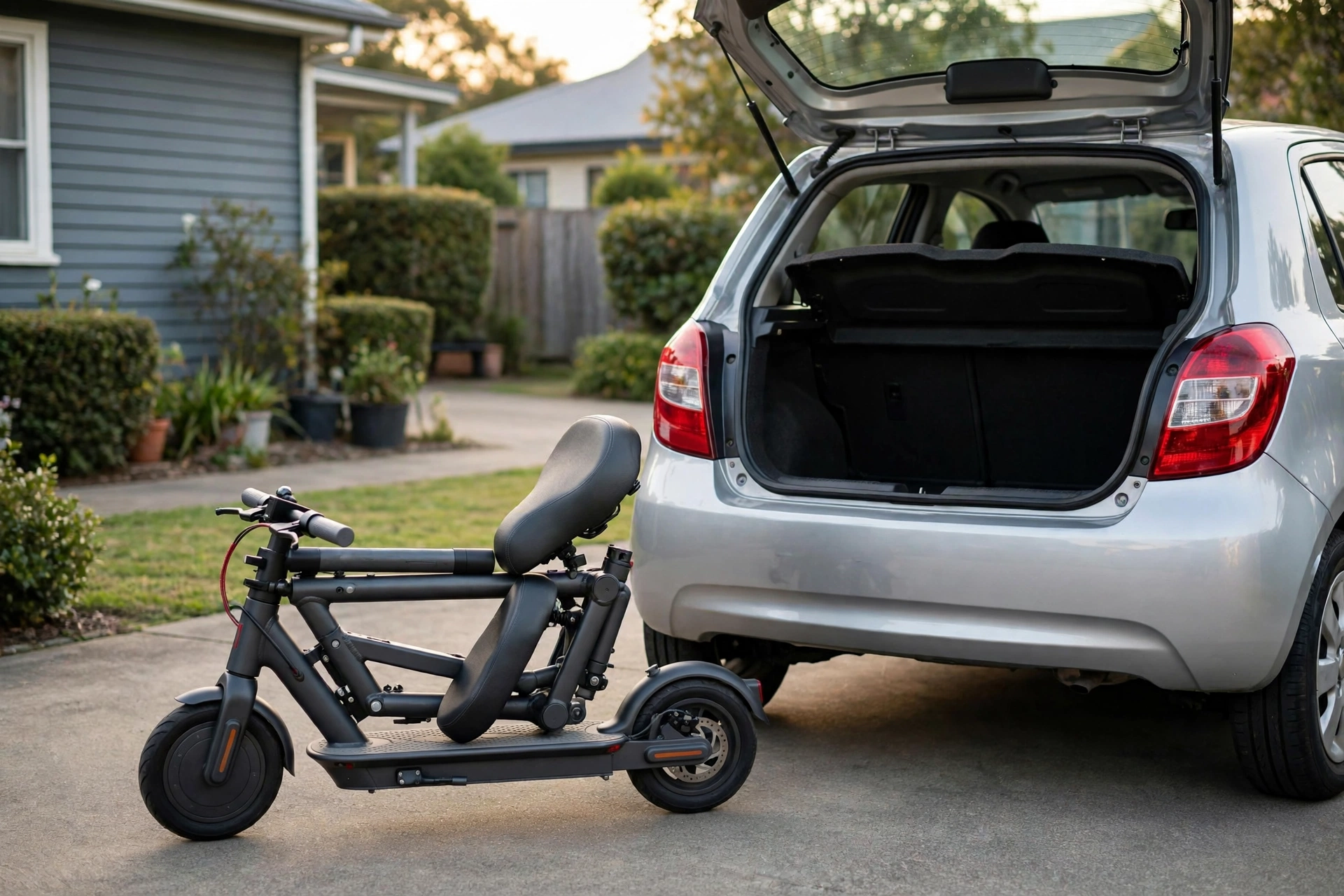
Two of our three picks, with help. The MAX G2 folds to a long, flat package at 53.5 lb, and its seat removes, so one able adult can load it. The three-wheeled TopMate ES32 folds smaller still at 34.6 lb. The EcoSmart Metro and RoadRunner V3, at 65 lb and 77.8 lb, are honest two-person lifts, better treated as garage-based transport. Measure your boot opening before buying; folded length, not weight, is the measurement that most often surprises people.
Do I need a licence for a seated scooter?
For the gentle end of this guide — machines limited to around 15–20 mph — most US states treat a seated scooter much like a standing one, and no licence is needed, though helmet rules vary. Once a seated scooter has no pedals and runs well past those speeds, as the RoadRunner V3 does, many states classify it as a moped, which can mean registration, a licence and insurance. Check your own state’s wording before buying the fast one.
Choosing an electric scooter with seat for adults comes down to fit, comfort and honest range. Test the seat height, check the tested range, and pick the electric scooter with seat for adults that suits your daily trips. With the right electric scooter with seat for adults, short errands become easier, calmer and far more enjoyable.
For daily errands, an electric scooter with seat for adults should feel steady, comfortable and easy to stop. Before you buy an electric scooter with seat for adults, check the seat height and the tested range. The best electric scooter with seat for adults for you is the one you will actually ride.
After a short test ride, an electric scooter with seat for adults either feels right or it does not. Trust that feeling when choosing an electric scooter with seat for adults, and remember that an electric scooter with seat for adults is a daily companion, not just a specification list.