Last updated: October 27, 2026
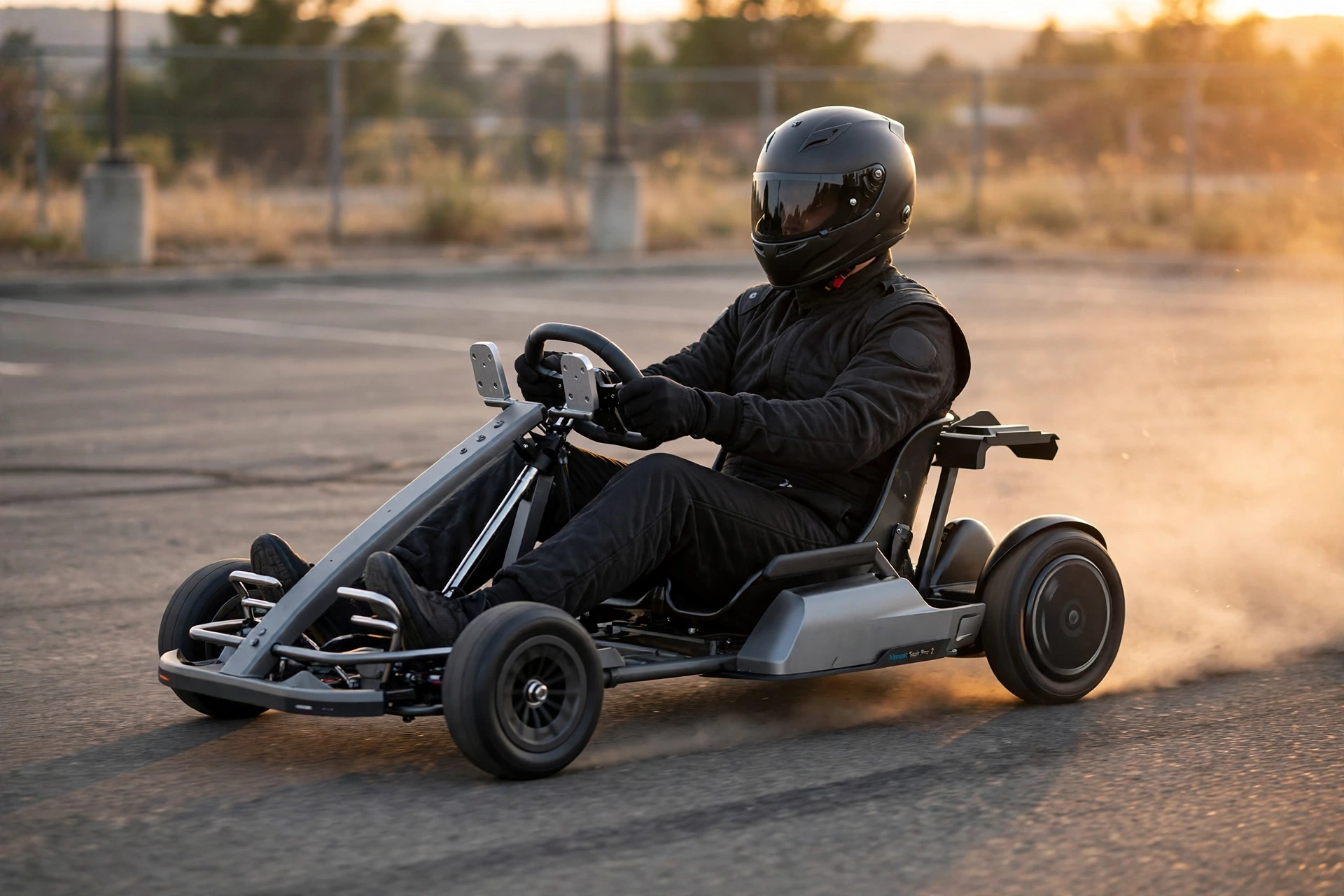
Most electric ride-ons are transport first and fun as an afterthought. The segway gokart pro 2 flips that order. It is a low steel kart frame, a racing wheel with paddle shifters, and a pair of electric motors with one job: make a private car park feel like a kart track. It tops out at 26.7 mph, it drifts on purpose, and when you unbolt the drive unit it turns into a PC racing controller and a self-balancing transporter. Nothing about it is a commute. That is exactly why the honest numbers matter, because the fun is real and the runtime is short, and a buyer who mixes those two up will feel cheated by week two.
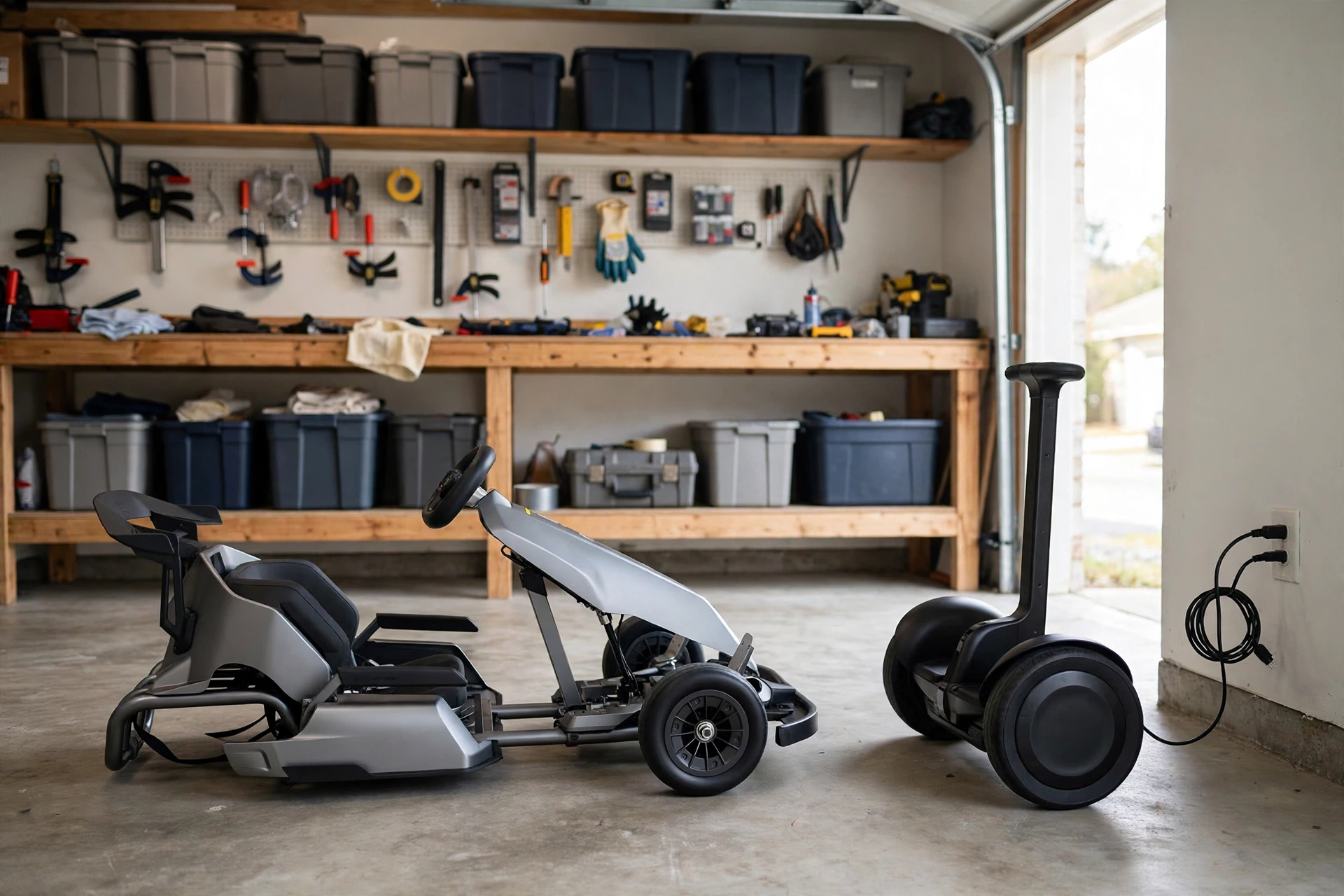
First, a correction that decides whether this product even makes sense to you. The segway gokart pro 2 is not built on the Ninebot Max G30 or Max G2 kick scooter, whatever older forum posts and sloppy listings imply. Segway builds it around the Ninebot S Max, the company’s beefed-up self-balancing two-wheeler. The kart kit — frame, seat, steering column, front axle — bolts onto the S Max, and the S Max’s two wheel motors become the kart’s rear axle. Unbolt it (a ten-minute job with the supplied tools, once you have done it once) and you have a self-balancing transporter that tops out at 12.4 mph on its own. If you came here picturing the tall kick scooter wearing a seat, you are thinking of a different product entirely; our guide to the Segway Ninebot Max G30P electric scooter covers the scooter side of the family.
The headline specs, all verified against Segway’s US store listing on October 27, 2026: two motors rated 450 W nominal each, peaking at 2,400 W each for a 4,800 W maximum, fed by a 432 Wh battery. Top speed 26.7 mph. Quoted range 15.5 miles, which Segway itself labels “typical” — hold that thought, because the real number is roughly half. Weight is about 106 lbs, payload is 220 lbs, and the price is $2,499.99 against a $2,699.99 MSRP, in stock at Segway’s store, Best Buy and Target at the same figure on the day we checked. There is no Pro 3 waiting in the wings as of October 2026; the Pro 2 is still the current flagship kart, which makes the buy-or-wait question simpler than usual.
Who should actually buy one? Adults and older teens (Segway rates it 14+) with regular access to private tarmac: a big driveway, a farmyard, an industrial estate car park on a Sunday, a kart track that allows electric entries. The frame adjusts for riders from about 4 ft 3 in to 6 ft 2 in, so households can share it. Who should not: anyone whose plan involves public roads, pavements or bike paths, because this is not a road vehicle in any jurisdiction we cover, and Segway says so in plain language on its own product page. And anyone expecting an hour of driving per charge should stop reading the brochure and start reading the runtime section below.
Segway gokart pro 2 specs: the numbers that carry weight
Start with the battery, because it explains everything else. 432 Wh is a small pack — roughly what a mid-range e-bike carries — asked to push a 106 lb kart plus a driver at up to 26.7 mph. The motors are not the limit; the energy is. Segway quotes about 4 hours for a full charge on the supplied 120 W charger, and that slow refill is the tax you pay between sessions. The pack is certified to UL 2272 by TÜV Rheinland, which is the fire-safety standard you want on any lithium device that lives in a garage, and the battery management system covers the usual over-voltage, under-voltage, short-circuit and overheating protections.
The chassis is automotive-grade HC420 high-strength steel, with what Segway calls three levels of collision protection around the driver. Weight distribution is 40 percent front, 60 percent rear, a deliberate supercar-style bias that keeps the driven axle loaded. Braking is dual: an electronic brake plus a mechanical handbrake, and the handbrake is the one you will use to provoke a slide. Ground clearance is 1.8 inches. Read that again. A standard speed bump is a wall. This kart belongs on smooth private tarmac, full stop — a gravel farm track will beach it, and a pothole you would not notice in a car will arrive straight through the unpadded bucket seat.
Build-quality nitpicks, since nobody else seems to list them in one place. The seat is hard plastic with no padding, and independent reviewers flag it as fine for 20 to 30 minutes and noticeable after that — which, conveniently or not, matches the battery. The rear tyres are TPE drift tyres: deliberately low-grip, deliberately sacrificial. They are consumables, like brake pads, and the quick-detach rear wheel system exists precisely because you will swap them. Front tyres are the high-grip pair and last far longer. Owner ratings split oddly by retailer — 4.4 stars across 27 reviews at Best Buy against 3.0 across a small set at Target, with the complaints clustering on battery life and a few early faults (beeping errors, a broken brake on one unit). Treat the pattern, not any single review, as the signal: the kart itself is solid; the battery is where expectations go to die.
Range and runtime: plan around minutes, not miles
Here is the section the brochure hopes you skip. Segway’s 15.5-mile figure is a gentle-driving number — low mode, light rider, flat ground, no slides. Driven the way the kart begs to be driven, the energy maths changes completely. A full, independent, long-form review of the segway gokart pro 2 by EatSip365’s reviewers measured roughly 25 to 35 minutes of hard Race-mode driving, worth about 6 to 8 miles, and 40 to 50 minutes in Sport mode, worth about 10 to 12 miles. Owner reports tell the same story in blunter language; “the battery is the worst thing about this item” is a fair summary of the unhappy minority. Our advice is to ignore the 15.5-mile claim entirely. Plan your sessions at half an hour. Everything about this product makes sense at 30 minutes and starts to chafe at 45.
Put that in laps, because laps are how karting brains work. Take a typical small club or rental kart loop at 0.25 miles (est. — most outdoor rental tracks run between a fifth and a third of a mile). At the brochure figure you would get 15.5 ÷ 0.25 = 62 laps per charge. At the tested Race-mode figure of about 7 miles, you get 7 ÷ 0.25 = 28 laps per charge. Twenty-eight hard laps is a genuinely good session — most rental kart races are 10 minutes — but it is not 62, and the gap between those two numbers is the whole honesty problem with this product category, the same gap we keep finding in Segway’s range claims across the range we tested in our Segway Xyber range and charging-cost breakdown.
Modes ration the fun. ECO caps speed at about 5 mph and exists for first-timers and small spaces. Sport caps at about 11 mph and is the mode that stretches a charge towards 50 minutes. Race unlocks the full 26.7 mph. Manual mode — the M+ setting — hands you three paddle-shifted gears capped at roughly 12.4, 20.5 and 26.7 mph, which sounds like a gimmick and is actually the most engaging way to drive it, because it gives your hands something to do on a long straight. Hills? Segway’s US listing quotes a 15 percent maximum slope, and the kart will climb a steep private drive, but sustained gradient at full payload eats the small battery alive. This is a flat-land toy. Accept that and it never disappoints; fight it and you will be pushing 106 lbs uphill, which is a special kind of buyer’s remorse.
Drift mode, paddle gears and the simulator trick
The Drifting Assistant System is the party piece and, unusually for a party piece, it is well judged. The rear TPE tyres have little grip to begin with, and the system lets you dial how much the electronics tidy up your slide, from a beginner setting that keeps the tail in line to a loose setting that lets the rear step out and stay out. Because the tyres are plastic-hard rather than sticky rubber, breakaway is progressive rather than snappy — the kart slides wide and slow instead of spinning. That is the right way to build a drift toy for non-racers, and it is the single best reason to buy this kart over a generic electric kart with a bigger battery. You are buying the slide, not the spec sheet.
Then there is the trick no rival matches. Park the kart in front of a PC, connect it wirelessly, and the segway gokart pro 2 becomes the racing simulator controller: the wheel, pedals and paddle shifters drive the game, the steering auto-centres, and a 360-degree haptic system shakes the rig for collisions and surface changes. The detachable Gen 2 Bluetooth speaker, which on track plays simulated engine notes — single-cylinder, twin-cylinder, V8 or V12 — adds the soundtrack indoors too. One hard limit, printed by Segway itself: the PS5 is not supported. PC sim racers get a genuinely unusual dual-use rig; console players get nothing, and should price the kart as a kart only.
The third identity, the S Max transporter mode, is the one we would delete if Segway asked us. As a self-balancing scooter it is heavy, short-legged at 12.4 mph, and outclassed by any $600 kick scooter as actual transport; as a way to move the kart’s motor unit from the garage to the car park without carrying it, it is handy. Judge the Pro 2 as a two-in-one (kart plus sim rig), not a three-in-one, and the value maths below gets harder, not easier — which is as it should be. Honest scoring beats brochure counting.
Segway gokart pro 2 price and the rental-kart maths
Is $2,499.99 (checked October 27, 2026) fair money? Only against the right comparison. Against a petrol kart you would own, it is cheap and silent and needs no engine work. Against the thing it actually replaces for most buyers — rental karting — the arithmetic is flattering, so let us show it in full.
Rental karting typically runs about $30 for a 10-minute race at US indoor and outdoor centres (est., based on common published session pricing — your local track will vary). That is $180 per hour of seat time. The Pro 2 at $2,499.99 ÷ $30 per race = 83.3 races to break even, and 83.3 × 10 minutes = 833 minutes, or about 13.9 hours of driving. At roughly 30 minutes of real driving per charge, that is about 28 charges. Own it for one active summer of weekend sessions and you have passed the rental habit it replaced. Running costs barely move the sum: a full charge is 0.432 kWh, and at a US average residential rate of about $0.17 per kWh (est.) that is 0.432 × $0.17 = $0.073 — seven cents a session. Even the battery-wear maths is gentle: at a typical lithium pack life of around 500 full cycles (est.), 500 × 0.5 hours = 250 hours of driving, so $2,499.99 ÷ 250 = about $10 per driving hour in hardware, against $180 per hour at the rental desk. Rear drift tyres are the one real consumable on top, and they are cheap, quick-release wear items rather than workshop jobs.
The same maths run honestly in reverse: if you will drive it six times and park it, the rental track wins and it is not close. The break-even needs those 28 charges to actually happen. And a word on charging infrastructure, since readers ask: the 120 W brick plugs into any ordinary wall outlet, no circuit work, no compatibility questions of the kind our EV charger compatibility checker exists to solve for full-size cars. The 4-hour refill is the real constraint — there is no fast-charge option, and a second S Max battery pack is not sold as a quick-swap spare in Segway’s US store, so back-to-back double sessions are a bring-a-book situation.
Ownership: weight, storage, and living with 106 lbs
The kart’s party trick at home is that the frame telescopes down from its full 55.9-inch length to roughly 41 inches (est., based on the frame’s published adjustment range), which is why image two above shows it fitting along a garage wall. But folded is not light. At about 106 lbs with the S Max attached, loading it into a car is a two-person lift, and the sensible pattern is the one owners settle into: keep it assembled, roll it, drive it where it lives. Storage footprint is modest, transport is the chore. Plan for that and it is a non-issue; buy it expecting scooter-like portability and it will sit in the garage reproaching you.
Day-to-day care is light. Check the rear tyres for flat spots and wear, keep the pack between charges rather than storing it flat or brimmed for months, respect the IPX4 splash rating — puddles and light spray, not pressure washers or storms — and keep the safety flag fitted, because the kart sits so low that a reversing car in a shared lot genuinely may not see it. Our standing advice on any Segway purchase applies here too: read the fine print the way we set out in how we research our guides, and cross-check the current listing on Segway’s official store page for the GoKart Pro 2 before money moves, because promotional pricing on this model moves around the MSRP through the year.
The legal bit: private land only, no exceptions
Plainest paragraph in this guide. The segway gokart pro 2 is not a road vehicle. It has no type approval, no road registration path, and no place on public roads, pavements, cycle lanes or pedestrian areas; Segway states “not permitted on the public road” on its own product page, and local rules in most US states and most other markets say the same in longer words. Legal use means private land with the owner’s permission, closed courses, and kart facilities that accept electric karts. Riders are rated 14 and up, payload tops out at 220 lbs, and a helmet is not optional at 26.7 mph with your head three feet off the tarmac — Segway includes the warning and we are not going to soften it. If your intended playground is the street outside your house, this is the wrong purchase and the electric mini bike category, with its messier but real road-legality questions, is at least the right conversation.
Verdict: our score for the segway gokart pro 2
Our score: 7.4/10 — Driving fun: 9/10 · Runtime honesty: 5/10 · Value: 7.5/10.
The fun score is the highest we have given anything in this category: the drift system is superbly judged, the paddle-shift manual mode is real engagement rather than theatre, and the simulator second life is unique. Runtime honesty scores 5 because the product is a 30-minute machine wearing a 15.5-mile badge — Segway’s own “typical” label is doing heavy lifting, and the fix costs Segway nothing but a clearer box. Value at 7.5 assumes you will actually use it: past roughly 28 charges it undercuts the rental habit decisively, and the S Max under it all is proven, certified hardware rather than a novelty motor. Buy it for the slide and the sim rig, budget your sessions at half an hour, keep it on private tarmac, and the segway gokart pro 2 is the most entertaining $2,500 in electric wheels. Buy it for the brochure range, and you will be the person writing the one-star review about the battery.
Frequently asked questions
Is the segway gokart pro 2 street legal?
No. It is not permitted on public roads, pavements or cycle paths — Segway states this on the product page, and it has no registration or type-approval route. Use it on private land with permission, closed courses, or kart tracks that accept electric karts.
How long does the battery actually last per charge?
Segway quotes up to 15.5 miles, but independent testing measured about 25–35 minutes (6–8 miles) of hard Race-mode driving and 40–50 minutes (10–12 miles) in Sport. Plan around 30 minutes of real driving, then about 4 hours to recharge.
Which scooter is the Gokart Pro 2 built on?
The Ninebot S Max self-balancing transporter — not the Ninebot Max G30 or G2 kick scooter. The S Max provides both rear drive motors and the battery, detaches for use as a 12.4 mph self-balancing ride, and the kart frame bolts onto it.
Does the gaming mode work with a PS5?
No. Segway states plainly that the PS5 is not supported. The simulator mode connects wirelessly to a PC, with haptic feedback, auto-centring steering and working paddle shifters in supported racing games.
What ages and sizes can drive it?
Segway rates it for riders aged 14 and up, from about 4 ft 3 in to 6 ft 2 in tall, up to a 220 lb maximum driver weight. The frame length and steering wheel position both adjust, so adults and teens can share one kart.
Is it worth $2,499.99 compared with rental karting?
If you will use it regularly, yes: at about $30 per 10-minute rental race (est.), the kart breaks even after roughly 83 races — about 14 hours of driving, or around 28 charges — and each home session then costs about seven cents in electricity. If it will sit in the garage after the first month, rentals stay cheaper.