Last updated: October 27, 2026
Here is the honest one-sentence verdict on the 2026 Honda Prologue: it is one of the roomiest, easiest family EVs you can buy new in America this year, it wears a Honda badge over General Motors bones, and you need to walk into the dealership knowing both of those things. Get past the badge question and the rest of the car is simple, sensible family transport. Ignore the badge question and you may be surprised later.
There is a second thing you need to know before anything else. Honda confirmed in July 2026 that 2026 Honda Prologue production ends when the model year wraps up, with dealers selling the remaining stock into early 2027. Honda has also said, plainly and on the record, that owners will keep full service, parts and warranty support through the dealer network. So this is a run-out model, not an abandoned one. That distinction matters, and it shapes the whole verdict below.
What kind of family car is it between those two facts? A big, calm, five-seat SUV that does the school run, the grocery run and the grandparents run without drama. It measures its life in stroller loads and seat-back legroom rather than lap times. The front-wheel-drive version is rated at 308 miles of range, which works out to roughly a week of family driving between charges for most households. The cabin is wide, the floor is flat, and the controls still include real buttons where your hands expect them.
The price story changed a lot this year, too. The 2026 Honda Prologue launched at $47,400 for the EX, but after the $7,500 federal tax credit ended on September 30, 2025, Honda cut the sticker by $7,500 in 2026. The EX now starts at $39,900 before the $1,495 destination charge. Honda essentially became its own tax credit, and families shopping this car in October 2026 are the ones who benefit.
What the 2026 Honda Prologue really is: Honda design, GM factory, shared everything underneath
Let us be straight about the family tree, because sales staff sometimes are not. The Prologue rides on GM’s Ultium battery platform, uses GM’s 85 kWh battery pack and GM’s motors, and is assembled by GM at Ramos Arizpe in Mexico, on the same line family as the Chevrolet Blazer EV, Equinox EV and Cadillac Optiq. Honda designed the body, styled and trimmed the interior, and tuned the steering and suspension to feel like a Honda. Think of it as a Blazer EV wearing a Honda suit that Honda genuinely tailored, rather than a Honda that happens to share a few parts.
Does that matter day to day? In three ways. First, the good stuff is shared: a proven battery pack, an 8-year/100,000-mile battery warranty, and a parts pipeline fed by much higher-volume GM models. Second, the recalls and software gremlins are shared too, and we will get to those honestly in the reliability section. Third, Honda’s own contributions are the ones you touch: the seats, the calm ride, the sensible dashboard.
Families cross-shopping the Blazer EV should know it starts at $46,495 including destination for the LT front-wheel drive, so the Honda is now the cheaper twin as well as the softer-riding one. If you want the wider new-versus-used picture before choosing, our guide to EV cars, their range, charging costs and who should buy them lays out the whole segment.
2026 Honda Prologue range: 308 miles on the sticker, a school week in real life
Every trim uses the same 85 kWh pack, so range comes down to motors and wheels. The official EPA figures, listed on the EPA’s fueleconomy.gov listing for the 2026 Honda Prologue, run like this. EX and Touring with front-wheel drive: 308 miles and 104 MPGe combined. EX and Touring with all-wheel drive: 294 miles and 99 MPGe. The Elite, all-wheel drive only with bigger 21-inch wheels: 283 miles and 95 MPGe. Power is 220 horsepower in front-drive form and 300 horsepower with the second motor, which is plenty for merging with a car full of kids and a boot full of shopping.
Now the tested reality. In Car and Driver’s 75-mph highway test, the Elite all-wheel drive returned 240 miles against its 283-mile EPA rating. That is the honest number to plan a fast interstate run around: about 85 percent of the sticker figure. Around town the story flips. The Prologue is efficient in stop-and-go driving, and owners regularly meet the EPA number in mixed suburban use, because regenerative braking hands energy back at every school-zone stop sign.
Our advice is simple: trust 308 miles for the weekly routine, plan road trips on roughly 240 to 260 miles (est.) between comfortable stops in the front-drive car, and knock off a further quarter to a third in deep winter cold (est., based on typical EV winter losses reported across the segment).
Charging: fine at home, merely average on a road trip
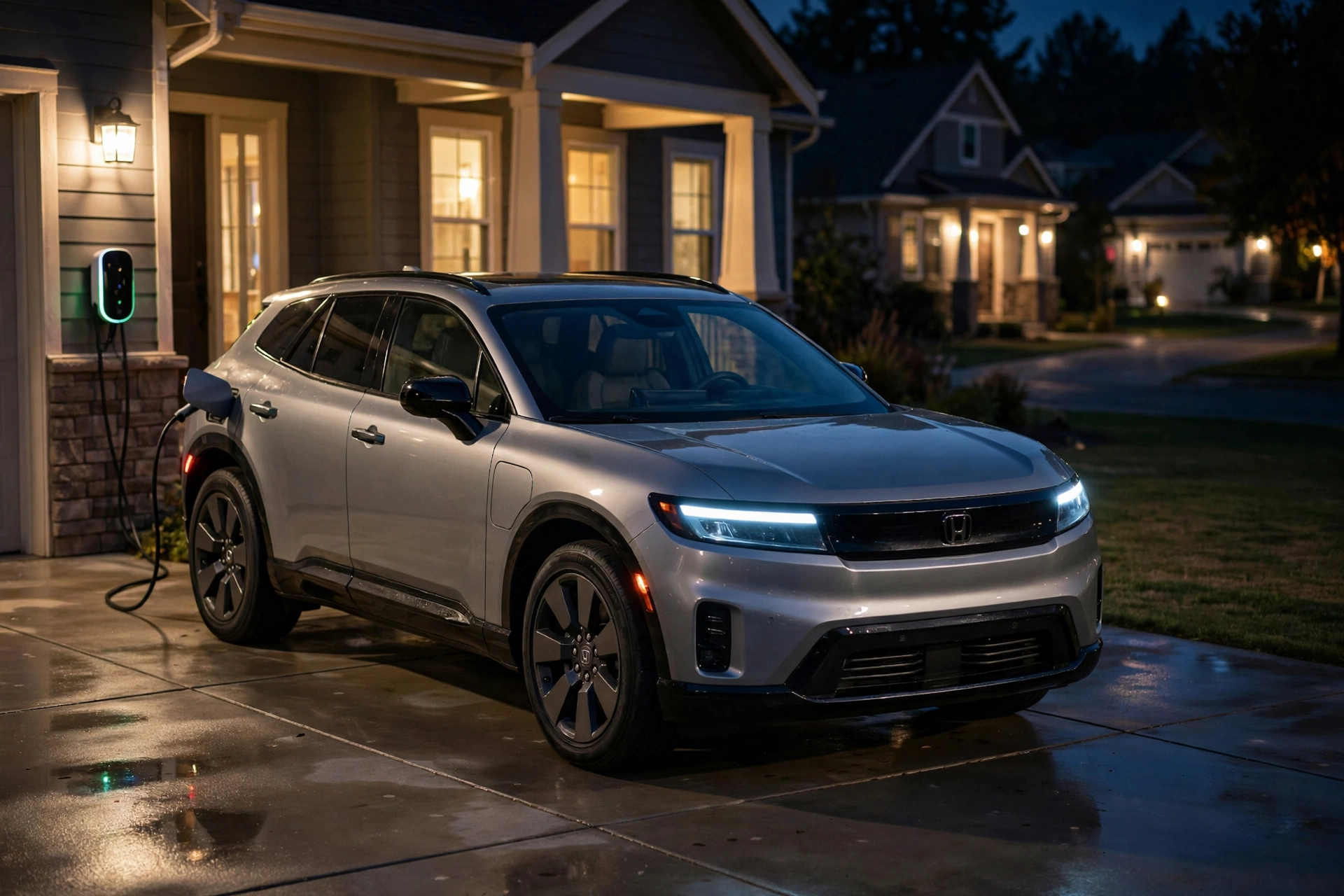
Home charging is where this car shines, the way family cars should. The onboard charger takes up to 11.5 kW, which Honda rates at up to 34.1 miles of range per hour plugged in. Plug in at 9 p.m. with the battery low and you wake to a full car; a complete charge from near empty takes about nine and a half hours.
For the 2026 Honda Prologue, Honda also sweetened the deal: a portable charging kit is now standard in the boot, and buyers can choose a Honda home wall charger with a $1,250 installation incentive, or a $500 credit if they cannot install one. Honda’s own summary of the package sits on Honda’s official Prologue page alongside the full trim walk-through.
Road-trip charging in the 2026 Honda Prologue is the weak spot, and we will not dress it up. Peak DC fast charging is 150 kW, Honda quotes about 65 miles added in 10 minutes and roughly 35 minutes from 20 to 80 percent, and the charge rate tapers early, so the second half of a session drags. Edmunds measured the Prologue’s charging pace at more than 18 minutes per 100 miles added, which trails the Hyundai Ioniq 5 and Kia EV6 by a wide margin.
For a family doing two or three long trips a year, that is a tolerable coffee stop with the kids. For a family driving 400 miles every other weekend, it is the wrong car. One practical plus: Honda sells a NACS-to-CCS adapter for $225, which opens up Tesla’s Supercharger network and makes route planning far easier than it was when this car launched.
Space, seats and strollers: where the Prologue earns its keep
Family space is the reason to buy the 2026 Honda Prologue, so let us measure it properly. The cabin offers 111.7 cubic feet of passenger volume, and the back seat has 39.4 inches of legroom. In parent units, that means two bulky rear-facing child seats fit without pushing the front seats into the dashboard, and a six-footer can still sit in front of one. The flat floor means the middle seat is genuinely usable for a booster rather than being a punishment perch.
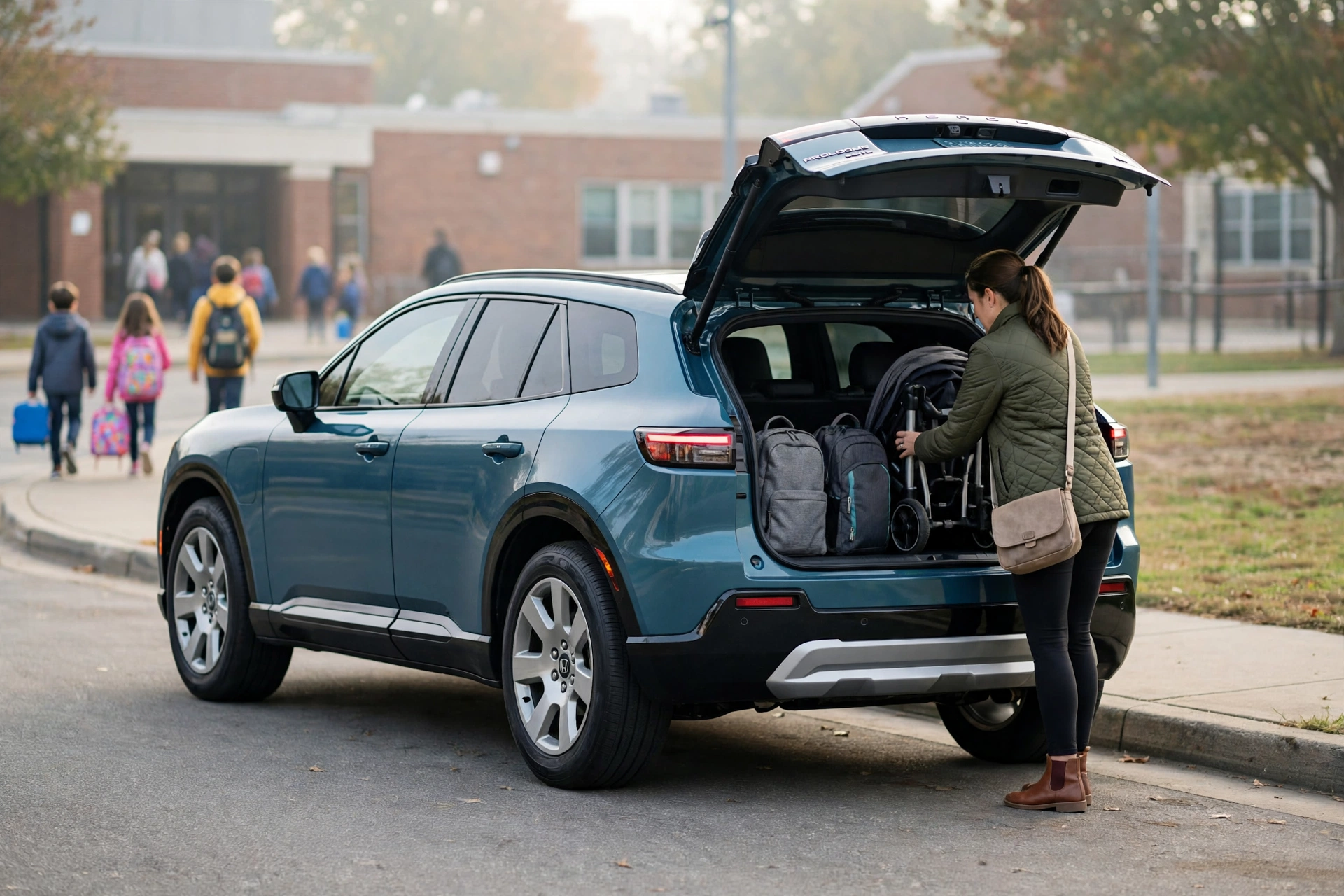
Cargo space in the 2026 Honda Prologue tells a more mixed story. There are 23.7 cubic feet behind the rear seats, which swallows a folded full-size stroller plus the weekly grocery shop, but not a double stroller and a holiday suitcase at the same time. Fold the 60/40 split seats and you get 57.7 cubic feet, enough for a flat-pack wardrobe run or two kids’ bikes with the front wheels off. There is no front trunk, which is a small daily annoyance when the charging cables need a home; they live in the standard portable kit bag under the floor instead.
Towing is rated at 1,500 pounds across the range: fine for a small utility trailer of garden waste, not fine for a camper. Judge it as a tall family wagon and it scores well. Judge it as an SUV in the rugged sense and it was never really that.
Screens and software: Honda kept the one thing GM threw away
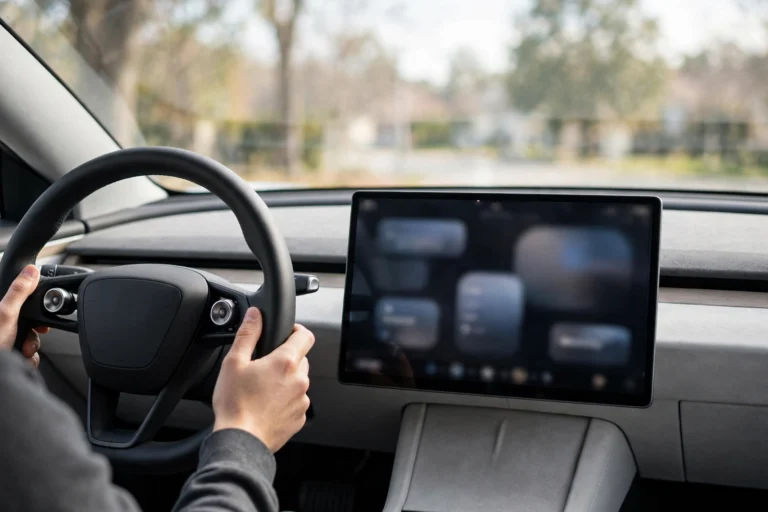
Every 2026 Honda Prologue gets Google built into its 11.3-inch touchscreen, so Google Maps and the Google voice assistant are native, and an 11-inch digital driver display sits in front of you. But here is the detail that decides this section: wireless Apple CarPlay and Android Auto are standard on every trim. Chevrolet removed phone projection from the Blazer EV entirely and asks you to live inside GM’s system instead. Honda kept your phone’s maps, messages and podcasts working the way your family already uses them, and for a lot of buyers that single decision settles the twin-versus-twin argument on its own.
The rest of the software picture is less rosy. The HondaLink phone app, which runs on GM’s OnStar backbone, is the part owners grumble about most: slow responses, frozen maps and laggy menus show up again and again in owner reports, and wireless CarPlay dropouts are a common complaint too.
Honda’s own hardware choices inside the cabin are better judged. There is a proper volume knob, real climate controls, and a wireless phone charger on the centre console. Our position: the in-car tech is good, the phone app is the weakest part of the ownership experience, and Honda should be embarrassed that a twenty-dollar weather app feels faster than the app that remote-starts a $41,000 car.
What the 2026 Honda Prologue costs: price per mile of range, and what a full battery costs
Prices checked October 27, 2026. Honda’s 2026 price cut gives us this ladder before the $1,495 destination charge: EX $39,900 front-drive or $42,000 all-wheel drive, Touring $44,200 or $47,000, Elite $50,400. Add destination and the real stickers are $41,395, $43,495, $45,695, $48,495 and $51,895. Now let us do the sum most reviews skip, and divide each sticker by its EPA range to get the price you pay per mile of range:
- EX front-drive: $41,395 ÷ 308 miles = $134 per mile of range
- EX all-wheel drive: $43,495 ÷ 294 miles = $148 per mile
- Touring front-drive: $45,695 ÷ 308 miles = $148 per mile
- Touring all-wheel drive: $48,495 ÷ 294 miles = $165 per mile
- Elite all-wheel drive: $51,895 ÷ 283 miles = $183 per mile
- Blazer EV LT front-drive (the GM twin): $46,495 ÷ 312 miles = $149 per mile
Read that list twice. The base 2026 Honda Prologue is not just the cheapest version of this car, it is the cheapest way to buy range in the entire platform family, undercutting its own Chevrolet twin by $15 a mile. The Elite charges you $183 per mile, a 37 percent premium over the EX, for leather, a moonroof and ventilated seats, while actually delivering 25 fewer miles of range.
The running-cost side is just as plain. Filling the 85 kWh battery from empty at an average US home electricity price of about $0.17 per kWh (est., based on EIA residential averages) costs 85 × $0.17 = $14.45. The EPA’s own figure works out to $1.22 per 25 miles, or about 4.9 cents a mile; a 30-mpg petrol crossover on $3.15-a-gallon fuel (est.) costs about 10.5 cents a mile in fuel alone. Our guide to what an electric car costs per mile shows how that gap adds up across a year of family driving, and it is worth running your own mileage through our total cost of ownership calculator before you sign anything.
Two more money facts a good salesperson may not volunteer. The lease maths on this car has been aggressive all year, and our breakdown of current Honda Prologue lease deals, prices and terms shows how to judge whether a quoted deal is genuinely cheap or just shuffled numbers. And depreciation has been brutal: low-mileage 2026 cars were already being advertised in October 2026 at just under $25,000 for an EX, a little over $25,000 for a Touring and around $30,000 for an Elite, per dealer listings reported that month. Painful for the first owner. Wonderful for the second.
Honda badge, GM bones: what the recall and reliability record actually shows
This is the section every Prologue shopper is really here for, so here it is without varnish. Consumer Reports’ owner-survey reliability score for the Prologue is 25 out of 100, which sits near the bottom of the class and is nothing like the record of a CR-V or a Pilot.
Owners of the 2026 Honda Prologue have reported a “Service High Voltage System” warning that can come with reduced power; Honda traced one cause to a calibration fault in the Battery Energy Control Module and fixes it with a dealer software update under a service bulletin rather than a recall. Twelve-volt battery drain, no-start mornings and charging failures also appear in owner reports, and a small number of cars have needed a replacement main battery under warranty.
The formal recall record for the 2026 Honda Prologue is more reassuring for 2026 buyers than for early ones. The 2024 model year collected three recalls, including one for a front lower control arm issue. In May 2026, recall 26V-306 covered 44,199 Prologues from 2024–25 for a rearview camera that could show a blank or distorted image, and a separate campaign addressed instrument clusters that could go blank on some 2024 cars. Both fixes are software.
The important line for this review: as of October 2026, the 2026 model year itself has no recalls on file, and the fixes from the earlier campaigns are baked into cars being built now. That pattern, a rough first year settling down, is exactly what the data shows.
So should the badge scare you off? Our answer is no, provided you buy with open eyes. The safety case is strong, with a five-star overall NHTSA rating. The battery warranty runs eight years or 100,000 miles.
And while no owner wants a software recall, software recalls that a dealer fixes free in a couple of hours are a very different burden from mechanical failures. The honest summary is that the Prologue has the reliability record of a GM Ultium product in its early years, roughly average-to-poor for a modern EV, wrapped in a Honda ownership experience that is better organised than most. You are not buying CR-V dependability. You are buying a good car with a patchy first-year record that has been steadily patched since.
Verdict by trim: our scores
Prologue EX — Our score: 8.4/10. Range: 9/10. Family space: 8/10. Value: 9/10. The sweet spot, full stop. Front-drive gives you all 308 miles, heated seats, the big screen, wireless CarPlay and Honda Sensing safety kit for $41,395 on the road-ready sticker. All-wheel drive at $43,495 suits snow-belt families and still scores well; it is the version we would buy with our own money in a cold state.
Prologue Touring — Our score: 7.8/10. Range: 9/10 front-drive, 8/10 all-wheel drive. Family space: 8/10. Value: 7/10. Leather seats, the 12-speaker Bose stereo, a panoramic moonroof and a hands-free power tailgate are all things families genuinely enjoy, and the tailgate alone justifies some of the $4,300 step when your hands are full of toddler. It is a fair price for the kit; it is simply not the bargain the EX is.
Prologue Elite — Our score: 6.9/10. Range: 7/10. Family space: 8/10. Value: 6/10. Ventilated seats, a head-up display and surround-view cameras are lovely, but you pay $51,895, lose 25 miles of range to the big wheels, and gain nothing your kids will ever notice. Buy the Elite used in a year’s time, when someone else has absorbed the steepest part of that depreciation curve.
If you are still torn between trims, or between this and the Korean twins, our method for checking figures before we publish is on our how-we-research page, and it is the same method we would suggest for your own test-drive notes.
Frequently asked questions
Is the 2026 Honda Prologue being discontinued?
Yes. Honda confirmed in July 2026 that production ends at the completion of the 2026 model year, and dealers will sell remaining stock into early 2027. Honda has committed to continued service, parts and warranty support for owners, and the car shares its platform with high-volume GM models, which helps parts supply. Treat it as a run-out bargain opportunity rather than an orphaned car.
How far does the Prologue actually go on one charge?
For the 2026 Honda Prologue, plan on the EPA figure for family routine driving: 308 miles front-drive, 294 all-wheel drive, 283 for the Elite. On a fast highway run, Car and Driver’s 75-mph test of the Elite returned 240 miles, so plan long-leg stops around 240 to 260 miles (est.) depending on trim, speed and weather.
Does the Prologue have Apple CarPlay?
Yes, wireless Apple CarPlay and Android Auto are standard on every trim, alongside Google built into the car’s own system. That is a real advantage over the Chevrolet Blazer EV, which dropped phone projection altogether.
How long does it take to charge at home and on the road?
At home on a 240-volt charger it adds up to 34.1 miles of range per hour and fills the battery overnight, about nine and a half hours from near empty. On a DC fast charger it peaks at 150 kW and takes roughly 35 minutes from 20 to 80 percent in good conditions, which is workable but slower than an Ioniq 5.
Should I buy new or used?
Used, unless the new-car deal in front of you is exceptional. Depreciation has been steep enough that low-mileage 2026 cars were listed from just under $25,000 in October 2026, barely more than half the new EX sticker, with most of the 8-year/100,000-mile battery warranty still ahead of them. Check that all recalls and software updates are complete, and have the battery health read at a Honda dealer before you buy.
Can it tow our family trailer?
Only a small one. The rating is 1,500 pounds across all trims, which covers a light utility trailer or a pair of jet skis. A family camper is beyond it, and range will fall sharply while towing, as it does with any EV.
Our final word on the 2026 Honda Prologue is simple: if you want a roomy, calm family SUV at a run-out price, the 2026 Honda Prologue is hard to ignore. Check the remaining 2026 Honda Prologue stock, test the EX first, and buy only after confirming every software update is complete.